


%203.svg)
Key Takeaways:
- Outsourced SDRs are third-party professionals or agency reps who handle prospecting and lead qualification for multiple clients, offering fast deployment for companies needing immediate pipeline generation without internal hiring.
- Successful outsourced SDR arrangements require verifying relevant experience, communication skills, CRM proficiency, and persistence while establishing clear KPIs, regular performance reviews, and trust-based collaboration from day one.
- Building your own dedicated offshore SDR team typically outperforms traditional outsourcing by providing exclusive focus, deeper product knowledge, stronger cultural integration, and better long-term retention at comparable costs.
Your sales pipeline needs qualified leads consistently. But hiring in-house SDRs means navigating lengthy recruitment cycles, high salaries, and training overhead that drains resources from other growth priorities.
That's why many companies turn to outsourced SDRs—third-party professionals or agencies that handle prospecting, qualification, and appointment setting without the burden of full-time hires.
For companies already exploring offshore options, the appeal is clear: lower costs, faster deployment, and access to specialized sales expertise. But choosing the right outsourcing partner and knowing when to pivot to a different approach can determine whether your pipeline thrives or stalls.
In this guide, we'll show you exactly what to look for when outsourcing SDRs offshore, how to work with them effectively, and when building your own dedicated offshore sales team makes more strategic sense.
What Is an Outsourced SDR?
An outsourced SDR is a sales development professional employed by a third-party agency or working as an independent contractor who handles top-of-funnel sales activities for multiple clients simultaneously.
Unlike in-house SDRs who work exclusively for your company, outsourced SDRs typically split their time and attention across several accounts. They might be part of an offshore sales outsourcing firm with teams in the Philippines, India, or Latin America, or they could be freelance professionals you hire through platforms like Upwork or Toptal.
Outsourced SDRs bridge the gap between lead generation and your sales closers or account executives. Their core responsibilities include:
- Identifying and researching potential prospects using your ICP
- Conducting cold outreach via calls, emails, and LinkedIn
- Qualifying inbound leads from marketing campaigns
- Scheduling discovery calls or demos with qualified prospects
- Updating your CRM with accurate activity and lead data
- Nurturing prospects who aren't ready to buy yet
The key advantage: you can get SDR capacity operational within days or weeks rather than months. The key tradeoff: shared focus and limited integration with your company culture.
Why Companies Choose to Outsource SDRs Offshore
Offshore SDR outsourcing solves immediate capacity problems while delivering significant cost savings compared to US hiring or outsourcing.
Dramatic cost reduction
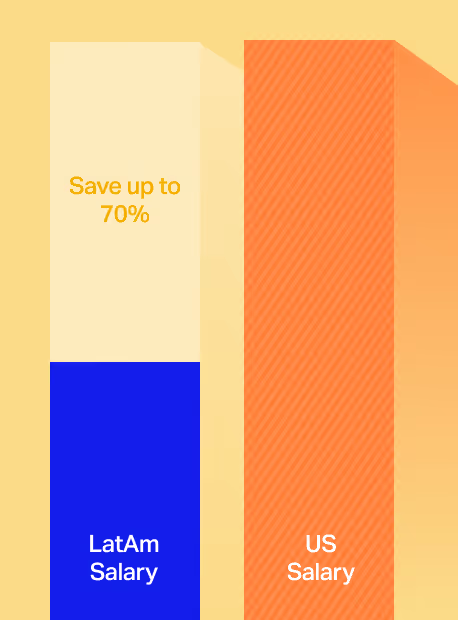
It costs substantially less to hire offshore SDRs rather than US-based reps. While US SDRs command $100K+ in total compensation, offshore SDR teams from agencies or freelance platforms charge up to 60% less, depending on location and provider.
These savings come from lower cost of living in offshore markets, not from compromising on capability. Many offshore SDRs have years of experience working with US companies and understand American business culture.
Immediate deployment without hiring delays
Most offshore SDR agencies can deploy reps within 1-2 weeks. You skip recruitment, interviews, onboarding, and training. The agency handles all logistics while you focus on providing target lists and messaging guidelines.
This speed matters when you're launching new products, entering new markets, or need pipeline fast to hit quarterly targets.
Access to specialized offshore markets
Offshore SDR outsourcing lets you tap into established markets known for sales expertise:
- Philippines: Strong English proficiency, cultural alignment with US business practices, experience with US sales processes. However, there are time zone challenges.
- India: Large talent pool, competitive pricing, growing expertise in B2B sales. Accent considerations for cold calling, significant time zone differences.
- Latin America: Near-perfect time zone alignment with US, high levels of English proficiency, cultural fit with American business style. Growing reputation for high-quality sales professionals.
- Eastern Europe: Strong technical knowledge for SaaS sales, European language capabilities. Large time zone differences with US West Coast.
For detailed comparisons, see our article on the best countries to find and hire top remote sales talent.
Flexibility to scale up or down
Outsourced SDR arrangements typically work on monthly contracts. Need more reps for a product launch? Add capacity quickly. Slow season? Scale back without layoffs or unemployment concerns.
This flexibility is particularly valuable for companies with seasonal sales cycles or those testing new go-to-market strategies.
What to Look for When Choosing an Outsourced SDR
Not all offshore SDR providers deliver equal results. The right partner drives pipeline. The wrong one wastes budget and damages your brand.
Relevant industry experience
Verify that the agency or individual SDRs have worked in your industry or with similar products. An SDR who's sold SaaS understands different qualification criteria than someone who's sold insurance or e-commerce.
Ask for specific examples:
- What companies have they worked with in your space?
- What average deal sizes have they handled?
- What sales cycles are they familiar with?
- Can they articulate your target buyer's typical pain points?
Industry experience dramatically reduces ramp time and improves conversation quality from day one.
Exceptional English communication skills
Your outsourced SDRs represent your brand on every call and in every email. Weak communication creates negative first impressions that damage conversion rates.
Test communication skills thoroughly:
- Conduct video interviews to assess pronunciation, fluency, and comprehension
- Have candidates explain complex concepts to verify clarity
- Review sample cold call recordings and email copy
- Check whether they can adapt tone for different buyer personas
According to one of our recruiters:
English proficiency is one of our top priorities when sourcing offshore SDRs. Prospects won't care where your SDR is located if they sound professional and can hold intelligent conversations. But a heavy accent or unclear communication will cost you meetings immediately.
Latin American SDRs, in particular, often have neutral accents and excellent English skills from working extensively with US companies. Many companies find that LatAm sales reps handle objections and build rapport as effectively as US-based reps.
Demonstrated persistence and resilience
SDR work involves constant rejection. The best offshore SDRs treat "no" as "not yet" and maintain consistent activity levels despite setbacks.
During interviews, ask:
- How do they handle prospects who hang up or ignore outreach?
- What's their approach to following up with non-responsive leads?
- Can they share examples of converting initially resistant prospects?
- How do they stay motivated during slow periods?
Persistence separates SDRs who book meetings from those who just make calls.
Ability to work autonomously
Offshore SDRs often operate across different time zones with limited real-time supervision. They need to manage their own schedules, prioritize tasks, and solve problems independently.
Look for evidence of self-management:
- Experience working remotely for US companies
- Track record of meeting quotas without constant oversight
- Proactive communication style (they surface issues before you ask)
- Strong organizational skills for managing multiple prospect conversations
SDRs who require micromanagement consume more of your team's time than they save.
CRM and sales tool proficiency
Modern SDR work requires technical fluency with:
- CRM systems (Salesforce, HubSpot, Pipedrive)
- Sales engagement platforms (Outreach, Salesloft, Apollo)
- Prospecting tools (ZoomInfo, LinkedIn Sales Navigator)
- Communication tools (Slack, Zoom, Teams)
Verify their experience with your specific tech stack. If they need training on multiple tools, factor that ramp time into your timeline.
Critical thinking and adaptability
Strong offshore SDRs don't just follow scripts robotically. They assess prospects, adjust messaging based on conversation flow, and identify opportunities others miss.
Test critical thinking during interviews:
- Present a challenging objection and ask how they'd respond
- Share a complex buyer scenario and have them explain qualification approach
- Ask them to critique sample outreach copy
- Discuss how they'd adjust strategy if current approach isn't working
Scripted responses suggest they'll struggle with real-world conversations.
{{offshore-talent}}
How to Work Effectively With Outsourced SDRs
Hiring offshore SDRs is the easy part. Managing the relationship determines whether you get results or waste money.
Establish clear expectations from day one
Don't assume outsourced SDRs will figure out what you need. Document everything:
Your ideal customer profile:
- Company size, industry, geographic focus
- Job titles and departments to target
- Technologies they typically use
- Budget ranges they have authority over
Qualification criteria:
- What makes a lead worth passing to sales?
- Disqualification red flags
- Timeline expectations (buying now vs. researching)
- Required information to collect before booking meetings
Activity expectations:
- Minimum calls per day
- Email outreach volume
- LinkedIn connection targets
- Meeting booking goals
Messaging guidelines:
- Your value proposition and differentiators
- Common objections and recommended responses
- Tone and style preferences
- Topics to avoid
The more clarity you provide, the better results you'll get.
Create trust-based relationships
Outsourced SDRs perform better when they feel valued rather than monitored like vendors.
Give them autonomy to test approaches, share their insights from conversations, and contribute ideas for improving messaging. When they suggest changes to scripts or qualification criteria based on prospect feedback, listen.
Build personal connections through regular video calls. Celebrate their wins and treat them like extensions of your team even if they're technically contractors or employed by an agency.
Implement regular performance tracking
Monitor both activity and outcome metrics:
Activity metrics:
- Calls made, emails sent, LinkedIn messages
- Conversation rates (% of dials that become conversations)
- Response rates on email sequences
Quality metrics:
- Meeting show rate (% of booked meetings that actually happen)
- Lead-to-opportunity conversion rate
- Average days to first meeting
- AE feedback on lead quality
Outcome metrics:
- Meetings booked per week/month
- Qualified opportunities created
- Pipeline influenced
- Cost per qualified meeting
Weekly reviews keep performance visible. Monthly deep dives identify trends and optimization opportunities.
Provide consistent feedback and coaching
Outsourced SDRs improve fastest with specific, actionable feedback.
Schedule weekly coaching sessions to:
- Listen to recorded calls together
- Review email sequences and suggest improvements
- Discuss challenging conversations and better approaches
- Share what's working for other reps
- Clarify confusing qualification scenarios
Don't wait for monthly reviews to address problems. Real-time feedback prevents bad habits from becoming ingrained.
Maintain regular communication rhythms
Bridge the geographic and organizational distance through structured check-ins:
Daily:
- Brief Slack updates on activity and blockers
- Questions about specific prospects or objections
Weekly:
- 30-minute sync on pipeline progress
- Review metrics and adjust tactics
- Share updates on product, messaging, or target changes
Monthly:
- Comprehensive performance review
- Strategic planning for next month
- Career development conversation
Consistent communication prevents the "out of sight, out of mind" problem that causes outsourced relationships to deteriorate.
Focus on results, not activity
It's tempting to obsess over call volume and email stats. But meetings booked and opportunities created matter more than activity metrics.
An SDR making 80 high-quality, well-researched calls will outperform one making 150 poorly targeted dials. Emphasize outcomes while using activity metrics to diagnose problems when results slip.
The Limitations of Outsourced SDRs
Offshore SDR outsourcing solves immediate problems but creates long-term challenges that affect pipeline quality and team performance.
Split attention across multiple clients
Outsourced SDRs rarely work exclusively on your account. They're typically juggling 2 to 4 clients simultaneously, each with different products, ICPs, and qualification criteria.
When quota pressure hits, your account competes with others for their focus and energy. Your pipeline becomes secondary to whoever is demanding the most attention that week.
Shallow product knowledge
Outsourced SDRs learn enough to execute scripts and handle basic questions. They rarely develop deep expertise because they're spreading their learning across multiple products.
When prospects ask detailed questions or push back on positioning, outsourced SDRs often stumble. They can't speak confidently about use cases, integrations, or competitive advantages because they haven't internalized your product deeply.
This shallow knowledge hurts conversion. Prospects sense when an SDR can't truly represent the product they're selling.
Limited cultural integration
Outsourced SDRs work for the agency, not for you. They don't attend your all-hands meetings, participate in company culture, or feel connected to your mission and values.
This distance shows up in subtle ways:
- Less enthusiasm when representing your brand
- Weaker alignment with your company's communication style
- Inability to speak authentically about company culture when prospects ask
- Lower commitment to solving problems or going the extra mile
High turnover and inconsistency
Offshore SDR agencies experience significant rep turnover. The person making calls this quarter might be gone next quarter. When they leave, you restart the learning curve with whoever replaces them.
This churn hurts prospect relationships and institutional knowledge. Every new SDR needs onboarding, training, and time to understand what works with your prospects.
Control and visibility gaps
You see what the agency reports, which might not tell the full story. Call recordings might be selective. Email copy might not match what you approved. Actual conversation quality might differ from what metrics suggest.
Limited visibility makes it hard to diagnose problems quickly or identify coaching opportunities before they become patterns.
Potentially higher long-term costs
While offshore outsourcing seems cheaper initially, those costs compound over time without building lasting equity.
Over 12-18 months, you might spend $24,000-$60,000+ per outsourced SDR—comparable to hiring your own offshore rep directly—without gaining a dedicated team member who grows with your business.
Why Building Your Own Offshore SDR Team Often Works Better
Here's what many companies discover after trying outsourcing: building your own remote sales team gives you offshore cost savings without sacrificing control.
You don't have to choose between expensive US SDRs and outsourced reps with divided attention. Building your own dedicated offshore SDR team gives you both cost efficiency and full integration.
According to Near's latest report on why more US companies are hiring in the US, 12% of US companies exploring Latin American hiring are specifically switching from outsourcing to building their own teams. And among companies making this switch, sales roles are a top priority.
The AvantStay example: What's possible with dedicated offshore hiring
Jake Breuner, VP of Sales at AvantStay, faced the classic SDR problem: 80% of his US-based SDRs missed quota, ramp times exceeded 6 months, and 33% quit within 4 months. Outsourcing could have plugged the gap temporarily, but Jake wanted sustainable results.
Jake built his own team of Latin American sales professionals through Near.
The results:
- Added $20M in ARR within 12 months
- Reduced ramp time from 6 months to 2 months
- Cut attrition from 70% to 20%
- Achieved 65% cost savings compared to US hires
- All hires placed in under 26 days
His first hire, Simon, logged 150+ dials daily, booked 1-2 qualified meetings per day, and was promoted to BD Manager within 7 months—now managing a team of 10.
{{banner}}
Key advantages of building your own offshore SDR team
- Exclusive focus on your pipeline: Your SDRs work only on your accounts, your prospects, your pipeline. No competing priorities or split attention. This focus drives better performance and deeper commitment.
- Deep product knowledge and cultural integration: Dedicated SDRs attend your team meetings, participate in training, and internalize your product deeply. They become true brand ambassadors who can handle complex questions and represent your company authentically.
- Long-term retention and growth: Unlike outsourced arrangements where reps rotate constantly, your own team members build careers with you. Top performers get promoted, mentor newer reps, and contribute institutional knowledge that compounds over time.
- Full control and visibility: You manage daily activities, coach in real-time, listen to all calls, and adjust strategy immediately. No waiting for weekly agency reports or wondering what's really happening.
- Comparable or lower costs than outsourcing: To hire Latin American SDRs costs $18K to $42K annually in base comp. This is comparable to or less than offshore outsourcing agencies charge—while delivering the benefits of dedicated team members.
Why Latin America specifically?
- Time zone alignment that enables real-time collaboration: Latin American SDRs work during US business hours. Daily stand-ups, coaching sessions, and prospect hand-offs happen in real-time. No waiting 12+ hours for responses or working odd shifts.
- Cultural alignment with US business expectations: LatAm professionals understand urgency, American communication styles, and US sales culture. Many have worked extensively with US companies and know exactly how to build rapport with American prospects.
- Excellent English proficiency: Top LatAm SDRs speak fluent English with neutral accents. Your prospects won't know or care where they're based because conversations flow naturally.
- Hunger and work ethic: LatAm SDRs bring the persistence and resilience that makes great sales professionals. They're not afraid to make 150+ calls daily and actually want to prove themselves rather than coast.
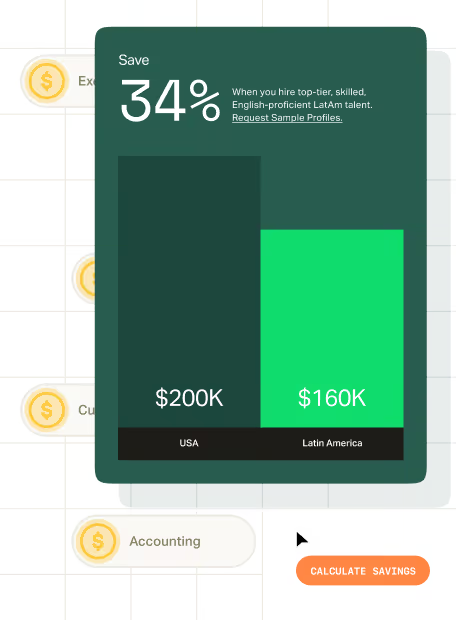
- Cost efficiency without quality tradeoffs: You achieve 30–60% savings compared to US hires while often getting better performance. These aren't “cheap” alternatives—they're strategic hires who happen to be based in a different geography.
For detailed salary comparisons, see our Sales Roles Salary Guide: US vs. Latin America.
When building your own team makes more sense than outsourcing
Consider hiring your own offshore SDRs in Latin America instead of outsourcing when:
- You need sustainable, long-term SDR capacity (12+ months)
- Product knowledge and brand representation significantly impact conversion
- Your sale requires consultative conversations, not just appointment setting
- You want to develop and promote top performers over time
- Cultural integration with your team matters
- Full control over processes, coaching, and quality is critical
- You plan to scale your SDR team significantly
For companies ready to build dedicated offshore teams, our guide on how to build a high-performing sales team provides a comprehensive framework.
When outsourcing might still make sense
Offshore SDR outsourcing can work for:
- Short-term campaigns or market tests (3-6 months)
- Immediate gap-filling while you hire internally
- One-time events or product launches
- Testing SDR effectiveness before committing to full-time hires
- Very simple, transactional sales requiring minimal product knowledge
{{prevetted-banner}}
Final Thoughts
Outsourcing SDRs offshore solves immediate pipeline problems. Agencies can deploy reps quickly, costs less than US hiring, and provides flexibility to scale.
But for sustainable, long-term results, building your own dedicated offshore SDR team typically delivers better outcomes. You get exclusive focus, deeper product knowledge, stronger cultural integration, and team members who grow with your business—all at comparable or lower costs than outsourcing.
The companies winning with offshore SDRs understand that geography doesn't determine performance. The best SDRs bring hunger, skills, and work ethic regardless of location. The question is whether you want those SDRs working for an agency or working for you.
If you're considering building your own offshore SDR team with Latin American professionals, read our guide on what sales leaders want to know about hiring from LatAm to address common concerns about accents, work ethic, and results.
Or schedule a free consultation to discuss how we can help you hire top pre-vetted SDRs in Latin America.
Frequently Asked Questions
What's the difference between an outsourced SDR and hiring my own offshore SDR?
Outsourced sales reps and SDRs work for third-party agencies and split their focus across multiple clients. Hiring your own offshore SDR means recruiting a dedicated professional who works exclusively for your company from a different geographic location.
When you hire a dedicated SDR, they integrate with your culture, develops deep product knowledge, and builds a career with you rather than rotating between client accounts.
How much does it cost to outsource SDRs offshore?
Offshore SDR outsourcing typically costs $2,000-$5,000 per rep per month depending on provider and location. This covers their salary, agency markup, management, and infrastructure.
Hiring SDRs in Latin America typically costs $18K-$42K annually in base compensation—often comparable to or less than outsourcing while providing dedicated team members.
What's the difference between an SDR and a BDR?
SDRs (Sales Development Representatives) typically focus on inbound leads—qualifying prospects who already showed interest through website visits, content downloads, or demo requests. BDRs (Business Development Representatives) usually handle outbound prospecting—cold calling and emailing prospects who haven't expressed interest yet.
Many companies use these titles interchangeably or combine both functions into one role.
Read Should You Hire Outsourced BDRs? The Complete 2025 Guide for more information about BDRs. Or have a look at the top companies for business development outsourcing.
Will prospects care that my SDRs are offshore?
Modern buyers care about whether SDRs can answer questions, understand their business, and move them toward decisions. Location doesn't matter if communication is excellent.
Top offshore SDRs—especially from Latin America—speak fluent English with neutral accents, understand US business culture, and build rapport as effectively as US-based reps. AvantStay's experience showed that prospects couldn't tell their SDRs were based offshore, and performance actually exceeded their US team's results.
How do I pay offshore SDRs if I hire them directly?
You have two main options: work with a sales recruitment and staffing partner that handles payroll, compliance, and HR administration, or use an Employer of Record (EOR) service that manages international employment logistics.
Both handle the complexities of international hiring so you can focus on building your team. Most companies find working with specialized recruitment partners faster and more cost-effective than managing international payroll themselves.
Can outsourced SDRs integrate with my CRM and sales tools?
Yes, most professional offshore SDRs have experience with common CRM systems (Salesforce, HubSpot, Pipedrive) and sales tools (Outreach, Salesloft, ZoomInfo). Verify tool proficiency during the vetting process and factor in training time if they're unfamiliar with your specific tech stack. When building your own team, you have more control over training and can ensure full proficiency with all your systems.







.webp)


%203.svg)
.avif)





%20(1).avif)

%20(1).png)