Hire Top Back-End Developers in LatAm. Same Quality. 66% Less.
Hire elite Back-End Developers in 22 days. Only interview talent pre-vetted for skill, experience, and cultural fit. We handle everything else.
.avif)
Trusted by 950+ fast-growing companies




Why Hire Back-End Developers in LatAm?
Hot Spot for Tech Talent
LatAm has a booming tech ecosystem with millions of skilled Back-End Developers.
US Time Zones
LatAm developers work during US working hours, making collaboration seamless. You’re hiring teammates, not offshore resources.
Seamless Work Culture
Near’s proven hiring process delivers candidates who are both a cultural and professional fit—helping you boost retention and build stronger teams.
Strong English
We don’t just screen for skills. We ensure all candidates have strong English proficiency.
Lower Operational Costs
LatAm salaries are 30-70% below US market. Hire the top 1% while keeping your hiring budget in check. It’s a win-win situation.
Top-Caliber Candidates in 3 Days.
We handpick the top 3 for your role based on skill, experience, and culture fit. In 3 days, interview candidates with track records at companies like:
.svg.avif)





Hire LatAm's Top 1% Back-End Developers in 22 Days
Join 950+ fast-growing US companies building high-performing teams with top LatAm talent—while cutting hiring costs by up to 66%. Hire smarter. Start your search today.
LatAm Back-End Developer Salaries and Skills by Experience Level
Make the right hire with transparent salary data and clear skill benchmarks for junior, mid-level, and senior remote Back-End Developers in Latin America.
See a few of our 160k+ pre-vetted candidates

Seniority
Skills & Tools

Seniority
Skills & Tools

Seniority
Skills & Tools

Seniority
Skills & Tools

Seniority
Skills & Tools

Seniority
Skills & Tools

Seniority
Skills & Tools

Seniority
Skills & Tools

Seniority
Skills & Tools

Seniority
Skills & Tools
Why Hire LatAm Back-End Developers with Near?

Faster Hiring
Interview 3+ candidates in 3 days. Pre-vetted for skill, experience, and culture fit. Get end-to-end support to make the right hire fast.

Risk-Free Hiring
Pay nothing upfront. Hire only if you’re happy. Plus, every hire is backed by our 180-day free replacement policy.

Build Real Teams
Every hire is a full-time teammate. Embedded in your team, aligned with your goals, and committed long-term.



Get Top Development Talent and Save up to 66% in Overhead Costs
Jr. Back-End Developer
Back-End Developer
Sr. Back-End Developer
Hire Developers with the Right Skills
We deliver candidates with a proven track record across the skills, tools, and technologies that matter.
Hire With Near's Proven Hiring Process
1. Discovery session
Share your hiring goals and we’ll guide you on roles, markets, and comp. Then align on how to hire and what to offer.
2. Kick-off call
Meet your recruiter to finalize the role and build your hiring plan. We’ll align on profile, process, and timeline.
3. Interviews and hiring
Review 3+ top candidates in under 5 days. Interview, choose your hire, and we’ll handle the rest.

After You Hire
Onboard, pay, retain
We support onboarding, payroll, and compliance, so your new hire integrates fast and sticks long term.

Ongoing support & team expansion
Keep hiring with the same speed and quality whenever you need. Your recruiter stays close to support future hires, backfills, or scaling your team.
%203.svg)
%201.svg)
Zero-risk hiring. If you don't make a hire, you don't pay anything.
What Leading Enterprises Say About Hire With Near

Hire With Near helped us take the burden of recruiting off our team—especially during tax season, when every hour counts. The quality of candidates has been phenomenal.
.avif)
Hire With Near takes care of the entire hiring process for us. All we have to do is interview the best 3 candidates and decide.

Hire With Near was a game-changer for our hiring strategy. We reduced our burn rate and built a much stronger marketing team with talent from Latin America.

We were determined to work with global talent in our local time zone, and Hire With Near helped us find great Latin American talent that has brought significant value to our team.

Every candidate I’ve received from Hire With Near has had excellent references and great experience. They’ve all been ready to jump into US-based legal work with very little training needed.

We hired 22 team members who share our core values: great attitude and desire to learn, resourcefulness, and adaptability. Hire With Near’s team was very responsive, and their easy-going communication fostered a seamless hiring process.

After building my team with Hire With Near, I wouldn't hire an SDR stateside anymore.

When I check with the department managers, they all say, ‘It’s like 100 out of 10.’ The talent we’ve brought in through Hire With Near has been professional, articulate, intelligent, and absolutely the right fit for our team.

Working with Hire With Near has been very helpful. It’s difficult when you’re one person doing all the initial screenings and sourcing. Hire With Near took a lot of that “workout” for me and provided great candidates quickly.

We found the right person through the help of Hire With Near. It has been transformational to our company. I wish we had done it ten years earlier.
.avif)
Success Stories



Hire With Near replaces a mis-hire at no additional cost.
With the staffing model, you can pause anytime a back-end developer isn't working out and Hire With Near will find a replacement with no additional fee.
With the recruiting model, you have up to 180 days to flag a replacement, also at no additional fee.
Every new hire, whether in Latin America or the US, carries some risk, and being a little nervous about whether someone will work out is normal. API and data-model quality show up within the first sprint or two of real tickets, well inside the window.
Hire With Near's vetting process is built to take most of that risk off the table upfront. The guarantee is the backstop if something gets missed.
Talk through the specifics with your Hire With Near rep before you sign.
Most clients receive a shortlist of strong, best-fit back-end developer candidates within three to five days of the kickoff call, and most make a hire within three weeks.
Those numbers are averages. Some placements close in under a week, while others take four to five weeks, depending on how many interview rounds you want to run and how long final-stage steps take.
Yes, every back-end developer on your shortlist has already been interviewed in English about technical work, because Hire With Near screens for communication that holds up in engineering practice, pull request write-ups, incident explanations, and design discussions, not just small talk.
Candidates with prior US-client experience get sourcing priority partly for this reason: their English has already carried code reviews, architecture debates, and postmortems for teams like yours.
If your team relies heavily on written precision (RFC-driven decisions, detailed runbooks), flag it at intake and the screening process will take that into consideration.
Yes, a Latin American back-end developer works as a full member of your team, in your standups, your repos, and your sprint, in real time. Because their workday closely aligns with yours, the time zone offset feels no different than working with a US teammate a couple of zones over.
That real-time overlap is most visible in back-end work when something breaks: the service owner is online during your business day, not asleep on the other side of the world. Teams that moved from far-offshore back-end support consistently point to incident response as the difference they feel first.
Ramp speed then depends on your intake clarity: a documented architecture, named conventions, and a defined first-month scope get a strong developer merging useful work in the first week or two.
For more on what other tech leaders dig into before hiring, check Hire With Near’s guide to the questions tech leaders ask when hiring in Latin America.
Yes, the back-end developers Hire With Near shortlists are screened on exactly that: designing clean APIs, modeling data that survives growth, and running services on cloud infrastructure with the load handling, caching, and error recovery that production traffic demands.
Seniority calibration is part of the screen. A mid-level candidate should own endpoints and schema changes confidently, while a senior one should show the architecture decisions they made and defended, systems they scaled, and incidents they diagnosed. Candidates presented as seniors have demonstrated that depth, not just accumulated years.
If your roadmap includes a known scaling challenge, a migration, a multi-tenant redesign, or a traffic spike you can see coming, name it at the intake conversation and candidates who have solved that specific problem get priority.
Latin American back-end developers cover every mainstream stack US companies run: Node.js and TypeScript, Python with Django or FastAPI, Java and Spring, C# and .NET, Go, PHP, and Ruby on Rails, along with PostgreSQL, MySQL, MongoDB, Redis, and the AWS, GCP, and Azure platforms those services deploy to.
The regional consultancy economy means many candidates have shipped in more than one stack, but Hire With Near screens against your primary one: the shortlist for a Java shop is Java engineers, not generalists who touched it once.
List your full stack at intake, including message queues, caching layers, and infrastructure tooling, and the hard filters match it.
Latin America's engineering hubs produce deep back-end benches, and Hire With Near drew from more than 20 countries across the region in 2025. Brazil, Colombia, and Argentina top the IT and engineering placement list in Hire With Near's State of LatAm Hiring Report.
Back-end depth tracks each market's history: Brazilian engineers cut their teeth on high-traffic consumer and fintech systems, Argentine developers are known for senior architecture skills and fluent English, and Colombian engineers often arrive straight from US SaaS teams. Mexico and Uruguay round out the usual sourcing map for these roles.
Overlap with your team comes standard: wherever the developer sits, their day aligns closely with yours, meaning plenty of shared hours when a deploy needs eyes at 4 p.m. your time. Sourcing concentrates wherever your stack and hours are best served. The talent, not the geography, drives the search.
Related reading: Discover the 22 Best Countries to Hire Remote Software Engineers and Developers
Hiring a back-end developer in Latin America through Hire With Near follows one of two paths, depending on whether you want Hire With Near to handle sourcing, payroll, and compliance or prefer to manage the employment side yourself.
With the staffing model, Hire With Near sources and vets the candidate, then handles payroll, compliance, and benefits administration on your behalf. You pay Hire With Near a monthly fee and don't need to set up a foreign entity or navigate Latin American employment law directly.
With the recruiting model, Hire With Near sources and vets the candidate and charges a one-time placement fee. You manage the employment relationship directly, either through a separate employer of record company (Deel, Globalization Partners, or similar) or by setting up your own local entity.
Then onboard for ownership: database and repo access with sensible permissions before day one, an architecture walkthrough in week one, and a first 30-day plan that moves from scoped endpoints toward owning a service, with on-call expectations stated upfront if you have them.
Related reading: How to Hire Latin American Developers: A Comprehensive Guide
Hire With Near vets back-end developers in Latin America through active sourcing, resume screening, a first-round interview, and a technical coding assessment. The strongest candidates from those stages become your shortlist.
Sourcing targets Latin American developers with verified US-client experience running production back ends, and the intake conversation scopes your language, database, and architecture before sourcing begins.
Resume screening applies your requirements as hard filters: your back-end language (Node.js, Python, Java, C#, Go), API and database design, cloud infrastructure experience, and production operations history are evaluated at this stage.
The first-round interview assesses English fluency for code review and standups, how the candidate reasons through data modeling and service design, and evidence of systems supported under production load.
After you choose your finalist, Hire With Near runs reference checks and an international background check to verify work history and references.
A mid-level back-end developer in Latin America typically earns $4,000 to $6,000 per month ($48,000 to $72,000 per year), compared to $73,000 to $134,000 per year for a US-based hire at the same level, according to Hire With Near's salary data.
Junior back-end developers in Latin America range from $2,500 to $3,800 per month ($30,000 to $46,000 per year) against a US annual range of $66,000 to $121,000, a savings of 55 to 62%.
Senior back-end developers range from $6,000 to $9,000 per month ($72,000 to $108,000 per year) against a US annual range of $90,000 to $164,000.
At product companies, where back-end engineers command premium salaries, the gap is even wider: $141,000 to $219,000 for mid and senior levels.
Hire With Near's fee is a transparent percentage of the monthly salary with no hidden costs, and the developer is dedicated to your systems full-time.
For the most up-to-date figures, see Hire With Near’s US vs. Latin America Salary Guide.
Resources to Hire the Best Back-End Developers


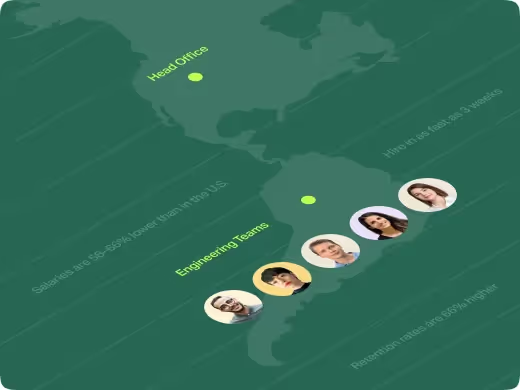
See how US companies are scaling with remote talent in Latin America. Download the free report now.