

%203.svg)
Key Takeaways
- AI has increased the demand for senior developers who provide judgment and oversight rather than reducing overall developer hiring needs.
- Traditional offshore hiring creates communication delays that slow down urgent development decisions and problem-solving.
- Hiring Latin American developers solves both problems because you can find senior talent who works during US business hours at rates you can afford.
Hiring outside the U.S. isn’t new. What’s changed is why and where. Teams that once defaulted to far-offshore arrangements are running into the same problem again and again: work stalls when the people you need are asleep.
At the same time, although the hype was that AI would flood the market with code and reduce demand for engineers, it instead changed which engineers you hire.
What’s still required is judgment. Teams need senior engineers who decide how to build, what to prioritize, and whether AI-assisted code is ready to release. In the U.S., that talent is in high demand and expensive.
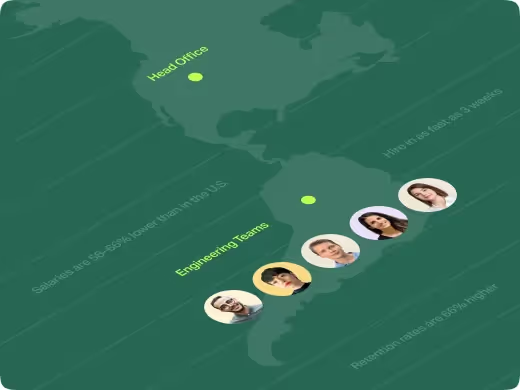
Put those together, and the choice gets simple: you want senior talent you can actually afford, working on your hours. That’s why more teams are hiring in Latin America. It offers full workday overlap with U.S. hours and makes senior expertise financially reachable for companies of all sizes.
This article explores why more U.S. companies are hiring developers and other engineering roles in Latin America and what it means for collaboration, budgets, and the kind of talent companies can hire.
Why More U.S. Teams Are Looking to Hire Tech Talent in Latin America
Real-time collaboration beats overnight handoffs
For decades, companies looked first to India and the Philippines—and later to Eastern Europe—to stretch budgets and add capacity. That offshore model is optimized for cost and follow-the-sun coverage. It fits jobs you can hand off overnight: support requests, routine updates, and tightly scoped tasks.
It doesn’t work well for solving problems that are urgent. The more time zone separation, the less live conversation you get.
Real-time back-and-forth—the kind you need for reviews and “Is this shippable?” decisions—works best when teams share their working day.
Looking at 12,038 employees, researchers found that an additional hour of time-zone difference cut real-time communication by 11%, shifting more work outside normal hours. Their advice: organize teams on a north–south line so workdays overlap.
With shared hours, you flag a problem at noon and release the fix by end of day. Without them, you write a Slack message and hope someone sees it at midnight.
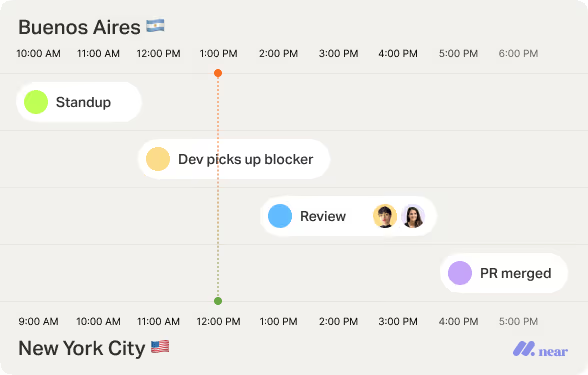
That’s why time zone alignment has become a key deciding factor in where to hire and why Latin America is the practical choice.
An engineering lead explained why they’re shifting to Latin America like this:
“Our senior QA in Sri Lanka is excellent, but we don’t get enough overlap to keep quality and throughput high. We often ship without her. The fix is obvious: a tester who is online when we are.”
Latin America spans U.S. time zones or sits close enough that most teams get 6+ hours of overlap without asking people to work non-traditional hours or skipping their input.
Teams are increasingly deciding that real-time back-and-forth matters more than a lower hourly rate 12 time zones away.
With AI boosting demand for senior devs, Latin America is the practical pipeline
AI hasn’t removed the need to hire developers; it’s increased the demand for more experienced ones.
Recent computer science graduates are struggling to find entry-level positions. According to data from the Federal Reserve Bank of NY, the unemployment rate for computer science grads is 6.1%. For computer engineers it’s 7.5%. Both are much higher than for other disciplines.
On the flip side, research by SignalFire of 650 million tech professionals shows an increase in hiring for mid and senior-level roles since 2023 at both big tech companies and startups.
Here are the types of roles teams are prioritizing:
- Principal-level software engineers (senior ICs) to set technical direction, review AI-assisted code, and make the call on what ships and when.
- Platform engineers to build the “plumbing” so products run fast, reliably, and cost-effectively (the tools, cloud setup, deploy pipeline).
- Data engineers to make sure the right data flows to the right places so AI features actually work in the product.
- Reliability engineers (SREs) to keep systems up and secure and prepare for incidents and audits.
- QA engineering leaders to catch issues before customers do, mixing hands-on testing with automation to keep quality high.
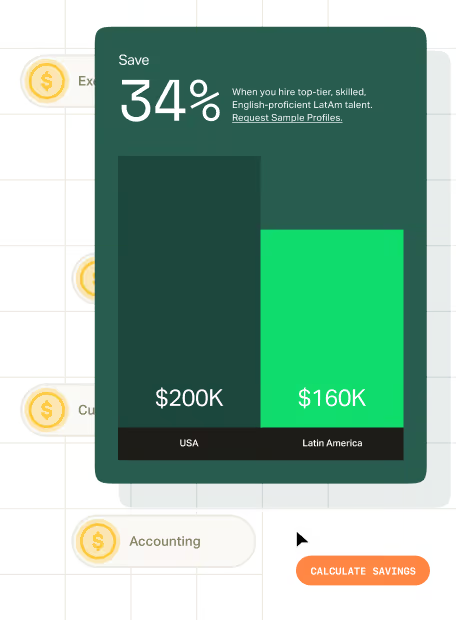
These mid- and senior-level roles command top-tier pay in the U.S., with annual salaries as high as $245,000 for a senior full-stack developer.
And even with headlines about a cooling market, the fundamentals haven’t changed. For much of the past few years, the U.S. has had fewer job seekers than open roles (BLS). And workforce participation hasn’t fully bounced back to pre-2020 levels (U.S. Chamber of Commerce).
In other words, experienced engineers are still hard to find and expensive to employ.
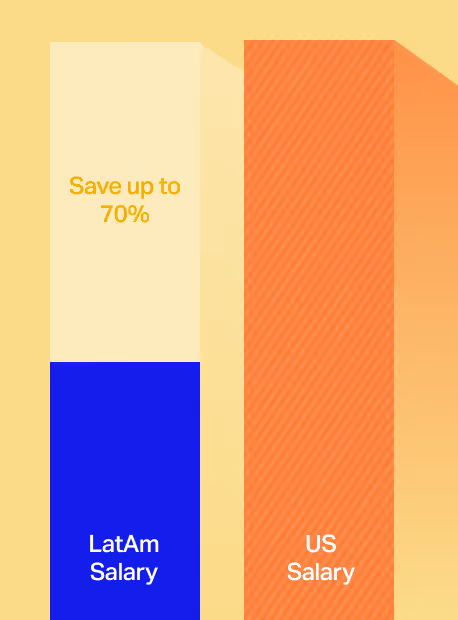
That’s what moves the search south. Hiring in Latin America typically lowers salary costs by roughly 30–70% compared with U.S. rates. This difference is driven by cost-of-living and local market conditions rather than capability or short-changing hires.
For a startup or mid-market company, that gap is often the difference between “two junior-level hires spread thin” and “one principal who raises the ceiling for everyone else.” It’s also a leveling effect: small firms can afford the caliber of talent that used to be the private preserve of big tech.
.avif)
Related reading: How AI and Time Zones Are Driving US Companies to Hire Developers in Latin America
The supply side: a bigger, readier talent pool
Latin America's technical capacity has grown substantially, turning it into a solid alternative to distant markets.
The numbers demonstrate this expansion:
- Large STEM pipeline: For example, in Mexico about 38% of college degrees are in STEM. In the U.S., it’s roughly 20% (Georgetown’s CSET).
- Growing developer communities: GitHub’s Octoverse 2024 points to fast-growing developer populations—Brazil >5.4M, Mexico >1.9M, Colombia >1M, Argentina >1.1M accounts—with double-digit year-over-year growth.
- Collaboration readiness: English proficiency helps with the day-to-day; Argentina, for example, sits in the “High” band on EF’s 2024 index and ranks near the top of Latin America.
The result is a large, experienced talent base that already works with U.S. stacks and practices and standard U.S. business hours.
According to Julia Guillen, a senior tech recruiter at Near,
"Clients are consistently surprised with the caliber of talent that’s available in LatAm. They don't expect to find senior engineers who've worked with major U.S. companies, understand modern development practices, and often have more hands-on experience with specific frameworks than candidates they'd find locally."
Related reading: US Hiring May Be Slowing, But US Companies Hiring in LatAm Isn’t
Final Thoughts
For big companies, this isn’t new; many have maintained Latin American engineering hubs for years. What’s changed is accessibility.
Remote-first norms and a deeper regional talent pool mean startups and mid-market firms can now do what only enterprises could do a decade ago: hire senior engineers who can raise the bar for architecture, reliability, and delivery cadence, without breaking the budget or waiting a day for answers.
The through-line is simple. AI raised the premium on judgment. The U.S. market keeps senior talent scarce and pricey. Latin America makes those hires reachable. And the north–south alignment lets teams move at the speed of conversation, not next-day catch-ups.
At Near, we specialize in helping U.S. companies build high-performing teams across Latin America. Here's what we've learned after helping 700+ companies hire in LatAm: the hard part isn't finding developers. It's finding the right ones who actually fit your team and deliver from day one.
We eliminate the guesswork. Our process gets you from "we need to hire" to "here are three vetted candidates" in under a week. No months of sorting through applications or hoping someone can actually code in production.
You interview for free, hire who fits, and get back to building your product. Simple as that.
Get profiles of pre-vetted candidates to see the caliber of engineering talent we can help you hire.
If you want to learn more about how the developer market looks across the region, we’ve prepared guides that cover that ground for specific countries. You can check how to hire developers in Peru, Brazil, Uruguay, Bolivia, and Chile.
Frequently Asked Questions
What developer roles can I hire in Latin America?
US companies hire the full range of developer roles in Latin America, from front-end and full-stack to specialized engineers.
Common hires include back-end developers, Angular developers, and Vue.js developers, all working in overlapping US time zones so they collaborate in real time—the time-zone advantage this article describes.
Can I hire developers for specialized work?
Yes, Latin American teams cover specialized development, not just senior generalist engineers.
Common needs include mobile app developers, cross-platform Flutter developers, Python development, web developers, and dedicated QA and software testing. If you'd rather compare providers first, see our roundup of the top companies for outsourcing software development.
How long does it take to hire a developer in Latin America?
You can hire a developer in Latin America in about three weeks with a staffing partner, versus the months a direct search often takes.
A partner with a pre-vetted talent pool can share a shortlist in a few days; the rest is interviews and your decision. Because Latin American developers work US hours, interviews and onboarding happen live—no scheduling around a large time-zone gap.







.webp)


%203.svg)
.avif)





%20(1).avif)

%20(1).png)