

%203.svg)
Key Takeaways
- Handing your team AI tools isn’t enough. Research from PwC found that only 20% of companies are capturing 74% of all AI-driven returns. The rest have the tools but not the results.
- The companies getting returns have been deliberate about how AI fits into their business and about having the right people in place.
- Two types of hires make the difference: senior professionals with the expertise and judgment to direct AI use, and AI engineers or automation specialists who build the systems, guardrails, and workflows that ensure quality consistency.
- Companies are able to hire both in Latin America at 40 to 60% lower cost than US-based hires.
Most US businesses are running at least one AI tool. Many are running several.
The expectation is generally that AI will handle the routine work, your team will focus on the important stuff, and productivity will go up.
But for many companies, that hasn’t been the experience.
PwC’s 2026 AI Performance study, which benchmarked more than 1,200 senior executives across 25 sectors, found that just 20% of companies are capturing 74% of all AI-driven returns.
The majority are stuck in what the researchers call “pilot mode”: lots of AI activity, but without measurable impact.
The gap isn’t necessarily the tools, but who’s running them.
Why Giving Employees AI Tools Doesn’t Automatically Improve Productivity
Many companies have introduced AI in the same way: give employees access, encourage them to use it, and assume that productivity will follow. It’s a reasonable assumption. But it’s also, for many teams, the wrong one.
A study by Boston Consulting Group of nearly 1,500 US workers found that productivity increased when employees were using a small number of well-integrated AI tools, and fell sharply once the number of tools and the cognitive overhead they create grew beyond what anyone could reasonably manage.
The researchers named the phenomenon “AI brain fry.”
When everyone is managing their own AI tools, building their own workflows, and having to make constant judgment calls about when to trust the output and when to push back, work expands. There are more drafts to review and more decisions to make, with less time to think about any of them.
The companies getting strong productivity returns have taken a different path.
PwC’s research found that what separates top performers isn’t more AI tools. It’s that they’ve redesigned how work gets done around those tools, rather than piling AI on top of the way work was already getting done.
The most AI-fit companies in PwC’s study delivered returns 7.2 times higher than their peers. What separated them was that they were deliberate about how AI fit into the way their business runs.
That kind of transformation requires more than tool adoption. It requires people who know how the work should function in the first place.
Why AI-Driven Organizations Are Leaning on Senior Hires More
Senior professionals bring something AI can’t replicate: the judgment to know when output meets the standard and when it doesn’t.
AI output is often like work from a very fast and very confident junior hire. It sounds right. It looks right. But an experienced marketer will notice when messaging is subtly off-brand. A finance leader will catch assumptions or numbers that don’t hold up.
Someone newer to the role may not spot the issues at all.
That’s why senior hires have become more valuable, not less.
They have the experience and judgment to determine what meets the standard, what needs revision, and where automation creates risk instead of leverage.
In AI-driven organizations, domain expertise has become the asset that makes everything else reliable.
The Hires Who Build the Systems That Make AI Work
If the first type of hire is about judgment, the second is about infrastructure.
At many companies right now, employees are building their own AI operation from scratch: their own prompts, their own process, their own way of checking outputs.
No-code AI tools have made it possible to string together automations and workflows without technical knowledge.
“Sure, anyone could ‘vibe code’ and tell ChatGPT or Claude to build me a system for this and that,” says Kevin Dubon, an operations systems architect at Hire With Near who has audited AI setups built this way. “But there are some very important things to keep in mind, one of them being security. You need to make sure that your system is not going to get hacked, especially if you’re dealing with customer data.”
PwC’s research found that the companies achieving the highest AI-driven performance share a specific habit: they build reusable, centralized AI components that teams can draw on consistently, rather than having every employee reconstruct the process independently.
They design guardrails and workflows so that AI handles the repeatable, predictable work automatically, and humans only step in for the cases that genuinely require their judgment.
This is the work of an AI engineer or automation specialist: building the systems and guardrails that make AI output consistent and trustworthy without requiring every employee to carry the full burden themselves.
It’s a different skill set from the judgment hire, and it solves a different problem. Together, these types of hires address the underlying issue that most companies are running into.
{{state-latam-hiring}}
Why US Companies Are Hiring the AI Talent They Need in Latin America
For most small and mid-sized US companies, hiring several senior professionals would be a significant budget stretch.
Professionals with genuine AI expertise and real domain experience command $120,000 to $180,000 or more in the US market. Automation specialists with infrastructure experience aren’t far behind.
A growing number of companies are finding both profiles in Latin America. Countries like Mexico, Colombia, Argentina, and Brazil have built substantial technology and professional talent pools over the past decade.
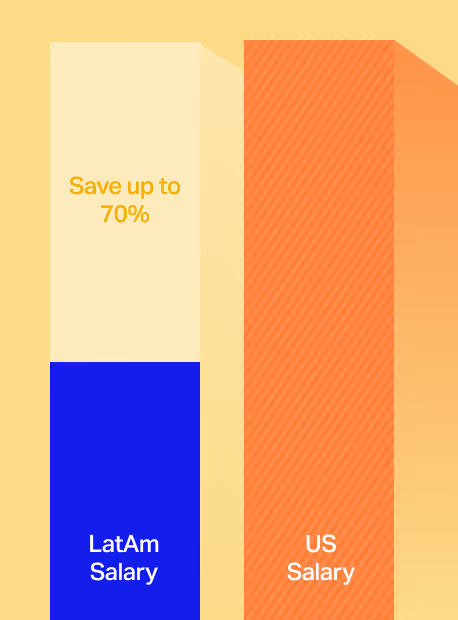
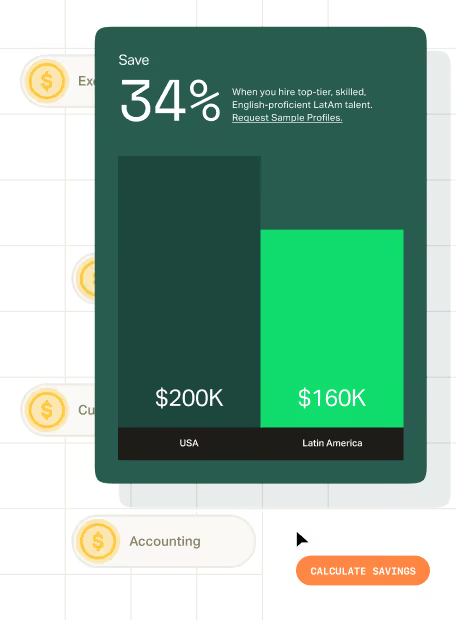
Senior professionals based in the region typically earn 40 to 60% less than US-market equivalents.
Companies hiring in Latin America average savings of $35,000 to $64,000 per hire annually compared to hiring US-based talent. And in our analysis of 2,000 placements, we’ve seen that 84% of the talent we place for US companies are mid-level or senior, an indication that companies are hiring offshore to access more experience than they can afford domestically.
Companies that couldn’t otherwise afford to, can now hire someone with enough experience and judgment to define how AI should and shouldn’t be used across the business and hire AI specialists to build the systems and infrastructure that make those decisions hold at scale. And according to our 2026 midyear data, those AI hires aren’t limited to engineering: the fastest growth is in marketing, finance, and sales roles.
Together, those two things are what separate the companies getting impressive returns from the ones still waiting for them.
Want to understand what AI-capable talent in Latin America looks like, and how quickly you can hire?
Hire With Near works with US companies to help them hire senior professionals and automation specialists who are vetted, available in your time zone, and ready to contribute from day one.
Book a free consultation to learn more about how we can help you hire top remote talent in Latin America.


.webp)


.webp)

.webp)


%203.svg)
.avif)




%20(1).avif)

%20(1).png)