


%203.svg)
Key Takeaways
- Latin American professionals work during US business hours: your EA is available in real time, not waking up at 3 a.m. or catching up 12 hours behind you.
- English proficiency among LatAm VA and EA candidates is strong enough for client-facing roles, with written English often cleaner than spoken, which matters most for this type of work.
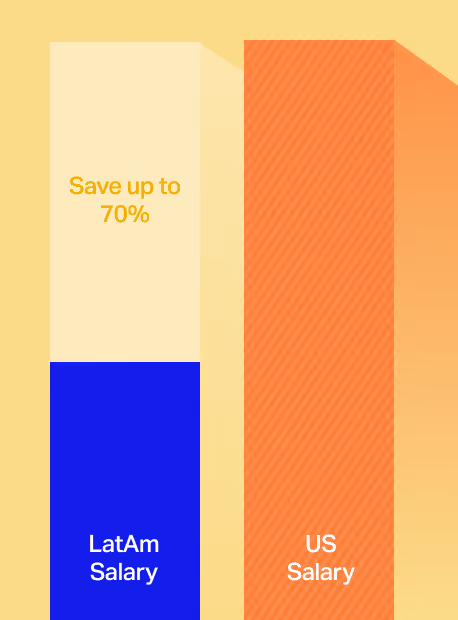
- Retention is strong because a US remote role pays LatAm professionals 60–80% more than they'd earn locally. This is a career opportunity they're looking to keep, not a temporary gig.
You've hit the ceiling. The calendar management, the inbox, the follow-ups, the research: it's all sitting on your plate when it shouldn't be. You know you need an executive assistant or virtual assistant. You've been looking at Latin America, and the pricing makes sense.
Then the questions start.
They're different from the questions people ask about hiring a developer or a customer support rep. When you're hiring an EA, this person is going into your email. Your calendar. Your client communications. And maybe even your financials.
So the concerns run deeper than accent worries.
You're thinking: Will they be reachable when I need them? How good is their English for client-facing work? What happens when they leave and take everything they've learned with them?
These are the right questions to be asking.
In my work recruiting executive assistants and virtual assistants for US clients at Hire With Near, I hear some version of all of these questions on almost every intake call. Here are my answers.
“Will They Work My Hours?”
Yes. Most of Latin America overlaps directly with US business hours. Your EA is available when you are, not waking up at 3 a.m. to answer your messages.
This concern almost always comes from people who've worked with offshore VAs in the Philippines or India. There, you might get one or two hours of real overlap if you're lucky, while most of the actual work happens when you're asleep.
Latin America is different. A VA or EA in Mexico City, Bogotá, or Buenos Aires starts their morning when you start yours. Same time zone, or within one to two hours of it.
For an executive assistant, real-time availability isn't a nice-to-have. It's the whole job. If you need something rescheduled at 10 a.m., you need a response at 10 a.m. If your calendar goes sideways, you need to reach your EA during your workday.
An assistant who's 12 hours ahead isn't really an assistant. They're an overnight message-relay service.
This time zone situation is one of the most commonly cited reasons business owners switch to Latin America from other offshore regions.
One business owner we spoke with said it plainly: “I have to stay in the Americas because of the time zone.”
Another had a Philippines-based VA whose hours made the role unworkable.
When you hire VAs and EAs in Latin America, you should expect full overlap with your core working hours. For an EA role, it's often the deciding factor.
“Will They Be Dedicated to Me, or Are They Juggling Other Clients?”
It depends on how you hire. Platform-based VAs typically work for multiple clients at once. A full-time direct hire works for you and only you.
This question comes from real experience. A lot of business owners who've tried Upwork or VA companies know the feeling: The person they hired seemed fine in the interview, but in practice wasn't fully present. Responses were slow. Work got done between other commitments, not during dedicated hours.
That's a problem with the freelancer model, not with hiring from Latin America. LatAm professionals are available for full-time, dedicated employment, the same structure you'd use with any full-time hire. When you bring someone on full-time, they work your hours, commit to your company, and aren't working for other clients on the side.
What to watch for when hiring: Confirm explicitly whether you're getting a dedicated full-time hire or a shared resource. Some platform models assign VAs to multiple clients even if they market it as “dedicated.” Ask the question directly before you start. One business owner told us their VA asked to take a second job just days into the role.
Again, that’s a red flag about the employment model, not about Latin America. A full-time employee with real employment status (benefits, a contract, accountability) doesn't behave that way.
“How Good Is Their English? I Need Someone Writing Emails to My Clients.”
English proficiency among LatAm VA and EA candidates is strong, including spoken fluency. Latin America has candidates with excellent English and little to no accent. The candidate pool is large enough that you can hold a high bar. You just need a process that finds them.
This is one of the most common concerns I hear, and it's the right question to ask. An EA is representing you in emails, on calls, and in client conversations. Vague reassurances about English quality aren't good enough for that kind of role.
This is where working with a recruiting partner makes a real difference when hiring a VA or EA.
Every candidate Hire With Near puts in front of you has already passed an English screening. You see a video interview before you schedule a live call, so you can hear how they speak, how they phrase things, and how they handle a question before committing any time.
If English quality is non-negotiable for your role, you say so up front, and only candidates who meet that bar come through.
If you're hiring independently, don't rely on a resume or a text-based application to evaluate English. Ask for a short recorded video response to a scenario relevant to the role. It tells you far more than any written sample about how someone really communicates.
One prospective client told me he wanted someone as fluent in English as he was. That's achievable. Latin America has that candidate. The work is making sure your screening process finds them.
Related reading: Do You Really Need a US-Based Virtual Assistant?
“What If They Leave After Six Months and Take Everything They've Learned With Them?”
Retention among Latin American remote professionals is strong, for a structural reason specific to this region.
This fear is more acute for EA roles than almost any other hire. An EA absorbs institutional knowledge fast. They know how you think, what you don't like, how to manage your calendar, and which clients are sensitive. Losing that person six months in doesn't just mean a vacancy. It means starting all over again.
Here's why the fear tends not to play out the way people expect with LatAm hires specifically.
A US remote position pays Latin American professionals significantly more than they'd earn in their local market, often 60–80% more. In Buenos Aires, Bogotá, or Mexico City, this isn't a job someone leaves lightly. It represents a genuine career step up, not a stopgap while they look for something better.
This is different from some offshore regions where remote work for US companies is so common it's become a starting point rather than a destination. In Latin America, the combination of salary premium, time zone alignment, and career development makes these roles valuable to the people in them.
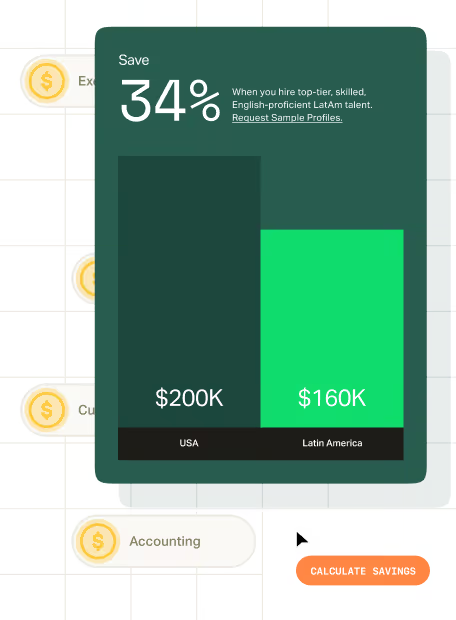
Kordis, a fractional CFO services firm, came to Hire With Near after cycling through talent based in the Philippines who kept leaving or underperforming. After placing a bookkeeper and an executive assistant with us, they've saved $109,000 annually and retained both hires.
That said, turnover isn't zero anywhere. The best protection for an EA hire: invest heavily in the first 30 days. The hires that stick for years are the ones who had a structured onboarding, a clear picture of what they owned, and a manager who treated them like a real team member from day one.
“How Do You Screen for Judgment? I Need Someone Who Thinks Ahead, Not Just Follows Instructions.”
This is the right question to ask when hiring a VA or EA. Judgment and initiative need to be evaluated deliberately. They don't show up on a resume.
This question comes almost exclusively from people who've hired a VA or EA from the Philippines or India before. The pattern they describe is consistent: technically capable, willing to work, but task-dependent. Every decision bounced back. Every ambiguity stalled. The hire wasn't extending the manager's capacity. They were creating a second inbox.
“The thinking is very basic. I can only tell them to do data entry,” said one business owner we spoke with. Another: “If anything deviated slightly from exact steps, it'd all come back to me.” A third put it plainly: “I'm hiring for judgment. She doesn't have the judgment.”
This isn't a geographic trait. You can find task-dependent workers and initiative-driven workers in any country. The difference is how you screen.
When I'm interviewing candidates for EA and admin roles, I build in scenarios specifically designed to surface this: What do you do when your manager is unreachable and you're not sure whether to act? Walk me through a time the right answer wasn't obvious. Give me an example of catching something your manager hadn't noticed.
The candidates who answer those questions well, with concrete decisions and real examples, are the ones who will take ownership. The ones who describe escalating every decision are the ones who will bounce it all back to you.
References matter here too. I ask specifically about autonomy: Did they ask for permission constantly, or did they act and report back? How often did they surface problems before being asked?
Hire With Near also uses Culture Index assessments as part of the screening process to map how autonomous a candidate is and how they handle ambiguity. If you're hiring independently, a work-style assessment serves the same purpose. The candidates who pass this kind of screening aren't just competent at the role. They're wired to own it.
When you're ready to hire an executive assistant, that kind of screening is what separates someone who can follow instructions from someone who can run things.
Related reading: Admin Assistant vs Executive Assistant: Which Job Title Gets You the Help You Actually Need?
If you'd like to explore the full picture first, including roles, costs, countries, and hiring models, our guide to hiring VAs, EAs, and other admin talent in Latin America covers all of it.
{{prevetted-banner}}
“What Happens if It Doesn't Work Out?”
Understand your safety net before you commit. For an EA role, the cost of a failed hire is higher than in most positions.
An EA absorbs institutional knowledge quickly. If they leave or don't work out, you'll need to rebuild the context that took months to build up.
If you're hiring through a recruiting or staffing partner, ask about the replacement guarantee before you sign. Hire With Near replaces the hire at no additional recruiting fee within the guarantee period, and the second search starts with a recruiter who already knows your requirements, which makes it faster.
If you're hiring an EA or VA independently in Latin America, build your own safety net: a trial period in the offer, a clear 30-60-90 day performance framework, and defined expectations from day one.
The business owners who report the smoothest EA hires are the ones who treated the first 30 days as a structured onboarding with defined milestones, not an open-ended settling-in period.
What typically causes EA hires to fail, regardless of region, is a mismatch between what the role required and what the hiring manager communicated before day one.
The EA who seemed great in interviews struggles because no one told them what level of calendar autonomy they had, or what owning communications really meant at this company. Set those expectations in writing before the hire starts.
ORBA Cloud CFO came to Hire With Near needing to fill an executive assistant role quickly without sacrificing quality. We sourced candidates, provided video recordings of interviews before the final decision, and provided onboarding support from day one.
The EA hire was completed in 13 days, and ORBA saved $159,000 annually. The process worked because expectations were clear on both sides from the start.
For companies thinking about building out a full administrative and operations team in Latin America, or considering whether a more senior executive search makes sense for a chief of staff or operations lead, that conversation usually starts with one hire done right.
Final Thoughts
The questions business owners ask about hiring VAs and EAs in Latin America are different from the ones they ask about other roles because the stakes are different.
An EA is inside your business in a way most hires aren't. You're trusting them with access, context, and judgment.
The good news: the time zone overlap is real for LatAm professionals, the English is there if you screen for it, and retention holds up because these roles are valuable to the people in them.
If you want to talk through what you're looking for and whether Latin America is the right fit, book a free consultation with Hire With Near.
No commitment required, just a direct conversation about what you need.






.webp)



%203.svg)
.avif)





%20(1).avif)

%20(1).png)