


%203.svg)
Key Takeaways:
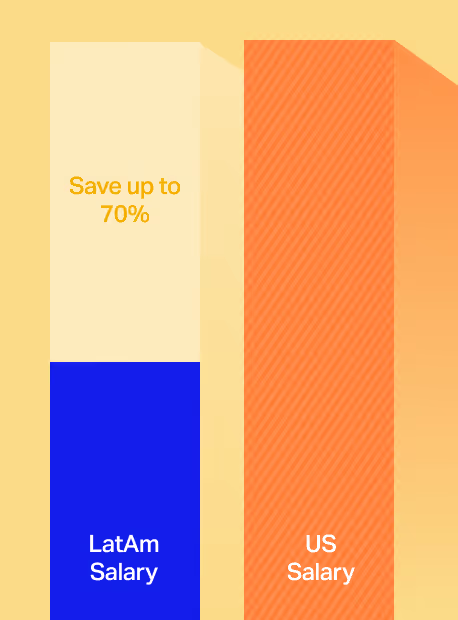
- Hiring VAs or remote executive assistants in Latin America gives business owners experienced, English-proficient professionals who work US hours at 60–80% below equivalent US salaries.
- A great assistant returns high-value hours to business owners by taking over scheduling, inbox management, follow-ups, and day-to-day operational decisions.
- AI tools cannot replace a skilled assistant because proactive judgment, institutional knowledge, and relationship handling require human initiative and oversight.
Here’s a moment most founders recognize: it’s Wednesday evening, you’re rescheduling a meeting you already moved once, and somewhere in a tab you opened this morning is the work you meant to get to.
That’s what happens when too many things route through you personally: booking your own flights, chasing a proposal you sent three weeks ago, checking your inbox for the tenth time in an hour because you’re worried you missed something important.
Meanwhile, the work that grows the business gets pushed to evenings and weekends, when you’re already depleted, and you never feel like you’re on top of anything.
Many business owners recognize this eventually and hire an assistant. One person whose job is to make sure everything that isn’t your highest-value work doesn't land on your desk.
Here’s what that looks like, and why so many business owners are hiring admin talent in Latin America.
Having a Great Assistant Gives You Time Back
The business case for hiring an assistant is almost always framed around time, but not in the "save 10 hours a week" sense. It’s about which hours you get back.
When a great assistant takes over your calendar, you stop losing the first 20 minutes of every morning to rearranging meetings. When they own your inbox, you stop checking it reflexively every 15 minutes. When they manage follow-ups, things get closed.
What changes most for a lot of people is the quality of their attention. When logistics are handled, you can think clearly. The focused work that used to get pushed to Sunday night starts happening on Tuesday morning, when you’re at your best.
And finally, the work that advances the business gets the hours it deserves.
As one founder running a busy real estate business, noted:
If I did one more deal a year with this person in place, they would pay for themselves.
As Dan Martell explains in Buy Back Your Time, if your highest-value work is worth more per hour than scheduling meetings and processing vendor emails, hiring an assistant pays for itself.
Another founder we talked to put it like this:
My assistant became my gatekeeper. They handle all of the BS so I can focus on what matters.
VA, EA, Virtual, In-Person: Does Any of It Matter?
Once business owners decide they want this kind of support, the next question is usually about what to call the role.
The terms "virtual assistant" and "executive assistant" get used almost interchangeably, but they describe different roles, and the difference matters when you’re trying to hire the right person.
A virtual assistant typically handles defined, repeatable tasks: inbox triage, data entry, scheduling, and research. They often work across multiple clients (if you’re hiring through a VA agency rather than a recruiter).
An executive assistant is a dedicated resource for one person or team. They’re expected to anticipate, not just execute. They manage complex calendars, own communications, coordinate travel, and often serve as a gatekeeper who decides what reaches you and what gets handled before it does.
In our experience, most business owners, when they describe what they want, are describing an executive assistant, even when they say "VA."
But when founders and operators describe their ideal hire, they rarely use formal job titles. They talk about wanting a "second brain," a "right-hand person," or "someone to run alongside me."
One business owner in professional services, looking to hire an assistant, put it this way:
This person needs to be on every one of my calls, and when there are action items, I can trust them to do those action items.
That’s an executive assistant.
The “virtual” part of the equation has also become less meaningful. Many teams are distributed now. Whether someone is down the hall or in another city or country, the working relationship looks the same: Slack, video calls, shared docs.
What really matters is whether the person has the initiative, judgment, and communication skills to take work off your plate without needing to be managed themselves.
Does AI Change the Need for an Assistant?
Some business owners might hesitate about hiring an executive assistant or VA because they think the cost isn’t justified if AI can take care of a lot of time-consuming admin tasks.
And, to a point, yes, it can.
But the gap between what a Claude or OpenClaw agent can do and what a human assistant can do is still huge.
AI responds when you ask it to. A great assistant notices when the vendor hasn’t replied in two weeks and follows up without being told.
They catch what’s about to become a problem before you know it existed. That kind of proactive judgment is what makes a good assistant genuinely valuable.
Also, a human assistant builds institutional knowledge over time. They learn which clients need a warmer tone, which meetings always run long, and which contacts need three nudges before responding. That knowledge compounds with every week they’re in the role. You can’t easily prompt your way to it.
Colleen Barry, Head of Marketing at Ketch, uses AI tools daily. She also works with a VA.
When I asked whether AI changed the need for human support, she said:
AI can help draft a message, but it won’t actually make sure things get done. A good VA brings reliability, communication skills, and attention to detail that goes beyond just output. Managing partnerships, coordinating with designers, and following up with vendors: these require persistence and relationship handling.
This reflects what our team consistently hears from business owners: The best assistants notice what’s about to fall through the cracks, follow up without being asked, and handle the human dynamics of a busy person’s work life.
A great assistant makes AI even more useful
AI can’t replace a great assistant. But that doesn’t mean AI shouldn’t play a big part in helping organize your work.
If you’re already using AI tools in your business, a skilled assistant is what makes those tools pay off. The AI output still needs someone to review it, apply judgment, and make sure the right version reaches the right person at the right moment.
Courtney Hickey, EA to the CEO at Zapier, doesn’t believe AI can replace a good EA. She has used AI to free up her time to deliver even more value in her role.
Speaking on the How I AI podcast, she described how automation has given her more time to spend on the judgment calls, the relationships, and the other things that can’t be automated:
I definitely am a believer that AI can only enable us in this role. There is simply too much to do.
Why Hiring in Latin America Makes Hiring an Assistant Feasible for Most Companies
The value case for hiring an assistant is clear. The next question most business owners ask is whether they can afford one.
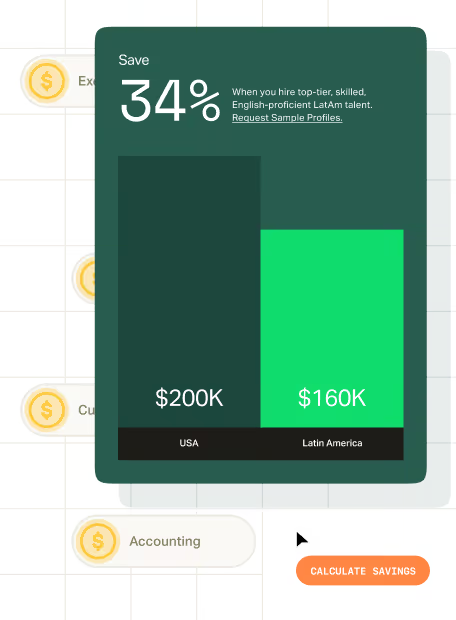
US administrative assistants earn $46,000–$69,000 per year. An experienced executive assistant can run considerably higher, up to $115,000. For a small business or a solo operator, that number can feel like the end of the conversation.
What many haven’t looked at closely is the option to hire in Latin America.
This isn’t offshoring in the traditional sense. Latin American professionals work in time zones that align closely with US business hours. They’re available on your calls and respond to messages during your same workday.
Source: Near’s 2026 US vs. LatAm Salary Guide
For people who have already hired a VA in the past, they usually have experience with hiring in Southeast Asia, particularly the Philippines, which has long been the go-to offshore VA market.
The feedback we hear from business owners who’ve tried to hire from distant time zones is consistent: asynchronous communication becomes a real tax.
One business owner, when describing the core problem when their Philippines-based assistant was working overnight shifts to cover US hours, said, "they just weren’t at their best." And many business owners simply don't want someone working an overnight shift just to accommodate their schedule.
The Latin American market offers something different: professionals who work the same hours you do, with strong English proficiency and cultural alignment with US business norms. For owners and executives who’ve tried offshore arrangements and found them operationally frustrating, it’s a meaningfully different experience.
In fact, according to Near’s State of LatAm Hiring Report, executive assistant is the fourth most popular role hired by US companies in Latin America, with administrative assistant ranking tenth.
{{state-latam-hiring}}
What to Look for When You Hire
The difference between a hire that transforms how you work and one that adds more to manage almost always comes down to one thing: whether the person takes ownership or just takes direction.
The assistants who make the biggest difference don’t wait to be told what to do. They notice what needs doing before you do.
That proactiveness isn’t a personality trait you can train into someone; it’s something you need to screen for.
Julia Guillen, a recruiter who specializes in placing executive assistants, described the profile this way:
What I look for is a proactive organizational mindset, someone who stays one step ahead of their executive’s needs rather than waiting to be told. Startup experience is a strong signal, because it tells you the candidate understands urgency and can operate without a lot of structure.
In interviews, strong candidates give specific examples. They can describe how they’ve handled competing priorities, explain their systems, and ask smart questions about the role because they’ve already thought about how to do it well.
The hiring process should test for this directly. Give candidates a small task relevant to your actual work. Ask how they’ve handled situations where multiple things were urgent at once. The answers will tell you more than a resume.
Final Thoughts
Most business owners who hire an assistant say the same thing afterward: they should have done it sooner.
The value isn’t only in the tasks that get handled. It’s in the focused hours that open up again and the strategy work that finally gets the attention it deserves.
If you’re running a business and still doing everything yourself, hiring an assistant in Latin America could be just what you need to take your business to the next level.
For a deeper look at what’s behind more US companies hiring in LatAm, this report covers the top reasons companies are expanding their hiring to Latin America.
For the full picture on how to hire, which countries to source from, what to screen for, and what it costs, see our guide to hiring VAs, EAs, and other admin talent in Latin America.
Frequently Asked Questions
What specialized assistant roles can US companies hire in Latin America?
Hiring an assistant in Latin America isn't one-size-fits-all—you can match the profile to the work you need done. Many business owners start with administrative assistants for scheduling, inbox management, and day-to-day coordination, then add more specialized support such as legal assistants for document preparation, case organization, and administrative work in law practices. Defining the tasks you need handled first makes it much easier to hire the right type of assistant.
What kinds of tasks can you hand off to an assistant?
Almost anything that eats up your day without needing to be done by you personally—calendar and inbox management, scheduling and meeting coordination, travel booking, data entry, CRM upkeep, research, and first-line email or customer follow-up. More specialized profiles can take on domain-specific work too, like an executive assistant supporting leadership directly. A good rule of thumb: track your week, flag the recurring low-leverage tasks, and start by handing those off.
How do you make sure an assistant is the right fit before hiring?
Treat it like any other key hire. Start by writing down the specific tasks and tools the role involves, then screen against them directly—a short video interview to check communication and responsiveness, plus a small paid test task that mirrors the real work (managing a sample inbox, booking a mock trip, or cleaning up a spreadsheet). Pay attention to proactivity and how clearly they ask questions, since a good assistant should take work off your plate, not add to it. Hiring through a vetted partner also narrows the pool to candidates already screened for English, reliability, and relevant experience.







.webp)


%203.svg)
.avif)





%20(1).avif)

%20(1).png)