Hire Top .Net Developers in LatAm. Same Quality. 60% Less.
Hire elite .Net Developers in 22 days. Only interview talent pre-vetted for skill, experience, and cultural fit. We handle everything else.
.avif)
Trusted by 950+ fast-growing companies




Why Hire .Net Developers in LatAm?
Hot Spot for Tech Talent
LatAm has a booming tech ecosystem with millions of skilled .Net Developers.
US Time Zones
LatAm developers work during US working hours, making collaboration seamless. You’re hiring teammates, not offshore resources.
Seamless Work Culture
Near’s proven hiring process delivers candidates who are both a cultural and professional fit—helping you boost retention and build stronger teams
Strong English
We don’t just screen for skills. We ensure all candidates have strong English proficiency.
Lower Operational Costs
LatAm salaries are 30-70% below US market. Hire the top 1% while keeping your hiring budget in check. It’s a win-win situation.
Top-Caliber Candidates in 3 Days.
We handpick the top 3 for your role based on skill, experience, and culture fit. In 3 days, interview candidates with track records at companies like:
.svg.avif)





Hire LatAm's Top 1% .Net Developers in 22 Days
Join 950+ fast-growing US companies building high-performing teams with top LatAm talent—while cutting hiring costs by up to 60%. Hire smarter. Start your search today.
LatAm Dot Net Developer Salaries and Skills by Experience Level
Make the right hire with transparent salary data and clear skill benchmarks for junior, mid-level, and senior remote Dot Net Developers in Latin America.
See a few of our 160k+ pre-vetted candidates

Seniority
Skills & Tools

Seniority
Skills & Tools

Seniority
Skills & Tools

Seniority
Skills & Tools

Seniority
Skills & Tools

Seniority
Skills & Tools

Seniority
Skills & Tools

Seniority
Skills & Tools

Seniority
Skills & Tools

Seniority
Skills & Tools
Why Hire LatAm .Net Developers with Near?

Faster Hiring
Interview 3+ candidates in 3 days. Pre-vetted for skill, experience, and culture fit. Get end-to-end support to make the right hire fast.

Risk-Free Hiring
Pay nothing upfront. Hire only if you’re happy. Plus, every hire is backed by our 180-day free replacement policy.

Build Real Teams
Every hire is a full-time teammate. Embedded in your team, aligned with your goals, and committed long-term.



Get Top Development Talent and Save up to 60% in Overhead Costs
Jr. .NET Developer
.NET Developer
Sr. .NET Developer
Hire Developers with the Right Skills
We deliver candidates with a proven track record across the skills, tools, and technologies that matter.
Hire With Near's Proven Hiring Process
1. Discovery session
Share your hiring goals and we’ll guide you on roles, markets, and comp. Then align on how to hire and what to offer.
2. Kick-off call
Meet your recruiter to finalize the role and build your hiring plan. We’ll align on profile, process, and timeline.
3. Interviews and hiring
Review 3+ top candidates in under 5 days. Interview, choose your hire, and we’ll handle the rest.

After You Hire
Onboard, pay, retain
We support onboarding, payroll, and compliance, so your new hire integrates fast and sticks long term.

Ongoing support & team expansion
Keep hiring with the same speed and quality whenever you need. Your recruiter stays close to support future hires, backfills, or scaling your team.
%203.svg)
%201.svg)
Zero-risk hiring. If you don't make a hire, you don't pay anything.
What Leading Enterprises Say About Hire With Near
.avif)
Hire With Near takes care of the entire hiring process for us. All we have to do is interview the best 3 candidates and decide.

Hire With Near’s team gave us confidence that we’d hire great talent quickly. They did a deep dive into our requirements, asked the right questions, and communicated our needs and goals back to us. They advised us on compensation, different talent markets, and our hiring process.

Hire With Near was a great extension of our internal recruiting team—efficient, communicative, and delivered top-tier candidates quickly.

It was our first global hire, and it was a success. Hire With Near's team guided us at every step. They connected us with highly-qualified candidates, supported us throughout the whole process, and we made a hire in under three weeks.

We were pleasantly surprised with all the candidates we interviewed, especially about how well-rounded they were and how much experience they had. We were blown away by the talent that existed that we just kind of weren't aware of.

We were determined to work with global talent in our local time zone, and Hire With Near helped us find great Latin American talent that has brought significant value to our team.

Hire With Near helped ensure we were selecting the right people for our team. The ability to interview multiple candidates and watch video recordings of the interviews before making a decision was a very strong point for Hire With Near.

Working with Hire With Near has been very helpful. It’s difficult when you’re one person doing all the initial screenings and sourcing. Hire With Near took a lot of that “workout” for me and provided great candidates quickly.

We hired 22 team members who share our core values: great attitude and desire to learn, resourcefulness, and adaptability. Hire With Near’s team was very responsive, and their easy-going communication fostered a seamless hiring process, helping us save $1.2M.

Hire With Near provides an easy hiring experience. They saved me a lot of time handling all the posting, sourcing, screening, and initial interviews. All I have to do is conduct final interviews to ensure cultural alignment. I made a hire in only 14 days.
Other roles Hire With Near can help you fill
.avif)
Success Stories



Hire With Near replaces a mis-hire at no additional cost.
With the staffing model, you can pause anytime a .NET developer isn't working out and Hire With Near will find a replacement with no additional fee. With the recruiting model, you have up to 180 days to flag a replacement, also at no additional fee.
Every new hire, whether in Latin America or the US, carries some risk, and being a little nervous about whether someone will work out is normal. Code quality and codebase fit in .NET work surface within the first sprint or two of merged changes, well inside the window.
Hire With Near's vetting process is built to take most of that risk off the table upfront. The guarantee is the backstop if something gets missed.
Talk through the specifics with your Hire With Near rep before you sign.
Most clients receive a shortlist of strong, best-fit .NET developer candidates within three to five days of the kickoff call, and most make a hire within three weeks.
Those numbers are averages. Some placements close in under a week, while others take four to five weeks, depending on how many interview rounds you want to run and how long final-stage steps take.
Yes, every .NET developer who reaches your shortlist has been interviewed in English about technical work, screened on the communication skills a working engineer needs, explaining a pull request, questioning a design, and giving a useful standup update.
Because much of the region's .NET work happened inside US-facing consultancies, candidates typically arrive with years of English-first engineering communication behind them, including the written kind that enterprise processes demand.
Raise the weighting at the intake conversation if your environment leans formal: change-management write-ups, architecture decision records, or compliance documentation are called out during screening when they're part of the job.
Nearshore .NET developers work your business hours, which changes the daily texture of engineering work: code reviews turn around in minutes, blockers get resolved in a quick call instead of an overnight message cycle, and production incidents find the service owner awake.
Offshore .NET staffing from South or Southeast Asia can look cheaper per hour, but teams that have run both models describe the same costs that never appear on the invoice: sprints stretched by 24-hour feedback loops, requirements garbled through handoffs, and senior staff working odd hours to bridge the gap. Depending on where you are in the US and where you hire from, you can find a developer who is in your exact time zone or only an hour or two off.
English fluency and US business-culture familiarity come with the territory: the .NET developers Hire With Near places have worked with US teams before, and are hired as full-time, dedicated team members rather than rotating vendor resources.
Yes, legacy .NET Framework work is one of the most common assignments for Latin American .NET developers, whose enterprise-heavy market history means many have spent years inside exactly the kind of ASP.NET WebForms, MVC, and WCF systems US companies still run.
Maintaining legacy .NET well is its own skill: working safely in large untested codebases, tracing behavior through old patterns, and making changes without breaking what generations of developers built. Candidates are screened for that temperament as much as the technical history, because not every developer wants legacy work, and a mis-matched hire churns quickly.
If your roadmap includes migrating from Framework to modern .NET, say so at intake: developers who have executed that migration, incrementally and in production, exist in the pool and can lead yours.
For more on tech leaders' most common concerns, visit Hire With Near’s guide to the questions tech leaders ask when hiring in Latin America.
Yes, Latin American .NET developers building for US clients work on modern .NET with current C#, ASP.NET Core APIs and Blazor front ends, Entity Framework Core, and cloud deployment that skews Azure but covers AWS as well. The ecosystem is identical to the one US .NET teams run.
Runtime currency is screened per candidate: some have spent recent years on modern .NET microservices, others in .NET Framework enterprise systems, and many have done both. Your intake specifies which world your code lives in and the shortlist will match it.
If Azure services are load-bearing in your architecture, Functions, Service Bus, AKS, name them, and candidates are filtered on hands-on experience rather than certification checkboxes.
.NET experience concentrates where enterprise and US-consultancy work concentrates, which in Latin America means Brazil, Colombia, and Argentina, the region's top three for IT and engineering placements in Hire With Near's State of LatAm Hiring Report, within a 2025 sourcing footprint of more than 20 countries.
Decades of enterprise software work built deep C# benches in all three markets: Brazilian developers out of banking and industry systems, Colombian developers from US-facing consultancies, and Argentine engineers known for senior-level architecture and English. Mexico and Costa Rica also produce strong .NET candidates from their US-nearshore corridors.
Any of them will share your working day, staying closely aligned with your hours (no different than collaborating with a teammate in another US region).
Hire With Near focuses the search wherever the strongest .NET candidates for your specific codebase are working.
Related reading: Discover the 22 Best Countries to Hire Remote Software Engineers and Developers
Hiring a .NET developer in Latin America through Hire With Near follows one of two paths, depending on whether you want Hire With Near to handle sourcing, payroll, and compliance or prefer to manage the employment side yourself.
With the staffing model, Hire With Near sources and vets the candidate, then handles payroll, compliance, and benefits administration on your behalf. You pay Hire With Near a monthly fee and don't need to set up a foreign entity or navigate Latin American employment law directly.
With the recruiting model, Hire With Near sources and vets the candidate and charges a one-time placement fee. You manage the employment relationship directly, either through a separate employer of record company (Deel, Globalization Partners, or similar) or by setting up your own local entity.
Then, onboard the way enterprise .NET teams do it well: repo, database, and Azure DevOps or CI access provisioned before day one, solution architecture and coding standards walked through in week one, and a first 30-day plan that moves from contained work items toward owning a service or module.
Further reading: How to Hire .NET Developers: The Complete Guide
Hire With Near vets .NET developers in Latin America through active sourcing, resume screening, a first-round interview, and a technical coding assessment. The strongest candidates from those stages become your shortlist.
Sourcing targets Latin American developers with verified US-client experience on .NET codebases, and the intake conversation scopes your .NET version, application type, and infrastructure before sourcing begins.
Resume screening applies your requirements as hard filters: C# proficiency, the .NET runtimes you run (modern .NET or .NET Framework), ASP.NET and Entity Framework experience, SQL Server, and Azure or AWS deployment history are evaluated at this stage.
The first-round interview assesses English fluency for code review and standups, how the candidate reasons through service and data design, and evidence of production .NET systems they have owned.
After you choose your finalist, Hire With Near runs reference checks and an international background check to verify work history and references.
A mid-level .NET developer in Latin America typically earns $4,000 to $6,000 per month ($48,000 to $72,000 per year), compared to $87,000 to $157,000 per year for a US-based hire at the same level, according to Hire With Near's salary data.
Junior .NET developers in Latin America earn $2,500 to $3,800 per month ($30,000 to $46,000 per year), compared to a US annual range of $80,000 to $144,000, a savings of 63 to 68%.
Senior .NET developers range from $6,000 to $9,000 per month ($72,000 to $108,000 per year) against a US annual range of $106,000 to $189,000.
Hire With Near's fee is a transparent percentage of monthly salary with no hidden costs, and the developer is a dedicated, full-time member of your team rather than a consultancy resource billed by the hour.
For the most up-to-date figures, see Hire With Near’s US vs. Latin America Salary Guide.
Resources to Hire the Best Dot Net Developers



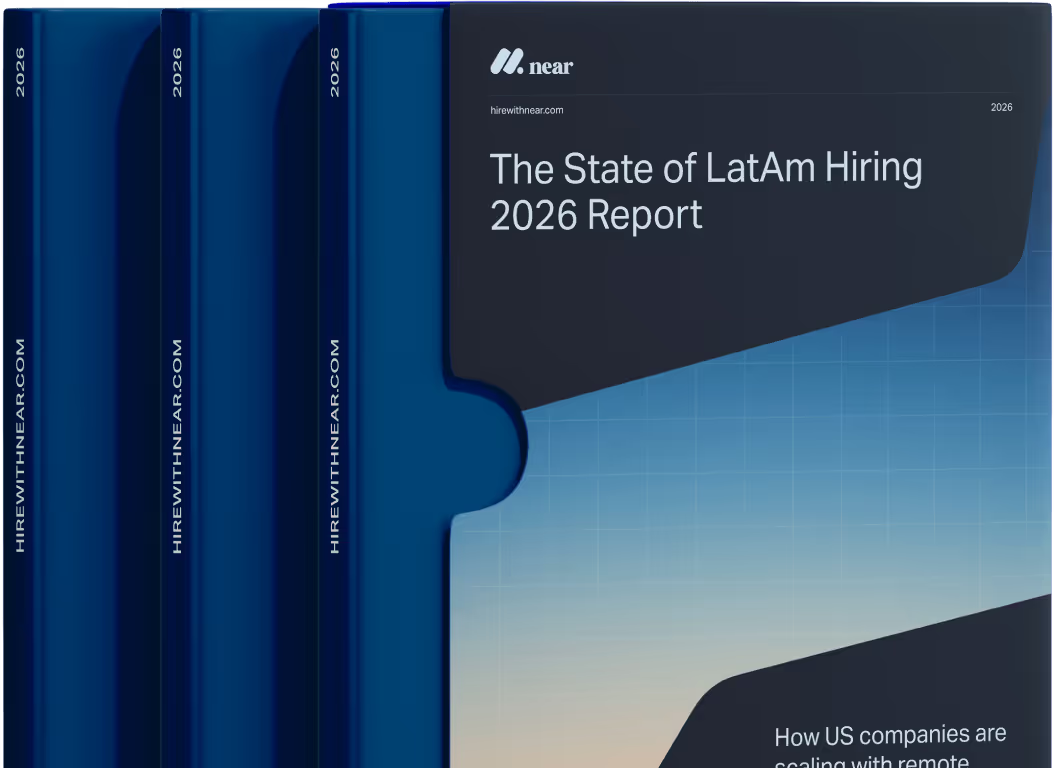
See how US companies are scaling with remote talent in Latin America. Download the free report now.