%203.svg)
Key Takeaways
- Software development companies to outsource to in Brazil include CI&T, Stefanini, BRQ Digital Solutions, Cheesecake Labs, and Radix. For companies that want to hire developers in Brazil instead of outsourcing to an agency, Hire With Near is the best choice.
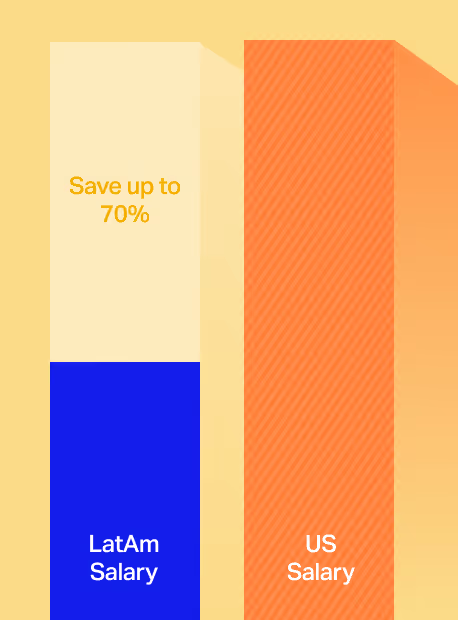
- Hiring your own full-time developer in Brazil often beats outsourcing to an agency in terms of control, retention, and long-term cost, with salaries running up to 70% below comparable US rates.
- Brazil offers a deep, fast-growing talent pool of nearly 6.9 million-plus developers and close working-hour overlap with US teams, whether you outsource a project or build your own team.
Software development outsourcing to Brazil means contracting a Brazilian development company or engineer to build software for your business, rather than hiring and managing that work in-house. It solves two problems at once: it gets you engineering talent at a salary your budget can cover and it keeps that talent working inside your business hours.
But outsourcing your software development function to an agency isn’t your only option. A growing number of US teams use a partner like Hire With Near to hire Brazilian developers directly, so the engineer joins their team instead of sitting on a vendor’s bench.
If you’re weighing an agency against hiring developers directly, this guide covers both: why Brazil is a strong outsourcing destination, what services and companies are available, what a developer costs, and how direct hiring compares.
6 Reasons to Outsource Software Development to Brazil
Brazil is Latin America’s largest tech economy and one of the countries that stand out in this arena, consistently ranking as a top outsourcing destination for US companies that want strong engineering talent at a lower cost.
Here are the reasons it keeps coming up when teams look outside the US:
1. Access to a talented workforce
Brazil has one of the deepest developer talent pools in the world and it keeps growing. According to GitHub’s 2025 Octoverse report, Brazil now has 6.9 million developer accounts on GitHub, up from 5.4 million in the 2024 edition, a jump of more than 1.5 million accounts in a single year, and the largest developer community in Latin America by a wide margin.
Demand for that talent is climbing just as fast. According to Hire With Near’s 2026 State of LatAm Hiring Report, software engineer was the sixth most-placed role among our 2025 Latin American placements, up 12 spots year over year with 250% growth in demand, and Brazil is one of our top sourcing countries for IT and engineering talent.
That depth means you’re not fishing in a shallow pond. The country’s top universities and technical institutes, like USP, Unicamp, UFRJ, and UFMG produce a steady stream of software developers, engineers, and tech professionals trained on the tools US teams already use.
2. Cost effectiveness
Outsourcing to Brazil gives you high-quality work at rates well below what you’d pay in the US, Canada, or Western Europe, typically 30–70% less for an equivalent senior developer.
That gap reflects Brazil’s lower cost of living rather than any compromise on quality, which is why more of what you spend can go toward senior talent, longer runways, or better tooling instead of overhead.
3. Overlapping working hours
Brazil shares most of the US working day, so you get real-time collaboration instead of overnight delays, as you can see in the table below:
A developer in Brazil is online during your business hours, which means live stand-ups, same-day answers, and handoffs that happen while everyone is at their desk.
That’s a big difference from offshoring engineering in distant locations, like Asian countries. Many US companies found the savings weren’t worth what they lost in speed and communication. One marketing agency put it bluntly after their first offshore hire:
I went the cheap route and paid for it. The time zone killed us.
That is the difference the overlap removes. A question you send in the afternoon gets an answer the same afternoon, not tomorrow.
4. Cultural affinity
Most Brazilian tech teams already work the way US teams do: the same sprint cadences, project management tools like Jira and Linear, and async communication habits built around Slack and daily standups.
Years of experience working with US and European clients, particularly in outsourcing and remote-first companies, have shaped how Brazilian developers structure their day and communicate progress.
That shared way of working cuts the friction that teams often hit with distant outsourcing arrangements. A developer who already expects a daily standup, a sprint retro, and a Slack thread instead of a status email adapts to your process in days, not weeks, which means projects move more predictably from the start.
5. Growing tech ecosystem
Brazil’s startup ecosystem is the largest in Latin America, with over 20,000 active companies and around 25 unicorns, including Nubank, the world’s largest digital bank by customer count, and iFood. São Paulo alone attracted more than $5 billion in venture funding in 2025, nearly 60% of all startup investment in the country.
Engineers coming out of this ecosystem have typically shipped products under real pressure, at real scale, inside companies solving hard regulatory and infrastructure problems, not just building demos.
The government has reinforced that growth with direct incentives: the Lei do Bem tax program offers substantial deductions on R&D spending, and FINEP and BNDES, Brazil’s national innovation agency and development bank, have committed tens of billions of reais to innovation financing through 2028.
6. Comprehensive range of services
From application development and software testing to system integration and IT consulting, Brazil covers the full spectrum of tech services.
That range means you can find one place to handle several needs at once, which is part of why Brazil works as a one-stop option for software development outsourcing.
{{state-latam-hiring}}
What Are the Software Development Services You Can Outsource to Brazil?
From web development to machine learning, Brazil’s developer talent covers the full range of services that US companies typically outsource. Here are the main ones:
Web development
Brazilian developers are strong at building dynamic, responsive, easy-to-use websites. They work with current frameworks to create sites that improve the user experience while meeting business goals.
This ranges from marketing sites and e-commerce platforms to complex web applications with real-time features, and teams frequently bring in experience from Brazil’s large e-commerce sector and fintech industry, where performance and reliability under heavy traffic are non-negotiable.
The result is code built to handle scale from day one, not retrofitted later.
Mobile app development
To meet the demand for mobile solutions, Brazilian teams offer full-cycle mobile app development, including design, coding, testing, and deployment, so your app meets high standards for functionality and usability.
Brazil has one of the highest smartphone penetration rates in Latin America, which has pushed local development teams to build native iOS and Android apps, as well as cross-platform solutions with React Native and Flutter, that hold up under real-world usage patterns.
Many developers have shipped apps used by millions of Brazilian consumers, giving them direct experience with the performance and localization challenges that come with scale.
Cloud solutions
Brazilian tech experts deliver cloud solutions, including cloud migration, infrastructure management, and service optimization, so your business can run efficiently and securely in the cloud. Teams often bring on a cloud developer for this work, with strong coverage of AWS, GCP, and Azure, along with the containerization and CI/CD practices that keep deployments fast and reliable.
This expertise has grown alongside Brazil’s fintech boom, where cloud infrastructure has to meet strict regulatory and security requirements, giving engineers direct experience building systems that hold up under compliance scrutiny.
Artificial intelligence and machine learning
Brazilian software developers build intelligent systems that automate processes, deliver predictive analytics, and support better decision-making across industries.
This is a common place to add an AI developer to a team, and Brazil’s strength here is backed by long-running academic programs in applied mathematics and computer science at universities like USP and Unicamp.
Talent in this space ranges from teams building recommendation engines and fraud detection models for fintech platforms to engineers integrating large language models into production products, reflecting how quickly Brazilian tech companies have adopted AI tooling.
Internet of Things solutions
With the rapid advancement of Internet of Things (IoT) technologies, Brazilian experts build solutions that connect devices and systems so data moves cleanly between them. This spans industrial applications, like manufacturing and agriculture, where Brazil has significant scale, as well as consumer-facing smart home and logistics tracking solutions.
Engineers working in this space typically combine embedded systems knowledge with cloud integration skills, since most IoT projects require both the hardware-facing code and the backend systems that make sense of the data it generates.
Custom software development
For businesses with unique challenges, Brazilian developers build custom software tailored to specific needs, delivering solutions that fit your goals and processes rather than forcing you into an off-the-shelf tool.
This work often involves close collaboration with product and business stakeholders to translate a workflow or business rule into working software, which is where Brazil’s cultural affinity with US business practices pays off directly: developers are used to iterative feedback cycles and comfortable pushing back when a requirement doesn’t make technical sense.
Legacy system modernization
Brazilian firms upgrade outdated systems to modern platforms and technologies, improving performance, security, and scalability so you get more life out of the systems you already run.
This includes migrating monolithic applications to microservices architectures, replacing outdated database systems, and rebuilding front-ends on modern frameworks without disrupting the business operations that depend on the legacy system staying online throughout the transition.
It’s detail-oriented, unglamorous work, and Brazil’s deep bench of senior engineers with enterprise experience makes it a strong market to source it from.
What Are the Best Places to Outsource Software Development in Brazil?
Several of Brazil’s cities stand out as strong locations for software development, each with a rich talent pool and solid infrastructure.
Here are the places worth knowing when you outsource software development in Brazil:
São Paulo
As Brazil’s largest city and financial hub, São Paulo leads in technological advancement and offers a dynamic market for software development. The city is home to numerous tech companies, startups, and innovation centers, including major players like Nubank, iFood, and Loft, alongside global firms like Accenture, IBM, and Capgemini that have built significant engineering teams there.
São Paulo is also a hotspot for diverse expertise and advanced tech. Its well-developed infrastructure and global connectivity also support efficient business operations, and the city hosts accelerators and innovation hubs like Cubo Itaú, one of Latin America’s largest startup hubs, which keeps the local talent pool close to cutting-edge product work.

Rio de Janeiro
Known for more than its landscapes, Rio de Janeiro has a growing tech sector that supports a wide array of IT services. The city’s universities and research institutions, including PUC-Rio and UFRJ, produce highly skilled professionals with particular strength in data science and energy-sector technology, shaped partly by the long-standing presence of Petrobras and other large enterprises with significant engineering operations there.
Its growing number of tech incubators, including Startup Rio and the accelerator network built around PUC-Rio’s Genesis Institute, gives startups and innovation fertile ground, which makes it an attractive place for software development outsourcing.
Porto Alegre
Porto Alegre has a reputation for a strong quality of life and a heavy emphasis on education, particularly in STEM fields, anchored by universities like UFRGS and PUCRS.
The city’s tech community is active, with tech parks like the Tecnopuc innovation hub, one of the most established in southern Brazil, supporting collaboration between startups, corporates, and research institutions.
Its lower cost of living compared with larger cities like São Paulo adds to its appeal for cost-effective outsourcing.

Curitiba
Curitiba is recognized for its sustainable urban planning and high quality of life, which attract both talent and companies. It’s also home to a growing cluster of tech firms and has been a base for logistics and smart-city technology, given its history as one of Brazil’s most efficiently planned cities.
Its education system, including strong programs at UFPR and UTFPR, supports a steady stream of qualified tech professionals, and government support for innovation has helped build a strong IT industry. Companies here benefit from a stable environment and a focus on efficiency.
Belo Horizonte
Belo Horizonte, with its fast-developing tech scene, is another strong candidate for outsourcing. UFMG anchors a large engineering graduate pipeline, and the city hosts numerous tech meetups and events, including a strong regional startup community, that encourage collaboration and networking among IT professionals.
With its mix of startups and established outsourcing firms that have long served enterprise software clients, Belo Horizonte offers a promising landscape for software development projects, particularly for teams that need dependable backend and enterprise software talent at a lower cost than São Paulo.
What Brazilian Software Development Companies Should You Consider?
For software development outsourcing in Brazil, these are solid options to know: CI&T, Stefanini, BRQ Digital Solutions, Cheesecake Labs, and Radix, all software development companies headquartered in the country.
These companies aren’t ranked and the best option for your business comes down to fit: what you are building, how much of it you want a vendor to own, and whether you would ultimately be better served by hiring your own developer instead.
For a wider view of vendors across the region, spanning industries and departments beyond software, from finance to marketing to customer support, see our roundup of the best LatAm outsourcing companies.
CI&T
CI&T is a Brazil-born digital transformation and software engineering firm founded in Campinas, São Paulo. It’s publicly traded on the NYSE (CINT) and has a strong US presence, working with enterprise clients on large-scale digital and software projects.
Stefanini
Stefanini is one of Brazil’s largest IT and software services providers, headquartered in São Paulo with a global footprint that includes the US. It offers software development, IT management, and a range of related technology services.
BRQ Digital Solutions
BRQ Digital Solutions is a large São Paulo-based digital and software engineering company. Its enterprise clients include Santander, B3 (Brazil’s stock exchange), Ambev (the beverage giant behind brands like Budweiser and Corona), and CPFL (one of Brazil’s largest electric utility companies), and it works across custom software, digital products, and technology modernization.
Cheesecake Labs
Cheesecake Labs is a product engineering studio founded in 2013 in Florianópolis, with a US office in San Francisco. It offers dedicated teams and staff augmentation across web, mobile, backend, and data and AI work.
Radix
Radix is a Brazil-founded engineering and software company based in Rio de Janeiro. It started in 2010 with an industrial and asset-intensive focus alongside data and software technology. Its enterprise customers include Johnson & Johnson and Shell.
Alternative to Outsourcing Your Development: Hire Your Own Developers in Brazil
Software development outsourcing to an agency in Brazil is one legitimate path, but for ongoing product work, hiring your own dedicated developer in the country often beats it.
You get an engineer embedded in your team and codebase, direct day-to-day collaboration, exclusivity, and better retention than a rotating agency bench, usually at a lower long-term cost.
Hire With Near’s research on why US companies turn to Latin American hiring found that 12% of them do so specifically to switch from outsourcing to hiring their own dedicated, direct employees.
One enterprise engineering leader at a US manufacturing and technology company explained why they moved away from the agency model:
We’ve had experience with contracted labor where we go to an agency. They provide us talent, but they are the supervisors. They run everything. And it’s been a bad experience. They haven’t met our expectations on quality.
With an agency, the vendor manages the engineers, sets their priorities, and sits between you and the developer doing the work. With a direct hire, the developer works on your team, under your management, on your roadmap.
What are the options for finding and hiring a developer?
If you decide to hire developers in Brazil rather than an outsourced project, you have a few ways to get there, from most hands-on to simplest.
- Source and hire on your own, using nearshore job boards, LinkedIn, and referrals, then handle the cross-border employment yourself, either by setting up a legal entity or using an employer of record to manage payroll and compliance without one. It gives you full control, but you carry the entire sourcing and vetting burden, and it is slow.
- Nearshore staff augmentation, where a firm places a pre-vetted developer onto your team to work under your direction while the firm stays the legal employer and handles payroll, benefits, and compliance. It fits teams that want to scale up or down or staff a defined project without committing to permanent headcount.
- A specialist recruiting partner, the simplest path for most companies building an ongoing product team. The partner sources and vets a full-time developer who joins your team and whom you employ, then handles the employment and compliance logistics in one relationship. This is the model that solves the tech leaders’ most common concerns about overlap, stand-ups, and communication.
ParkMobile, the US parking app that’s part of the global EasyPark Group, is a good example of the direct-hire path working at scale. Its back-end and platform engineering had been handled by outside development agencies for years, so every time those developers rolled off, they took hard-won knowledge of ParkMobile’s systems with them.
Working with Hire With Near, the company brought that work in-house, hiring nine senior engineers at an average time to hire of 24 days, with most roles closing in under a month. Building the team in-house cost about 73% less than equivalent US hires would have, saving over $1 million a year. Akshay Gokarnakar, the company’s TA Lead, put it this way:
Collaboration with Hire With Near is solving the problem of entering a completely new market for us. They have been an invaluable partner in this expansion, helping to successfully close roles quickly. Their deep understanding of the local talent landscape is what allows them to source and vet top-tier candidates efficiently. — Akshay Gokarnakar, TA Lead, ParkMobile
If you’re still weighing whether to hire an in-house developer or outsource, our full breakdown of that decision covers the trade-offs in more depth.
You can also check our full guide about how to hire developers in Brazil. And if you’re interested in other countries, we also cover how to hire developers in Colombia and hire developers in Argentina.
How Much Does It Cost to Hire a Software Developer in Brazil?
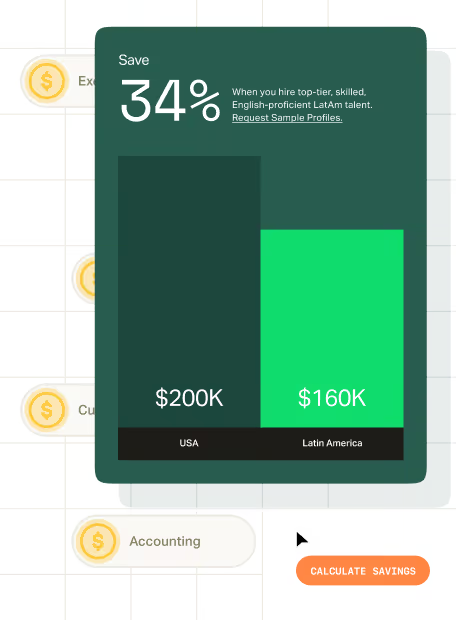
Hiring a software developer in Brazil typically costs up to 70% less than a comparable US hire, which leaves room to bring on more seniority for the same budget, according to Hire With Near’s IT Roles Salary Guide.
These are Hire With Near’s Latin America-wide benchmarks, and Brazilian developer salaries fall within those ranges across common roles, from full-stack developers to back-end and DevOps engineers:
For the most up-to-date figures, see Hire With Near’s US vs Latin America Salary Guide.
Here is the practical effect: According to our salary data, hiring a senior engineer in Brazil often costs about what a mid-level engineer costs in many US markets, which changes what your team can ship.
For a fuller breakdown of developer salaries in Latin America by role and seniority, our IT salary guide covers the ranges in detail.
How Hire With Near Helps Companies Hire Developers in Brazil
Hire With Near sources, vets, and places dedicated, full-time Brazilian and wider Latin American developers who work in your time zone, join your team directly, and report to you, while we handle the employment and compliance logistics.
You describe the role, and our tech recruiters source from our large pre-vetted candidate pool and run fresh sourcing to find exactly what you’re looking for through our nearshore staffing and recruiting services. That fresh sourcing is the differentiator: we don’t just put forward whoever is already in the pool.
You get candidates within 3–5 days, you interview and choose, and once you hire, we manage payroll, benefits, and local requirements.
Our recruiters run first-round interviews and can help you administer your own technical assessments or case study assignments, helping you decide what those should look like in the first place. Most companies run their own technical testing once we’ve sourced the shortlist, but we can administer it on your behalf if you’d prefer.
Those first-round interviews sometimes include having a candidate walk through a project they completed, explained in plain language. It’s a strong read on how clearly an engineer communicates and on their English, not a replacement for your own technical evaluation.
Here’s how our recruiters vet and screen Latin American engineers before you ever see a shortlist:
Our recruiters also flag that a college degree is a weak filter for engineering talent in Latin America. Natasha Tarapow, a Recruitment Consultant at Hire With Near, explains why:
A lot of the great engineers in Latin America don’t have a college degree, and that doesn’t mean they’re bad candidates. The dynamic here is that many of the best engineers started working before they graduated. They got a really good job and didn’t have time to finish. We always recommend to clients that they don’t make a degree a must-have, because they might be losing out on some really good candidates. — Natasha Tarapow, Recruitment Consultant, Hire With Near
Teams that try to run sourcing themselves usually find it becomes a second job. One digital product agency with most of its engineering team already in Brazil told us the DIY approach had worn thin:
We have been doing it ourselves and it’s getting to be a lot of work. I feel like it would be faster, more efficient, and a better use of our time if these candidates were pre-vetted, pre-screened a little better.
That is the gap we close. We give you access to a talent pool of 160,000-plus pre-vetted candidates, fill 97% of the roles we take on, and back every placement with a 180-day replacement guarantee.
Whether you need to hire software engineers or broader developer talent, or run executive-level engineering hiring for a VP or director of engineering, we handle the search end to end.
If you want to see how we stack up against other providers, we are also on our own list of the best companies to hire developers in Latin America.
{{consultation}}
Final Thoughts
Brazil is a strong destination for software development outsourcing, with deep talent, close working-hour overlap, and rates well below US equivalents. If you want a vendor to own a project, the Brazil-based firms above are worth a look.
But for ongoing product work, hiring your own dedicated developer in Brazil is often the better long-term move: you get an engineer embedded in your team, working your hours, on your roadmap, with the retention and control an agency bench can’t match.
Hire With Near helps US companies do exactly that, sourcing and vetting full-time developers in Brazil and across Latin America and handling the employment logistics. If you’re also considering expanding your operations in other departments, make sure to check our “Hiring in Brazil: What US Companies Need to Know” guide.
To see the caliber of talent you can find with Hire With Near, fill out this short form and we’ll send you a list of handpicked software engineering candidates.
Frequently Asked Questions
Can I hire developers in Brazil directly instead of outsourcing to an agency?
Yes, you can hire a dedicated full-time developer in Brazil who joins your team and works in your codebase, rather than renting a rotating resource from an agency.
Direct hiring gives you control, exclusivity, day-to-day collaboration, and better retention, because the engineer is yours, not shared across a vendor’s clients.
A recruiting partner can source and vet the person for you and handle the employment and compliance logistics, so you get the benefits of a direct hire without sitting between yourself and a middleman.
What is the difference between outsourcing and nearshore hiring in Brazil?
Outsourcing hands a project or a managed team to a vendor that owns the people and the work, while nearshore hiring means bringing on a developer in a nearby time zone, like Brazil, who works directly on your team.
Staff augmentation sits between the two: a firm places a developer on your team but stays their legal employer.
The main reason teams choose nearshore or direct hiring is control and real-time collaboration, since the developer works your hours and follows your roadmap.
Do software developers in Brazil speak English?
Yes, the Brazilian developers US teams hire speak professional English, fluent enough to explain technical decisions, write clear documentation, and hold their own in an architecture review or a client call. What matters for engineering work is the ability to articulate technical work clearly, not a perfect accent.
A good recruiting partner screens for communication as well as code, so you are evaluating people who can collaborate with your team, not just pass a technical test.
What time zones do Brazilian developers work in?
Brazilian developers work during US business hours, overlapping your team’s day, whether you are on the East Coast, in the Central states, or on the West Coast.
Because most of Latin America doesn’t observe daylight saving time, the exact gap shifts a little through the year, but a Brazilian teammate still shares the bulk of your working day wherever you are in the US.
That overlap is the main advantage over Asia-based offshore teams, where the workday barely lines up: you get live stand-ups and same-day answers instead of waiting overnight for a reply.
What are the best companies to hire developers in Brazil?
The best choice depends on whether you want to outsource a project or hire your own developer, but if you want a dedicated developer who joins your team, Hire With Near sources and vets full-time Brazilian and Latin American developers for you. You can compare options in our roundup of the best companies to hire developers in Latin America.
If you would rather outsource the work to a Brazil-based vendor, the software development firms listed earlier in this article, including CI&T, Stefanini, and BRQ Digital Solutions, are all solid options.






.webp)
.webp)


%203.svg)
.avif)





%20(1).avif)

%20(1).png)