


%203.svg)
Key Takeaways
- When US companies hire developers in Brazil, they get access to the largest developer talent pool in Latin America: engineers who work during US business hours at 30–70% below US salary rates.
- You have four ways to hire developers in Brazil: freelance platforms, hiring directly with an EOR, nearshore staff augmentation, or a staffing and recruiting partner. The choice comes down to whether you need short-term project help or a long-term, full-time engineer on your team.
- A specialist partner can put a first shortlist in front of you in 3 to 5 days and have a developer on your team in under three weeks, compared to the three to six months a US engineering search typically takes.
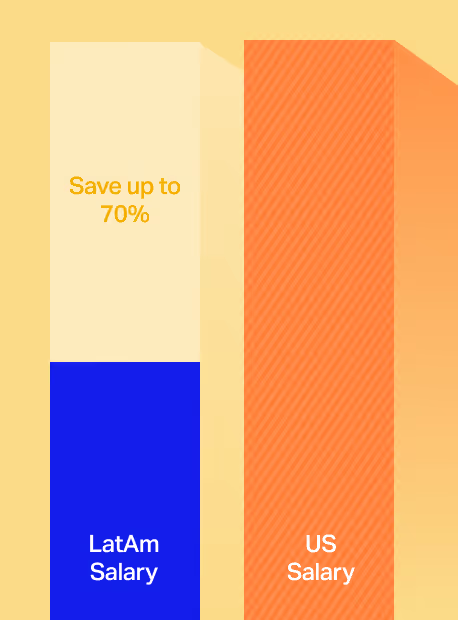
When US companies hire developers in Brazil, they get access to the largest developer talent pool in Latin America: mid-level or senior engineers who work during your business hours at salaries up to 70% below US equivalents. For teams that need engineering capacity without the overnight lag of far-offshoring, Brazil is one of the strongest options for development hiring.
Hire With Near’s research into why US companies hire in Latin America found that 30% are switching from offshore to nearshore specifically for real-time overlap. Brazil sits one to two hours ahead of the US East Coast, which means standups happen live, code reviews don’t wait until the next day, and urgent fixes get handled the same afternoon.
If you’re not sure where to start or which hiring model fits your situation, this guide covers what Brazilian developers cost, what technical skills they bring, the four ways to hire them, and what to know before you start.
Why Should I Hire Developers in Brazil?
Brazil is one of the most proven countries to hire software engineering talent in Latin America, pairing the region’s deepest talent pool with real-time overlap and senior engineers at a meaningfully lower cost.
According to Hire With Near’s 2026 State of LatAm Hiring Report, Brazil is the top country from which US companies hire software engineers and accounts for 14% of all nearshore placements, leading IT and engineering placements specifically.
Brazil has the largest developer talent pool in Latin America
Brazil’s developer community isn’t just large. It’s growing faster than most regions in the world. According to GitHub’s 2025 Octoverse report, Brazil now has 6.9 million developer accounts, up from 5.4 million in the 2024 edition, a jump of 1.5 million accounts in a single year. That makes Brazil one of the fastest-growing developer ecosystems globally, ahead of most Western European countries in absolute size.
São Paulo and other major tech hubs have produced a generation of engineers with experience inside enterprise-scale systems, US-facing startups, and companies like Nubank, iFood, and Totvs that operate at the same level of technical complexity as large US tech firms.
For teams that need engineers who have solved hard problems in production, not just built course projects, that depth is what makes Brazil the top sourcing country for Hire With Near’s engineering placements.
Your team gets real-time overlap with Brazilian developers
Brazil sits one to two hours ahead of the US East Coast and two to four hours ahead of the West Coast, depending on the season. A developer in São Paulo or Rio de Janeiro shares most of the working day with teams across the US, as the table below shows:
This time zone alignment means live standups, same-hour code review, and real-time handoffs instead of overnight delays.
That overlap matters more than most teams realize. Research from Harvard Business School, Georgetown, and Rice University, published in Organization Science, found that larger time zone gaps force employees to work outside their normal business hours just to stay in sync.
This pattern creates measurable collaboration friction and, over time, contributes to retention problems. The burden tends to fall disproportionately on the people working the off-hours. Aligning teams along a north-south axis, like the US to Brazil, avoids that structural cost entirely.
The same budget hires more senior talent in Brazil
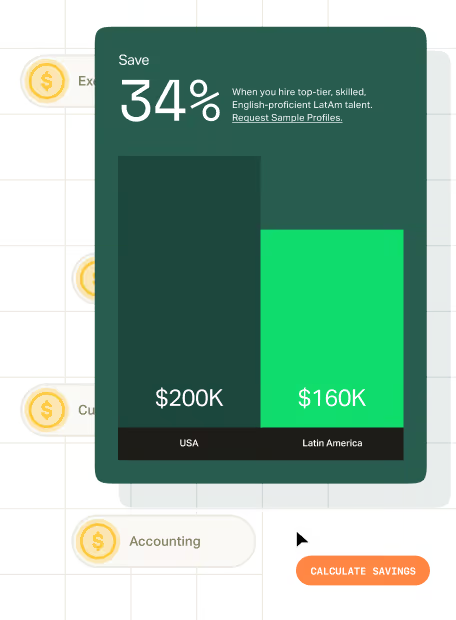
Hiring developers in Brazil typically costs 30–70% less than equivalent US hires. According to Hire With Near’s salary data, a senior software engineer in Brazil earns $72,000–$108,000 a year, while the same role in the US runs $140,000–$238,000. That means the budget that covers one mid-level US hire often funds a senior Brazilian engineer, with room left to grow the team.
The savings come from the cost of living, not capability. According to Hire With Near’s 2026 State of LatAm Hiring Report, 98% of engineering placements in Latin America were mid-level or senior professionals. Companies aren’t turning to the region to fill junior seats. They are using it to access experienced engineers they can’t afford to hire domestically.
To ground these numbers, take a look at the comparison between the cost of living in São Paulo and Rio de Janeiro, Brazil’s two largest cities, and Atlanta, Georgia, a comparable US tech and corporate hub:
Source: Numbeo.com
What Technical Skills Do Brazilian Developers Have?
Brazilian developers cover the full modern stack, with particular depth in a few areas worth calling out individually.
- Backend and full-stack engineering is where Brazil is most consistently strong. Java and Node.js are the most common backend languages, alongside Python and PHP. Brazilian engineers who have worked inside large-scale systems, at fintechs like Nubank, at enterprise tech firms, or at global outsourcing companies like Accenture and Capgemini, bring the kind of production experience that shows up in system design, not just syntax.
- Frontend development follows the same modern patterns as the rest of Latin America: React is dominant, with Angular and Vue also well-represented. The depth of dedicated frontend specialists is strong in Brazil’s larger tech hubs.
- Data, machine learning, and AI is where Brazil stands apart from most of Latin America. Hire With Near’s recruiting team consistently places Brazil among the top three LatAm countries for hiring machine learning engineers and nearshore AI engineers. That depth is supported by engineering universities like USP, Unicamp, and UFRJ, which have long-running programs in computer science and applied mathematics.
- Cloud and DevOps talent has grown significantly alongside Brazil’s enterprise tech sector, with strong coverage of AWS, GCP, and Azure, plus containerization and CI/CD tooling.
Shopify, Amazon e-commerce, and blockchain specialists exist, but are harder to source. Plan for a longer search if your role requires one of these.
Brazilian developers are highly skilled and tend to keep up with the latest technologies. The quality of the talent is something that consistently surprises US companies hiring in Latin America. Julia Guillen, Senior Tech Recruiter at Hire With Near, puts it this way:
Clients are consistently surprised by the caliber of talent that’s available in LatAm. They don’t expect to find senior engineers who’ve worked with major U.S. companies, understand modern development practices, and often have more hands-on experience with specific frameworks than candidates they’d find locally.
Why communication matters as much as technical skill
Technical skills are only part of what makes a hire work. The other part is how someone communicates: whether they flag a blocker without being asked, push back when something doesn’t make sense, and integrate naturally into how your team operates day to day.
This is where Latin American developers, including those from Brazil, tend to stand out from other offshore regions.
Hayden Cohen, co-founder and CEO of Hire With Near, explains why that communication advantage runs deeper than English proficiency:
What Developer Roles Can I Hire in Brazil?
The roles US companies hire most from Brazil map directly to the stacks where Brazilian developers are strongest. Here are the most commonly placed roles, with salary ranges based on Hire With Near’s benchmarks:
- Software engineer: The most in-demand role across the board. Brazilian software engineers cover the full development lifecycle, from architecture decisions to shipping features, and are the top placement category for Hire With Near in Brazil.
- Full-stack developer: Works across both front end and back end, which suits lean teams that need a range without splitting the hire into two roles. Strong coverage of React plus Node.js or Python on the back end.
- Back-end developer: Handles servers, databases, and APIs. Brazil’s depth in Java, Python, and Node.js makes it one of the strongest markets in the region for senior back-end talent.
- Front-end developer: Builds the interfaces users interact with. React is dominant, with Angular and Vue also well-represented across Brazilian engineering teams.
- DevOps engineer: Keeps deployments reliable and infrastructure costs in check. Strong familiarity with AWS, containers, and CI/CD pipelines across Brazil’s enterprise tech sector.
Brazilian developer salaries fall within Latin America’s broader ranges, which Hire With Near benchmarks across the region. Here’s how those figures compare to equivalent US hires:
For the most up-to-date figures, see Hire With Near’s US vs Latin America Salary Guide.
Where Is the Tech Talent? Brazil’s Tech Hubs
São Paulo is the center of gravity for Brazilian tech, but strong talent is spread across several cities. For remote hiring, that works in your favor: you hire from a national pool, not one crowded market.

São Paulo and Campinas form the largest and most internationally connected tech cluster in the country. São Paulo concentrates the highest density of enterprise tech professionals, with a strong presence of global firms like Accenture, Capgemini, and IBM alongside a maturing startup scene.
Campinas, about 100km away, is anchored by Unicamp, one of Brazil’s top engineering universities, and has a long-established tech sector that feeds into the São Paulo market.
Rio de Janeiro has a strong concentration of data science, AI, and energy-sector tech professionals, shaped partly by the presence of Petrobras and other large enterprises that have built significant engineering teams there. PUC-Rio and UFRJ are two of the country’s strongest engineering universities and produce a consistent pipeline of senior talent.
Florianópolis has developed a reputation as one of Brazil’s most active startup cities relative to its size, with a tech community that punches above its weight in product and software development. It also ranks as the top city in Brazil for English proficiency according to the EF English Proficiency Index 2025.

Belo Horizonte has a large engineering graduate pipeline through UFMG and a growing tech sector built on enterprise software and outsourcing firms.
Porto Alegre follows a similar profile, with strong backend and systems engineering talent tied to its university ecosystem.
Recife’s Porto Digital cluster is one of the most deliberately built tech ecosystems in Latin America: a government-backed initiative that turned a historic neighborhood into a tech hub and has attracted hundreds of companies and thousands of engineers over the past two decades.
For the country view, see our full guide about hiring remote talent in Brazil.
How Can a US Company Hire Developers in Brazil?
US companies have four ways to hire developers in Brazil: freelance marketplaces, hiring directly, a nearshore staff augmentation company, or a staffing and recruiting firm. The right choice comes down to one question: do you need short-term help on a project, or a long-term, full-time developer on your team?
The same four routes apply anywhere you hire developers in Latin America. Brazil is simply the deepest market for them. I’ll cover them in order from most hands-on to simplest.
Freelance platforms and marketplaces
Freelance platforms give you the fastest access to contractors, but you get people juggling several clients rather than an engineer embedded in your codebase.
Marketplaces like Upwork, Toptal, and Arc are built for short-term, project-based work. For anything ongoing, you carry all the risk on quality and retention yourself.
Related reading: Hire With Near vs. Toptal: Which Is Best for Remote Talent?
Hire directly
Hiring directly means you source and vet candidates yourself and take on the employment relationship. For a cross-border hire in Brazil, that requires one of two mechanisms:
- Set up a legal entity: Registering a Brazilian subsidiary gives you full control, but it takes three to six months, carries high upfront legal and accounting costs, and requires ongoing compliance with Brazil’s CLT labor framework, one of the most detailed in the region. It only makes sense if you’re planning on hiring 50-plus people in the country. For a handful of developers, the overhead isn’t worth it.
- Use an employer of record: An employer of record becomes the legal employer on paper, handling contracts, payroll, and compliance without you needing your own entity. In Brazil specifically, that means managing mandatory benefits built into every employment contract: the 13th salary, vacation bonuses, and healthcare. The catch: an EOR handles employment logistics, not recruiting. You still source and vet every developer yourself, through job boards for hiring in Latin America or your own network. If you are comparing providers, EOR companies vary widely in Brazil coverage and price.
Nearshore staff augmentation
Nearshore staff augmentation is the model for short-term, project-based needs, adding vetted engineering capacity to your existing team for a defined period. The firm places a pre-vetted engineer on your team to work under your direction, stays the legal employer, and handles payroll, benefits, and compliance.
It fits a sprint push, a launch, or a fixed-length project. Be clear-eyed, though: most of these firms are built for short-term rotations, with developers who move between clients every few months, which is a poor fit when you want someone to stay and own the work.
Our explainer on IT staff augmentation goes deeper into the topic and staff augmentation versus outsourcing for software development compares it to handing a project to an outside shop.
Staffing and recruiting firm
A staffing and recruiting firm is the path when you want a long-term, full-time developer who becomes a permanent member of your team. You describe the role and the firm sources and vets the engineer. Then, you interview the candidates and make a decision.
Once you make the hire, the partner handles payroll, benefits, and compliance in the background. It’s the simplest option for most companies hiring full-time remote talent.
Conversion Logix, an Inc. 5000 digital advertising agency, used this model to build a 15-person team across engineering, marketing, finance, and support, including a machine learning engineer.
They cut sourcing and interview time in half, averaged a 22-day time to hire, and saved $781,000 annually compared to equivalent US hires.
Tawnya Morse, their Client Services Manager, described the difference:
The time savings and quality of candidates have been outstanding. Communication was also seamless, making it easy to work with Hire With Near.
Our long-term nearshore staffing and recruiting placements are built to last: full-time developers who stay, learn your product, and become permanent members of your team. You get a vetted candidate shortlist in 3–5 days and the hire is usually in place within 21 days.
You can compare specialists in our roundups of the best LatAm staffing firms and the best companies to hire developers in Latin America.
What US Companies Need to Know Before Hiring in Brazil
Before hiring in Brazil, plan for three things: working hours, IP protection, and Brazil’s employment framework. None is a blocker, and a staffing partner handles most of the details.
Working hours are the easy one. Brazil sits one to two hours ahead of Eastern Time, two to three hours ahead of Central Time, and three to four hours ahead of Pacific Time. That means standups, code reviews, and quick calls happen live across most of the US workday, regardless of where your team sits.
IP and data security deserve real attention, especially for fintech and healthcare industries, or AI work where an engineer touches credentials, source code, or sensitive data. Standard practice is an NDA plus an IP-assignment agreement so that everything the developer builds belongs to your company. A good partner builds these protections into the standard paperwork from day one so you are not negotiating them role by role.
Brazil’s employment framework is the part that most companies underestimate. The CLT (Brazil’s labor law framework) sets formal rules for all employees, including mandatory severance fund contributions, a 13th-month salary owed each year, and structured vacation bonuses. These details trip up companies hiring directly.
They’re exactly what an employer of record or a staffing partner manages in the background, so you never have to become an expert in Brazilian labor law.
Before you write the job spec: don’t gate on degrees
One practical note from our recruiting team before you start sourcing: don’t make a degree a hard requirement. As Natasha Tarapow, Recruitment Consultant at Hire With Near, explains:
A lot of the great engineers in Latin America don’t have a college degree — and that doesn’t mean they’re bad candidates. Many of the best engineers started working before they graduated. They got a really good job and didn’t have time to finish. We always recommend to clients that they don’t make a degree a must-have, because they might be losing out on some really good candidates.
Screen for what someone has built and how they talk about it, not whether they finished school.
For the wider set of concerns, our roundup of the questions tech leaders ask about hiring developers in Latin America is a useful companion.
How Hire With Near Helps US Companies Hire Developers in Brazil
Hire With Near sources, vets, and places full-time Brazilian developers on your team and handles payroll, benefits, and compliance in the background, so you get a dedicated engineer without building international HR.
The process starts with a first shortlist in 3 to 5 days, and our placement data shows software engineering roles filling in about three weeks, against the three to six months a US search often takes. 98% of the engineers we place are mid-level or senior.
The vetting resolves the fear most engineering leaders carry into a search: that a recruiter will throw fifty unvetted resumes over the fence. Natasha Tarapow describes what our team looks for:
We always ask candidates to tell us about a project they’ve worked on, not just that they use this language and that one, but what their role was and what they actually did. It’s important that they can explain their work to someone who isn’t a developer. If they can do that, that tells me a lot.
That technical-project screen sits alongside a technical assessment (if you want us to administer one for you), an English evaluation, and reference and background checks, so the people you interview have already cleared a real filter.
The pattern our recruiters see most often is companies making one hire, seeing the quality, and coming back for more. One US software company that returned for a repeat developer hire put it simply:
We had a 21-year-old from Brazil who was just phenomenal. Like, genuinely one of the best developers we’ve ever had. That’s why we’re back.
We also handle leadership roles through executive search in Latin America when you need a VP of Engineering or a CTO rather than an individual contributor.
Final Thoughts
Hiring developers in Brazil is one of the clearest ways for a US company to get more engineering capability from the same budget, in your own working hours.
You have four real options, and the deciding question stays the same throughout: do you need short-term project help or a long-term member of your team? For most companies building software for the long haul, a full-time, vetted developer wins.
Hire With Near moves fast, with a first shortlist in 3 to 5 days, and our default is placements built to last: engineers who stay, learn your product, and grow with your team.
If you want to explore it, book a free consultation to talk through your requirements with our team. We’ll share salary benchmarks for the roles you’re considering, including current Brazil-specific figures, and a clear picture of the process.
{{latam-hiring-cta-v2}}
Frequently Asked Questions
What is the average salary for a software developer in Brazil?
A software developer in Latin America generally earns between about $30K and $108K a year, depending on seniority, up to roughly 70% below the US equivalent. These are standard regional benchmarks from Hire With Near’s salary data rather than Brazil-only figures, so a specific offer depends on the role, the stack, and experience.
How long does it take to hire a developer in Brazil?
Most companies hire a developer in Brazil in under three weeks, with a first shortlist of vetted candidates in 3 to 5 days when you work with a staffing partner. That compares with the three to six months a US engineering search often takes.
Brazil is also one of the fastest nearshore markets to fill, so if you have a project shipping next quarter, the timeline works in your favor.
Do Brazilian developers speak English well enough for daily standups?
Yes, the developers Hire With Near places are vetted for English and are fully conversational for standups, code review, and written work.
One honest nuance: Brazil isn’t a top-tier English-speaking country the way Argentina is, and Brazilian professionals often have a more noticeable accent.
Accent and fluency aren’t the same thing, though. The engineers we place can explain their work, discuss architecture, and handle client calls clearly, which is exactly what the English assessment in our process confirms.
What tech stacks are Brazilian developers strongest in?
Brazilian developers are strongest in mainstream web and enterprise stacks and in data, machine learning, and AI. Common skills include Java and JavaScript, Python, React and Node, .NET and C#, PHP, and cloud and DevOps tooling, plus a deep data and AI bench that ranks Brazil among the top three countries in Latin America for those roles.
Rarer stacks in the region include Shopify, Amazon e-commerce, and blockchain.
Is it better to hire freelance or full-time developers in Brazil?
Hire full-time when you need someone to own the work, and use freelancers only for genuinely short-term projects.
Freelance marketplaces give fast access to contractors, but those contractors typically juggle several clients, and you carry all the risk on code quality and retention.
A full-time, vetted developer is embedded on your team, learns your codebase, and is accountable to you alone, which is why most companies hiring for ongoing work choose the full-time route.
Does Brazil have strong intellectual property protections?
Yes, Brazil has established intellectual property law and is a member of the major international IP treaties. In practice, your protection comes from the contracts you put in place. Standard practice is an NDA plus an IP-assignment agreement so that all code and work product belong to your company, structured through your staffing partner or employer of record.
What other developer roles can US companies hire in Latin America?
Beyond generalist developers, US companies hire a wide range of specialized engineers in Latin America, including React developers, Python developers, mobile developers, and AI developers.
These roles carry the same time-zone overlap and cost advantage as any other engineering hire, which makes it simple to build a full team rather than a single hire.
What’s the best way to hire developers in Brazil?
The best way to hire a full-time developer in Brazil is to work with a staffing and recruiting partner that both sources vetted engineers and handles employment, payroll, and compliance. That combination gets you a dedicated engineer in under three weeks without setting up a local entity or learning Brazilian labor law yourself.
If you need short-term project capacity instead, nearshore staff augmentation is the better fit, and a partner that offers both can point you to the right one.






.webp)
.webp)


%203.svg)
.avif)





%20(1).avif)

%20(1).png)