.png)
Key takeaways
- Latin American professionals work US business hours and typically earn 30–70% less than US equivalents, which translates to an average of $35,000–$64,000 saved per hire annually, without trading down on seniority.
- The strategy works across nearly every remote-capable function. Finance and accounting, software engineering, sales, marketing, and operations all have deep talent pools in Latin America, and the region’s top countries (Argentina, Brazil, Colombia, and Mexico) each have distinct strengths by department.
- There are two paths to hiring in Latin America: do it yourself, handling sourcing on your own and using an EOR for compliance, or work with a nearshore staffing and recruiting partner like Hire With Near that handles all of it in a single relationship.
Hiring remotely in Latin America gives US companies access to a talent market full of skilled professionals whose salary expectations fit their budget, who want to work with American teams, and who tend to stay once they join. Thousands of businesses are already hiring this way to scale.
This is the practical guide to making the hiring process work: I’ll explain who benefits most from attracting remote talent in Latin America, which roles and industries it works for, which countries to look at, and the two main ways to bring someone on.
Why Do US Companies Hire Remote Talent in Latin America?
If you’ve never hired outside the US, it’s reasonable to ask why Latin America is the go-to region specifically.
- The salaries fit their budget
- The working hours line up with their team
- The professionals they hire integrate naturally into the US team culture
- The talent they need is easier to find
1. Cost efficiency without sacrificing quality
Let’s start with the numbers, because they’re what get most people to look in the first place.
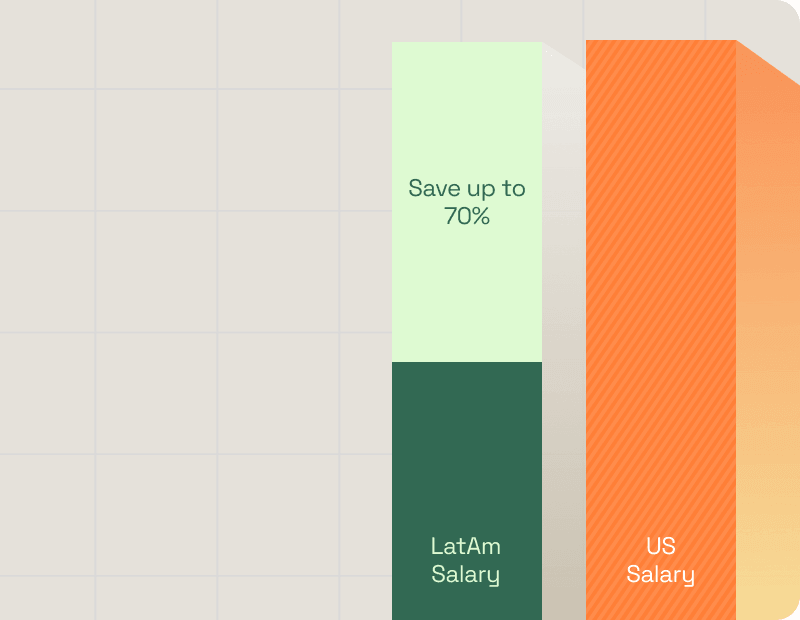
Professionals in Latin America typically have salary expectations 30% to 70% lower than their US counterparts. According to Hire With Near’s 2026 State of LatAm Hiring Report, that works out to an average of $35,000 to $64,000 saved per hire, depending on the position.
That difference isn’t because the work is worth less or the quality is lower. It’s a reflection of the cost of living: a salary that would be uncompetitive in Austin or Chicago is excellent in Buenos Aires or Bogotá.
That means you save substantially, and your hire often earns well above their local market. The table below shows what that looks like for a few common roles, based on Hire With Near's benchmarks; for the most up-to-date figures, see Hire With Near's US vs. Latin America Salary Guide.
| Role | Average LatAm salary | Average US salary | Typical savings |
|---|---|---|---|
| Accountant | $24K–$60K | $65K–$139K | 54–68% |
| Executive assistant | $14K–$42K | $62K–$115K | 62–77% |
| SEO specialist | $24K–$48K | $57K–$124K | 55–64% |
| SDR | $18K–$42K | $75K–$136K | 66–78% |
| Full-stack developer | $36K–$108K | $83K–$184K | 38–64% |
Hire With Near’s COO, Franco Pereyra, has a simple way to estimate salaries in Latin America:
Take whatever you’d spend on a US salary and divide by two. 50% of a US salary tends to be very competitive across the board.
First-time hirers assume those salaries mean junior people. The data says the opposite: in our 2026 State of LatAm Hiring Report, 84% of placements were mid-level or senior. Companies aren’t hiring cheap juniors to save money. They’re hiring the senior, experienced talent they couldn’t find or afford at home, for what hiring a mid-level US professional would cost.
2. Overlapping time zones and real-time collaboration
The savings get people interested. The time zone alignment is what makes it work day to day, and this is the single biggest difference between hiring in Latin America and the offshore hiring in distant locations you may have heard mixed things about.
When your team is in Asia or Eastern Europe, the workday barely overlaps yours. A question you send in the afternoon gets answered while you sleep. Every small clarification costs a day, and on anything time-sensitive, that coordination tax compounds fast.
One engineering lead faced this same situation and described the problem this way:
Our senior QA in Sri Lanka is excellent, but we don’t get enough overlap to keep quality and throughput high. We often ship without her. The fix is obvious: a tester who is online when we are.
Hiring in Latin America doesn’t result in that problem. You get live standups, same-day answers, and handoffs that happen during the workday, wherever your team sits in the US.
The region spans roughly the same band of hours as the continental US. Depending on where your team is based and where you hire from, you can easily ensure your hire is at their desk during your exact business day.
The table below shows how the major Latin American hiring markets line up against each US time zone during Daylight Saving Time (March–November); note that most Latin American countries don't observe Daylight Saving Time, so these times shift by one hour outside of that window, once the US reverts to standard time.
| City | 9 a.m. in New York | 9 a.m. in Chicago | 9 a.m. in Denver | 9 a.m. in Los Angeles |
|---|---|---|---|---|
| Bogotá, Colombia | 8 a.m. | 9 a.m. | 10 a.m. | 11 a.m. |
| Buenos Aires, Argentina | 10 a.m. | 11 a.m. | 12 p.m. | 1 p.m. |
| Mexico City, Mexico | 7 a.m. | 8 a.m. | 9 a.m. | 10 a.m. |
| São Paulo, Brazil | 10 a.m. | 11 a.m. | 12 p.m. | 1 p.m. |
| Lima, Peru | 8 a.m. | 9 a.m. | 10 a.m. | 11 a.m. |
A teammate in Mexico City shares nearly the whole day with a team in Chicago, while someone in Bogotá lines up closely with New York. Even the widest pairing, a US West Coast team and someone in Argentina or Brazil, still shares a solid block of hours.
3. Deep cultural alignment and English proficiency
Top professionals in Latin America’s major hiring markets have typically spent years working with or for US companies. They know US business norms: direct communication, ownership of outcomes, firm deadlines.
That’s also what Franco Pereyra, our COO, thinks:

What sets Latin American talent apart from other regions is that you’ll find people who are proactive and creative. People who come up with ideas and new solutions. If you’re looking for folks who can bring something to the table, who will push back if they think your idea doesn’t make sense, that’s what you find in Latin America.

Franco Pereyra
Co-founder & COO of Hire With Near
Many Latin American professionals have worked at global firms. J.P. Morgan, Amazon, and the Big Four accounting firms (Deloitte, EY, PwC, and KPMG) all have large operations in the region, which means big-company training and exposure to international standards.
And because people in Latin America consume much of the same media, use the same tools, and follow many of the same brands, collaboration tends to feel natural in the first week rather than something you have to engineer.
For those worried about English skills, language proficiency is strong across major hiring markets. According to the EF English Proficiency Index 2025, Argentina ranks 26th globally and first in Latin America, in the “High” proficiency band. Honduras and Uruguay follow with consistent professional English across their major cities.
In practice, for the mid-level and senior candidates that US companies hire most, strong professional English is the norm, and it’s one of the things our recruiters screen for as part of the first-round interview.
4. A deeper talent pool for hard-to-fill roles
The fourth reason is simple scarcity. According to ManpowerGroup’s talent shortage survey, 69% of US employers report struggling to find people with the skills they need.
For some roles, hiring in the US has become close to unworkable: months of searching, thin candidate pools, and offers that get outbid before the ink dries. Hiring accountants is the notorious example. For specialized and senior roles, that’s even more complicated.
The region’s universities produce deep benches in accounting, engineering, and business fields, and demand keeps proving how versatile the talent is: in our placement data, demand for software engineers grew 250% year over year, and companies filled over 400 role types in a single year, from financial analysts to sleep-scoring technicians.
- BDR/SDR
- Accountant
- Customer Support Rep
- Executive Assistant
- Financial Analyst
- Software Engineer
- Bookkeeper
- Marketing Specialist
- Legal Assistant
- Admin. Assistant

The rule of thumb our team uses: if the work can be done remotely, there’s talent for it in Latin America.
Who Can Benefit From Hiring in Latin America?
Hiring remotely in Latin America isn’t limited to one kind of company. We’ve seen it work for early-stage startups and for 1,500-person enterprises. But after more than 3,500 placements, the companies that get the most out of it tend to look like one of these four.
Growth-focused businesses that need talent they can’t afford locally
You know exactly who you need, but every qualified US candidate is beyond what you can justify paying. Hiring in Latin America resolves the standoff: you get expertise comparable to the US candidates you couldn’t stretch to, the role gets filled properly instead of half-filled by whoever fits the budget, and the difference gets reinvested in the business.
Companies in this group often tell us the reinvestment mattered more than the savings themselves: the money that didn’t go into one US salary funded tooling, marketing, or an additional hire.
Startups and scale-ups that need to move fast
When you’re growing quickly, the constraint usually isn’t just money; it’s also time. A US search for a specialized role commonly runs three to six months. But a funded startup burning through its runway doesn’t have that time.
By working with a partner like Hire With Near to hire in Latin America, our clients can fill roles in three weeks or under, which means they can build a functioning team in the time a US process would still be screening resumes.
One healthtech startup we worked with hit this wall in its steepest growth phase: the whole recruiting function was two people, and the hiring plan was far bigger than those two professionals could deliver.
Hiring in Latin America through Hire With Near allowed the company to add the people they needed at the pace the business demanded, instead of the pace two internal recruiters could manage.
Read the full case here: How a Startup Hired 7 LatAm Engineers Fast During Hypergrowth
Companies coming off a rough offshore experience
A surprising number of the companies we work with tried offshore hiring first, usually in Asia, and came away frustrated. In most cases, the complaint traces back to the time zone: feedback loops that took a full day, meetings someone had to attend at midnight, and quality problems that were really coordination problems in disguise.
If that’s your story, Latin America is a genuinely different model, and the difference is structural, not a matter of trying harder.
FinanceWithin, a fractional finance firm, came to us after exactly this experience with an offshore team in India. The combination of overlapping hours and pre-vetted candidates changed both the speed and the stability of their hiring, as Sheena Malson, their Director of Accounting, put it:
When we saw candidate quality, it became clear these were truly top-tier professionals, better than what we found independently.

Sheena Malson
Director of Accounting, FinanceWithin
We’ll share more about their experience later.
Established companies testing something new
Not everyone is scaling or struggling. Some companies just want to try a role they’ve never had, a new sales function, a first dedicated designer, without betting a full US salary on an experiment.
For example, LifeSource Water Systems, an established California manufacturer, wanted to test a new sales assistant role but found local hiring too expensive and risky for an unproven position.
They reached out to Hire With Near and placed two sales assistants from Latin America in nine days. One of them booked eight meetings in the first eight days. The experiment paid for itself almost immediately.
Across all four groups, the pattern that stands out isn’t that these companies settled for less to save money. It’s that most of them report the quality genuinely surprised them, with hires who match or outperform their US counterparts in both skill and engagement.
What Industries Hire in Latin America?
Nearshoring isn’t concentrated in a single sector. In Hire With Near’s 2026 State of LatAm Hiring Report, the companies hiring ranged across more than 20 industries. A few stand out for the largest share of placements.
Here are the five busiest, and the kinds of roles they fill:
Marketing and advertising
The recruiting for the marketing industry is the single biggest source of nearshore hires, at 12.2% of all placements in our report. It makes sense: a modern and high-performing marketing team runs on specialized roles, and almost none of them need to sit in a room with you. Companies hire SEO specialists, paid media managers, content writers, and digital marketing managers from across the region.
Rankings.io, an SEO agency serving law firms, is a good example. With a single HR manager on staff, they needed to fill web design, paid ads, PPC, project management, and six SEO specialist roles all at once, and previous staffing agencies hadn’t kept up. Working with us, they filled all 11 roles in about three weeks. Gillian Alvillar, the company’s HR director, praised the partnership:
When I check with department managers, they say, ’It’s like 100 out of 10.’ The talent through Hire With Near has been professional, articulate, intelligent, and absolutely the right fit for our team.

Gillian Alvillar
HR director, Rankings.io
That pattern, senior specialists across several disciplines at the same time, is a big part of why marketing teams hire in Latin America.
Finance and professional services
Financial services is the second-biggest industry at 10.1%, and accounting adds another 6.5%. Together, finance and accounting make the most common department we place overall. Companies hire bookkeepers, staff accountants, financial analysts, controllers, and finance managers, many of them trained on US GAAP.
This is where FinanceWithin lands, the fractional finance firm mentioned earlier. After high turnover and inconsistent quality with an offshore team in India, they switched to hiring in Latin America.
The results: hiring time down from three weeks to as little as seven days, about $1.15 million saved annually, and the ability to bring on multiple bookkeepers, accounting managers, and financial analysts within days when ten new client engagements landed at once.
You can hire finance and accounting talent in Latin America across that same range of roles.
Software and technology
Recruiting for SaaS companies and tech companies in Latin America is increasingly focused on building the teams that ship: engineering, product, growth, and data. In the previous year, we saw requests for software engineering placements grow 250% year over year, jumping from the 18th most-filled role to the 6th. And these aren’t junior hires: 98% of our engineering placements were mid-level or senior.
The roles driving that growth span the full stack: software engineers, back-end developers, DevOps engineers, QA engineers, and increasingly AI developers and data engineers. Brazil leads in engineering placements, producing the largest developer community in the region.
ParkMobile is a parking platform trusted in over 4,200 cities across 21 countries. Like many tech companies, they had relied on outside development agencies for years, and every time a developer left, the knowledge of their systems left with them.
They needed to bring engineering in-house with senior professionals who could think alongside product strategy. US rates of $148,000 to $214,000 per role were off the table.
Through Hire With Near, they placed 9 senior engineers in Colombia, including a developer who had built eBay’s native Compliance Module and one who had integrated OpenAI and Google AI into production at Mercado Libre. They saved over $1 million annually, with an average time to hire of 24 days.
You can hire software and IT talent in Latin America across the whole stack.
Real estate
Real estate is about 4% of placements, smaller than the others here, but it’s a good sign of how far nearshore hiring reaches. Property, vacation-rental, and brokerage companies hire sales development reps, transaction coordinators, executive assistants, bookkeepers, and marketing support.
The standout example is AvantStay, a vacation-rental platform that needed to build an outbound sales engine to hit an aggressive revenue target. Jake Breuner, their VP of Sales, was openly skeptical that remote talent could carry quota, so they started with a single test hire. That first SDR booked 15 meetings in his first 30 days and was promoted to team lead within three months.
Their Latin American SDR team scaled to 18 people, added $20 million in new annual recurring revenue, and saved more than $1.3 million a year in payroll costs. Ramp time dropped from six months to two. On the strength of that first hiring push, AvantStay expanded into finance and operations roles in the region. As the VP put it afterward:
From day one, the talent was extremely sharp and ramped very quickly. Every hire was fantastic right out of the gate. After building my team with Hire With Near, I wouldn’t hire an SDR stateside anymore.

Jake Breuner
VP of Sales, AvantStay
For property businesses, real estate recruiting in Latin America is a natural entry point.
These four hire the most, but they’re not the whole story. Our data covers 411 distinct roles across more than 20 industries, so if your sector isn’t above, there’s a good chance we place there too:

What Are the Top Roles to Hire Remotely in Latin America?
If a role can be performed remotely, you’ll find qualified people in Latin America to fill it. That said, a handful of roles account for a large share of what US companies hire, and if you’re new to this, they’re the proven paths: deep candidate pools, fast timelines, and well-understood savings.
Here’s each one, with what to know before you hire.
Finance and accounting
Here’s what first-timers need to know: a university accounting degree in a country like Argentina takes five or six years to complete, and when evaluated in the US, it’s generally treated as equivalent to a degree plus a postgraduate qualification.
Layer on the Big Four exposure that’s common in the region’s finance talent, and the US GAAP requirement that worries so many companies turns out to be a solved problem.
Lucas Stepanenko, who leads finance and consulting sourcing on our team, explains what he sees:
LatAm finance professionals have strong academic training and a lot of exposure to Big Four firms. That gives them experience with international markets and makes them deeply experienced in key accounting standards like US GAAP and IFRS, which are among the most common requirements we see from our clients.

Lucas Stepanenko
Finance Sourcing Manager, Hire With Near
The table below shows the roles companies most often hire; if this is the function you're building, start with finance and accounting hiring in Latin America.
| Role | Average LatAm salary | Average US salary | Typical savings |
|---|---|---|---|
| Accountant | $24K–$60K | $65K–$139K | 54–68% |
| Staff accountant | $30K–$60K | $71K–$110K | 44–59% |
| Bookkeeper | $22K–$60K | $46K–$74K | 23–56% |
| Financial analyst | $24K–$60K | $80K–$150K | 56–70% |
| Controller | $42K–$90K | $110K–$230K | 56–69% |
Software engineering
Technical talent is the fastest-growing category in the region and professionals work across every major stack. Python, JavaScript, and React dominate the requests we see, with strong benches in PHP, .NET, and data engineering.
Typical savings run from 29 to 70% in comparison with US salaries and engineering roles are filled in about three to four weeks. Companies most often hire:
| Role | LatAm annual salary | US annual salary | Typical savings |
|---|---|---|---|
| Full-stack developers | $36K–$108K | $83K–$184K | 38–64% |
| Back-end developers | $30K–$108K | $66K–$164K | 29–60% |
| Front-end developers | $30K–$108K | $70K–$162K | 29–61% |
| DevOps engineers | $30K–$100K | $100K–$197K | 46–70% |
| Data engineers | $42K–$84K | $89K–$204K | 56–60% |
One tip from our technical recruiters that saves first-time hirers a real headache: don’t make a college degree a hard requirement. Many of the region’s strongest engineers started working before they finished their degree and never went back. Screening them out on paper means losing exactly the experienced, high-ownership candidates you want.
To build out the function, see software engineering hiring in Latin America.
Operations and support
These roles have the widest cost gaps and the fastest hiring timelines (one to two weeks). They’re also where most companies make their first LatAm hire.
Our operations recruiter, Camila Banchero, describes what she looks for in candidates:
As an operations professional, you have to be very proactive and take ownership. You’re the one who has to search for inefficiencies and look for opportunities to improve processes. And I think that’s something Latin American candidates know how to deal with. They’re not people who just wait for instructions.

Camila Banchero
Operations Recruiter, Hire With Near
Hiring an executive assistant from Latin America saves companies 62% to 77% compared to a US hire. These professionals are typically bilingual, highly organized, and used to supporting US executives across the workday.
Hiring customer support reps is also a great choice: your customers get help during their day, from people who are bilingual in English and Spanish and genuinely engaged with the work. Honduras and Jamaica have become standout markets here, and in the case of Jamaica, with native English. Savings typically range from 58% to 63%.
The table below shows the common roles filled in this function, and for the broader function, see VAs, admin, and ops and customer support hiring.
| Role | LatAm annual salary | US annual salary | Typical savings |
|---|---|---|---|
| Executive assistants | $14K–$42K | $62K–$115K | 62–77% |
| Bilingual customer support reps | $22K–$30K | $52K–$84K | 58–63% |
| Virtual assistants | $18K–$34K | $44K–$77K | 52–65% |
| Project managers | $30K–$48K | $77K–$157K | 59–70% |
| Operations analysts | $24K–$48K | $73K–$128K | 59–68% |
Marketing
Marketing is one of the largest hiring categories in the region, with typical savings between 52% and 73%. Argentina, Brazil, and Mexico all have deep benches, and Argentina in particular stands out for senior marketing and leadership hires.
Verbatim, a digital marketing agency, is a good picture of what this looks like: the agency wanted to expand from content into full-stack creative services but found US design salaries prohibitive.
Hiring designers from Latin America cut those hiring costs by 73% (about $100,000 a year) and filled roles four times faster than their usual process, which is what made the service expansion viable at all.
One honest tip: the most common mistake companies make in this category is stuffing four specialties (SEO, paid ads, content, design) into one job post. Those are different specialists in Latin America, just as they are in the US. Deciding which one you’re hiring first will get you dramatically better candidates.
The table below shows the most frequently hired marketing roles, and to build the function, see marketing hiring in Latin America.
| Role | LatAm annual salary | US annual salary | Typical savings |
|---|---|---|---|
| Digital marketing specialists | $24K–$54K | $59K–$124K | 52–64% |
| Content writers | $18K–$36K | $61K–$109K | 64–72% |
| SEO specialists | $24K–$48K | $57K–$124K | 55–64% |
| Social media managers | $24K–$36K | $59K–$95K | 59–62% |
| Email marketing specialists | $24K–$48K | $56K–$112K | 53–62% |
Sales
Sales development is consistently the single most-filled role in the region, two years running in our data. Latin American SDRs and BDRs handle prospecting, appointment setting, and outbound campaigns, working your hours, calling in accent-neutral or lightly accented English, and typically saving from 66% to 79% versus a US hire.
What makes the fit unusually strong is motivation: sales candidates in the region actively prize US-client experience as a career credential, which shows up as fast ramps and low attrition, the exact opposite of the churn-heavy US SDR market.
Lexicon, a legal content company, is a good example: their CEO was personally running sales because a US hire wasn’t financially viable. Through Hire With Near, they filled the SDR role and saved $43,000 annually, freeing the CEO to focus on running the business.
The table below shows the five most hired sales roles. If you want to build a whole team, see sales hiring in Latin America.
| Role | LatAm annual salary | US annual salary | Typical savings |
|---|---|---|---|
| SDRs | $18K–$42K | $75K–$136K | 66–78% |
| BDRs | $18K–$42K | $78K–$167K | 72–79% |
| Account executives | $24K–$36K | $84K–$169K | 75–76% |
| Account managers | $24K–$48K | $83K–$185K | 71–76% |
| Appointment setters | $14K–$30K | $58K–$134K | 74–79% |
Which roles don’t work as well?
It’s important to note that not every role is a good fit for nearshoring. Anything requiring physical presence obviously doesn’t translate (facilities, in-person retail, lab work).
Roles requiring a US-specific license, like a US-licensed attorney or CPA sign-off authority, are usually a poor fit, even though the supporting roles around them (legal assistants, staff accountants) are among the region’s best.
And work that depends on deep, real-time knowledge of a hyper-local US market, some field sales and community-based roles, is harder to do well remotely from anywhere.
For nearly everything else that happens on a laptop, the talent is there.
%203.svg)
Which Countries Should You Hire From?
Good news first: you don’t have to pick a country before you start. The role usually picks it for you, because each market has its own strengths and any good search covers several countries at once. That said, knowing the landscape helps you ask better questions and set smarter expectations.
Hire With Near places talent from more than 20 countries across Latin America. Four of them account for the majority of placements, each bringing something distinct to the table.

Argentina
Argentina is the strongest market in the region for finance and accounting. Buenos Aires, in particular, produces professionals with deep US GAAP experience and familiarity with US close cycles.
The country is also the top choice for bookkeepers and legal assistants, and it has a strong reputation for senior data and AI talent. Silicon Valley AI companies have established regional hubs in Argentina at a higher rate than almost anywhere else in Latin America, which reflects the depth of the engineering and data science pipeline.
Argentina’s currency instability comes up regularly in hiring conversations. It’s worth addressing directly: it shapes local compensation dynamics and is part of why US-dollar pay is so attractive to candidates there, but it has no bearing on candidate quality.
Further reading: Hiring in Argentina: What US Companies Need to Know

Brazil
Brazil is the clear #1 for IT and engineering and a strong marketing market, producing specialists with experience across e-commerce, digital advertising, and the SaaS industry.
For technical roles specifically, Brazil’s depth is hard to match. The country’s universities produce strong machine learning, data engineering, and full-stack graduates, and the talent has typically worked with US companies or US-adjacent environments.
Spanish isn’t the language here (Brazilians speak Portuguese), but English proficiency in the professional class is strong, and the time zones line up as well as anywhere in the region.
Further reading: Hiring in Brazil: What US Companies Need to Know

Colombia
Colombia is the top hiring destination for accounting and finance, sales, and customer support.
Bogotá aligns exactly with US Eastern Time from November through March and sits just one hour behind during Daylight Saving months, making it the tightest time zone fit on the East Coast.
Colombia also produces consistently high volumes of English-fluent, US-client-experienced professionals across nearly every function Hire With Near places.
For companies making their first Latin American hire, Colombia is the most common starting point, and for companies hiring across multiple functions, it’s usually the highest-volume single country in the search.
Further reading: Hiring in Colombia: What US Companies Need to Know

Mexico
Mexico City and most of the country run on Central Standard Time year-round. Since these regions don’t observe daylight saving time, the exact gap with US time zones shifts by an hour between summer and winter, but a Mexico City hire still completely aligns with your day.
They can effortlessly join your morning standup, whether your team is in New York, Chicago, Denver, or Los Angeles, with no one working unusual hours to make it happen.
Mexico’s STEM pipeline is notable: according to the country’s Secretariat of Economy, approximately 37.5% of university degrees are in STEM fields, compared to roughly 20% in the US. The country produces strong engineering and data talent, particularly out of Guadalajara and Mexico City.
For non-technical roles, Mexico is a consistent source of marketing specialists and accounting professionals who’ve worked directly with US companies, and it ranks third overall for both sales and accounting and finance placements in Hire With Near’s data.
For bilingual roles serving US Spanish-speaking markets, Mexico is one of the strongest sources: native Spanish speakers with strong English and close US cultural familiarity.
Further reading: Hiring in Mexico: What US Companies Need to Know
Other markets worth knowing
Beyond the top four, US companies hire successfully across many other locations in Latin America. Honduras is strong for sales, Costa Rica for bilingual and multinational-trained talent, and Jamaica for native-English customer support.
For a full breakdown of options by region and talent type, see the best countries to hire remote talent, or check the list below for more nearshore hiring destinations:
How to Hire in Latin America on Your Own
Now comes the practical part. Plenty of companies run the whole process themselves. It takes more time, and there are a few things you have to get right, but the steps are clear once they’re laid out.
Step 1: Decide on the employment structure
Before you post a job, choose how you’ll legally employ and pay someone in another country. If you’re doing it on your own, there are two paths you can take:
- Set up your own legal entity: Register a subsidiary in the country you’re hiring in. It gives you full control, but it’s heavy: several months to stand up, real upfront cost, and ongoing legal and accounting support. It only makes sense when you’re hiring dozens of people and want a permanent presence.
- Use an employer of record (EOR): An employer of record is a third party that becomes the legal employer on paper while you manage the day-to-day work. After you choose the candidate, the EOR handles contracts, payroll, tax withholding, benefits, and local compliance. Our list of the best EOR companies can help you choose the best partner.
If you’d rather skip the setup and get straight to the hire, a nearshore staffing and recruiting partner handles all of this for you. We’ll cover what that looks like in a later section.
| Hiring option | Best for |
|---|---|
| Establish a legal entity | Large companies building a permanent in-country presence, with legal and HR infrastructure to support it |
| Use an EOR | Companies that have already found their candidate and need compliant employment, payroll, and benefits handled |
| Work with a staffing and recruiting partner | Companies that want sourcing, vetting, employment, payroll, and compliance handled in a single relationship |
Step 2: Where to source high-quality candidates
Nothing matters more to the quality of your hire than where you look. You could write the most compelling offer a candidate has ever seen, and if it’s posted in the wrong place, you’ll be disappointed with every applicant. The usual channels are:
- LinkedIn and referrals: Still the fastest way to reach experienced, passive candidates who aren’t actively applying.
- A job board for hiring in Latin America: Regional and remote-focused boards put you in front of candidates already looking for US roles.
- Freelance platforms: Freelance platforms like Upwork and Toptal give fast access to contractors, but they’re built for project work, not full-time team members. The talent is usually splitting attention across clients, and quality and retention are on you. If you’re evaluating Toptal specifically, see how it compares to Hire With Near.
If you choose to go it alone, our recruiting team recommends sticking to LinkedIn, referrals, and job boards specifically built for Latin American talent seeking US roles. General-purpose job boards tend to flood you with unqualified applications, and freelance marketplaces are built for project work: the strongest candidates on them are usually juggling several clients and aren’t looking for a dedicated full-time role.
Step 3: Write a job post that attracts strong candidates
Strong candidates in Latin America have options, so your post needs to be a pitch, not a form.
Cover the basics thoroughly: who your company is, what the role involves day to day, and what the requirements genuinely are (separate must-haves from nice-to-haves; every unnecessary requirement costs you good applicants).
Then, sell the parts that matter to this talent pool: earnings in USD, real growth opportunity, direct access to leadership if your team is small, and performance bonuses if you offer them.
Two field-tested tips. First, state a salary range rather than a single number: you won’t scare anyone off, and you keep room to negotiate. Second, be specific enough that unqualified people rule themselves out. Vague posts generate application floods you’ll pay for in screening time.
Step 4: Screening, verifying English fluency, and managing resume differences
Screening internationally has a few wrinkles worth knowing in advance:
- Resumes look different: Latin American resumes often run four or five pages for experienced candidates and include far more personal detail than US resumes. That’s convention, not padding.
- Credentials have different names: Before dismissing an unfamiliar qualification, look up its local equivalent. Many map to (or exceed) US certifications under different names, the Argentine accounting degree being the classic example.
- Verify English before the live interview: For any role where English matters, check it asynchronously first. Tools like Videoask and MyInterview let candidates answer a few screening questions on video before you spend a calendar slot. You’ll know in two minutes of footage whether communication will be an issue.
- Then interview the person, not the checklist: By the time someone reaches a live interview, you know they’re qualified on paper. Use the conversation to find out what they’d be like to work with: ask about their most significant accomplishment in each relevant role, listen for how clearly they explain their own work, and pay attention to whether they ask good questions back. Reference checks work internationally too: ask candidates for references who speak English, if possible.
Step 5: Make an offer and onboard properly
When you’ve found your person, move quickly and formally. A proper offer letter should cover the role and duties, working hours, compensation in full (salary, any bonuses and their conditions, payment frequency and method), contract type, start date, and vacation time. Most of this will have been discussed already. The letter is where it stops being a conversation and becomes a commitment.
If you’re unsure what benefits and perks to include for a remote Latin American hire, Hire With Near has a guide covering what resonates most with candidates in the region.
Before you set the number, check what fair compensation looks like in the candidate’s country, because a great salary in Mexico looks different from one in Brazil, and what reads as generous in one market is mediocre in another.
Then, onboard like you mean it. Remote hires can’t absorb your company by osmosis, so structure the first weeks deliberately: clear goals for week one, introductions across the team, a named person to ask questions, and regular check-ins. Companies that invest here are repaid in productivity and retention many times over.
What Does Working With a Staffing Partner to Hire in Latin America Look Like?
Doing it yourself works, but it asks you to be the recruiter, the HR team, and the compliance department all at once.
A nearshore staffing and recruiting partner exists to do that work for you, and for most companies hiring full-time, it’s the simplest and fastest way.
To give you an idea of the process of working with a hiring partner, we will explain how Hire With Near’s process works.
You can work with Hire With Near in one of two ways:
- As your recruiting partner, we find and vet your ideal candidate. You make the hire and employ them however works best for you.
- As your full-service staffing partner, we find the candidate, and you hire them through us: we handle payroll, administer benefits, manage compliance, and provide ongoing support for as long as they’re on your team.
Here’s how the process works:
1. Kickoff call
We learn your business, the role, and your preferences.
Our recruiters advise on what’s competitive in the local market for the role and country you’re targeting, so you go in with benchmarks, not guesses.
2. Sourcing
Our sourcers pull from a pool of 160,000+ pre-vetted candidates and run fresh sourcing for each role. Rather than surfacing whoever happens to be sitting in a database, the team actively searches for people who match your specific requirements.
3. First-round interviews
We run first-round interviews with shortlisted candidates, checking English fluency in a working context, communication style, relevant experience, and overall fit.
For roles where a walkthrough of past work matters, like engineering, data, and creative, the interview includes one. For phone-facing roles, we assess spoken English clarity directly.
4. Shortlist delivery
Most clients get a shortlist of three to five pre-vetted candidates within three to five business days of the kickoff call. It includes profiles, recordings where relevant, and the recruiter’s notes on each candidate.
5. Your interviews
You interview the candidates you want to meet, and we handle scheduling. You haven’t paid anything at this point: there’s no fee until you make a hire.
6. Offer and hire
Once you’ve chosen, we advise on the offer and handle the employment side.
As mentioned earlier, you can work with us two ways: as a full-service partner, where we manage payroll, benefits, and compliance through our nearshore staffing and recruiting services, or as a recruiting agency, where we place the candidate and you manage the employment relationship yourself, through an EOR or your own entity.
7. Onboarding and ongoing support
We support onboarding and stay available after the hire is made. Every placement comes with a 180-day replacement guarantee, double the industry standard: if a hire doesn’t work out within those first 180 days, we replace them at no extra cost.
Most companies make a hire within three weeks of the kickoff call. Harder roles, like senior technical positions and niche specializations, take a bit longer.
Across 950+ companies and 3,500+ placements, we fill 97% of the roles we take on, and our placements stay an average of three years. We also hold a 4.9 rating on G2 across 150+ reviews.
If you want to compare providers before committing to one, see Hire With Near’s roundup of the top remote recruitment agencies for US companies.

What Is The Legal and Compliance Framework When Hiring in Latin America?
Two legal elements come up in almost every cross-border hire and are worth understanding before you make the offer.
US tax compliance: The W-8BEN form
When you pay an international contractor, the IRS requires them to complete a W-8BEN form (for individuals) or W-8BEN-E (for entities). This form establishes that the contractor is a non-US person, exempts them from US withholding tax, and protects you from liability.
Keep a signed copy on file for every international contractor you pay. If you’re employing through an EOR, they handle this. But if you’re paying contractors directly, this is non-negotiable.
Protecting your business: IP assignment and international NDAs
Standard US employment contracts include IP assignment clauses automatically. For international contractors, they don’t. Make sure your contractor agreement explicitly states that any work product created for your company is owned by your company, not the contractor. The same applies to NDAs covering your proprietary information, client data, and business processes.
Latin American employment law in most countries enforces these clauses when properly drafted. Work with an attorney familiar with the specific country’s contract law, or use an EOR or a staffing and recruiting partner whose agreements already include these protections.
Why Is Now a Good Time?
If you’re persuaded but tempted to file this under “someday,” three things are worth weighing.
- The tooling has never been better: A few years ago, international hiring meant real administrative overhead. Today, platforms like Deel and Multiplier generate locally compliant contracts and run international payroll in a few clicks, and the collaboration stack your team already uses (Slack, Microsoft Teams, ClickUp, Miro) was built for distributed work. The operational excuse for waiting has mostly evaporated.
- Locked-in savings is resilience: If the last few years taught anything, it’s that conditions turn quickly. Structurally lower payroll on key roles is protection you keep in good times and bad, and it’s much easier to build in calmly now than under pressure later.
- The window on “before everyone else” is narrowing: The companies that build their Latin American teams now get first pick of the talent and years of accumulated savings. We’re already seeing real competition for the region’s top engineering talent. The advantage goes to companies that move while their competitors are still deliberating.
Final Thoughts
Hiring remotely in Latin America gives you experienced professionals, working your hours, at 30% to 70% below US salaries, and the quality of the talent is the part that consistently surprises people, not the cost.
The strategy works across nearly every industry and remote-capable role, and there are two proven ways in: do it yourself with the roadmap above, or work with a partner who’s already built the infrastructure.
Everything you need for the DIY route is in this guide, and it’s genuinely doable. Just weigh the learning curve honestly: companies that go it alone often spend months on the process, and the cost of a mis-hire along the way usually exceeds what a partner would’ve charged.
If you’d rather see who’s already doing this well, our roundup of the best staffing firms for hiring in Latin America is a good next read, and our success stories show what the results look like across industries, including all the companies mentioned in this guide.
If you’re interested in the staffing and recruiting partner route, book a free consultation to talk about the process with our team. We’ll give you salary benchmarks for the roles you’re thinking about and walk you through what the process would look like for your specific situation.

