


%203.svg)
Key Takeaways
- To hire offshore bookkeeping talent, define your scope, choose a region with US time zone overlap, work with a recruiting firm that vets finance candidates, and onboard your new hire with the same rigor as any full-time employee.
- Companies hiring bookkeepers from Latin America save $27,000–$66,400 annually compared to US equivalents, based on compensation benchmarks from Hire With Near's 2026 State of LatAm Hiring Report.
- Partnering with a staffing firm that specializes in LatAm finance talent typically places bookkeepers in two to four weeks, compared to months of independent search.
Your bookkeeping backlog is growing, month-end close is slipping, and the candidates you've interviewed locally are either unavailable or out of budget. That bottleneck compounds quickly because delayed reconciliations affect cash flow visibility and (eventually) important business decisions.
But there’s a direct solution to all of this through offshore bookkeeping talent. Companies often get excellent results when they define requirements, choose a region with strong time zone alignment, work with a recruiting partner that vets finance candidates, and onboard new hires with the same rigor they’d apply to any full-time team member.
For most US companies, Latin America is the right region for this, not because it's the cheapest option, but because it's the most workable one.
Companies in our accounting industry network routinely save $27,000–$66,400 annually per hire while gaining professionals with full accounting degrees and US GAAP familiarity.
When people say ‘offshore bookkeeping,’ they usually mean one of two models:
- A third-party firm that assigns shared staff to your account
- A dedicated full-time bookkeeper who works only with your business
In this article, we focus on the second model: hiring a dedicated full-time professional who works remotely as part of your team.
The difference between hiring in Latin America versus the Philippines or India is significant, especially for finance work that requires real-time communication. This article covers the full process for how to hire offshore bookkeeping talent, including a section on nearshore vs. far-offshore so you can make the right call for your team.
What Does an Offshore Bookkeeper Do?
An offshore bookkeeper handles the same day-to-day financial tasks as an in-house hire. Common tasks include:
- Accounts payable and receivable
- Payroll processing
- Bank reconciliation
- Financial reporting
- Expense tracking
- Month-end close
The main difference is that they work remotely, usually as a full-time employee dedicated to your company, rather than a shared resource split across multiple clients.
One thing that surprises many US employers is the credential level you often encounter when hiring from Latin America. Many LatAm finance professionals hold full accounting degrees and have completed postgraduate credentials, with exposure to Big Four firms and international accounting standards.
My experience sourcing candidates from this region has shown them to be very well versed in key accounting standards like US GAAP and IFRS, which happen to be the most common requirements we see from clients.
This matters because US employers often post a "bookkeeper" role expecting a mid-level hire and discover they've attracted candidates with the equivalent of an accounting degree plus postgraduate credentials. That credential depth, combined with US GAAP familiarity, means ramp-up time is typically shorter than employers expect.
When to Outsource Bookkeeping
Outsourcing vs. in-house bookkeeping is a decision that makes sense to revisit at multiple stages of business growth, but the reasons vary. It’s worth noting upfront that "offshore bookkeeping" can mean two very different things.
- One model involves hiring a third-party vendor that assigns shared resources to your account.
- The other involves hiring a full-time professional who works exclusively for you, remotely.
Hire With Near operates in the second model. You get a dedicated team member, not a rotating cast of contractors.
According to Accounting Today, the number of candidates sitting for the CPA exam has fallen 27% over the past decade, and accounting graduates declined 17% between 2016 and 2022. That structural shortage is pushing more US businesses to look beyond their local market.
Cost savings
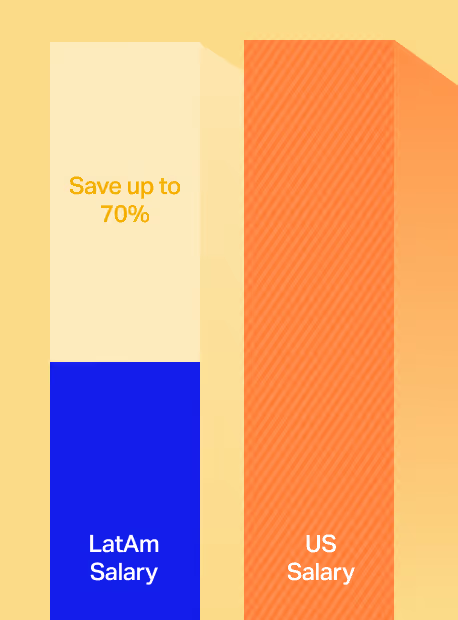
Hiring a full-time bookkeeper based in Latin America costs significantly less than a US equivalent. This is possible not because of lower quality, but because of different market dynamics and cost of living. Based on compensation benchmarks, junior and mid-level LatAm bookkeepers typically cost $22,000–$36,000 annually, compared to $46,000–$72,000 for a comparable US hire (a significant savings gain).
Focus on core business activities
If you're still doing your own bookkeeping, or if a non-finance team member is handling it, outsourcing bookkeeping services frees up time that you can redirect toward growth. The math is simple when you estimate your hourly value as a founder or operator. It’s far higher than the cost of a bookkeeper.
Scalability
You can scale your bookkeeping capacity without the overhead of a full internal hire cycle. Offshore bookkeepers work as dedicated full-time employees, so you get the consistency of an in-house team member. This option also comes with the flexibility to adjust the scope as your business growth demands it.
Access to expertise and compliance knowledge
LatAm bookkeepers often bring broader exposure than their job title implies. They come with multi-client backgrounds, familiarity with US GAAP, and experience working with US-based companies. This shortens onboarding and reduces the compliance risk that comes with hiring someone who's never worked with US business practices before.
Further reading: What Smart Companies in America Are Doing to Overcome the Accounting Talent Shortage
Pros and Cons of Hiring Offshore Bookkeeping Talent
Hiring offshore bookkeeping talent has genuine advantages, but it's worth being clear-eyed about the trade-offs. The calculus shifts significantly depending on where you hire.
Pros
Cost savings with specific upside. Bookkeepers in Latin America typically cost $27,000–$66,400 less per year than a US equivalent. For small and mid-size businesses, that's a meaningful budget line.
Access to a larger talent pool. The domestic shortage of accounting professionals is real. Expanding your search to Latin America opens up a much broader candidate base, often with stronger credentials than the job title implies.
Time zone alignment (for LatAm specifically). Professionals in Argentina, Colombia, and Mexico work during US business hours. Daily standups, real-time questions, and month-end collaboration happen live. This advantage is specific to nearshore LatAm and does not apply to far-offshore regions.
Scalability. You can add capacity without a long US hiring cycle. Placement timelines through a staffing firm typically run two to four weeks.
Cons
Communication challenges with far-offshore. If you're using bookkeeping services in the Philippines or India, expect a 10-to-15-hour time difference. Finance work that requires back-and-forth throughout the day becomes difficult, and this is the most common regret I hear from companies that chose far-offshore for bookkeeping.
One finance leader I've spoken with described it clearly after about a year of managing a finance team in Mumbai:
"The talent is solid…but boy, trying to manage someone in such a different time zone has been hard. Hiring in LatAm and staying kind of within the same reasonable time zone just makes so much more sense for us."
Compliance complexity. Hiring international talent involves contracts, local labor law, and tax considerations. Working through a staffing firm that handles compliance reduces this risk significantly, but it's not zero. With every layer of law or industry regulation, there’s an additional layer of risk to consider.
Ramp-up time. Even strong candidates need time to learn your systems and preferences. Plan for a 30-to-60-day onboarding window before full productivity, during which time you still make a significant investment into the talent.
Quality inconsistency if going direct. Platforms and freelance boards make it easy to find candidates but much harder to verify them. Without a rigorous screening process, quality varies. A recruiting partner with a vetting process addresses this directly.
Nearshore vs. Offshore Bookkeeping: What's the Difference?
Nearshore and offshore are often used interchangeably, but for bookkeeping specifically, the distinction matters.
‘Offshore’ and ‘nearshore’ refer to where your bookkeeper is based, not the vendor structure. Offshore means hiring in geographically distant countries with large time zone gaps for US companies, such as the Philippines or India.
Nearshore means hiring in countries in the same or neighboring time zones as the US, primarily in Latin America (for example, Mexico, Colombia, Argentina, or Brazil). The time difference to most US cities is typically zero to three hours, which makes real-time collaboration much easier.
For bookkeeping specifically, this matters more than it does for, say, content production or graphic design. Month-end close involves real-time questions. Reconciling an account error requires back-and-forth in the same afternoon, not a 24-hour email thread. A controller who needs to pull a number before an investor call can't wait until the next morning. Hours spent waiting can degrade the client experience and put your business reputation at risk.
Research supports this: according to a Harvard Business School/INFORMS study, each additional hour of time zone difference reduces real-time communication by 11%. The researchers specifically recommend organizing distributed finance and operations teams along a north-south axis, such as the U.S.–Latin America corridor, to maximize workday overlap.
The CFO of a company we worked with put it this way after considering the Philippines: "We looked at the Philippines, but my team pushed back. With a 15-hour difference, they knew it wouldn't work. The controller-level staff already had huge workloads. What they needed wasn't just another body. It was someone they could work with in real time, side by side, to get through it. That's why we moved the search to LatAm."
For most US companies hiring bookkeepers, nearshore Latin America is the better choice, not because far-offshore talent is lower quality, but because the collaboration model is fundamentally different.
How Much Does It Cost to Hire an Offshore Bookkeeper?
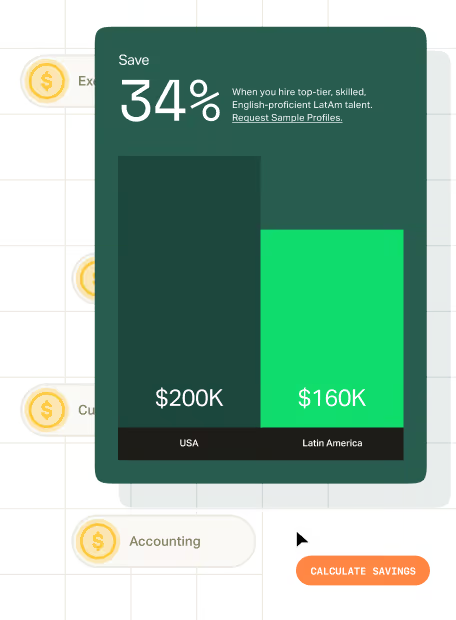
Bookkeepers based in Latin America typically cost $22,000–$36,000 per year depending on seniority, compared to $46,000–$74,000 for a US equivalent. That translates to savings of $27,000–$66,400 annually per hire, based on compensation benchmarks.
According to Near's 2026 State of LatAm Hiring Report, which analyzed 2,000+ placements, the average LatAm bookkeeper earns $28,800 per year versus $66,500 per year for a US bookkeeper, a 57% cost difference.
Bookkeeper was the 7th most-placed role in 2025, with Argentina as the top hiring country.
Compensation data reflects 2026 benchmarks. Actual salaries depend on the candidate's seniority, country of hire, and specific tool expertise. Senior LatAm bookkeepers, for example, who hold advanced accounting credentials may command compensation toward the upper end of these ranges.
Actual cost also depends on whether you hire through a staffing firm with a placement fee or directly. A firm handles vetting, compliance, and onboarding logistics, which reduces your internal time investment. For full compensation context, see Hire With Near's salary guide for US vs. Latin America and the accounting roles salary guide.
Further reading: Outsourced bookkeeping cost guide
Steps to Hire Skilled Offshore Bookkeeping Professionals
The ten steps below cover the full process from determining your initial needs to hire your new bookkeeper.
1. Define your requirements
Before you begin your search, clearly outline what you need from your offshore bookkeeping talent. Determine the scope of work, key responsibilities, the level of expertise required, and whether you need part-time, full-time, or freelance support.
A detailed understanding of your needs will guide the entire hiring process.
2. Choose the right offshore location
Many countries offer advantages in terms of average labor costs, size of talent pool, and language skills. Starting from the perspective of considering what region you want to hire from can help narrow your search for offshore talent.
Research and choose a location that aligns with your business needs. Latin America, for instance, is known for deep finance talent, including professionals with strong credentials who cost significantly less than US equivalents.
The minimal time zone difference between Latin America and the US means real-time collaboration is also very straightforward.
3. Select a reliable outsourcing partner or platform
Partnering with a reputable outsourcing firm, like Hire With Near, or using reliable job platforms can help speed up your search for the right offshore bookkeeper. It also reduces the effort involved in vetting candidates.
These partners often have a pre-vetted pool of candidates and use stringent screening processes to help quickly hire only the right candidates.
For better results, focus on firms that specialize in accounting and bookkeeping, with a verifiable track record in finance placements. Also, check that there are no hidden costs within their fee structure.
4. Create a detailed job description
Establish your hiring needs through clearly-stated duties, qualifications, and expectations for the role. Include details such as:
- Scope of tasks (including, accounts payable/receivable, payroll management, financial reporting, reconciling bank statements)
- Required qualifications and certifications
- Preferred experience in specific industries or software (QuickBooks or Xero, for example)
- Working hours and expected availability
- Any additional preferences, such as language proficiencies or communication skills
One note on job descriptions: distinguish your non-negotiable tool requirements from nice-to-haves. Listing every tool as a requirement filters out strong candidates who are missing one software but are otherwise excellent. They can always get up to speed on a certain tool after onboarding.
5. Conduct a thorough screening process
Once you receive applications, review resumes, evaluate cover letters, and perform initial telephone or video interviews.
When screening bookkeepers, I look for two signals above everything else. First, I check for multi-client experience. They must have:
- Managed multiple client relationships simultaneously
- Know how to communicate with different people
- Stay organized under volume
- Handle the complexity that comes with serving several clients at once
They must also have experience with US-based companies. That signals familiarity with US GAAP and shortens ramp-up time considerably. Then, I verify US GAAP familiarity directly during the interview. Don't assume it based on credentials alone.
If you're working with a recruitment agency, they'll handle much of this screening themselves, including technical assessments and cultural fit evaluation.
6. Check references and credentials
It's essential to validate the qualifications and past performance of potential candidates. Conduct reference checks to verify their work history and reliability in context with your specified requirements.
7. Negotiate and finalize the contract
After selecting the candidate, meet with them on the terms of employment, including salary, working hours, and any other benefits.
Make sure to include specifics about the nature of their work, confidentiality agreements, and compliance with your local regulations. Draft a detailed contract that both parties can agree upon and sign.
8. Onboard and train your new bookkeeper
Proper onboarding and training are crucial for integrating your new offshore bookkeeper into your team. Provide them with a thorough orientation about your company, its values, procedures, and the specific software or tools they will be using.
This helps them understand their role and hit the ground running.
9. Establish communication and reporting protocols
Decide on the frequency and format of updates, the tools you will use for communication (Slack or email), and how to handle any issues or questions that may arise. Make sure there is a mutual understanding of expectations from both sides.
10. Monitor performance and provide continuous support
Once your offshore remote bookkeeper is on board, provide continuous monitoring and support to help them succeed. Most businesses find that offshore bookkeepers are just as reliable as in-house staff when it comes to maintaining financial records. But you still need to review their work against your standards and provide feedback when needed.
Offer ongoing support and training to help them stay updated on any changes in procedures or software. Keeping the lines of communication open will help maintain a high level of quality and efficiency in their work, even as you expand your client base and service offerings.
Where to Find Offshore Bookkeeping Talent
You have three main options for sourcing talent. You can hire directly through job boards, use a freelance platform, or work with a recruiting firm that specializes in LatAm finance talent.
Direct and freelance sourcing gives you more control over the search, but requires you to build your own vetting process. A specialized firm handles candidate sourcing, screening, and compliance, and typically places candidates in two to four weeks.
If you're looking to compare your options before committing, we've put together a dedicated guide to the best staffing firms for hiring bookkeepers in Latin America. It covers the top options, what each one specializes in, and how to evaluate fit for your business. Hire With Near's finance industry page is also a good starting point for understanding the range of finance and accounting roles available from Latin America.
For a curated list of vetted providers, see the best bookkeeping outsourcing services available for US companies.
Case Study: Real Savings From LatAm Bookkeeping Hires
The savings figures cited in this article aren't hypothetical.
Kordis, a fractional CFO services firm, tried the obvious offshore solution first with bookkeepers from the Philippines. The talent was solid, but the collaboration window was minimal. When CFO-level bookkeeping work requires answering urgent client questions or course-correcting mid-close, a 12-plus-hour time gap makes that nearly impossible.
Kordis switched to Latin America through Hire With Near, hiring a bookkeeper and an executive assistant. The shift resulted in $109,000 annual savings and the real-time collaboration their work required.
ORBA Cloud CFO, a bookkeeping and fractional CFO firm, had a similar experience. Their offshore team's time zone misalignment meant work happened while the US team was asleep, with no ability to collaborate or course-correct in real time. Switching to LatAm talent through Hire With Near resulted in $159,000 in annual savings across two roles and an overall much smoother workflow.
On the smaller end, one health and beauty supplement e-commerce company needed a single bookkeeper and was struggling with the revolving-door quality of offshore platforms. Hire With Near helped them hire a bookkeeper five times faster than their previous attempts, saving $26,000 annually. As this use case proves, sometimes the win is in getting the right person in place and keeping them there.
Further reading: Outsourced bookkeeping providers for CPA firms
Final Thoughts
Hiring offshore bookkeeping talent is one of the more practical ways to add finance capacity without the overhead of a US hire. The savings are real, the talent pool is deep, and the process is more manageable when you work with a firm that knows how to screen and place finance professionals.
If you want to compare your options before deciding on a partner, the best staffing firms for hiring bookkeepers in Latin America guide covers the landscape.
Frequently Asked Questions
What does an offshore bookkeeper do?
An offshore bookkeeper handles the same core tasks as an in-house hire, including accounts payable and receivable, payroll processing, bank reconciliation, financial reporting, expense tracking, and month-end close. The distinction is that they work remotely, typically as a dedicated full-time professional rather than a shared contractor.
Many bookkeepers based in Latin America hold full accounting degrees and have US GAAP experience, which means their capabilities often exceed what the job title implies in the US market.
How much does it cost to hire an offshore bookkeeper?
Bookkeepers in Latin America typically cost $22,000–$36,000 per year, depending on seniority, compared to $46,000–$74,000 for a US equivalent. According to Hire With Near's 2026 State of LatAm Hiring Report, the average LatAm bookkeeper earns $28,800 per year versus $66,500 for a US hire, a 57% difference.
Actual cost depends on the candidate's seniority, country, and whether you hire through a staffing firm or directly.
What is the difference between offshore and nearshore bookkeeping?
Offshore bookkeeping refers to hiring in geographically distant countries, often with 10-to-15-hour time zone gaps, such as the Philippines or India. Nearshore bookkeeping means hiring in countries with the same or adjacent time zones: for US companies, that's Latin America.
For finance roles that require real-time collaboration during month-end close or daily communication, nearshore Latin America is the more practical model.
Can I hire international bookkeepers?
Yes, US companies can legally hire international bookkeepers, either directly as independent contractors or as full-time employees through an employer of record or staffing firm that handles local compliance and payroll.
The most practical approach for most companies is working with a recruiting partner that manages contracts, onboarding, and payments on your behalf, reducing the compliance overhead you'd face hiring directly.
Is AI replacing offshore bookkeepers?
No. Automation is handling more routine data entry and transaction categorization, but bookkeepers are still essential for tasks that require judgment. Human-in-the-loop tasks include reconciling discrepancies, communicating with vendors and clients, preparing reports for leadership, investors, or clients, and interpreting financial data.
The demand for bookkeepers who can work across tools like QuickBooks and Xero, communicate clearly in English, and collaborate in real time is actually growing, not shrinking.
How do I evaluate an offshore bookkeeper's qualifications?
The clearest differentiator to look for is multi-client experience: candidates who've managed multiple client relationships simultaneously know how to communicate under volume and stay organized across competing demands. Prioritize candidates with US-based company experience, which signals US GAAP familiarity and shortens ramp-up time considerably.
Practical red flags include job hopping, poor English fluency, and vague answers in interviews.
What other finance and accounting roles can I hire from Latin America?
Beyond bookkeepers, US companies hire a wide range of finance and accounting roles from Latin America through Hire With Near, including accountants, accounts payable specialists, controllers, and payroll specialists.
Latin American talent in these roles typically offers the same technical depth as US professionals, with real-time time zone overlap and compensation that makes senior-level hiring financially viable. The depth of the LatAm finance talent pool means you're not limited to junior hires.







.webp)


%203.svg)
.avif)





%20(1).avif)

%20(1).png)