.webp)


%203.svg)
Key Takeaways
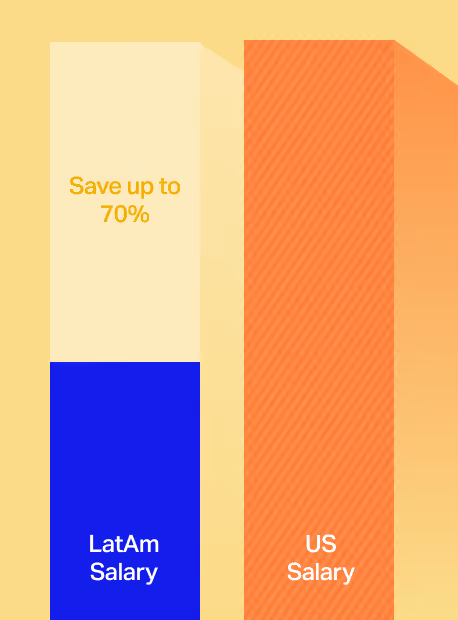
- A mid-level Salesforce developer in Latin America earns $36K–$48K per year versus $99K–$151K in the US. The same budget that covers one US mid-level Salesforce developer can fund a senior developer plus an admin in Latin America, at 30–76% below US salary equivalents, with full overlap on US business hours.
- The four ways to get nearshore Salesforce work done are: hiring a consulting partner for bounded projects, staff augmentation for temporary capacity, freelancers for small, defined tasks, and direct hire through a recruiting partner for lasting in-house capability. Direct hire is the only model where platform knowledge stays on your team permanently.
- The strongest vetting signal for a nearshore Salesforce developer is whether they can explain a specific implementation clearly to a non-engineer. This also predicts how they'll work with your sales and RevOps teams day to day.
Nearshore Salesforce development means hiring Salesforce developers based in Latin America who work during your business hours. If you're looking into it because US developer rates are out of range or searches are taking too long, this guide covers what you need to make the decision.
In this article, I compare the four ways to get Salesforce work done in Latin America, what a developer's salary is at each seniority level, where the talent is concentrated, and how to vet a candidate before you hire.
Hire With Near's salary data puts those hires at up to 76% below their US equivalents, with developers working in your time zone from day one.
What Is Nearshore Salesforce Development?
Nearshore Salesforce development means having your Salesforce environment built, customized, and maintained by developers based in Latin America, at up to 76% below US rates, in time zones that overlap the US workday.
Day to day, that work covers:
- Building custom objects, flows, and validation rules
- Writing Apex triggers and Lightning Web Components
- Connecting Salesforce to your billing, marketing, and data tools
- Configuring CPQ and managing product catalogs
- Managing releases and sandbox environments
- Supporting the admins and end users who live on the platform
Salesforce development isn't standard software engineering. Developers work within a proprietary platform with its own language (Apex), its own component framework (Lightning Web Components), its own deployment tooling, and its own governance limits that don't exist in traditional codebases.
A strong general-purpose engineer won't automatically be effective in Salesforce. The platform has enough depth and quirks that experience inside it matters as much as raw coding ability. That's why Salesforce certifications carry real weight here: they signal platform-specific knowledge, not just programming fundamentals.
Why Do US Companies Choose Nearshore Salesforce Development?
Companies choose to nearshore their Salesforce work for three reasons: real-time collaboration during the US workday, strong English across the talent pool, and senior skills at salaries that stretch the same budget much further.
These reasons are similar to those leading US companies to hire Latin American developers in general. Salesforce roles just feel it more sharply because the platform touches revenue every day.
Real-time collaboration during your workday
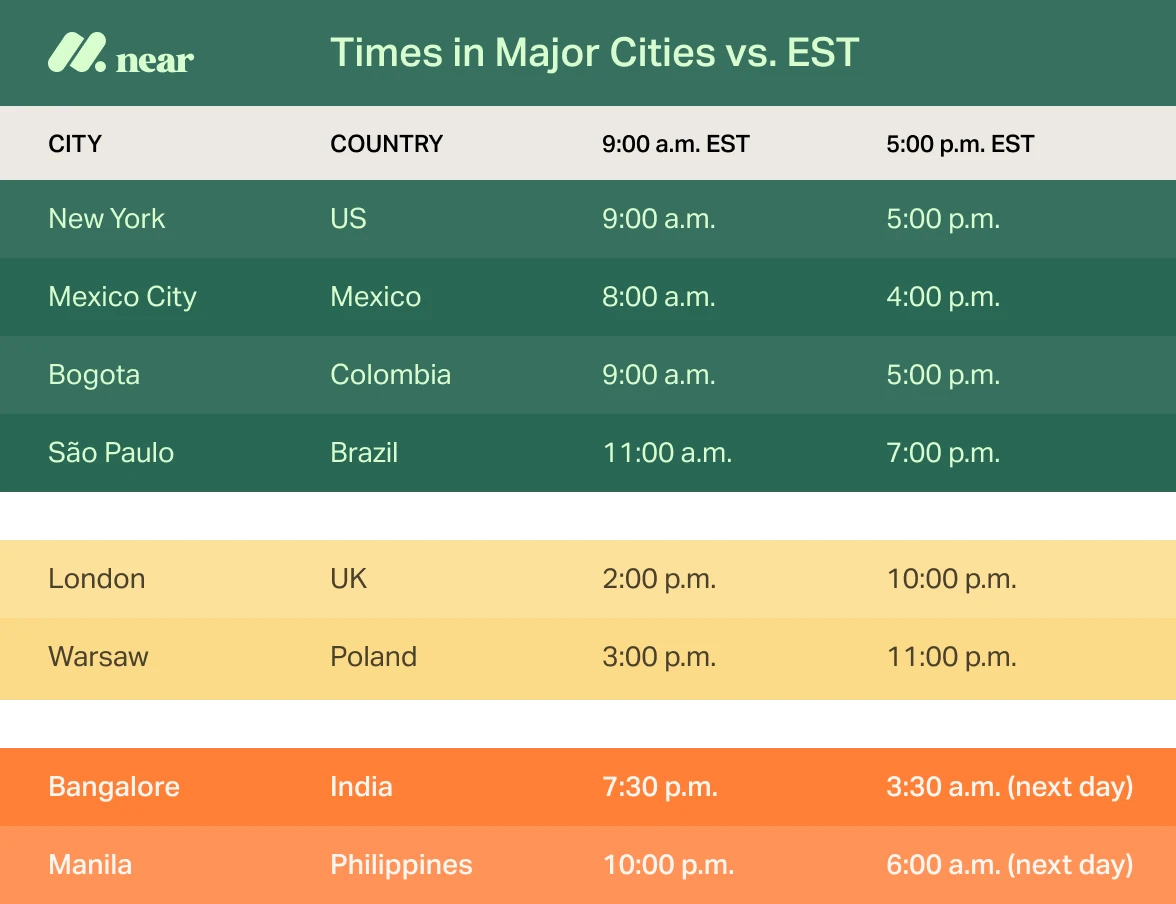
A Salesforce developer in Latin America is online while your US team is, whether your office runs on Pacific, Mountain, Central, or Eastern time. A broken flow reported at 10 a.m. gets picked up at 10 a.m., and a RevOps request doesn't wait overnight for an answer.
The research backs up how important this is. Harvard Business School and INFORMS research, covering more than 12,000 employees, found that synchronous communication, such as calls and video chats, declined by 11% for every additional hour of time zone difference.
To preserve real-time collaboration, the researchers recommended distributing teams north to south. A US and Latin America team is exactly that geometry, as you can see in the image below:
Bilingual professionals used to US teams
Salesforce work is collaboration-heavy. Developers gather requirements from sales leaders, push back on bad ideas, and explain trade-offs to people who've never seen Apex.
Latin America's tech workforce has spent years working for US companies, so strong English and familiarity with US business habits are the norm among the candidates who reach your shortlist. Every candidate can be screened for both.
Franco Pereyra, COO of Hire With Near, highlights the mindset that Latin American professionals bring to US teams:
What sets Latin American talent apart from other regions is that you'll find people who are proactive and creative — people who come up with ideas and new solutions. If you're looking for folks who can bring something to the table, who will push back if they think your idea doesn't make sense, that's what you find in LatAm.
The same budget hires more senior talent
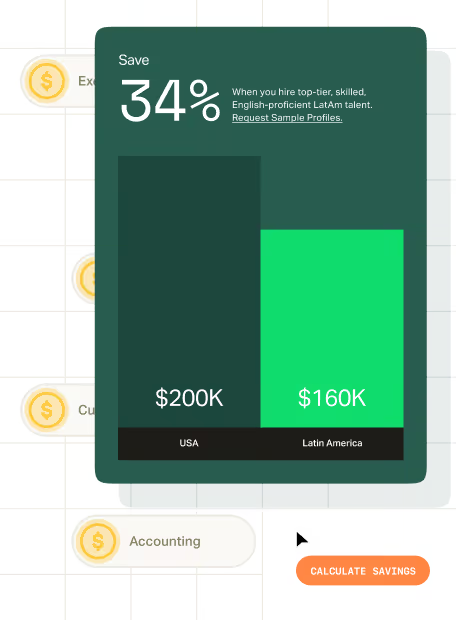
Latin American salaries are lower because of a lower cost of living, not because of lower capability. That's an advantage for companies hiring in the region, because the same budget that gets you one US mid-level developer can fund a senior developer plus an admin in Latin America.
That's the real value: more platform capability for the same spend, at rates that are competitive and sustainable in local markets.
Later in this guide, I break down exact salary ranges for Salesforce developers, admins, consultants, and managers in Latin America compared to their US equivalents, so you can run the numbers against your own budget.
In the video below, Hire With Near's co-founder Hayden Cohen offers additional perspective on why Latin America, in particular, stands out as a strategic choice for remote developer hiring, highlighting unique regional strengths that go beyond the basics:
Offshore vs. Nearshore Salesforce Development: What's the Difference?
The difference comes down to working hours. For US companies, a nearshore developer is a developer based in Latin America who shares your business hours. An offshore developer is based in a distant country, like India, the Philippines, or Eastern Europe, who works typically while your office is mostly closed.
Offshore hiring attracts hiring managers and leaders’ attention because of the initial lower rates. But with time, it doesn't pay off: a question sent in your afternoon waits until the next day, and a two-day fix becomes a week of handoffs.
Plenty of companies learn this the expensive way. In Hire With Near's research on why US companies are hiring in Latin America, 30% of companies exploring Latin American hiring were switching away from offshore regions specifically to get working-hours overlap back.
Beyond time zone misalignment, companies also flag communication and working style as friction points with far-offshore teams. Natasha Tarapow, Hire With Near's Senior Recruiter for Development and Engineering, frames that difference:
The problem companies have with hiring in India isn't technical ability; it's cultural fit. They find people who are very strong technically, and they're cheap to hire compared to the US, but they're not a good cultural fit to typical US business practices. They take a long time to answer Slack messages, and they don't notify their managers about what they're working on. In Latin America, we found that talent is not that way. We're very communicative. People really try to go above and beyond in their jobs.
Offshore still makes sense for genuinely asynchronous work with generous timelines, but Latin America stands out for software development when teams depend on real-time collaboration.
How to Get Nearshore Salesforce Work Done: The 4 Ways
US companies get nearshore Salesforce work done through one of four models:
- Salesforce consulting partner: You contract a firm to deliver a defined project. The firm scopes, staffs, and manages the work.
- Staff augmentation: A vendor places its own pre-vetted Salesforce professionals on your team to work under your direction. The vendor remains their employer.
- Freelancers and independent consultants: You contract individuals for hourly or project-based work and manage quality, security, and continuity yourself.
- Direct hire through a recruiting partner: You hire your own Salesforce developers in Latin America. The partner sources and vets candidates and can handle employment, payroll, and compliance.
The right model for your company depends on whether the work has an end date. I'll explain them in order, from most outsourced to most in-house.
Option 1: Salesforce consulting partner
A Salesforce consulting partner is an external firm you contract to deliver a defined scope of work. You don't hire the developers directly. Instead, the firm staffs the project with its own people, manages the engagement, and hands over the result when the work is done.
A consulting partner is the right call when the work is a bounded project: an initial implementation, a migration off a legacy CRM, a CPQ rollout with a hard deadline. The firm brings architects and developers who’ve done that exact project many times, and you pay for delivery, not for building a team.
The trade-offs are cost and continuity. Blended hourly rates add up fast on long engagements, and when the project ends, the platform knowledge leaves with the firm.
If your Salesforce roadmap is a continuous backlog rather than a project, you'll be buying that context over and over.
Option 2: Staff augmentation
Staff augmentation means a vendor places pre-vetted Salesforce professionals on your team, working under your direction, while the vendor stays their legal employer and handles payroll, benefits, and compliance.
It's a way to rent capacity, and it should never be confused with building a team yourself: the people are the vendor's employees embedded in your workflow.
It fits teams that need to scale up for a stretch, staff a defined initiative, or add a specialist without committing to permanent headcount. Flexibility is the draw, and time to start is a close second: both are big reasons US companies choose nearshore staff augmentation when the roadmap spikes faster than hiring can keep up.
Hire With Near offers this path through our nearshore staff augmentation service.
Option 3: Freelancers and independent consultants
Freelance platforms and independent consultants give you the fastest access to Salesforce skills for small, well-defined tasks: a flow fix, a report package, a one-off integration.
But for ongoing platform ownership, the model gets shaky: you manage vetting, quality, and security alone, and the person maintaining your revenue system is splitting their attention across several clients.
The failure mode is familiar to anyone who has tried to run a serious system implementation on hourly help: costs compound faster than progress does, and you end up paying for context every time a new person touches the project.
One founder, six months into paying for hourly platform support plus an outside consulting firm on an ERP rollout, told us:
I've been trying to get my inventory inside NetSuite for the last six months. I'm working with NetSuite's internal team, and I've purchased 30 hours a quarter for their expertise, and then they're charging me more after that. I've also got a separate consulting firm involved. I'm starting to see that it'd be more cost-effective to have a full-time employee.
The same arithmetic applies to Salesforce.
Option 4: Hire your own nearshore Salesforce developers
Direct hiring is the model for lasting capability: a full-time Salesforce developer who joins your team, learns your organization's history, and compounds that knowledge year after year. It's how you stop re-buying context from outside firms.
Bonfire, an e-commerce platform for custom merchandise fundraising, chose this path. At first, Dan Strogiy, their Director of Design and UX, was burning two to three months per search, searching himself for a senior technical hire.
Then, Hire With Near took over sourcing and screening and filled the role in six weeks, roughly twice as fast. The hire stayed more than two years and saved the company $53,000 annually against a comparable US salary. Dan Strogiy put it this way:
It was shocking to see the difference between the talent Hire With Near brought versus other firms I worked with… Efficiency. That is the biggest benefit of working with Hire With Near.
You have two main routes to get there:
- You can run this yourself: Post on LinkedIn or a nearshore job board, screen the applicants, and once you've chosen someone, use an employer of record to employ them compliantly without setting up a local entity.
- Rely on a specialist recruiting partner: Hire With Near combines the search and the employment logistics in one relationship through our nearshore staffing and recruiting services. You describe the role and we present pre-vetted candidates. Once you hire, we handle payroll, benefits, and compliance, so the hire feels as simple as adding someone down the street.
A nearshore recruiting partner works whether you need one developer or want to hire remote software engineering talent in Latin America across your stack, and it's how the strongest nearshore staffing companies operate generally.
Which model fits your company?
How Much Do Nearshore Salesforce Developers Cost?
Hiring a Salesforce developer in Latin America costs $30K–$72K per year, depending on seniority, compared with $92K–$172K for an equivalent US hire, according to Hire With Near's salary data. At the mid level, where most first hires land, that's $36K–$48K against $99K–$151K in the US.
These are the four most commonly hired Salesforce roles as of July 2026, according to Hire With Near's salary benchmarks: Salesforce developers, Salesforce admins, Salesforce consultants, and Salesforce managers.
For the most up-to-date figures, see Hire With Near's US vs Latin America Salary Guide.
Read the table as a budget question rather than a discount. The gap between a US senior developer and a Latin American one funds a second full role: the admin who keeps the org clean, or the consultant who translates business requirements before they hit the dev queue.
Figures for adjacent roles are in our IT Roles Salary Guide, and if you're benchmarking against other regions, we've also broken down how much offshore developers cost.
{{salary-guide-cta}}
Which Latin American Countries Have the Strongest Salesforce Talent?
Most of Latin America's Salesforce talent is concentrated in four countries: Mexico, Colombia, Brazil, and Argentina.
The developer base behind it is large and growing fast: GitHub's Octoverse 2024 report counts more than 1.9 million developer accounts in Mexico, 1 million in Colombia, and 1.1 million in Argentina, all growing at double-digit rates year over year.
The 2025 version of the report points to 6.9 million accounts in Brazil.
Mexico
Mexico pairs the region's second-largest developer pool with a workday that lines up almost entirely with a team in Chicago, Dallas, or Denver.
Years of nearshore work for US companies mean deep experience with US business practices, and the tech workforce has grown up building for US clients, which translates into familiarity with US-style project management, sprint cycles, and direct communication.
Our guide to nearshore software development in Mexico covers the market in detail.
Colombia
Colombia has become a first stop for US companies hiring developers, with strong English proficiency across its tech workforce, and a time zone that sits close to US Eastern time all year.
Bogotá's tech scene has grown rapidly over the past decade, fueled by government investment and a maturing startup ecosystem that has produced a generation of developers with experience inside complex, US-facing platforms, Salesforce included.
If you're considering it, here's what to know about outsourcing software development to Colombia.
Brazil
Brazil is the region's largest tech market by a wide margin, which matters for a specialized skill set like Salesforce: a bigger base means more certified developers at every seniority level.
São Paulo's developer community is particularly strong in enterprise platform work: the concentration of multinational companies headquartered there has created sustained demand for Salesforce expertise across sales, service, and revenue operations functions.
We've written about why companies choose Brazil for software development.
Argentina
Argentina has a senior-heavy engineering culture and some of the strongest English in the region. Its clocks run just one to two hours ahead of the US East Coast, meaning an Argentine developer's workday easily overlaps with your East Coast afternoon and your West Coast morning.
Argentina also ranks as Latin America's top country for English proficiency according to the 2025 EF English Proficiency Index, and its universities produce a high volume of engineering graduates, many of whom enter the workforce with enterprise platform experience from working with US companies early in their careers.
For a closer look at the market, see our guide to software development outsourcing in Argentina.
Further reading: Top Software Development Outsourcing Countries: A Guide for US Employers
How to Vet a Nearshore Salesforce Developer
Vet a nearshore Salesforce developer on five things: certifications with active maintenance, real Apex and Lightning work they can describe specifically, integration experience across your tech stack, judgment about when to use declarative tools instead of code, and English clear enough to gather requirements from your revenue team.
Most companies come to Hire With Near specifically for mid-level and senior engineers. According to the 2026 State of LatAm Hiring Report, 84% of the placements were mid-level or senior professionals. The checks below are built for that level of candidate.
1. Certifications that match the work
Platform Developer I is the baseline for a developer role; Platform Developer II and App Builder signal depth. Treat certifications as a floor rather than proof: they confirm platform knowledge, and the checks below confirm whether the candidate can apply it.
One detail worth checking: Salesforce certifications require maintenance through seasonal release exams. A candidate with credentials they haven't kept current is working from an older version of the platform. Ask when they last completed a maintenance module.
2. Real Apex, Lightning, and LWC work
Ask what they built, for whom, and what broke. A strong candidate can walk you through a specific trigger they refactored, a Lightning Web Component they shipped, and the governor limits that forced a design change. Vague answers about “working on Salesforce” usually mean configuration experience presented as development.
3. Integration experience
Most Salesforce pain lives at the edges, where the platform meets billing, marketing, and data tools. Look for hands-on work with REST and SOAP APIs, middleware, and at least one messy real-world sync they can describe end to end, including how they handled failures.
4. Judgment about when to skip code
The best developers write less Apex, since work handled with flows and standard configuration is cheaper to maintain. Ask how they decide between declarative tools and code. A candidate who reaches for Apex by default will build you an org only they can maintain.
5. Communication you can put in front of the business
Salesforce developers work with sales and operations leaders every week, so the technical screen can't be the whole screen. In the interviews our recruiters run for platform roles, the strongest signal is rarely the certification list. Natasha explains what she listens for:
We always ask candidates to tell us about a project they've worked on — not just that they use this language and that one, but what their role was and what they actually did. It's important that they can explain their work to someone who isn't a developer. If they can do that, that tells me a lot.
Red flags worth naming
A resume that lists every Salesforce cloud (Sales, Service, Marketing, Commerce, CPQ) without depth in any of them usually signals surface-level exposure rather than real implementation experience.
The platform is too broad for one person to be genuinely strong everywhere. Strong candidates tend to have clear areas of depth alongside general familiarity with the rest.
The parallel jobs red flag applies here too. A candidate claiming two or three concurrent full-time Salesforce roles is almost certainly context-switching in ways that will hurt your organization. Ask directly about current commitments.
References that go beyond general character
For a platform role, a general reference isn't enough. Ask for someone who worked with the candidate on a specific implementation, like a technical lead, a project manager, or a business stakeholder who lived inside the org they built.
The question to ask: what would you have done differently on that project, and what role did this person play in those decisions? How a candidate is described when things got hard is more useful than how they're described when everything went smoothly.
Beyond the technical screen, the rest of your diligence follows the same questions tech leaders ask when hiring in Latin America: time zones, standups, security, and equipment.
If you want to go deeper on candidate evaluation, Hayden Cohen walks through how to assess experience, English proficiency, and cultural fit when hiring for technical roles in Latin America:
Final Thoughts
The right model for nearshore Salesforce development depends on the shape of the work. A consulting partner is the better call for a bounded implementation or migration with an end date. If Salesforce runs your revenue operations year-round, hiring your own Salesforce developers in Latin America is the most valuable model: the platform knowledge stays on your team, and the salary math works in your favor every month.
If you're still comparing partners, start with the companies that help you hire top developers in Latin America.
If you're ready to explore what that looks like for your company, book a free consultation to talk through your requirements with our team. We'll share salary benchmarks for the roles you're considering and a walkthrough of the process, so you have what you need to decide whether it's the right fit.
{{latam-hiring-cta-v2}}
Frequently Asked Questions
Why hire a Salesforce developer through a nearshore partner?
A nearshore recruiting partner gets you a vetted Salesforce developer who works your business hours without you running the sourcing and screening yourself.
A partner like Hire With Near already knows where the strong candidates are, tests for the skills that matter, and can handle employment, payroll, and compliance after the hire.
You get the lasting in-house capability of a direct hire with none of the international hiring logistics.
How much does it cost to hire a Salesforce developer in Latin America?
Salesforce developer salaries in Latin America run from around $30K per year for junior talent to $72K for senior, with mid-level developers in the $36K–$48K range, based on our salary data. Equivalent US salaries span $92K–$172K. Budget the full range against seniority: hiring a senior Latin American developer still costs less than a junior hire in the US.
Is nearshore Salesforce development more cost-effective than onshore or offshore?
Nearshore is substantially more cost-effective than onshore, with Salesforce salaries in Latin America up to 75% below US equivalents, and it usually beats offshore once you count coordination costs.
Offshore hourly rates can look lower, but overnight turnaround on every question slows delivery, and slow delivery on a revenue platform is its own expense.
Nearshore keeps the savings while keeping the work inside your business day.
Further reading: Nearshore vs. Offshore vs. Onshore: Compare Outsourcing Types
What experience do nearshore Salesforce developers have?
Nearly all the engineering professionals placed with US companies through our process are mid-level or senior, and most have spent years building for US businesses already. For Salesforce specifically, that typically means certified developers with production Apex and Lightning experience, integration work across common US tech stacks, and English strong enough to gather requirements directly from your revenue team.
Which Latin American countries are best for Salesforce talent?
Mexico, Colombia, Brazil, and Argentina have the deepest Salesforce talent pools in Latin America. Mexico offers the closest schedule alignment for Central and Mountain teams, Colombia combines strong English with near-Eastern hours, Brazil has the region's largest developer base, and Argentina skews senior with excellent English.
How long does it take to hire a Salesforce developer through Hire With Near?
Most technical roles fill in roughly three weeks in our experience, from the role briefing to an accepted offer. You review a shortlist of pre-vetted candidates rather than a pile of applications in 3–5 days, interview the ones you like, and we handle the offer, contracts, and onboarding logistics once you choose.
What other Salesforce and IT roles can you hire in Latin America?
US companies hire across the full Salesforce and IT stack in Latin America. Alongside Salesforce developers, admins, consultants, and managers, that includes software engineers in Latin America, full-stack developers in Latin America, nearshore DevOps engineers, and QA engineers in Latin America.
The advantages are the same across roles: salary savings of up to 75% and a team that works your business hours.



.webp)
.webp)


.webp)


%203.svg)
.avif)





%20(1).avif)

%20(1).png)