


%203.svg)
Key Takeaways
- Nearshore staff augmentation places Latin American developers inside your team under your direction, with a staffing partner handling payroll, compliance, and employment logistics so you don't have to.
- The core advantage over offshore is time zone alignment: Latin American developers work during US business hours, which means you get their best thinking rather than their tired late-night effort.
- When choosing a nearshore partner, the most important distinction is whether they place developers looking for short-term contracts or long-term team members. Most do the former; a few specialize in the latter.
Nearshore staff augmentation is the practice of adding developers and other tech professionals from Latin America to your team, while a staffing partner handles payroll, compliance, and employment logistics.
It gives you fast access to engineers at a fraction of US salaries, in your own time zone. It’s a great option when your existing team is stretched thin, and you need to add development capacity, but you can’t afford another six-month US hiring cycle or the salary expectations that come with it.
This guide explains what nearshore staff augmentation is, how it differs from offshore models, what it costs, and how to find the right partner for your situation.
What Is Nearshore Staff Augmentation?
Nearshore staff augmentation is the practice of adding developers or other tech professionals from Latin America to your team.
They work directly inside your processes, take direction from your leads, and participate in your workflow as if they were any other team member, while a staffing partner handles employment, payroll, and compliance in the background.
Nearshore, in this context, refers specifically to Latin America. The underlying staff augmentation model is the same whether you're working with developers in Bangalore or Buenos Aires: the staffing partner handles employment, you direct the work.
The geographic proximity to the US creates meaningful operational differences in how the arrangement performs day to day.
Here’s how it typically works:
- You define your requirements: tech stack, seniority level, team culture, and how long you need the role filled.
- The staff augmentation partner presents developers they’ve already matched against your requirements.
- You have full say over who joins your team.
- The developer starts inside your workflow: your standups, your sprint, your PR review process. The partner handles contracts, payroll, compliance, and sometimes equipment.
This is different from full project outsourcing, where you hand off ownership of a deliverable to an external team. With staff augmentation, you direct everything and retain control of all project management.
Nearshore vs. Offshore Staff Augmentation: Why Latin America?
The primary advantage of nearshore staff augmentation over traditional offshore models is time zone alignment. Latin American developers work during your business hours, so real-time collaboration is genuinely possible, wherever your team sits in the US.
Everything else about the staff augmentation model stays the same, whether you're working with an agency in Asia, Eastern Europe, or Latin America. But the geographic difference fundamentally changes how effectively you can work together.
When you work with staff augmentation agencies in India or the Philippines, you're dealing with 10 to 15 hour time differences. That means:
- Your morning standup lands in the middle of their evening.
- Questions asked in your afternoon don't get answered until the next morning.
- Code reviews happen overnight, adding a full day to your feedback loop.
- Production issues during your business hours wait until their team wakes up.
Many companies that have tried hiring offshore developers and found it frustrating weren't necessarily working with bad developers. The time zone gap was the problem. It breaks the natural rhythm of how development teams communicate and collaborate.
Latin America solves this. Most Latin American countries fall within a few hours of US time zones, so your hire is online and working through your business day whether your office runs on Pacific, Mountain, Central, or Eastern time. Everyone can reasonably attend the same meetings without anyone working graveyard shifts.
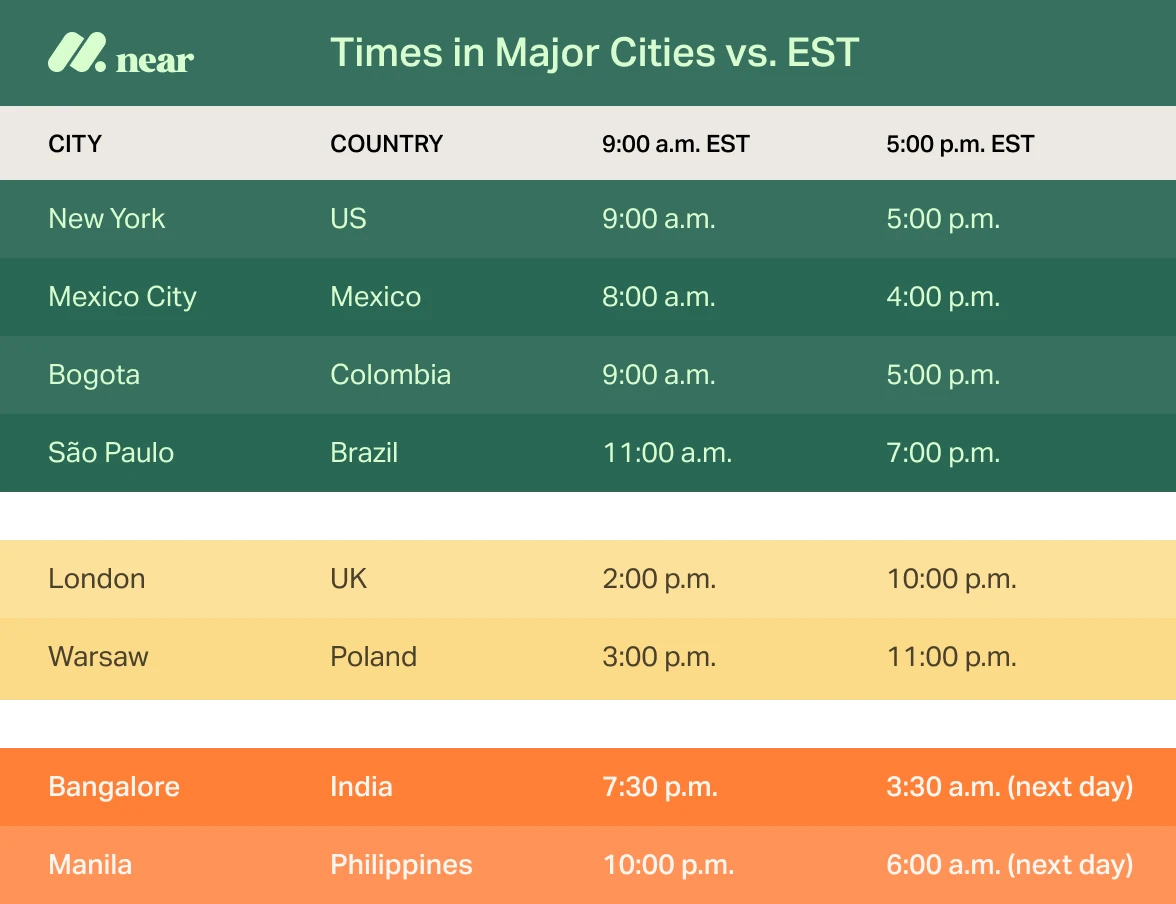
This makes a real difference in how work gets done. When Latin American developers keep your team moving, it's because they can jump on a call when you hit a blocker, join real-time design discussions, and review pull requests during your actual workday.
The other advantages you'll often hear about, cultural alignment, English proficiency, and familiarity with US business practices, are legitimate benefits. But the time zone overlap is what makes nearshore fundamentally different from offshore staff augmentation.
Further reading: Offshore vs. Nearshore: Why Latin America Stands Out for Software Development
Benefits of Nearshore Staff Augmentation for US Companies
Nearshore staff augmentation gives US companies two wins at once: it brings the cost savings of hiring abroad without the time zone friction, and it removes the administrative burden of hiring internationally.
For most US companies, those two things together are what make it worth considering.
Demand for the region's developers backs that up. According to Hire With Near's 2026 State of LatAm Hiring Report, demand for software engineers grew 250% year over year, jumping to become one of the fastest-rising roles US companies now hire in Latin America.
Franco Pereyra, Hire With Near’s Co-Founder and COO, has a rationale for why this is happening:
What sets Latin American talent apart from other regions is that you'll find people who are proactive and creative. People who come up with ideas and new solutions. If you're looking for folks who can bring something to the table, who will push back if they think your idea doesn't make sense, that's what you find in Latin America.
Cost savings compared to hiring in the US
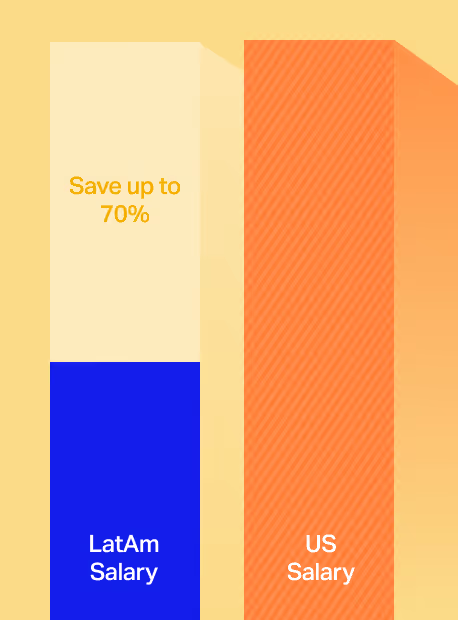
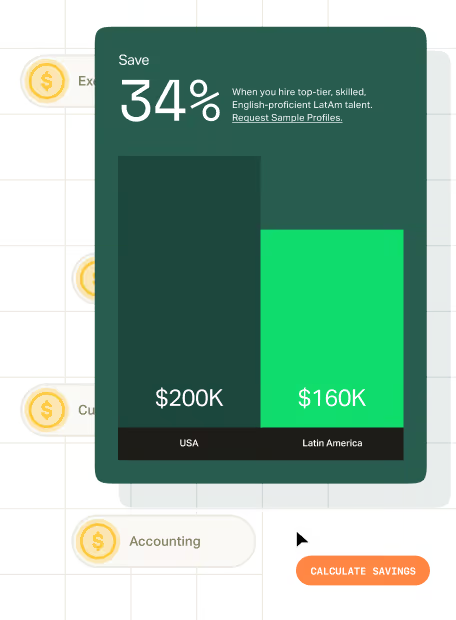
Hiring a developer in Latin America costs 30 to 70% less than the US equivalent, and the same budget buys you more seniority.
A senior full-stack developer in Latin America typically earns $72,000 to $108,000 a year, according to our salary data, compared with $104,000 to $184,000 for the equivalent US hire.
Even with a staff augmentation partner's service fee included, Latin American developer salaries still represent 30 to 70% savings against US rates, and that's before you factor in the cost of a failed hiring cycle or months of open headcount.
The difference is cost of living and local market conditions, not capability. Latin American engineers are doing the same work, with the same stacks, at salaries that reflect what's competitive in their market.
To put the range in concrete terms, here's what these engineering roles pay in Latin America compared with equivalent US hires, according to Hire With Near's salary benchmarks:
For the most up-to-date figures, see Hire With Near's US vs Latin America Salary Guide.
Read those ranges as budget enablement, not cheap labor: the budget required to hire a mid-level engineer in the US often covers the cost of hiring a senior engineer in Latin America. The savings hold at the top of the org chart too, whether you're adding one engineer or filling executive-level roles like an engineering manager or VP of engineering.
In my experience recruiting developers, clients are consistently surprised by the caliber of talent available in LatAm. They don’t expect to find senior engineers who’ve worked with major US companies, understand modern development practices, and often have more hands-on experience with specific frameworks than candidates they’d find locally.
According to GitHub's 2025 Octoverse report, Brazil now has 6.9 million developer accounts on GitHub. Country-level figures for the rest of Latin America weren't released in the 2025 edition, but the 2024 report counted Mexico at 1.9 million, Argentina at 1.1 million, and Colombia at over 1 million, all with double-digit year-over-year growth.
It's one of the fastest-growing developer ecosystems in the world, which is part of why companies can find strong candidates quickly rather than waiting months for the right person to surface.
The logistics are handled for you
Hiring internationally is genuinely complicated. Employment contracts under local labor law, payroll disbursement across borders, tax compliance in Argentina or Colombia, benefits administration: each of these requires expertise you probably don’t have in-house, and building it takes time you don’t have.
This is one of the main reasons US companies choose to work with a nearshore staff augmentation company rather than trying to hire LatAm engineers independently.
The staffing partner brings existing infrastructure across LatAm markets. They know what a competitive offer looks like in Buenos Aires right now, they manage payroll and compliance for every hire, and they handle the on-the-ground logistics, including equipment and workspace support, so none of that falls on your team.
The result is that you can go from first conversation to a developer in your sprint in under three weeks, without becoming an expert in international HR.
That speed and simplicity are a meaningful part of the value, not just the cost savings.
The talent itself is the other half of the value. This video digs into why Latin American engineers tend to click with US teams:
How Much Does Nearshore Staff Augmentation Cost?
The total cost of nearshore staff augmentation comes down to two things: the developer's salary and the partner's service fee. For most US companies, the combined cost still runs 30 to 70% below a comparable US hire, but the exact number depends on a few variables worth understanding before you sign anything.
Three factors drive the total:
- Seniority: a senior engineer commands a higher salary than a mid-level one, in Latin America just as in the US. You can see the full range by role in the salary table above.
- Tech stack: in-demand or scarce skills command higher salaries. Common stacks like .NET, PHP, and JavaScript are plentiful across Latin America; niche skills cost more because fewer people have them.
- Country: salary ranges vary across the region. Argentina and Brazil tend to run more competitively than Colombia and Mexico, though every market has strong talent at different price points.
How you pay for all of that depends on the commercial model, and there are two common ones.
The most common is paying an ongoing monthly rate that covers the developer's salary and the partner's fee for as long as the engagement lasts. With that model, you usually don’t know what the developer earns; you pay the staff augmentation provider, and they determine what share of that fee goes to the developer. The second model is one that is more transparent, where you know what the developer earns and what fee goes to the partner.
Fees vary widely from provider to provider, so ask any partner three things directly: what exactly is included in their rate, whether there are setup or offboarding costs, and what happens to the fee if a hire doesn't work out. A transparent partner will give you clear numbers before you commit; a vague answer here is a warning sign.
Types of Nearshore Staff Augmentation (Engagement Models)
Nearshore staff augmentation comes in three engagement models, and the right one depends on whether you have a defined project with an endpoint or an ongoing need for people who stay.
Project-based
Project-based engagements bring in developers for a specific deliverable with a clear start and finish, like building a feature, migrating a system, or clearing a backlog. This works well when the need is temporary and you know the work will wrap up.
The trade-off is continuity: once the project ends, the knowledge those developers built up usually leaves with them.
Dedicated team
A dedicated team is a group of developers who work only on your product for an extended period, often to stand up a new function or scale an existing one. You get more continuity than a project-based model and a team that grows familiar with your codebase.
It's a strong fit when you're building capacity you'll need for the foreseeable future.
Long-term embedded placement
Long-term embedded placement puts individual developers on your team as full members who are there to stay, not to rotate out at the end of a contract. This is the model for core product work, where you need someone who understands why past architecture decisions were made and will still be there a year later to build on them.
Which model you pick is really a question of how long you need the capacity, and that decision deserves its own section.
How to Choose the Right Partner for Nearshore Development
Choosing a nearshore development partner comes down to three things: how rigorously they vet engineers, whether their developers are looking to stay long term, and how honest they are about pricing and sourcing.
Whether you need one engineer or want to hire a nearshore development team, the partner you pick matters more than any single candidate.
Not all staff augmentation companies or staffing partners specializing in placing developers offer the same market knowledge or candidate quality.
A partner that specializes in nearshore IT and tech staffing knows what a competitive offer looks like in Buenos Aires or Mexico City today and can tell a strong resume signal from a weak one.
When evaluating options, look for:
- Transparent pricing with no hidden fees
- The ability to interview and approve candidates before they start
- Clear contracts around timelines, extensions, and termination
- A track record in your specific tech stack
- Honest answers about how they source: are they pulling from a fixed bench of available contractors, or doing a custom search for your role?
The biggest differentiator is vetting. A lot of companies come to a partner precisely because doing it themselves stopped scaling. As the head of a digital product agency that had been sourcing its own Latin American engineers put it:
We have been doing it ourselves and it's getting to be a lot of work. I feel like it would be faster, more efficient, and a better use of our time if these candidates were pre-vetted, pre-screened a little better.
Real vetting is more than a coding test. When I'm evaluating an engineer, I ask them to walk me through a project, what their role was and what they actually did, and whether they can explain it without drowning me in jargon.
That tells me two things at once: whether they did the work, and whether they can communicate with a team that isn't all engineers. I also tell clients not to make a US college degree a must-have. A lot of strong Latin American engineers started working before they graduated and never finished, and they're not weaker candidates for it.
You can see what the right partner delivers in a real hire. When Bonfire, an e-commerce platform, needed a senior UX Engineer, its design leader had been spending two to three months per role on manual LinkedIn and job board sourcing. Working with Hire With Near, sourcing and screening were handled for him, the search closed in six weeks, saved about $53,000 a year versus a US hire, and the engineer stayed more than two years.
Their VP of Product Management put it simply:
It was shocking to see the difference between the talent Hire With Near brought versus other firms I worked with.
The best staff augmentation companies make the process clear: you know exactly what you're paying, who you're getting, and what happens if it doesn't work out.
We keep a list of the top staff augmentation companies in Latin America, plus a broader roundup of the best nearshore staffing companies, to help you put together a shortlist.
Short-Term Placements vs. Long-Term Team Members: The Most Important Question to Ask
Most traditional staff augmentation firms are structured around short-term contractor rotation. Developers cycle between client engagements every 3 to 6 months, and those developers know it.
They're not there to build deep knowledge of your codebase or grow with your product. They're filling a slot until the next engagement. That model works well if you have a specific project with a clear endpoint and won't need that capacity long-term.
But a lot of companies come looking for staff augmentation because they need to scale development capacity, and what they actually need is people who stay. They need someone who'll understand why certain architecture decisions were made and who'll still be there in a year when they need to build on top of that work. Traditional staff augmentation isn't designed for that.
A smaller group of nearshore staffing companies, like us at Hire With Near, specialize in placing long-term developers: people who are specifically looking for a stable position where they can build real ownership of the work.
If you're going that route, it's worth reading up on how to build a nearshore team in Latin America before you start.
Key things to look for when comparing partners:
- How developers are sourced: Bench-based firms match you to whoever is currently available. Companies focused on long-term placements do a custom search for your specific role. It takes slightly more time but produces a meaningfully better fit.
- What the developers are expecting: Ask the partner directly. Are their candidates typically looking for 3- to 6-month contracts, or are they placing people who want a permanent position?
- How compensation is structured: With some staffing models, the partner controls the developer's compensation, and you have little input. With others, you set the salary yourself based on market benchmarks the partner provides, which matters a lot for retention.
Final Thoughts
Nearshore staff augmentation solves the two main friction points of offshore hiring: the time zone gap that forces good developers to do their best work at their worst hours, and the administrative burden of hiring internationally.
Latin America gives you developers who work when your team works, inside your workflow, at 30 to 70% below US developer rates, without you having to become an expert in cross-border payroll.
Whether you're weighing nearshore staff augmentation or a broader move to hiring remotely in Latin America, the part worth thinking through carefully is who you partner with. If you genuinely need short-term capacity for a defined project, a traditional staff augmentation company works well.
If you're building core product capacity and want developers who stay and grow with your codebase, look specifically for a partner that screens for long-term fit and places developers who want a permanent home, not their next 3-month engagement.
At Hire With Near, that's the distinction we build around.
We handle all the payroll, compliance, and employment logistics so you get the speed and simplicity of a staffing partner. But the developers we place are screened specifically for long-term fit: people who want a stable position where they can build real ownership of the work.
If you want to see what that looks like for your specific roles, whether you need to hire developers or stand up a full team, schedule a free consultation to talk through your requirements with our team.
{{latam-hiring-cta-v2}}
Frequently Asked Questions
What’s the difference between nearshore and offshore staff augmentation?
The main difference is time zones. Offshore staff augmentation typically involves contractors from Asia (India, Philippines, Vietnam) who work 10 to 13 hours offset from US time zones. "Nearshoring" focuses on Latin America, where developers work within a few hours of US time zones, enabling real-time collaboration.
The staff augmentation model itself stays the same regardless of location.
Which Latin American countries are best for nearshore staff augmentation?
Argentina and Brazil have deep tech talent pools and excellent engineering education. Mexico offers the closest time zone alignment for West Coast US teams.
Colombia combines strong talent with competitive costs.
But in my experience, you can find great developers throughout Latin America. The best country depends on your specific technical needs and budget, as each market has different strengths and salary ranges.
How much does nearshore staff augmentation cost?
Nearshore staff augmentation costs the developer's salary plus the partner's service fee, and the all-in total typically runs 30 to 70% below a comparable US hire.
What you pay depends on the engineer's seniority, their tech stack, and the country they're based in. Ask any provider exactly what's included in their rate and whether there are setup or offboarding costs, so you can pencil out the full number before you commit.
The salary table earlier in this guide shows typical annual ranges by role.
How do nearshore staff augmentation companies vet developers?
Strong nearshore partners vet developers with a technical assessment or take-home project, a walk-through where the candidate explains their past work, and an English and communication check.
The technical assessment confirms the person can actually code in production rather than just talk about it. The project walk-through, where a candidate explains what they built to someone non-technical, is where communication gaps show up.
Most rejections come down to those two filters: failing the technical test, or being unable to explain their work clearly. Ask any partner to describe their process step by step before you trust it.
How good is Latin American engineers' English, and can they communicate with your team?
Yes, engineers in the top Latin American tech markets generally speak strong professional English and can handle standups, code reviews, and architecture discussions with a US team.
Fluency matters more than accent here; what you want is someone who can articulate why a PR broke production or defend a design decision on a call. Look for markers like prior US-client experience and clear written documentation, and confirm it yourself in the interview. Countries like Argentina, Colombia, and Mexico consistently rank in the higher English-proficiency bands in the region.
How long do nearshore developers typically stay?
Developers placed in long-term, embedded roles tend to stay for years, while contractors on rotating engagements move on every few months by design, so retention depends on the model you choose.
If retention matters to you, choose a partner that places people looking for a permanent position rather than their next short contract. The developer Bonfire hired through Hire With Near, for example, stayed more than two years. When someone is hired into a stable role where they can build ownership of the work, they have a reason to stick around.
How long do staff augmentation contracts typically last?
With traditional staff augmentation, most contracts run 3 to 6 months before the contractor is rotated to another client. Some partners extend contracts if both sides agree.
If you’re looking for developers who stay and build institutional knowledge, look for a partner specifically focused on long-term placements. Those developers are placed with the expectation of staying indefinitely, not rotating out.
What's the difference between staff augmentation and direct hire?
With staff augmentation, the agency employs the developer and may rotate them between clients. You direct their day-to-day work, but the employment relationship sits with the agency. With direct hire, you bring the developer on as a full-time employee of your company. They work for you, not for an agency, and there’s no intermediary involved after they start.
The practical difference comes down to control and continuity. Staff augmentation gives you the flexibility to end the engagement when a project wraps up. Direct hire gives you a team member who is invested in your company specifically, not just available for their current assignment.
A company like Hire With Near sits somewhere in between: we handle payroll, compliance, and employment infrastructure in the background, but the developer reports to you, you set their salary, and the hire is yours for the long term.
How much day-to-day control do I have over a nearshore developer?
You direct their work the same way you would any member of your team: what they build, how they prioritize, which meetings they attend, and how they fit into your standups and sprint. A nearshore developer placed for a long-term, embedded role works as a full part of your team and takes direction from your leads, while the staffing partner handles payroll, compliance, and local benefits in the background so none of the employment logistics fall on you.
The one thing worth confirming with any partner is whether their developers are placed for the long term or rotated between clients every few months. That determines whether the person stays embedded with your team and grows with your codebase, or moves on just as they've gotten up to speed.
What other tech roles can I hire in Latin America?
Beyond full-stack developers and software engineers, US companies hire a wide range of tech roles in Latin America, including back end developers, front end developers, QA engineers, DevOps engineers, data engineers, and machine learning engineers. Latin American talent in these roles typically offers the same technical depth as US-based professionals, with better time zone alignment than offshore alternatives and cost savings of 30 to 70%.







.webp)


%203.svg)
.avif)





%20(1).avif)

%20(1).png)