


%203.svg)
Key Takeaways
- Time zone misalignment creates invisible productivity drains that compound over time, turning "quick fixes" into multi-day delays and blocking critical decision-making when teams can't collaborate in real-time.
- The "follow the sun" development model sounds efficient but rarely works in practice because most software development requires iterative collaboration, not assembly-line handoffs between distant teams.
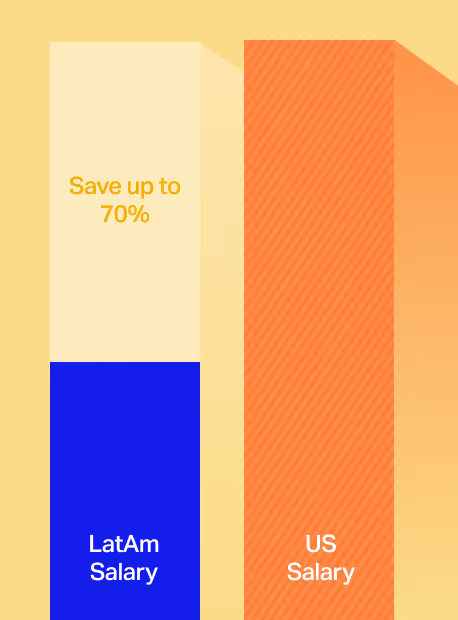
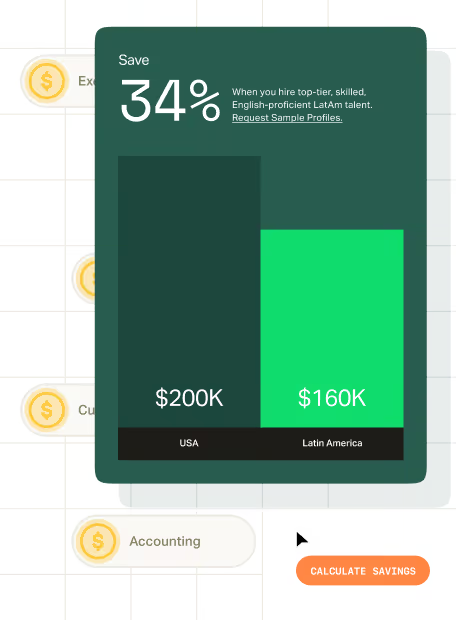
- Working with developers in Latin America gives you hiring costs 30% to 70% below US rates, with time zone overlap that enables real-time collaboration and faster project velocity.
You decided to augment your team with offshore developers to move faster and save money. Instead, you're watching critical bugs discovered at 2 p.m. sit until your India team starts their day, sprint planning sessions that span three days because of scheduling conflicts, and "quick questions" that take 24 hours to get answered.
The collaboration friction is killing your development velocity. What should be rapid iteration cycles have turned into slow, frustrating handoffs. Your team is working harder just to maintain momentum, and you're starting to wonder if the cost savings are worth the operational headaches.
This isn't about the skills of offshore developers. It's about the hidden costs of time zone misalignment that no one talks about when they're selling you on "global talent pools."
There's a better way to staff this: hiring developers in Latin America, where the workday actually overlaps yours.
Across the 950+ US companies we've helped build Latin American teams for, I've had this conversation more times than I can count. It's not a niche problem.
Hire With Near's research on why US companies hire in Latin America, an analysis of 2,000+ hiring conversations, found that 30% of the companies looking at the region are moving off an offshore model, and time zones are the reason they give.
What Is The Problem with Traditional Offshore Development?
The problem is that a 12-hour gap turns every clarification into a lost day. The engineering leaders we work with tell us the same stories:
- "The handoffs are brutal." A simple API question turns into a multi-day process when your developer needs clarification but won't see your response for 12 hours.
- "Our retrospectives are always about communication." When you can't collaborate in real-time, everything breaks down to delayed feedback and missed context.
- "We're spending more time managing than building." The overhead of coordinating across massive time gaps starts eating into the very savings you hired for.
You know how development works. It's iterative, collaborative, and depends on quick feedback loops. But when those feedback loops are broken by time zones, even simple tasks become complex.
Why Hiring Developers in Latin America Changes Everything
You might not get "follow the sun" development, but you can get a whole lot more done while the sun is up for your entire team.
The companies that switch from traditional offshoring to Asia to building development teams in Latin America transform how fast they ship.
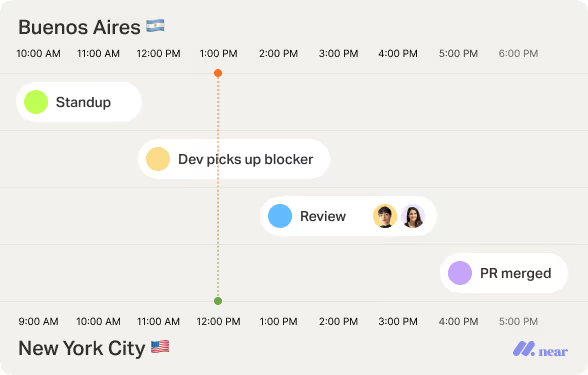
Latin America spans roughly the same band of hours as the continental US, so your engineers are online during your business day, wherever your team sits. Nobody works nights to make that happen.
Here's roughly how the region lines up with a US workday:
Most Latin American countries don't observe daylight saving time, so the exact gap shifts by an hour twice a year.
This means standups where everyone's there. Sprint planning that happens in a two-hour session instead of three days of back-and-forth emails. Production issues that get fixed same day.
One of our clients described the shift:
Yesterday, we found a bug in production at 3 p.m. Our developer in Colombia was online, we jumped on a call, walked through the issue together, and had a fix deployed by 4:30 p.m. Six months ago, with our India team, that would have been a next-day fix at best.
When you can flag a problem at noon and ship the fix by the end of day, your entire development velocity changes.
Your developers in Latin America can join your daily standups, participate in planning sessions, and contribute to technical discussions as full team members. They're not catching up on what happened while they slept; they were part of the conversation.
What Experienced Engineers in LatAm Bring
The CTOs we work with also tell us that developers in Latin America bring more than matching working hours. They also have:
- Strong English communication skills for clear technical discussions
- Experience working with US companies and development practices
- Familiarity with modern tech stacks and methodologies
- Ownership and reliability that the engineering leaders we place for consistently call out
Julia Guillen, Senior Tech Recruiter at Hire With Near, sees that reaction on search after search:
Clients are consistently surprised with the caliber of talent that's available in Latin America. They don't expect to find senior engineers who've worked with major U.S. companies, understand modern development practices, and often have more hands-on experience with specific frameworks than candidates they'd find locally.
— Julia Guillen, Senior Tech Recruiter, Hire With Near

Final Thoughts
If you're dealing with the collaboration friction of traditional offshoring, you don't have to choose between cost savings and operational efficiency.
Developers in Latin America offer significant cost advantages (typically 30% to 70% less than US developers) with the time zone alignment that makes distributed teams work.
We've now worked with 950+ US companies making the transition from traditional offshoring to building teams in Latin America, and the pattern I see is consistent: they wish they'd made the switch sooner.
If you're still weighing it, our guide to hiring remotely in Latin America covers how the model works in practice.
A 12-hour gap costs you more than slow replies. Momentum leaks out between handoffs, and that friction compounds across your whole development cycle.
You already know how software development works best. LatAm hiring just gives you the team structure to make it happen efficiently.
Ready to build a LatAm development team that works when you work?
Hire With Near recruits from a talent pool of 160,000+ pre-vetted candidates, and we fill 97% of the roles we take on. That's how companies hire developers in Latin America quickly without lowering the bar.
Schedule a free, no-commitment consultation call to see how we can help you build a high-performing team with real-time collaboration and significant cost savings.
{{latam-hiring-cta-v2}}
Frequently Asked Questions
How much does it cost to hire a developer in Latin America?
US companies save 30% to 70% compared to US salaries, depending on seniority and tech stack.
For example, here are the average annual salary ranges for a full-stack developer, according to Hire With Near's 2026 salary data:
- Junior: $36,000 to $46,000 in Latin America vs. $83,000 to $142,000 in the US
- Mid-level: $48,000 to $72,000 in Latin America vs. $90,000 to $154,000 in the US
- Senior: $72,000 to $108,000 in Latin America vs. $104,000 to $184,000 in the US
Across seniority levels, that lands inside the 30% to 70% range companies typically save by hiring in Latin America, while still paying competitively for the region.
For the most up-to-date figures, see Hire With Near's US vs Latin America Salary Guide.
How long does it take to hire a developer in Latin America?
When you work with Hire With Near, the process is fast. We send a shortlist of vetted candidates in 3 to 5 days after the kickoff call, and most of our clients make a hire in under three weeks. That's much faster than DIY recruiting, which can stretch into months.
Speed doesn't have to mean cutting steps. One US healthtech startup hired 7 senior engineers at a 14-day average time-to-hire while keeping its full 8-step interview process intact, and saved $323,000 a year against US salaries.
Should I hire a dedicated developer or work with a development agency?
Hire a dedicated developer if you're building ongoing engineering capacity; an agency fits short, self-contained projects. Here's the difference:
- Development agencies can make sense for quick, short-term projects, but you’re renting talent. Engineers often rotate off projects, and communication goes through project managers instead of directly with the devs.
- Dedicated developers hired through a recruiting and staffing agency like Hire With Near become part of your team. They join your standups, work your hours, and stick around long term, building institutional knowledge.
If you want speed and real team integration, dedicated hiring through a partner is usually the better choice. We cover the benefits in more detail here: Why Forward-Thinking CTOs Are Turning to LatAm to Build Better Engineering Teams.
Our guide to how to hire Latin American developers compares the hiring models side by side.
What developer roles can I hire in Latin America?
US companies hire the full range of developer roles in Latin America, from front-end and full-stack to specialized engineers.
Common hires include back-end developers, Angular developers, and Vue.js developers, all working in overlapping US time zones so they collaborate in real time, which is the same productivity advantage this article describes.
If you're building out a wider engineering org, IT and tech recruiting in Latin America covers the full set of roles companies staff this way.
Can I hire developers for specialized work like mobile, Python, or QA in Latin America?
Yes, Latin American teams cover specialized development, not just generalist engineering.
Common needs include mobile app developers, cross-platform Flutter developers, Python development, web developers, and dedicated QA and software testing. If you'd rather compare providers first, see our roundup of the top companies for outsourcing software development. For full-time hires rather than project work, our list of the best LatAm staffing firms is the closer match.







.webp)


%203.svg)
.avif)





%20(1).avif)

%20(1).png)