.webp)


%203.svg)
Key Takeaways
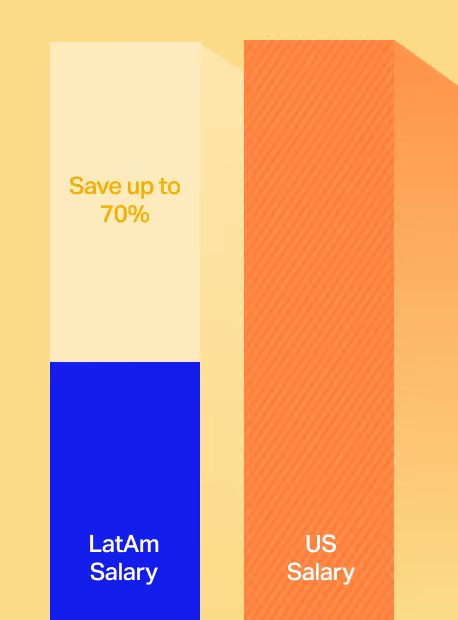
- US companies choose Latin America for offshore software development because they can hire experienced engineers who work during their own business hours, at salaries 30–70% lower than US equivalents, with strong English and the same technical depth as US developers.
- Latin America added 3.2 million net new developers on GitHub in a single year, and Brazil is now the fourth-largest developer community in the world.
- Brazil, Mexico, Argentina, and Colombia stand out for their deep tech ecosystems, competitive salaries, and government-backed programs supporting IT hiring.
Scroll through Google Maps and just south of the US, you'll find 7.9 million square miles of diverse countries, cultures, and cities we all know as Latin America.
The region is home to a rapidly growing tech industry, where expert developers are building everything from fintech platforms to AI-driven applications. That's opened up a real opportunity for US companies: offshore software development in Latin America gives you access to top talent, competitive rates, and time zones that make real-time collaboration easy.
In this article, I'll break down the differences between nearshoring and offshoring, highlight the best offshoring hubs, and share tips for working with Latin American teams. Whether you're hiring your first offshore dev or scaling up to a full team of software engineering talent in Latin America, there's plenty to explore.
Why Do US Companies Choose Latin America for Software Development?
US companies choose Latin America because it's the only offshore region that combines a large, fast-growing engineering community with a working day that lines up with theirs, at salaries well below US rates.
For companies looking to scale without overspending, nearshore development in Latin America is an increasingly popular choice. The region is thriving with a growing pool of highly skilled developers fluent in JavaScript, Python, Java, C#, and TypeScript.
And if your project requires more specialized expertise, you won't have to look too hard. While languages like Rust, Kotlin, and Scala may not be as common, they're becoming increasingly accessible as LatAm's developer community matures.
The scale is easy to underestimate. According to GitHub's Octoverse 2025 report, Latin America added 3.2 million net new developers on GitHub in a single year, with Brazil, Mexico, and Colombia named the region's stand-out markets. Brazil alone now has 6.89 million developers on the platform, the fourth-largest community in the world, and GitHub projects 19.6 million by 2030.
Hire With Near has helped hundreds of engineering leaders make this decision, and the pattern is consistent: they don't come to the region looking for a discount. They come because they've run out of ways to hire the seniority they need at home, and Latin America is the only place they can add that person to the team without also adding a twelve-hour handoff.
Government policy and trade agreements are accelerating the pipeline
Latin America's rise as a tech offshoring hub isn't random. It's backed by government initiatives and international trade agreements. Free trade deals like CAFTA-DR and bilateral free trade agreements with Chile, Colombia, Panama, and Peru have made cross-border collaboration with US businesses easier than ever.
Workforce upskilling is another key factor. According to the World Economic Forum's Future of Jobs Report, 84% of employers in Latin America and the Caribbean plan to upskill their own workforce for digital and tech skills. Another 81% are accelerating task automation, and 68% expect to hire staff with new skills.
The WEF's regional analysis names broadening digital access as the most transformative trend in Argentina, Brazil, Colombia, and Mexico, with big data analysts and AI specialists among the roles set to surge. The Future Investment Initiative Institute's Future of Work report, covering 19 Latin American and Caribbean countries, reaches a similar conclusion on the region's readiness for AI-driven work.
Employers, governments, and developers are all pushing in the same direction, which is why the talent pool keeps deepening instead of plateauing.
Nearshore vs. Offshore: How Does Latin America Compare with Other Regions?
“Offshore” is an umbrella term for hiring talent in any country outside your own, whether that's a developer in India, Poland, or Brazil. Within that broader category sits nearshore, a term whose meaning is rooted in its own name: hiring in a country close enough that your workday still overlaps. For US companies, nearshoring means hiring in Canada or countries in Latin America, where our focus is in this article.
Time zone alignment: Real-time collaboration
Latin America's advantage over distant offshoring regions like Asia or Eastern Europe is the working day: your engineers are online while you are, so stand-ups, code reviews, and blockers get handled the same day instead of the next.
Here's how the main Latin American time zones line up with the four US time zones:
Time zone differences might not seem like a dealbreaker until you're stuck in a cycle of delayed responses. Imagine your project manager in Denver staring out the window at the sunset, wrapping up tasks on their Gantt chart for the afternoon. Meanwhile, your Python developer in the Philippines is only just greeting the sun and waking up to their morning coffee. That's a full workday lost before the first update even comes in.
Engineering leaders describe the consequence in throughput, not convenience. One founder of a web3 startup told us:
We currently have a senior QA that is focused on both manual testing and automation. She's based in Sri Lanka, and I don't get her enough during my day to actually allow us to keep on that high quality and high throughput for my team. We often release without her. So it's not good, right?
In Hire With Near's analysis of 2,000+ conversations about why US companies are exploring Latin American hiring, 30% said they were switching from offshore to nearshore specifically to close the time zone gap. If you hired a developer in LatAm, say, Colombia or Peru, they would be online at the same time, keeping projects moving in real time.
Cultural and business alignment
Business hours line up, but so does the way people work inside them: agile sprints, async standups, and direct feedback loops are standard practice across Latin America's tech sector, not something a new hire has to learn on the job.
English fluency at the professional level is common, especially among engineers who've already worked with US clients, so there's no translation layer slowing down a code review or a product discussion.
And the communication style itself tends to match what US teams expect: direct, opinionated, and comfortable pushing back rather than defaulting to agreement. This is something US leaders notice fastest. Hire With Near's Co-founder and COO put it this way:
What sets Latin American talent apart from other regions is that you'll find people who are proactive and creative. People who come up with ideas and new solutions. If you're looking for folks who can bring something to the table, who will push back if they think your idea doesn't make sense, that's what you find in Latin America.
— Franco Pereyra, COO and Co-founder, Hire With Near
That's the kind of fit US teams notice quickly: engineers who don't just execute a spec, but think alongside the team the way a US hire would.
In the video below, Hayden Cohen, Hire With Near's CEO and Co-founder, explains how to spot cultural fit when interviewing a developer for an open position:
Talent quality and availability
According to Hire With Near's 2026 State of LatAm Hiring Report, software engineer was the fastest-rising role in our 2025 placements, up 250% year over year and jumping 12 spots to the sixth most-filled role. Of those engineering placements, 51% were senior and 47% mid-level.
US demand moved the same way: the SignalFire State of Talent Report found mid- and senior-level tech hiring recovered in 2024 while entry-level hiring kept contracting. The experienced engineer you can't find locally is the one every other US company is chasing too.
One of our recruitment consultants, Julia Guillen, sees the reaction on nearly every search:
Clients are consistently surprised by the caliber of talent that's available in LatAm. They don't expect to find senior engineers who've worked with major U.S. companies, understand modern development practices, and often have more hands-on experience with specific frameworks than candidates they'd find locally
— Julia Guillen, Recruitment Consultant, Hire With Near
Latin America's developers are fluent in modern tech stacks, from JavaScript and Python to cloud platforms and AI tools, and finding specialized expertise is often easier there than in markets where competition for experienced software engineers is more intense.
Cost competitiveness: strategic economics
Latin America pairs senior-level engineers with lower salary costs, which is why it offers one of the best price-to-quality ratios in nearshore software development. You hire an A-player engineer while paying less than a B-player US hire would cost you.
The reason for that is cost of living, not cutting corners. Living expenses in LatAm tech hubs run far below US cities, which is why a salary 30–70% under the US equivalent still buys a better standard of living locally.
A developer in Buenos Aires or Mexico City can maintain an excellent standard of living on a salary that would barely cover rent in San Francisco. So you can pay competitive local rates that attract great engineers and fit your budget, which is a very different thing from paying someone less than they're worth.
Companies like Microsoft, PwC, JP Morgan, and Google have been building teams in Latin America for decades. Thanks to remote work becoming standard, smaller companies now hire from the same talent pool.
Related reading: Nearshore vs. Offshore vs. Onshore: Compare Outsourcing Types
How Much Does It Cost To Hire Software Developers in Latin America?
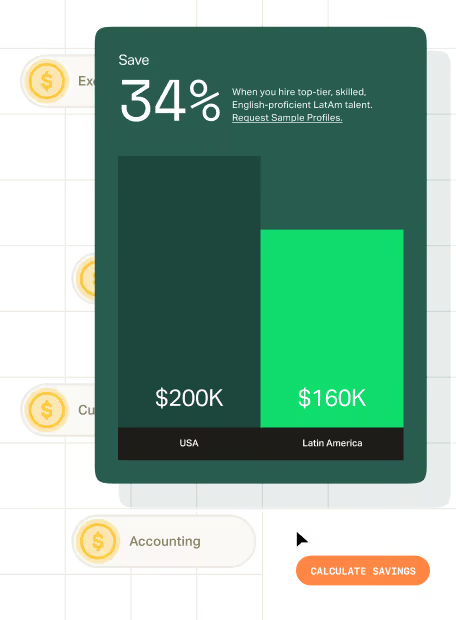
Hiring a software developer in Latin America typically costs between $30,000 and $108,000 a year, depending on the role and seniority, against $66,000 to $238,000 for the same hire in the US.
Here's what hiring five of the most commonly requested engineering roles costs compared to equivalent US hires, according to Hire With Near's own salary benchmarks:
For the most up-to-date figures, see Hire With Near's US vs Latin America Salary Guide.
Our placement data shows 98% of the engineers we place are mid-level or senior, so a realistic budget lives in the middle-to-upper part of the Latin America column.
Pay at the bottom and you're bidding against every local employer for the same candidates, and losing. Pay in the upper half and you hire an engineer with a decade of experience for less than a mid-level US hire costs you today.
Our offshore developer rates guide covers how those figures compare with other regions.
Related reading: Nearshore Salesforce Development: How to Hire in Latin America in 2026
Which Latin American Countries Are Best for Software Development?
Brazil, Mexico, Argentina, and Colombia are the strongest countries for software development in Latin America: they have the region's largest engineering communities, the deepest experience working with US companies, and enough English depth to staff a full team. Chile, Costa Rica, and Peru are strong second-tier options, depending on your stack and budget.
Read two numbers side by side for each country below: its developer community on GitHub, which shows depth, and its share of our own placements, which shows where US companies hire most. Colombia leads our placements at 23%, followed by Argentina at 21% and Brazil at 14%, and Brazil is our busiest country for IT and engineering roles.
Here's how the seven compare.

1. Brazil: The powerhouse of Latin American tech
With over 500,000 professional developers, Brazil has the region's largest tech workforce, excelling in AI, IoT, and mobile app development. The wider community is bigger still: GitHub's Octoverse 2025 report puts Brazil at 6.89 million developer accounts, fourth in the world.
Centered in Brasília Time (UTC-3), Brazil’s major tech hubs sit just one to two hours ahead of US Eastern Time. Because Brazil operates on standard time year-round, engineers there share at least a half-day of real-time overlap with West Coast teams and an almost entire workday with the East Coast.
In our experience, English proficiency among Brazilian developers is moderate to high. Our guide to hire developers in Brazil covers salaries, sourcing, and what to expect.
2. Argentina: The science & technology hub
Argentina leads in telecommunications, IoT, and AI development, with more than 1.1 million developers on GitHub as of its 2024 Octoverse report and 22% year-over-year growth.
This is the country we see the most US companies hiring from. However, it's not the cheat code for growth it once was. For a long time, inflation was out of control and demand for US dollars was off the charts. Now that the peso is stabilizing, local employers are offering better salaries and benefits that offshore contracts often don't include.
Your dollar still goes farther than it would in the US, and Argentina's engineering talent is genuinely deep. The country's telecom and fintech sectors have produced a large pool of engineers comfortable with high-traffic distributed systems, cloud migrations, and data-heavy platforms.
Our guide to hire developers in Argentina goes through the tradeoffs. Like Brazil, Argentina runs one to two hours ahead of the US East Coast, with the gap shifting when US clocks change.

3. Mexico: The nearshoring champion
Proximity to the US makes Mexico a prime nearshoring choice, and its community is the region's second-largest: over 1.9 million developers on GitHub as of the 2024 Octoverse report, growing 21% year over year.
USMCA agreements simplify hiring and Mexico broadly aligns with US Central Time, so most US teams get a nearly complete working day of overlap.
We find the English proficiency of Mexican developers is really high, so you can expect a good level of communication efficiency there.
Start with our guide to hire developers in Mexico if it's your first hire in the country.
4. Colombia: Hire With Near's number one hiring destination
Colombia accounts for 23% of all the placements we make, more than any other country in the region, and it passed a million developers on GitHub in the 2024 Octoverse report with 25% year-over-year growth.
Tech talent there is supported by ProColombia, a government initiative that attracts foreign investment and strengthens the IT sector through funding, training, and tax incentives.
With moderate to high English proficiency and Bogotá roughly aligned with US Eastern time, US teams collaborate through the full working day without scheduling problems.
Our guide to hire developers in Colombia walks through the market, salaries, and hiring process.

5. Chile: Stability meets innovation
As an OECD member since 2010, Chile benefits from strong economic policies, a rising GDP, transparent regulations, and sustained infrastructure investment, making it one of the most stable offshoring destinations in Latin America.
With high English proficiency and a working day that sits 0 to 2 hours ahead of US Eastern Time depending on opposite Daylight Saving shifts, Chile offers reliable operations and a well-developed tech ecosystem.
Our guide to hiring software developers in Chile covers the market in practice.
6. Costa Rica: The Silicon Valley of LatAm
Costa Rica is top-ranked in Latin America for business environment and tech innovation, and it's easy to see why. Intel's $1.2 billion investment in semiconductor production, announced in 2023, fueled a thriving tech sector and attracted engineering talent.
With very high English proficiency and a working day that lines up closely with US Central Time, it's one of the region's top countries for offshore software development in Latin America.
Read our guide to hire developers in Costa Rica if you're considering it.

7. Peru: An emerging fintech & AI hub
Peru has been expanding its tech sector through education and AI-driven workforce development, and it posted the fastest developer growth of any LatAm country in GitHub's 2024 Octoverse report: 27.5% year over year, to more than 583,000 developers.
The country is also investing heavily in infrastructure upgrades, and as its fintech and AI industries grow, upskilling initiatives keep building the developer pipeline.
With moderate English proficiency and a working day closely aligned with US Eastern time, Peru is an increasingly attractive option for offshore software development in Latin America.
Our guide to hiring in Peru covers the market in more detail.
{{state-latam-hiring}}
What Are The Options for Hiring Software Developers in Latin America?
You have five realistic options: source and hire on your own, use a freelance platform, hand the work to an offshore development shop, use staff augmentation, or work with a specialist staffing and recruiting partner.
For most companies building a permanent engineering team, relying on a staffing and recruiting company is the fastest route to a great hire.
Here they are from most complex to simplest.
Option 1: Source and hire on your own
Sourcing and hiring on your own means you find and vet candidates yourself, then take on the employment relationship directly. For a cross-border hire, that requires one of two mechanisms:
- Set up a legal entity: Registering a company in the country gives you full control, but it takes months to establish and carries real legal and accounting overhead. This route only makes sense once you're building a substantial in-country presence, not hiring one or two developers.
- Use an employer of record: An employer of record company becomes the legal employer of your developers on paper, handling contracts, payroll, tax withholding, local benefits, and compliance without you needing your own entity.
It's important to note that an EOR handles employment logistics, not recruiting. You still have to find, screen, and vet every candidate yourself, in a market you probably don't know, against salary expectations you have no benchmark for.
You can source through LinkedIn or a job board for hiring in Latin America, but that sourcing and vetting work is the part that actually takes time.
Option 2: Freelance and contractor platforms
Platforms like Upwork and Toptal give you fast access to contractors, which suits short-term or project-based work. However, they're a poor fit for a full-time engineering hire: the developer is splitting attention across several clients, quality and retention are entirely your problem, and there's no continuity when they move on.
For permanent roles, specialist staffing gives you fundamentally different results for full-time remote hires.
Option 3: An offshore development shop
This is the route most companies mean when they set out to outsource software developers in Latin America. A dev agency takes a scope of work and delivers it with its own team, which is reasonable for a defined project with a clear end date.
The catch shows up when the work is your core product: knowledge of your systems lives with contractors who eventually roll off, and it leaves with them.
In the video below, Hayden Cohen explains why top developers prefer joining a team directly over working through a dev shop:
Option 4: Staff augmentation
A staff augmentation firm maintains a bench of pre-vetted engineers and places them directly onto your team, working under your day-to-day direction as if they were your own hires. The firm remains the legal employer behind the scenes, handling payroll, benefits, and compliance, while you manage the actual work.
That structure sits between a freelance platform and a permanent hire: you get far more vetting and accountability than a marketplace search would give you, plus more flexibility than committing to permanent headcount, since the engineer can roll off once the engagement ends.
It fits teams staffing a defined project or adding capacity they may want to scale back later, rather than teams looking to build a long-term, dedicated team member.
Related reading: What Is IT Staff Augmentation and How Can It Benefit Your Business?
Option 5: A specialist staffing and recruiting partner
A specialist staffing and recruiting partner sources, vets, and employs the engineer for you in one relationship, which makes it the simplest option for most US companies. You describe the role; the partner sources and vets candidates against your requirements, presents a shortlist, and then handles payroll, benefits, and local compliance once you hire.
It's better because you skip both hard parts, finding qualified candidates and setting up cross-border employment, and get a full-time team member instead of a contractor on loan.
Hire With Near does exactly that through our nearshore staffing and nearshore software engineering staffing services, and the engineer joins your team as a full-time member of it, not as an outsourced contractor.
The choice between the last two options comes down to two questions: how permanent is this role, and do you want to employ the person yourself?
How Does the Hiring Process for Software Developers Work?
A nearshore engineering hire runs on roughly a three-week clock: a shortlist in 3 to 5 days, your own interview loop over the following week or two, then an offer.
Here's what happens at each step:
- Intake on the role and the stack: We go through the real technical requirements, not the job title. That means the frameworks in production, the seniority the team needs, who the person reports to, and whether your stack has real depth in the region.
- Sourcing against your requirements: Every search is a fresh headhunt built around your role. We're not forwarding you whoever happens to be sitting on a bench, and that difference shows up in the shortlist.
- English assessment: This happens before you see a candidate, and the bar is technical communication under pressure. We ask them to explain why a deploy broke, write documentation another engineer can follow, and hold their own in an architecture review. Conversational fluency isn't the test.
- Screening interviews: Our recruiters screen for the signals your hiring managers would test for. One of our recruiters describes what he looks for:
The main thing I look for is ownership. I always look for developers who have worked in startups or smaller companies, because those are the people who probably have ownership. If you bring them a problem, they won't ask how to solve it, they'll try their own ideas, they'll be creative.
— Federico Bilello, Recruiter for Software Engineering, Hire With Near
- Your interview loop: You keep your own technical bar. We don't replace your coding assessment, your system design round, or your team interviews, and we don't ask you to lower the bar to hit a timeline.
- References and background checks: Run before an offer goes out, not after.
- Offer guidance: We tell you what the local market pays for that seniority so your offer is competitive where the candidate lives, and we help you close.
- Onboarding: Contracts, payroll, benefits, equipment, and local compliance, handled so the engineer's first day looks like any other new hire's.
Our guides on how to hire remotely in Latin America and running a nearshore team go deeper on building a team this way.
What it looks like in practice: ParkMobile
ParkMobile, a parking and mobility platform used in 4,200+ cities, had its back-end and platform engineering done by third-party agencies for years. Every time a contractor rolled off, the knowledge of ParkMobile's systems left with them, which their Head of Engineering for Mobile Payments and Billing named outright as a business risk.
They wanted their own senior engineers, but US rates of $148,000 to $214,000 per role ruled out building the team domestically, and Colombia, the market they wanted to pilot, was one they had never recruited in.
We ran sourcing, English screening, and candidate management inside ParkMobile's own ATS, screening for exactly what their hiring managers would test: whether a candidate could reason through tradeoffs, communicate under pressure, and own product work independently.
First shortlists landed within a week of kickoff, hires closed in 24 days on average, and we placed more roles than any other channel, including ParkMobile's internal sourcing. The result: nine senior platform, back-end, and iOS engineers in Bogotá, at $1,066,085 in annual savings against US rates, a 73% reduction.
ParkMobile's TA Lead described the outcome this way:
The engineers we hired are performing exceptionally well. They show up, they take accountability, and they take a genuine interest in the team.
— Akshay Gokarnakar, TA Lead, ParkMobile
The screening mattered even more because ParkMobile's Colombia team is fully remote, with no local office to anchor culture around. In the clip below, Akshay explains why getting the vetting right was the deciding factor for a team built that way.
That's also the answer to whether this scales. Once ParkMobile's B2B leadership saw what the team was delivering, they expanded the program and started hiring team leads in Colombia.
That progression is where our executive search for engineering leadership work usually begins: a first hire, then a team, then the people who run it.
Is Hiring in Latin America Always the Right Choice?
Hiring in Latin America is the wrong call in four situations, and it's worth naming them plainly rather than watching a company force it. Across the 950+ US companies Hire With Near has helped build LatAm teams for, the ones who get this decision right checked these first.
- You need someone physically on-site, or in an onshore-only compliance regime: Hardware labs, secure facilities, and contracts requiring US-based personnel don't bend for a remote hire, however good.
- Your stack is niche, legacy, or hardware-adjacent: The region has enormous depth in JavaScript, Python, Java, .NET, and modern cloud tooling. It's thin in some specialized and older ecosystems, and a thin market means a long search, not a cheap one.
- You need someone starting next week: Three weeks to hire is fast, but the engineer still has to give notice. If your project ships next quarter with zero slack, a contractor or a dev shop is the honest answer.
- You want a fixed-scope project delivered turnkey: If you don't want a team member and don't want to manage one, you want an agency, not a hire. That's a legitimate choice, just a different one, and the hire in-house or outsource question is worth settling first.
Outside those cases, the model works for the reasons this article lays out: real seniority, a shared working day, and salaries that let you hire the engineer you need.
The questions tech leaders ask about hiring developers in Latin America and the misconceptions about offshore development that trip companies up are both worth reading before you commit.
How Do You Work Effectively With a Latin American Development Team?
Working well with a Latin American development team comes down to three things: clear communication tools, expectations set on day one, and the right hiring partner behind the team.
Here's how to build a strong working relationship with your LatAm developers and pick the right outsourcing company:
- Use the right communication tools: Every engineer needs to know what's in flight and what changed. Platforms like Slack for real-time chats, Jira for project tracking, and GitHub for version control keep that visible to the whole team.
- Set clear expectations from day one: Outline project goals, deadlines, and deliverables early to avoid confusion. Get project managers involved in sharing roadmaps to maintain priorities and work efficiently.
- Pick the right hiring partner: Look for companies with experience in your particular tech stack, good client reviews, and a history of successful projects, and expect that information to be easy to find. You also need to decide which kind of partner you want. There are three choices: an end-to-end development company you hand your whole project to, one of the nearshore software development companies that staffs a team for you, or a specialist recruitment company to hire nearshore developers whose placements join your own team.
- Check infrastructure reliability: Most of the cities in Latin America have reliable infrastructure, but it's still wise to confirm that your team has stable internet, secure systems, and proper cybersecurity measures in place.
- Understand legal and contract details: Different countries have unique labor laws, tax regulations, and IP protections. Make sure contracts are airtight to avoid compliance issues later. Or work with a partner who will handle compliance with local labor laws for you.
Follow these steps and you will build a team of skilled developers in Latin America while keeping collaboration smooth and efficient. The common nearshore outsourcing mistakes piece covers what tends to go wrong.
Final Thoughts
If you're struggling to find developers locally or your hiring budget is getting squeezed, Latin America offers a practical solution that doesn't force you to compromise on quality.
The key is approaching nearshoring strategically. Look for developers who have experience working with US companies, strong English skills, and expertise in your tech stack. The time zone alignment means they'll be online when you are, and the cultural similarities make collaboration easy.
Our team at Hire With Near can help with every step, from sourcing and screening to making competitive offers that attract top talent. We've spent years building relationships in the LatAm tech community, so we know exactly what it takes to hire and retain the region's best developers.
Our process digs deep to understand your company culture. Sure, we know our front-end from our full-stack and our JavaScript from our Java, but finding the right developer isn't just about checking technical boxes. It's about finding someone who will thrive in your team's environment and contribute to your company's success.
Ready to explore offshore software development in Latin America? Book a free consultation call to talk through your specific requirements with our team. We'll give you salary benchmarks and explain how the process works.
{{latam-hiring-cta-v2}}
Frequently Asked Questions
What types of software engineers can I hire from Latin America?
Latin America has a diverse pool of specialized software engineers across various technologies. Companies commonly hire front-end developers, nearshore mobile developers, and Latin American data engineers.
Whether you need expertise in React, Java, Python, or cloud platforms, LatAm's tech ecosystem has professionals skilled in modern development frameworks and practices.
Should I use a staffing agency to hire Latin American developers?
Using a software engineer staffing agency can cut your time-to-hire from the 3 to 6 months a US search takes to under three weeks, and it removes the complexity of international recruitment.
Specialized agencies maintain pre-vetted talent pools, handle compliance and payroll administration, and understand the nuances of different Latin American tech markets.
This approach is particularly valuable if you lack in-house expertise in sourcing, screening, and onboarding international developers, or if you need to fill roles quickly without building internal recruitment infrastructure.
What specialized developer roles are available in Latin America?
Beyond general software engineers, Latin America offers specialists in emerging technologies and niche platforms. Companies can hire AI developers, machine learning engineers, blockchain developers, and QA engineers from the region. The growing tech ecosystem also supports framework-specific expertise like React developers, Node.js developers, and Python developers.
How do you know a Latin American developer can code before we hire them?
Every candidate goes through recruiter screening and an English assessment before you see them, and then through your own technical bar, which we don't replace. Our recruiters screen for evidence of real ownership and for the specific frameworks in your stack, against what your hiring managers test for.
ParkMobile kept their full interview loop inside their own ATS. Another engineering client kept an eight-step process and still averaged 14 days to hire.
You keep the coding assessment and we make sure the people reaching it are worth your cycles.
How long does it take to hire a developer in Latin America?
Most companies hire a developer in Latin America in under three weeks, against 3 to 6 months for the equivalent US search. You'll get a shortlist in 3 to 5 days, and our data puts a software engineering search at a minimum of about 21 days, with most roles closing in 7 to 28 days.
ParkMobile hired nine senior engineers at a 24-day average.
The start date is the part we don't control: the engineer still has to work out a notice period, typically two to four weeks in the region.
What happens if the developer we hire doesn't work out?
Every placement is backed by a 180-day replacement guarantee, double the industry standard, so if the hire doesn't work out in the first six months, we find you a replacement. Engineering hires are expensive to onboard, and you shouldn't carry that risk alone in a market you're testing for the first time.
In practice, we rarely need to: we fill 97% of the roles we take on and our placements stay an average of three years.






.webp)
.webp)


%203.svg)
.avif)





%20(1).avif)

%20(1).png)