Hire Top QA Engineers in LatAm. Same Quality. 74% Less.
Hire elite QA Engineers in 22 days. Only interview talent pre-vetted for skill, experience, and cultural fit. We handle everything else.
.avif)
Trusted by 950+ fast-growing companies




Why Hire QA Engineers in LatAm?
Hot Spot for Tech Talent
LatAm has a booming tech ecosystem with millions of skilled QA Engineers.
US Time Zones
LatAm developers work during US working hours, making collaboration seamless. You’re hiring teammates, not offshore resources.
Seamless Work Culture
Near’s proven hiring process delivers candidates who are both a cultural and professional fit—helping you boost retention and build stronger teams.
Strong English
We don’t just screen for skills. We ensure all candidates have strong English proficiency.
Lower Operational Costs
LatAm salaries are 30-70% below US market. Hire the top 1% while keeping your hiring budget in check. It’s a win-win situation.
Top-Caliber Candidates in 3 Days.
We handpick the top 3 for your role based on skill, experience, and culture fit. In 3 days, interview candidates with track records at companies like:
.svg.avif)




Hire LatAm's Top 1% Qa Engineers in 22 Days
Join 950+ fast-growing US companies building high-performing teams with top LatAm talent—while cutting hiring costs by up to 74%. Hire smarter. Start your search today.
LatAm QA Engineer Salaries and Skills by Experience Level
Make the right hire with transparent salary data and clear skill benchmarks for junior, mid-level, and senior remote QA Engineers in Latin America.
See a few of our 160k+ pre-vetted candidates

Seniority
Skills & Tools

Seniority
Skills & Tools

Seniority
Skills & Tools

Seniority
Skills & Tools

Seniority
Skills & Tools

Seniority
Skills & Tools

Seniority
Skills & Tools

Seniority
Skills & Tools

Seniority
Skills & Tools

Seniority
Skills & Tools
Why Hire LatAm QA Engineers with Near?

Faster Hiring
Interview 3+ candidates in 3 days. Pre-vetted for skill, experience, and culture fit. Get end-to-end support to make the right hire fast.

Risk-Free Hiring
Pay nothing upfront. Hire only if you’re happy. Plus, every hire is backed by our 180-day free replacement policy.

Build Real Teams
Every hire is a full-time teammate. Embedded in your team, aligned with your goals, and committed long-term.



Get Top Development Talent and Save up to 74% in Overhead Costs
Jr. QA Engineer
QA Engineer
Sr. QA Engineer
Hire Developers with the Right Skills
We deliver candidates with a proven track record across the skills, tools, and technologies that matter.
Hire With Near's Proven Hiring Process
1. Discovery session
Share your hiring goals and we’ll guide you on roles, markets, and comp. Then align on how to hire and what to offer.
2. Kick-off call
Meet your recruiter to finalize the role and build your hiring plan. We’ll align on profile, process, and timeline.
3. Interviews and hiring
Review 3+ top candidates in under 5 days. Interview, choose your hire, and we’ll handle the rest.

After You Hire
Onboard, pay, retain
We support onboarding, payroll, and compliance, so your new hire integrates fast and sticks long term.

Ongoing support & team expansion
Keep hiring with the same speed and quality whenever you need. Your recruiter stays close to support future hires, backfills, or scaling your team.
%203.svg)
%201.svg)
Zero-risk hiring. If you don't make a hire, you don't pay anything.
What Leading Enterprises Say About Hire With Near

Hire With Near helped us double the size of our sales force in four months. We hired top talent, injecting fresh energy and expertise into our team, Hire With Near's team was very responsive and knowledgeable.

Hire With Near is incredibly proactive and engaged and easy to communicate with. The team is also highly collaborative, making the entire process smooth and effective. They work today as valued extension of our internal team, which speaks to their strong partnership approach.
.avif)
The experience was nothing short of exceptional. From start to finish, the entire process was remarkably smooth, and the team at Hire With Near played a pivotal role in making our hiring journey a success.

Hire With Near not only helped us navigate the hiring process but fundamentally changed our approach to building our team. Their ability to connect us with high-quality, dedicated talent has been invaluable.

When I check with the department managers, they all say, ‘It’s like 100 out of 10.’ The talent we’ve brought in through Hire With Near has been professional, articulate, intelligent, and absolutely the right fit for our team.

We were determined to work with global talent in our local time zone, and Hire With Near helped us find great Latin American talent that has brought significant value to our team.

Hire With Near was a game-changer for our business. We increased lead generation by 100% with marketing talent from LatAm we hired through Hire With Near.

It really just felt like Hire With Near was embedded in our team. It felt like we’d hired an in-house recruiter. This made my job really easy.

Partnering with Hire With Near has been a major win. The speed, the talent pool, and the overall quality have not only met but actually raised our hiring expectations.

Partnering with Hire With Near saved us $43k annually in overhead costs and reduced our hiring timeline by up to three months.
.avif)
Success Stories



Hire With Near replaces a mis-hire at no additional cost.
With the staffing model, you can pause anytime a QA engineer isn't working out and Hire With Near will find a replacement with no additional fee.
With the recruiting model, you have up to 180 days to flag a replacement, also at no additional fee.
Every new hire, whether in Latin America or the US, carries some risk, and being a little nervous about whether someone will work out is normal. Gaps in test coverage or bug-report quality show up within the first regression cycle or two, well inside the window.
Hire With Near's vetting process is built to take most of that risk off the table upfront. The guarantee is the backstop if something gets missed.
Talk through the specifics with your Hire With Near rep before you sign.
Most clients receive a shortlist of strong, best-fit QA engineer candidates within three to five days of the kickoff call, and most make a hire within three weeks.
Those numbers are averages. Some placements close in under a week, but others take four to five weeks, depending on how many interview rounds you want to run and how long final-stage steps take.
Hire With Near screens QA engineers for precise written English, because a QA engineer's main output is written: reproduction steps a developer can follow exactly, expected-versus-observed behavior stated without ambiguity, and test documentation that the whole team relies on.
The first-round interview tests this in context by having candidates describe defects and coverage decisions, and sourcing favors QA engineers whose previous US-client roles required daily written reporting in English. Spoken fluency for standups and bug triage calls is assessed in the same interview.
The candidates who reach your shortlist have already cleared that bar.
If your team has heavier documentation needs, such as regulated-industry test evidence, flag it at intake.
Yes, a Latin American QA engineer works your business hours, joins sprint ceremonies live, and turns bugs around the same day they surface. Because their clocks are at most one to two hours off from the US East Coast, they share most of the US workday with your team.
This is the practical difference from offshore QA. Teams that ran testing from Asia or Eastern Europe describe the same cycle: a build finishes in the US afternoon, testing happens overnight, and developers wake up to a bug list with no tester online to clarify it. With QA in your time zone, the find-fix-verify loop closes inside one working day.
If your release trains run on specific hours, evening deploys, or Friday code freezes, name it at the intake conversation and candidates are screened for that availability.
Learn more about what tech leaders ask before hiring from the region: “Will They Join Our Stand-ups?” and Other Questions Tech Leaders Ask About Hiring Developers in Latin America
Yes, test automation is a core skill in the Latin American QA market, and Hire With Near screens automation candidates on the specific framework your suite runs on, whether that is Selenium, Cypress, Playwright, or Appium for mobile, plus the API testing layer with tools like Postman.
Automation depth varies by candidate, and the screening separates three profiles: manual testers, automation engineers who write and maintain test code in JavaScript, TypeScript, Python, or Java, and hybrid QA engineers who do both. Intake pins down which profile your team needs, so the shortlist matches it.
If you're starting automation from zero, senior candidates who have stood up a framework from scratch, wired it into CI, and taught a team to maintain it are the profile to ask for, and they exist in the region at meaningful numbers.
Hire a dedicated QA engineer when quality is an ongoing need tied to a product you ship continuously. Outsource QA to a testing vendor when you need short-term coverage for a one-off release, an audit, or a compliance certification push.
For most product companies shipping every sprint, the dedicated hire wins: quality knowledge compounds, and a QA engineer who knows your product catches what a rotating vendor team misses.
The economics favor the dedicated hire sooner than most teams expect. QA outsourcing contracts are typically priced by tester-month or by project. A sustained engagement adds up quickly, often costing more than the $36,000 to $48,000 per year that a dedicated mid-level Latin American QA engineer earns, and without the product knowledge that a full-time hire builds over time.
Hire With Near places full-time QA engineers on your team in your time zone, which delivers the cost savings that drive most QA outsourcing decisions while keeping the tester inside your standups, your sprint, and your definition of done.
QA engineers are available across the whole region, and Hire With Near sourced talent from more than 20 Latin American countries in 2025. IT and engineering placements concentrate in Brazil, Colombia, and Argentina, according to Hire With Near's State of LatAm Hiring Report, and QA hiring follows the same map.
Each market brings a slightly different profile: Brazil's testing talent grew up inside its large enterprise and consultancy sector, Colombia's QA engineers frequently arrive from US startup teams, and Argentina combines strong English with senior automation experience.
Since QA sits inside your sprint, overlap matters, and with a Latin American hire, it's built in. Your QA engineer will work in your time zone or within one to two hours of it, no more offset than a teammate in another US region. Sourcing priority follows your requirements, because the goal is the best QA engineer for your product, wherever they live.
Related reading: Discover the 22 Best Countries to Hire Remote Software Engineers and Developers
Hiring a QA engineer in Latin America through Hire With Near follows one of two paths, depending on whether you want Hire With Near to handle sourcing, payroll, and compliance or prefer to manage the employment side yourself.
With the staffing model, Hire With Near sources and vets the candidate, then handles payroll, compliance, and benefits administration on your behalf. You pay Hire With Near a monthly fee and don't need to set up a foreign entity or navigate Latin American employment law directly.
With the recruiting model, Hire With Near sources and vets the candidate and charges a one-time placement fee. You manage the employment relationship directly, either through a separate employer of record company (Deel, Globalization Partners, or similar) or by setting up your own local entity.
Once hired, onboard them the way you would any remote QA hire: test environment and bug-tracker access on day one, a walkthrough of your release process in week one, and a 30-day plan that moves from executing existing test plans toward owning coverage for a product area.
Related reading: Why You Should Hire QA Testers and Engineers in Latin America
Hire With Near vets QA engineers in Latin America through active sourcing, resume screening, a first-round interview, and a practical testing assessment. The strongest candidates from those stages become your shortlist.
Sourcing targets Latin American QA engineers with verified US-client experience testing production software, and the intake conversation scopes your product, test tooling, and the manual-versus-automation mix before sourcing begins.
Resume screening applies your requirements as hard filters: test case design, automation frameworks like Selenium, Cypress, or Playwright, API testing, and bug-tracking workflow experience are evaluated at this stage.
The first-round interview assesses English fluency for bug reports and standups, how the candidate designs test coverage for a feature, and how they prioritize when release day compresses testing time.
After you choose your finalist, Hire With Near runs reference checks and an international background check to verify work history and references.
A mid-level QA engineer in Latin America typically earns $3,000 to $4,000 per month ($36,000 to $48,000 per year), compared to $79,000 to $132,000 per year for a US-based hire at the same level, according to Hire With Near's salary data.
Junior QA engineers in Latin America range from $2,500 to $3,000 per month ($30,000 to $36,000 per year) against a US annual range of $67,000 to $112,000.
Senior QA engineers range from $4,000 to $5,500 per month ($48,000 to $66,000 per year) against a US annual range of $97,000 to $162,000.
Savings typically land between 51 and 68%, depending on seniority.
Hire With Near's fee is a transparent percentage of the monthly salary with no hidden costs, and the QA engineer works full-time on your product rather than rotating across a vendor's accounts.
For the most up-to-date figures, see Hire With Near’s US vs. Latin America Salary Guide.
Resources to Hire the Best QA Engineers



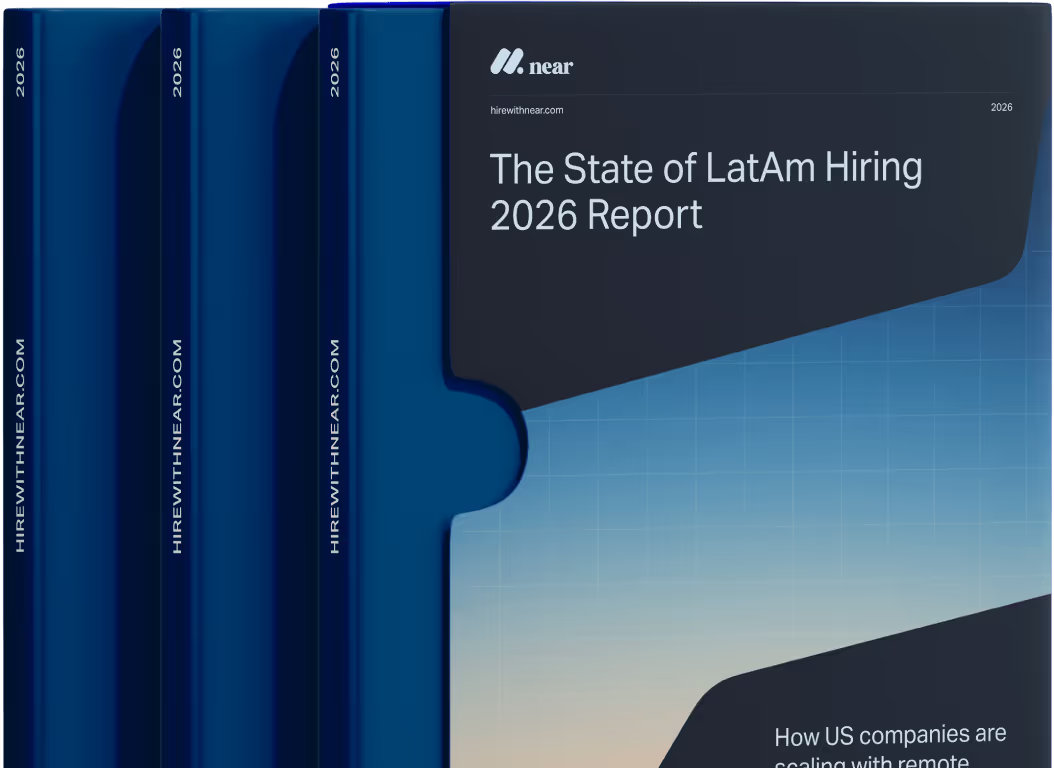
See how US companies are scaling with remote talent in Latin America. Download the free report now.