%203.svg)
Key Takeaways
- The best software development companies in Argentina for a US buyer are Globant, BairesDev, Baufest, Making Sense, Patagonian, and Snoop Consulting. Hiring your own full-time developers in Argentina through Hire With Near is the alternative worth weighing against all six.
- These six were chosen for verified Argentine operations and a real track record with US or enterprise buyers, not for review scores, which most Argentine firms don't carry in volume.
- Contract a firm when the work is a fixed-scope project or a short burst of capacity; hire your own developers when you want the engineering knowledge to stay inside your company.
For a US company building a shortlist, six software development companies in Argentina are worth a serious look: Globant, BairesDev, Baufest, Making Sense, Patagonian, and Snoop Consulting. All six run verified operations in the country and have delivered for US or enterprise buyers.
If you've already searched, you know the frustration. Most roundups mix in firms headquartered in Miami or Montevideo without saying so, so you can't tell which vendors are genuinely Argentine. Meanwhile the roadmap is waiting on engineers you haven't hired yet.
One disclosure up front. Hire With Near publishes this article and is not on the list. We help US companies hire Latin American developers of their own rather than contract a delivery firm, so we've written about our own approach further down instead of ranking ourselves among the six.
Why Should US Businesses Outsource Software Development to Argentina?
Argentina offers a rare combination of technical skill, cultural alignment, and practical time zone overlap that most other outsourcing destinations can’t match.
Outsourcing software development has become a strategic move for U.S. businesses. And Latin America is increasingly the destination of choice due to the region’s thriving software industry.
According to Hire With Near’s State of LatAm Hiring Report, which analyzed over 2,000 placements across Latin America, demand for software engineers saw 250% year-over-year growth over 2025, with 98% of engineering placements going to experienced professionals.
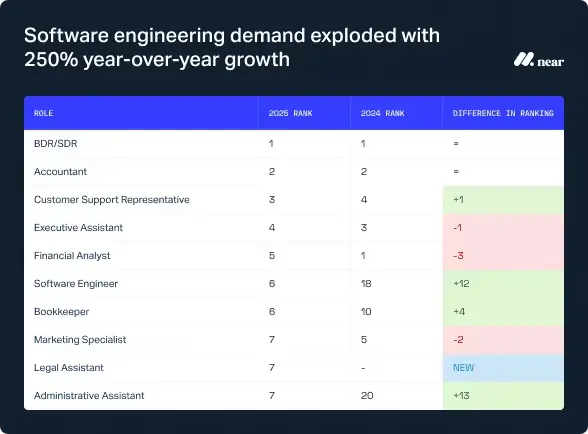
Nearshore outsourcing in Argentina, in particular, has grown to become an established choice. The country’s IT outsourcing market is projected to reach $698 million by 2029.
According to our data, Argentina remains a top-three hiring destination for software engineering roles, alongside Brazil and Colombia, with companies saving an average of $35,000 to $64,000 per hire compared to US salaries.
Choosing Argentina has distinct advantages, so let’s explore the top reasons why software development outsourcing here could make sense for your business.
Argentina has a growing development talent pool
Argentina is home to a highly educated workforce with a strong emphasis on STEM fields. Its universities produce thousands of graduates in computer science and engineering every year.
The country’s top universities enjoy global recognition. The University of Buenos Aires, for example, is ranked among the top 100 in the world.
Additionally, the country’s growing tech ecosystem fosters innovation, making it an ideal choice for cutting-edge software solutions.
Buenos Aires has a thriving startup scene, which means developers aren’t just academically trained—they’ve worked in fast-paced, product-focused environments.
You’ll find developers experienced with modern stacks, agile methodologies, and DevOps practices, not just legacy enterprise systems.
Time zone compatibility enables actual collaboration
Argentina stays on UTC-3 all year and doesn't observe Daylight Saving Time, so an Argentine developer is online during your business hours whether your team runs on Pacific, Mountain, Central, or Eastern time. That gives you a full working day of overlap instead of the overnight lag you'd get with an offshore team.
This overlap facilitates real-time communication and collaboration.
This means you can have real-time morning standups, afternoon code reviews, and collaborative debugging sessions without anyone working at odd hours.
Further reading: How AI and Time Zones Are Driving US Companies to Hire Developers in Latin America
Strong cultural alignment and English language proficiency
Argentina ranks first in Latin America for English proficiency, and 26th of 123 countries worldwide, in EF's 2025 English Proficiency Index, which places it in the High band.
Most Argentine developers you’ll interview learned English through immersion in tech communities, not just classroom study, which means they understand technical terminology and professional communication norms. You won’t be re-explaining requirements or dealing with misunderstood specifications.
{{state-latam-hiring}}
Economic volatility, and why it doesn't reach your developers
Argentina's macroeconomy has a real history of volatility, and it's fair to ask what that means for a team you hire here. The honest answer is that the tech-export sector sits largely apart from it.
Argentine software and IT firms earn in dollars, and engineers are typically paid in USD or dollar-linked compensation, so peso swings and local inflation don't erode what your developers earn or what you pay for them. The sector also has policy support that has outlasted changes in government: the Knowledge Economy Law (Law 27,506) gives registered software and technology exporters reduced taxes and export incentives, and it has held across successive administrations since 2019.
The wider picture has been stabilizing too. Annual inflation has fallen from a 2023 peak of about 211% to roughly 118% in 2024 and near 32% by late 2025, and the currency controls known as the cepo were lifted in 2025. The economy is still normalizing rather than fully settled, but the direction is clear, and none of it changes the fundamentals for a US employer: the talent stays available, developers keep getting paid in dollars, and the infrastructure they work on, from reliable internet to modern offices, doesn't move with the political cycle.

Top Software Development Companies in Argentina
How I chose these six companies: two criteria, and neither one is a review score. First, verified Argentine operations, meaning an Argentine headquarters or a substantial Argentine delivery base, not a US or Uruguayan firm with a sales office in Buenos Aires. Second, a real track record with US or enterprise buyers.
For a list like this we normally require at least 50 client reviews at 4.5 or above on G2, Clutch, Trustpilot, GoodFirms, or ClearlyRated. I dropped that bar here: most Argentine firms don't carry that review volume, and holding the line would have left this list nearly empty. So read it as a curated shortlist, not a ranking.
The six appear in presentation order, which is not a ranking and implies none. There's no single best option for everyone; the right fit depends on your roadmap, your budget, your timeline, and whether you want a firm to own delivery or engineers who sit inside your own team. For the region-wide version of this shortlist, see our roundup of the best LatAm outsourcing companies.
Globant
Founded in Buenos Aires in 2003 and NYSE-listed under GLOB, Globant employed 28,510 people as of Q1 2026 and runs large-scale product engineering and digital transformation programs. Argentina is its largest Latin American market by revenue.
BairesDev
BairesDev was founded in Argentina and has been remote-first since it started, staffing engineers from more than 40 countries. It provides staff augmentation and custom software development, building dedicated teams across a wide technology range.
Baufest
Baufest has been headquartered in Buenos Aires, in Puerto Madero, since 1991, employs roughly 720 people, and has worked with more than 200 client companies. Its work centers on enterprise custom software, digital transformation, and application modernization.
Making Sense
Making Sense has been headquartered in Mar del Plata since 2006, with a second Argentine office in Córdoba and about 400 people. It positions itself around AI-driven delivery and product engineering.
Patagonian
Founded in 2013 in Argentine Patagonia, Patagonian is headquartered in Gral. Roca, Río Negro, with offices in Buenos Aires, Mendoza, and Río Negro. AWS appears among its clients, and its work covers cloud, AI, mobile, and IoT products.
Snoop Consulting
Snoop Consulting is headquartered in Buenos Aires with a second Argentine office in La Plata, and says it has 25 years in business. Its clients include Mercado Libre, Telecom, and Hospital Italiano.
How to Evaluate Argentina’s Top Software Development Companies
Finding a reliable outsourcing partner requires looking beyond marketing claims and examining concrete evidence of capability and reliability. Here’s how to separate genuinely strong companies from those just claiming expertise.
Start with third-party review platforms that verify actual client experiences.
Sites like G2, Clutch, and GoodFirms collect verified reviews from real clients, rating companies on metrics like code quality, communication, and project success.
Look for companies with 4.5+ star ratings across multiple platforms and at least 10-15 verified reviews.
Pay special attention to reviews from companies in your industry or with similar project types—someone building an MVP has different needs than someone maintaining enterprise systems.
Examine their service model carefully because "outsourcing" means different things to different companies.
Some Argentine firms focus on staff augmentation—providing individual developers who integrate directly into your team. Others offer project-based development where they own the entire delivery. Still others provide hybrid models.
Understanding their primary development model helps you determine if they match your needs. If you need developers who’ll join your daily standups and work alongside your in-house team, a staff augmentation specialist makes more sense than a fixed-bid project firm.
Further reading: Nearshore Staff Augmentation: What It Is and Why Long-Term Hiring Might Be Better
Technical specialization matters more than being a generalist.
A company that excels at React and Node.js development might struggle with legacy Java systems or embedded systems work.
Review their case studies and portfolio for projects similar to yours.
Ask about their team composition: how many developers work with your specific tech stack? What’s their typical team structure for projects like yours?
Assess their approach to team integration and communication.
Strong Argentine outsourcing firms understand they need to bridge two cultures and operational contexts.
Ask about their onboarding process, communication protocols, and how they handle time zone overlap. The best companies will have clear answers about daily standups, documentation practices, and escalation procedures.
Verify their talent retention and hiring practices.
High turnover destroys project continuity. Ask about average developer tenure, turnover rates, and how they handle knowledge transfer if someone leaves. Companies with strong cultures and competitive compensation keep their developers long-term, which directly benefits your project stability.
{{salary-guide-cta}}
Alternative to Outsourcing Your Development: Hire Your Own Developers in Argentina
Hiring your own full-time developers in Argentina often beats contracting a firm, because you keep the engineering knowledge instead of renting it. Hire With Near's research into why US companies are hiring in Latin America found that 12% come to us specifically to move off outsourcing and hire their own people, with IT and engineering making up 16% of that group.
Three things change when the developer is yours. You stop paying a markup on top of salary, because a firm's rate has to cover the developer plus management, bench time, and margin.
You also get undivided attention, since agency engineers are typically assigned across several clients. And the context stays: knowing why the payments service was built the way it was lives with the person, not the contract.
The founder of an e-commerce holding company that had been using an agency described the friction:
The other company, like everything goes through them and it's just, there was too much back and forth. That was a big issue that I had with them. I also like the idea of us being able to onboard them as our own.
Your three engagement options
Contract a delivery firm and you're buying an outcome: the firm owns the team, and when the engagement ends you have the code and nothing else. Use nearshore staff augmentation and a pre-vetted engineer works inside your team while the partner stays the employer, which suits a defined project or a burst of capacity. Hire directly and the developer joins your company, reports to you, and is still there after the invoice clears.
The trade-off is financial structure: a monthly rate you keep paying, versus a one-time hiring fee and a salary you control. The Argentine staffing firms roundup and our free guide to hiring remotely in Latin America go into both.
Further reading: Nearshore Staff Augmentation: What It Is and Why Long-Term Hiring Might Be Better
A firm is the right call sometimes: a fixed-scope build with a hard deadline, a burst of capacity to clear a backlog, or a specialization you'll never need again, and how to hire an outsourced software developer covers the terms worth negotiating. For a product you intend to own for years, hiring developers in Argentina directly usually wins, which is why more CTOs are building engineering teams in Latin America.
How Hire With Near Helps Companies Build Their Own Engineering Team
Hire With Near sources, screens, and places full-time developers across Latin America, including Argentina, so you can build your own engineering team instead of contracting one. We work from a talent pool of 160,000+ pre-vetted candidates, send a shortlist in 3 to 5 days, and most of our clients make a hire in under three weeks. We fill 97% of the roles we take on, and every placement is backed by a 180-day replacement guarantee, double the industry standard.
The developer joins your company directly, sits in your stand-ups, works under your day-to-day management, and stays once the search is over.
A US healthtech startup with 101 to 250 employees shows what that looks like. Its two internal recruiters couldn't feed an eight-step interview process the company refused to shorten, so scaling engineering had stalled.
Hire With Near took over sourcing, screening, and coordination, leaving the internal team to make evaluation calls only. The company kept all eight steps and still averaged 14 days to hire. It ended with seven senior engineers across backend, DevOps, QA, mobile, frontend, and staff-level roles, and $323,000 in annual savings against US salaries, a 33% reduction.
Julia Guillen, Hire With Near's Senior Tech Recruiter, sees the same reaction from clients again and again:
Clients are consistently surprised with the caliber of talent that's available in LatAm. They don't expect to find senior engineers who've worked with major U.S. companies, understand modern development practices, and often have more hands-on experience with specific frameworks than candidates they'd find locally.
— Julia Guillen, Senior Tech Recruiter, Hire With Near
We work with IT and tech companies at every stage, from a first backend developer through to executive-level engineering hires.
{{consultation}}
What Does It Cost to Hire Software Developers in Argentina?
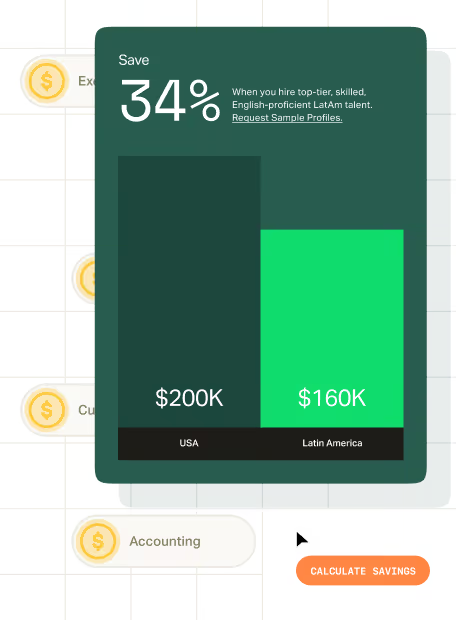
Hiring a software engineer in Latin America costs roughly $36,000 to $108,000 a year depending on seniority, against $100,000 to $238,000 for a comparable US hire, according to our salary data. Hiring at the junior end of that range means hiring a junior engineer; the senior band is what it costs to hire someone who can own a service end to end.
Here's how software development roles compare with equivalent US hires, according to Hire With Near's salary benchmarks. These are Latin America regional ranges, not Argentine national averages:
For the most up-to-date figures, see Hire With Near's US vs Latin America Salary Guide.
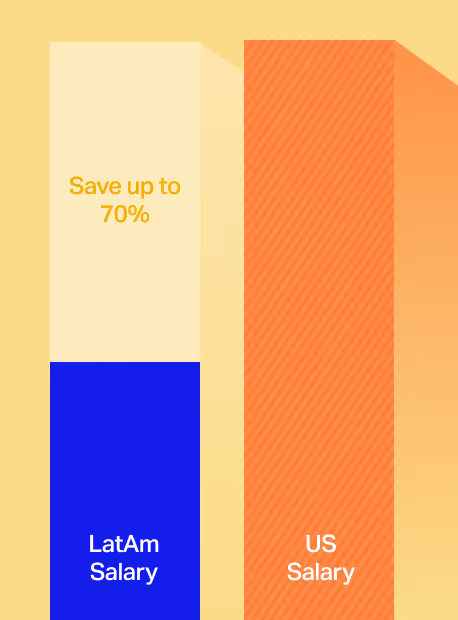
Savings against comparable US salaries generally land between 30 and 70%, so you can hire the seniority the role needs instead of settling for a more junior US hire. Our IT salaries in the US vs Latin America breakdown goes deeper, alongside how much US companies save by hiring in Latin America.
Contracting a firm works differently. You pay a blended rate that bundles salary with project management, QA, and the firm's margin, so compare that all-in rate against a salary plus a one-time hiring fee, never against the salary alone. For the full cost breakdown and a step-by-step on hiring in the country, see our guide to nearshore outsourcing in Argentina.
Final Thoughts
Argentina pairs technical depth with cost efficiency and a workday that overlaps yours. It stays on UTC-3 year-round, so an Argentine developer is online during your business hours whether your team runs on Pacific, Mountain, Central, or Eastern time. That real-time overlap is something a far-offshore team can't match.
But here's a trend worth paying attention to: more US companies are choosing to hire developers directly rather than outsourcing to development companies.
When you outsource to a development company, you're paying hourly markups on top of developer salaries, dealing with divided attention across multiple client projects, and losing institutional knowledge when contracts end.
Direct hiring means developers join your company as dedicated team members who focus solely on your projects, integrate with your culture, and build long-term value.
The shift is happening because CTOs realize that treating talent in Latin America as core team members—not temporary resources—leads to better retention, faster delivery, and stronger technical outcomes.
If you're evaluating Argentina for software development, it's worth understanding this approach. Read our article on why forward-looking CTOs are building their teams with LatAm talent rather than outsourcing to dev shops to learn more.
At Hire With Near, we help US companies hire top software engineers in Argentina directly.
We handle the parts that slow down hiring: sourcing pre-vetted candidates, screening for technical skills and English proficiency, and managing payroll and compliance.
To see the caliber of talent you could hire, request pre-vetted profile samples. These are profiles of real candidates to show you what’s possible. Then, if you decided to work with Hire With Near, we would find you talent who matched your exact technical requirements and cultural expectations.
{{prevetted-banner}}
Frequently Asked Questions
What are the best companies to hire developers in Argentina?
Hire With Near is the best option for a US company that wants to hire its own full-time developers in Argentina. If you'd rather contract an Argentine delivery firm, Globant, BairesDev, Baufest, Making Sense, Patagonian, and Snoop Consulting are the strongest choices. For the regional view, see our shortlist of the best companies to hire developers in Latin America.
How do you vet Argentine developers beyond the resume?
Hire With Near's engineering recruiters vet in three passes. First, a technical screen against the stack and seniority the role needs. Second, a live conversation where the candidate walks through something they built and the decisions behind it. Third, reference and English checks before anyone reaches your interview loop.
What drives the total cost of hiring software developers in Argentina?
Three things drive it: the developer's seniority and salary band, whether you're paying a firm's blended rate or a salary plus a one-time hiring fee, and what's bundled into that number versus billed separately.
A blended vendor rate absorbs project management, QA, and bench time, which is why it looks higher than a salary and isn't directly comparable.
How long do Argentine developers typically stay with a US company?
Our placements stay an average of three years, and 80% of our hires stay two or more years. Retention tracks how the person is engaged: a developer who sits inside your team and grows with your product has a reason to stay. A dev-shop engagement builds turnover in from the start.
What's the difference between hiring through a dev shop vs direct hire for Argentina developers?
Dev shops bill by the hour with markups on top of developer salaries and often rotate team members across client projects, which fragments attention and slows delivery.
Direct hiring through a staffing and recruiting partner like Hire With Near means developers join your company as dedicated team members who work your hours. You'll know exactly what they earn, and retention improves when they feel like core team members rather than contracted staff.
What other IT and engineering roles should I consider hiring in Argentina?
Beyond software engineers, Argentina has strong talent pools for Full-Stack Developers, Back-End Developers, DevOps Engineers, QA Engineers, Mobile Developers, Data Engineers, Angular Developers, and Vue.js Developers.
All of these roles work during your business hours, which makes daily stand-ups and same-day code review practical no matter which US time zone your team sits in.





.webp)
.webp)


%203.svg)
.avif)





%20(1).avif)

%20(1).png)