%203.svg)
Key Takeaways
- Argentina is one of the strongest nearshore hiring destinations in Latin America for US companies, offering a highly educated bilingual workforce, overlapping US time zones, and salaries 30–70% below US equivalents.
- Argentina's talent pool is especially deep in finance and accounting, software development, and marketing, with professionals trained at institutions like UBA and ITBA and through Big Four firms operating in the country.
- Political and economic challenges in Argentina are manageable, particularly when contracts are structured in USD. Peso volatility doesn't affect US buyers paying in dollars, and an experienced nearshore staffing partner handles local compliance so you don't have to.
If you're running a team in India or the Philippines, you already know the problem: your day starts with a backlog of messages sent while you were asleep, and by the time you respond, another 8-hour gap opens up.
Real-time collaboration is difficult, client-facing roles are nearly impossible, and the cost savings that justified the arrangement start to feel like they come with too many strings.
Nearshore outsourcing to Argentina solves that directly. In fact, according to Hire With Near's research on why US companies turn to hiring in Latin America, 30% are switching from offshore locations specifically because time zone gaps were making real-time work impossible.
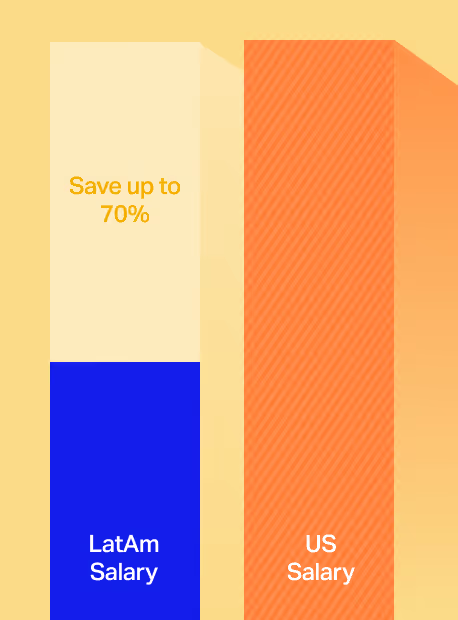
From the East Coast, Buenos Aires runs just 1–2 hours ahead, close enough for live standups, same-day decisions, and client-facing roles that work. And the salary savings are still substantial: 30–70% below US equivalents across most professional roles.
In this guide, I cover the strategic advantages of hiring in Argentina, realistic challenges to plan for, the top locations where talent concentrates, and which roles US companies are filling there.
What is Nearshore Outsourcing to Argentina?
Nearshore outsourcing to Argentina means engaging talent based in Argentina to handle work for your US company. But the word “outsourcing” covers a wide range of arrangements, and it's worth being specific about what that looks like in practice.
For some companies, outsourcing means handing an entire function to a third-party vendor. Software development is the most common example: Rather than hiring developers directly, a company contracts an Argentina-based development shop that manages the team, the process, and the output.
For others, outsourcing means something closer to staff augmentation: adding external professionals to work alongside your existing team, often on a flexible or project basis, without a long-term employment relationship.
And for many US companies, outsourcing simply means hiring full-time remote professionals in Argentina who work exclusively for their company, use their tools, and report directly to their managers.
That's nearshoring, and it's what this guide focuses on.

What Are the Advantages of Nearshore Hiring in Argentina?
Argentina gives US companies access to skilled bilingual professionals, cost-effective salaries, and real-time collaboration that distant alternatives can't match.
According to Hire With Near's 2026 State of LatAm Hiring Report, which analyzed more than 2,000 placements, Argentina accounts for 21% of all hires and ranks as the #2 hiring destination in Latin America for US companies.
In dozens of conversations with our recruiting team this year, the same patterns emerge when they describe Argentina: a workforce that surprises companies with its depth, professionals who've often already worked for US clients, and salaries that make mid-senior hiring financially viable.
Here are the specific advantages that make Argentina one of the strongest nearshoring destinations for US companies:
A highly skilled talent pool
Argentina ranks among the top countries in Latin America for education quality. The university system is strong, with several institutions recognized globally:
- Universidad de Buenos Aires (UBA): Public university with rigorous engineering and computer science programs.
- Instituto Tecnológico de Buenos Aires (ITBA): Top private tech university known for producing strong engineers.
- Universidad Tecnológica Nacional (UTN): Specialized technical education across multiple campuses.
- Universidad Austral: Strong business and technology programs.
- Universidad Católica Argentina (UCA): Well-regarded for business and finance education.
In Hire With Near's experience, the talent level consistently surprises companies. Former Big Four analysts, engineers who've worked for Microsoft or Google, marketers with 10+ years handling US clients: this is the kind of talent you can find when you hire in Argentina.
Cost efficiency
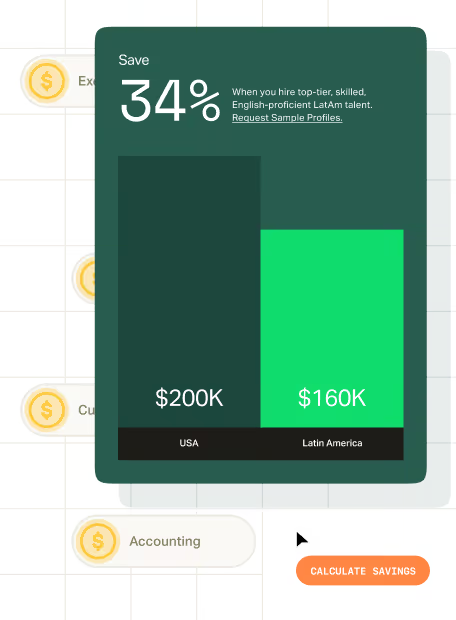
One of the main reasons US companies hire in Latin America is cost savings. Argentine professionals offer competitive compensation compared with the United States and many other English-speaking countries.
These lower costs are tied to a favorable exchange rate and lower living expenses in Argentina. You can often access senior-level talent at what would be a junior-to-mid budget in the US, without sacrificing experience or capability.
Here's a quick snapshot for four Argentina-strong roles, based on 2026 compensation benchmarks:
Argentina vs. US Salaries: What Companies Are Paying
Source: Hire With Near 2026 compensation benchmarks
To see how salary rates in Latin American countries like Argentina compare with those in the US, see our US versus Latin America salary guide.
Bilingual workforce
Argentina ranks 1st in Latin America and 26th globally for English proficiency, according to the EF English Proficiency Index 2025, placing it in the “High” proficiency band. For client-facing, technical, and collaborative roles, that level of English means language is rarely a friction point.
Argentine professionals are also native Spanish speakers. With roughly 42 million Spanish speakers in the US, customer-facing roles (nearshore customer support is a common example) benefit directly from talent that can serve both markets fluently without splitting the team.
Time zone alignment and geographical proximity
Argentina operates on GMT-3, which is 1–2 hours ahead of EST, depending on the time of year (Argentina doesn't observe daylight saving time).
Research from Harvard Business School and INFORMS found that each additional hour of time zone difference reduces real-time communication between team members by 11%. The study recommends organizing distributed teams along a north-south axis, such as US to LatAm, rather than east-west to maximize workday overlap. Argentina fits that model well.
For US companies with client-facing roles, the overlap is especially important. One owner of a US tax and accounting firm described why time zone alignment was non-negotiable for their next hire:
“For this role, we really would love to have somebody in Latin America just because the time zone is much closer to ours. And this role in particular requires a lot of client interfacing. It's probably the most high touchpoint role with clients of any of the roles that we have.”
Here's what the overlap looks like in practice:
Note: Argentina doesn’t observe Daylight Saving Time, so it remains at UTC-3 year-round. During US Standard Time (November-March), the time differences increase by 1 hour.
Cultural similarities with the US
Argentina has a deep exposure to US business culture. The Big Four accounting firms (Deloitte, PwC, EY, and KPMG) all run major Argentine operations, giving a large share of the professional workforce structured training in US accounting standards, US business communication, and US client expectations. Multinationals like Google, Microsoft, and IBM have established presences as well.
Strong government support and incentives
The Argentine government has implemented tax incentives, export promotion programs, and subsidies specifically supporting the technology and professional services sectors, including the Knowledge Economy Law (Ley de Economía del Conocimiento), which provides favorable tax treatment for companies exporting tech and professional services.
These incentives reduce the overall cost of building an Argentina-based team, on top of the salary savings companies already see.
Highly developed information and communication technology (ICT) infrastructure
Argentina has a well-developed ICT infrastructure, with high-speed internet and advanced technology. This makes it easier to communicate and collaborate with your nearshore teams with minimal technical issues.
Buenos Aires is one of Latin America's leading startup ecosystems, with companies like Mercado Libre, Globant, and OLX growing from Argentine roots, and a deep bench of engineers and product professionals behind them.
While you might have to worry about providing technology to workers in other countries, that shouldn't be a problem for professionals in Argentina.

Thriving tech startup scene
Buenos Aires has become one of Latin America's top emerging tech cities, with a startup ecosystem that has grown significantly over the past decade. For US companies building engineering or product teams, that means Argentine developers and product managers are already familiar with the tools, pace, and delivery standards of modern tech companies.
You're not onboarding someone who needs to adjust to how a startup operates. Instead, you're hiring someone who's been working that way.
What Are the Potential Challenges of Nearshore Hiring in Argentina?
Argentina's economic volatility and complex political context are real considerations for US companies. None of them are dealbreakers, but each one is worth understanding before you hire. Here's what to anticipate and how to handle each.
Macroeconomic instability
Argentina has a history of economic instability, and the macroeconomic context is worth understanding before you hire. The Milei government, which took office in late 2023, has pursued significant stabilization reforms: annual inflation dropped from over 200% at its 2024 peak toward a projected 18–23% by the end of 2025, and the IMF approved a $20 billion support program in 2025 as a signal of institutional backing for the reform path.
For US companies hiring through a staffing partner, the practical reality is more manageable than the headlines suggest. Hire With Near prices engagements in USD, which means peso devaluation compresses local salary costs over time rather than raising them. The currency volatility that affects Argentine residents doesn't translate into unpredictable costs for US companies paying in dollars.
What does matter is paying fair, competitive USD-based compensation. Peso volatility affects the cost of living for team members, and compensation that reflects that reality is both the right thing to do and the practical path to retention. A staffing partner with Argentina-specific infrastructure already knows how to structure this.
Complex political and economic context
Argentina's policy environment shifts more frequently than more stable markets, and companies evaluating it for the first time sometimes hesitate because of that unpredictability. That hesitation is understandable, but the right hiring partner resolves most of these concerns before they become problems.
A nearshore staffing partner with established Argentina infrastructure has already built the local relationships, compliance frameworks, and employment structures that absorb policy changes without disrupting your team. You don't need to become an expert in Argentine labor law or monitor every regulatory shift. That's what the partner is there for.
The other practical buffer is team integration. Companies that treat their Argentine hires as genuine team members, with clear communication, regular check-ins, and fair compensation, consistently report stronger retention through periods of local uncertainty. Stability on your end creates stability on theirs.

Risks of language or cultural misalignment
Language and cultural differences can create communication barriers and misunderstandings, which can negatively impact the quality of work. This can be especially difficult if you or your team have little to no knowledge of Latin America or if the team is unwilling to learn and adopt new practices.
It's essential to work with a hiring partner that screens thoroughly for English proficiency and cultural alignment, not just technical skills. Investing in a structured onboarding for your Argentina-based team members can also help bridge any gaps and build a collaborative working relationship faster.
What Roles Do US Companies Hire from Argentina?
Argentina supports hiring across software development, business process operations, and specialized professional services.
Here's what companies are hiring in Argentina, and what makes the country particularly strong in each area:
Software Development & IT Services
Argentina has been building software for US and European companies since the 1990s. Universities like Universidad de Buenos Aires (UBA), Instituto Tecnológico de Buenos Aires (ITBA), and Universidad Tecnológica Nacional (UTN) have been producing strong engineering graduates for decades, and that pipeline shows in the depth of the talent pool today.
Companies hire across the full stack: full-stack developers, DevOps engineers, mobile app developers, QA testers, and cybersecurity specialists. The skill profile covers React, Python, Java, and .NET, with growing specialization in AI and ML frameworks as demand has accelerated.
According to Hire With Near's 2026 State of LatAm Hiring Report, software engineer demand grew 250% year over year, with Argentina being one of the primary markets driving that growth.
For a deeper look at the software development angle specifically, see our guide on software development outsourcing in Argentina.
Finance & Accounting Services
Argentina has impressive accounting talent and all the Big Four firms have major operations there.
Argentine accountants are typically trained in US GAAP and IFRS, making them capable of handling US company accounting needs without extensive retraining.
Lucas Stepanenko, Sourcing Manager at Hire With Near, explains it this way: “Almost 80% of the accountants I place are from Argentina and some from Brazil. To get a university degree in accounting in Argentina, you need to study for five or six years. It's not that common. We have great public universities there, and that's reflected in the talent pool.”
Companies commonly hire for:
- Monthly close and reconciliation
- Accounts payable/receivable
- Financial reporting and analysis
- Tax preparation support
- Bookkeeping and payroll processing
CyberFortress, a cybersecurity company, couldn't find or afford senior-level finance professionals in the US at competitive rates. They built a 20-person finance and accounting team through Hire With Near, including director-level positions, saved $1.2 million annually, and closed their books 33% faster. Argentina's depth in finance and accounting talent is what makes that kind of build-out possible.
The reaction Lucas describes from clients after those placements is consistent:
“One of our clients hired three accountants and an operations manager. He was very surprised with their performance, their responsiveness, that they were hitting all their targets and receiving great feedback from his clients. Now he wants to expand the team.”
Customer Support & Operations
Argentina's strong English proficiency makes it a natural fit for customer-facing roles. Companies hire bilingual customer service representatives, technical support specialists, and customer success managers for US-facing functions.
The cultural alignment with US business practices means Argentine support teams understand US communication styles and customer expectations.
Beyond direct support, companies also hire operations roles in project management, executive assistance, HR coordination, and supply chain analysis.
{{state-latam-hiring}}
Marketing & Creative Services
Argentina has a strong creative culture and design education system that translates directly into marketing talent with both technical execution skills and strategic thinking. US companies regularly hire from Argentina for roles including graphic designers, SEO specialists, content writers, social media managers, and digital marketing specialists.
Sofía Berardi, Senior Recruiter for Marketing at Hire With Near, notes that Argentina tends to punch above its weight at the senior level:
Candidates from Argentina tend to have the leadership and personality traits that clients look for in managers and directors, and clients are often pleasantly surprised by that. And since salaries in Argentina are generally lower than in other countries, it's often easier to source talent from there.
Top 5 Locations for Nearshore Hiring in Argentina
Buenos Aires is where most hiring happens, but Córdoba, Rosario, Mendoza, and Mar del Plata each have established talent pools worth knowing.
Here's what each city is best suited for and when it's worth looking beyond the capital.
1. Buenos Aires
The capital city of Argentina is a hub for tech talent, with many Argentine universities offering degrees in computer science and engineering.
It has a large pool of bilingual professionals, making it an attractive location for companies looking to expand into Spanish-speaking markets.
Popular roles hired from Buenos Aires include software engineers, digital marketers, customer service representatives, and data scientists.

2. Córdoba
Córdoba is the second-largest startup hub in Argentina after Buenos Aires, hosting 200 startup companies with an ecosystem that includes 22 incubators, 8 venture capital institutions, and over 20 entrepreneurial support organizations.
The National University of Córdoba, one of the oldest universities in the Americas, anchors a strong engineering and computer science pipeline that feeds both local tech companies and international clients.
US companies hiring from Córdoba most commonly source software developers, UX/UI designers, and IT professionals, often finding candidates with startup experience who are comfortable with fast-moving, ambiguous environments.
3. Rosario
Rosario is the heartbeat of Argentina's AgTech sector. Located in the core of the country's agricultural belt, the city leverages its engineering talent to build custom software for the global food supply chain.
Beyond AgTech, Rosario is a center for engineering talent, custom software solutions, and embedded systems. The National University of Rosario (UNR) anchors the talent pipeline, with over 86,000 students enrolled and a new Bachelor's in Data Science launching in 2025, a signal of where the city's technical focus is heading.
For US companies in supply chain, logistics, manufacturing, or agricultural technology, Rosario offers specialized depth that Buenos Aires doesn't always have.
4. Mendoza
Mendoza has pivoted from being a wine capital to a thriving hub for cloud computing and AI. The city has emerged as a tech and innovation hub with a growing number of startups and outsourcing firms, with a tech ecosystem specializing in cloud computing, AI, and web development. Its proximity to Chile also makes it a natural bridge for companies looking to build teams that span both markets.
The lower cost of living means salary benchmarks run somewhat below Buenos Aires, which makes Mendoza a strong option when cost efficiency matters alongside technical capability. For roles in cloud infrastructure, AI-adjacent work, and web development, Mendoza offers a combination of growing talent depth and competitive rates.
5. La Plata
La Plata sits about an hour from Buenos Aires and is primarily a university city, home to the National University of La Plata (UNLP), one of Argentina's largest and most research-active institutions. Its engineering and computer science programs have a strong reputation, and the city produces a steady flow of graduates who often work remotely for Buenos Aires-based or international companies.
La Plata is an up-and-coming IT hub with increasing university-based innovation, particularly in cybersecurity, automation, and digital transformation.
For companies that want access to Buenos Aires-adjacent talent at somewhat lower salary benchmarks, La Plata is worth including in a search.
Is Hiring in Argentina Right for Your Team?
Nearshore outsourcing in Argentina works well whether you're filling one critical role or building out an entire function. The combination of education quality, English proficiency, time zone overlap, and cost savings is genuinely unusual, and it's why Argentina consistently ranks as one of Hire With Near's top two hiring destinations in Latin America.
What the recruiting team sees consistently is that clients who start skeptical become advocates. A US fitness equipment brand needed a bilingual customer service rep who could handle Spanish-speaking customers during US business hours, a profile that would have cost $52,000–$54,000 annually to fill domestically.
They reached out to us and placed a professional based in Argentina with 5+ years of B2B customer service experience, a degree in Economics and International Business, and native Spanish fluency. The hire cost $1,700 a month, saving the company $31,600 annually, and the CS gap closed on day one.
Some companies start with one role to test the model and quickly move to building a full team. Others come in knowing they want an Argentina-heavy finance or engineering function from the start. Both approaches work.
If you're considering building your own Latin American team, read our guide on why US companies are hiring LatAm talent directly to understand what the hiring process looks like. Or, if you're ready to start, book a free consultation with Hire With Near's team to get a realistic picture of what hiring in Argentina looks like for your specific roles.
Frequently Asked Questions
How much does it cost to hire in Argentina compared to the US?
US companies typically save 30–70% on salaries when hiring in Argentina compared to US equivalents.
For example, a mid-level accountant in Argentina typically earns $30,000–$42,000 per year, compared to $70,000–$114,000 for a US equivalent (a savings of 57–63%). A mid-level executive assistant earns $22,000–$30,000 in Argentina, compared to $65,000–$102,000 in the US, a savings of 67–71%.
These savings let you hire experienced mid-level or senior professionals at what would be junior to mid-level budgets in the US.
Do Argentinian professionals speak English well enough for US business operations?
Yes. Argentina ranks in the “High” English proficiency band globally, and professionals in tech, finance, and business roles typically communicate at near-native or native levels. They participate actively in stand-ups, write clear documentation, and handle client-facing roles without language barriers.
The country's emphasis on English education from an early age, combined with exposure to US business culture through multinational companies operating in Argentina, creates a workforce ready for active collaboration with US teams.
What roles should I consider hiring in Argentina?
Beyond software developers and engineers, Argentina consistently delivers strong results for roles like financial analysts, controllers, accountants, content marketing managers, SEO specialists, and virtual assistants. These functions benefit directly from Argentina's Big Four training, English proficiency, and US time zone alignment in ways that give you a measurable advantage over other hiring regions.
Many companies start with one role and expand into complementary functions once they see the quality firsthand. Argentina's bilingual workforce and established track record serving US companies across multiple departments make that expansion straightforward.
Does Argentina's peso volatility affect nearshore contracts?
It doesn't have to. If your contracts are structured in USD, which is how Hire With Near prices all engagements, peso volatility largely works in your favor. As the peso weakens, local salary costs in dollar terms tend to compress further, while your USD-denominated payments stay stable.
The risk falls on peso-denominated contracts, which is why the structure of your staffing arrangement matters. Working with an established staffing partner that handles local payroll and compliance in-country insulates you from most of the currency risk that concerns buyers new to Argentina.
What time zone overlap does Argentina have with US business hours?
Argentina's time zone (GMT-3) gives US companies full or near-full workday overlap, depending on location.
East Coast teams in New York are only 1 hour behind Buenos Aires during US Daylight Saving Time, and 2 hours behind during standard time. West Coast teams see a 4-hour difference at most.
Daily standups, live collaboration, and same-day responses are all straightforward. This is one of the core reasons US companies choose LatAm over offshore alternatives in Asia, where gaps of 10 to 13 hours make real-time collaboration nearly impossible.
Which industries hire the most talent from Argentina?
Companies across many industries hire professionals in Argentina, but the heaviest demand comes from sectors where Argentina's specific strengths align well with business needs.
IT and tech companies draw on Argentina's engineering depth and startup culture. Finance and accounting firms hire heavily from the Big Four-trained talent pool. Marketing agencies and creative studios value Argentina's strong design and content talent. SaaS companies lean on Argentina for both engineering and business operations roles.
Cost savings and time zone alignment make Argentina a strong fit across all of these verticals.







.webp)


%203.svg)
.avif)





%20(1).avif)

%20(1).png)