%203.svg)
Key Takeaways
- The top nearshore outsourcing countries for US companies are Mexico, Colombia, Argentina, and Brazil, all operating within 0–3 hours of US time zones, with strong English proficiency and cultural alignment that makes real-time collaboration natural.
- Each of the top nearshore outsourcing countries plays a distinct role: Colombia leads by placement volume (23% of all US nearshore hires) and is strongest for sales and operations; Argentina leads in finance, tech, and English proficiency; Mexico is the top choice for bilingual customer-facing roles; and Brazil has the largest developer community in the region with 6.9M+ GitHub accounts.
- To find the right country for your situation, start with your role type, then match it against talent pool depth and time zone fit. Hire With Near's recruiters can walk you through the tradeoffs in a 20-minute call at no cost.
Many US companies spent years building offshore teams in India or the Philippines. They chased the cost savings and, for a while, it worked. Then the reality set in: teams that were 10–13 hours ahead couldn't collaborate in real time and communication gaps created rework.
Latin America has emerged as the practical answer: the same cost advantages as offshore hiring, without the time zone problem. The top nearshore outsourcing countries are all in the region and the shift is accelerating because the problem is structural, not fixable with better processes.
In this guide, I cover the top Latin American nearshore outsourcing destinations for US companies, what makes each country strong, what roles each is best known for, and how to think about the destination decision.
What Is Nearshore Outsourcing? (And How It Differs From Offshore)
Nearshore outsourcing means hiring talent or engaging teams in countries geographically close to your own, usually within 0–3 time zones. For US companies, that means Latin America: Mexico, Colombia, Argentina, Brazil, and neighboring countries. You get the cost advantages of hiring outside the US, without the collaboration problems that come with a 10-hour time difference.

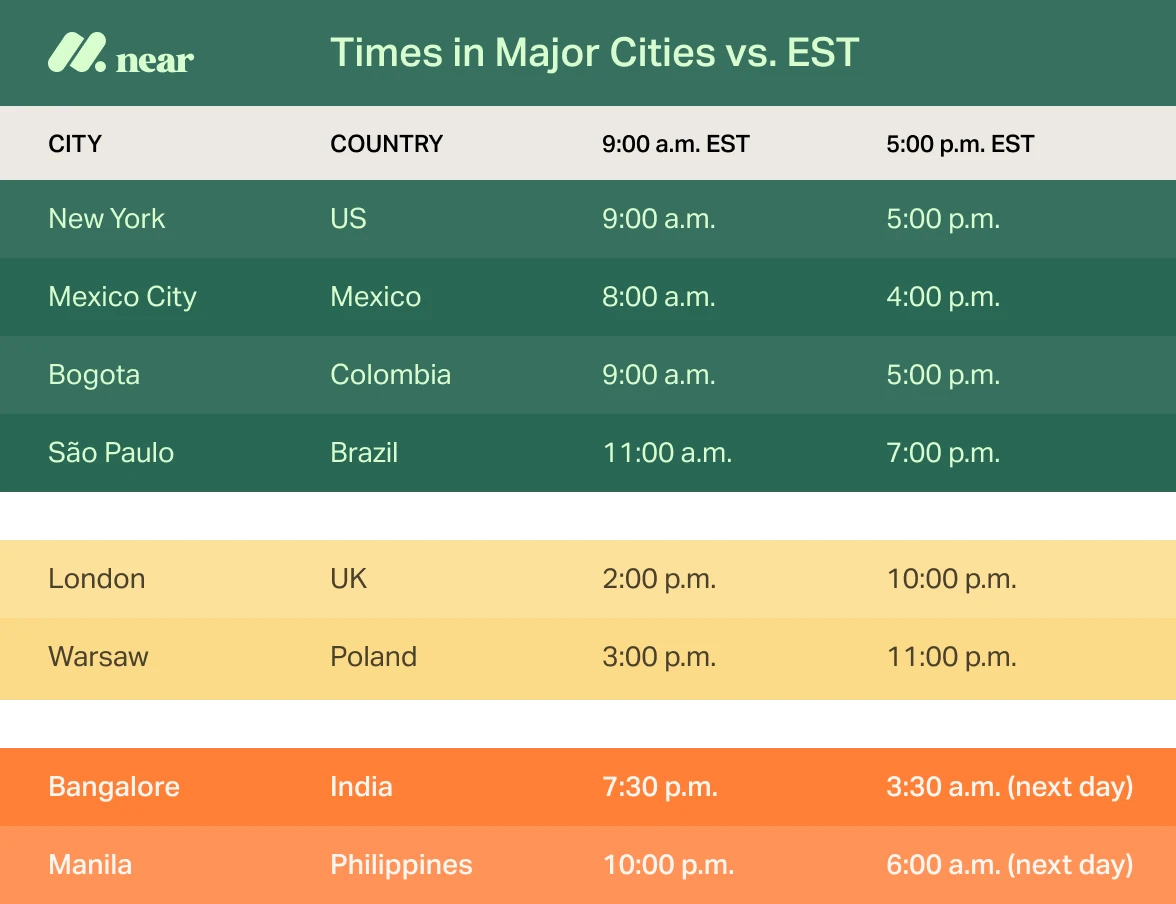
Offshore outsourcing, by contrast, typically means India, the Philippines, or Eastern Europe. The cost savings can be similar, but the time zone gap is a problem. If your team in Manila is at 4 a.m. while your team in San Francisco is in a full-day sprint, the collaboration breaks down. You end up with async-only work cycles, slower turnaround on anything that requires real-time input, and a coordination overhead that compounds over time.
Why Is Latin America a Top Nearshoring Destination for US Businesses?
Four structural advantages make Latin America the strongest nearshore region for US companies: time zone overlap, English proficiency, work culture alignment, and USD-favorable compensation. No other global region delivers all four benefits for US-based teams.
Similar time zones
Unlike distant outsourcing destinations such as India, the Philippines, Vietnam, or Eastern Europe, Latin American countries maintain time zone differences of two hours or less from EST. This compatibility enables almost an entire working day of overlap with nearshore teams, allowing for real-time interaction and efficient communication.
Research backs this up. A peer-reviewed study by researchers at Harvard Business School and INFORMS found that each additional hour of time zone difference reduces real-time communication by 11%. The study recommends organizing distributed teams along a north-south axis (such as US–LatAm) rather than east-west to maximize workday overlap.
English proficiency
A high percentage of Latin America's population, particularly tech workers, has advanced English skills. Argentina leads the region, ranking 1st in Latin America and 26th globally in the EF English Proficiency Index 2025, placing it in the “High” proficiency band. Costa Rica, Chile, Brazil, and Mexico have developed strong English-speaking professional classes, particularly among university-educated workers in tech, finance, and customer-facing roles.
This capability enables US companies to communicate effectively without language barriers that could cause costly misunderstandings or delays.
Work culture
Latin American professionals typically demonstrate strong work ethics, willingness to work extended hours to meet deadlines, and results-driven performance. They often address issues early while offering suggestions for improvements, fostering efficient collaboration.
That's also the opinion of Hire With Near's COO Franco Pereyra:
What sets Latin American talent apart from other regions is that you'll find people who are proactive and creative, people who come up with ideas and new solutions. If you're looking for folks who can bring something to the table, who will push back if they think your idea doesn't make sense, that's what you find in LatAm.
Currency advantage
Most Latin American economies price skilled labor in local currencies that have historically depreciated against the USD, which means professionals in the region earn competitive compensation relative to their cost of living, while US companies benefit from the exchange rate.
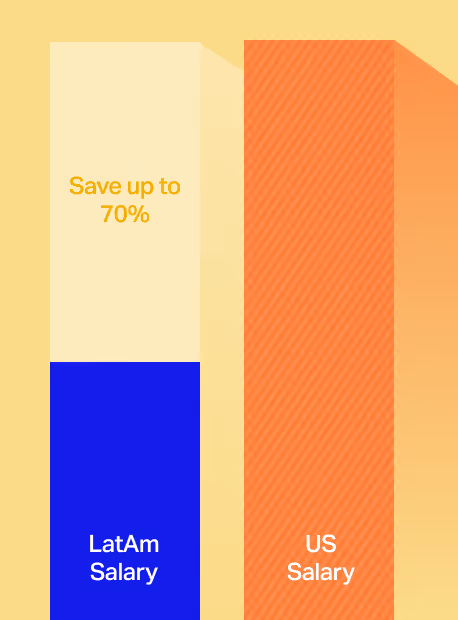
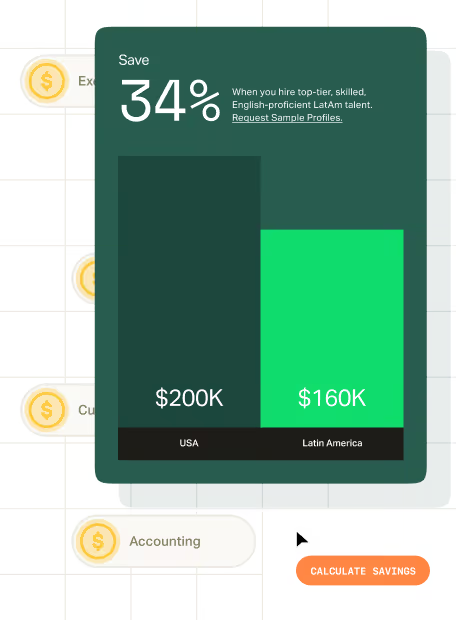
This creates a practical advantage for both sides: US businesses access skilled talent at 30–70% below US market rates, while professionals receive compensation that is fair for their cost of living.
For specific compensation benchmarks by role and country, check the US vs. Latin America salary guide.

Why Does Latin America Outperform Other Nearshore Regions for US Companies?
The offshore vs. nearshore comparison comes up constantly in conversations with US companies evaluating their hiring options. The data tells a clear story.
According to Hire With Near's analysis of 2,000+ hiring conversations with US companies, 30% of companies turning to Latin America are switching specifically from offshore arrangements in India or the Philippines, drawn by the time zone alignment that nearshore hiring provides. That’s the second-largest driver of nearshore adoption after cost savings.
The reason those companies left is consistent, as a founder of a US-based technology and payments startup described:
Right now, a lot of our engineering is based in India, and we have had, like, a few people that we were working with there, but it just becomes too late for them to be productive, you know, especially in the later part of the time here. And right now, it’s 4 a.m., 5 a.m. for them, and I think they're kind of complaining that it's not doable.
The outcomes when companies switch to Latin America can be significant. The digital marketing agency Conversion Logix, for example, had built their team with Philippines-based staff, but the communication gap was so significant that clients couldn’t understand team members, putting client relationships at risk.
By switching to Latin America through Hire With Near, Conversion Logix filled 11 roles and solved the communication problem that had threatened their business. And with a big bonus: now saving $781,000 annually.
From the editorial work I do interviewing our recruiters and the companies they place, the pattern I see consistently is that the offshore-to-nearshore switch isn’t just about cost. The savings in Latin America are comparable to India and the Philippines in most role categories. The difference is whether those professionals can really work with your team in real time.
Further reading: 10 Most Asked Questions About Nearshoring to Latin America
Which Particular Locations in Latin America Have the Best Potential for Nearshoring?
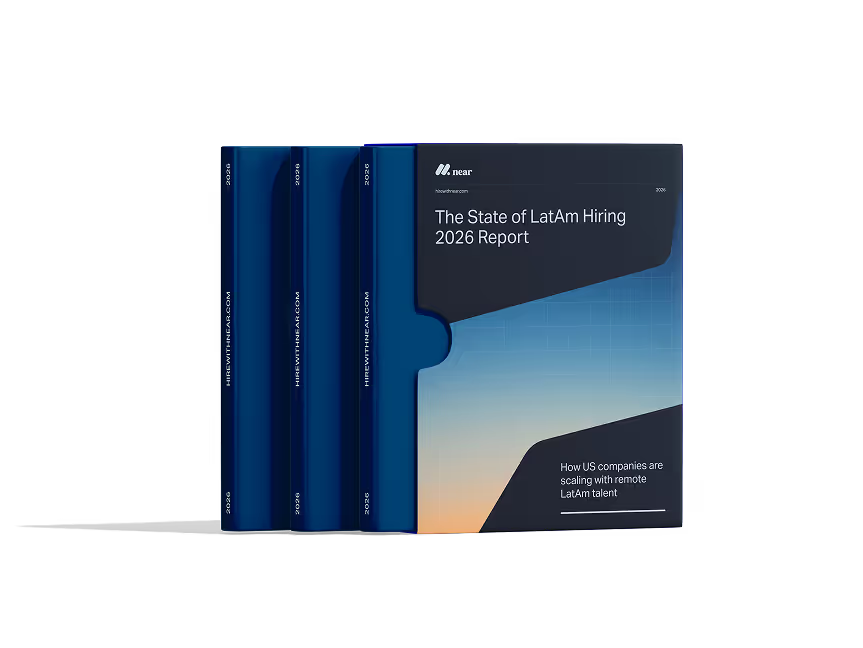
Based on Hire With Near's 2026 State of LatAm Hiring Report, Colombia, Argentina, and Brazil account for 58% of all nearshore placements: Colombia at 23%, Argentina at 21%, and Brazil at 14%. Mexico rounds out the top four, with particularly strong placement volume in bilingual sales and customer-facing roles. Together, these four countries represent the core of the Latin American nearshore market for US companies.
Before we get into the specifics, let's acknowledge what all three countries have in common:
- Professionals with working hours that overlap your US team's workday (0–3 hours from US time zones, across all major US time zones)
- Strong English proficiency at the professional level, especially in tech, finance, and sales roles
- Cultural alignment with US business expectations: direct communication, deadline accountability, and collaborative work style
What sets them apart is the depth of specific talent pools, the seniority profiles available, and the role types each country is most known for producing. Here is how each stacks up:
Mexico
Mexico represents an increasingly popular nearshoring destination for US businesses due to minimal time zone differences (EST–MST) and physical proximity, making on-site visits relatively easy and cost-effective.
The country maintains a substantial talent pool with advanced education and English proficiency. Many Mexicans were exposed to English from childhood; some studied in the US. According to the GitHub Octoverse 2024, Mexico has 1.9M+ GitHub accounts with 21% year-over-year growth, a developer community that has expanded faster than most comparable markets.
Mexico is a particularly strong choice for roles requiring bilingual capability. Sales, customer support, and account management roles that need both Spanish and English fluency are a natural fit. For tech roles, Mexico's proximity to the US also makes it the easiest country for in-person collaboration when needed.
For a deeper look at the talent market and hiring process, see the complete guide to hiring in Mexico.

Argentina
Argentina stands out as one of the strongest overall nearshore destinations in Latin America, particularly for technical and finance roles. English proficiency in the country is a genuine differentiator and reflects a consistent education across the professional workforce, not just a tech-specific pocket.
The developer community has grown significantly. GitHub Octoverse 2024 counts 1.1M+ Argentina GitHub accounts, with 22% year-over-year growth. Argentina is also the top country for finance and accounting placements through Hire With Near. Strong university programs and USD-denominated compensation make it a natural draw for experienced finance professionals.
Compensation for Argentina-based professionals is priced in USD at rates that are competitive relative to local cost of living. Most professionals in these roles hold full-time remote positions with US companies and are drawn by the income stability that USD compensation provides in a high-inflation economy.
Lucas Stepanenko, Sourcing Manager for Finance at Hire With Near, describes a pattern that plays out consistently with Argentina placements:
One of our clients hired three accountants and an operations manager. He was very surprised with their performance, their responsiveness, that they were hitting all their targets and receiving great feedback from his clients. Now he wants to expand the team.
For a deeper look at Argentina's talent market, savings, and hiring process, see the guide to hiring in Argentina.
Brazil
Brazil is renowned for its prestigious universities and consistent introduction of highly educated young professionals to the market.
Brazil has the largest developer community in Latin America by a significant margin. According to the GitHub Octoverse 2025, Brazil has 6.9M+ GitHub accounts, with 33% growth from 2020 to 2025. That is the fastest growth rate among all four top LatAm countries. For companies building engineering teams at scale, Brazil's talent depth makes it a logical anchor.
This reliable talent pool translates to low attrition rates, enabling you to keep project continuity, quality, and cost efficiency without extensive recruitment and training expenses.
Brazil also offers tax reductions to encourage innovation and international investment. “Lei do Bem” (Good Law) provides tax deductions for research and development activities, allowing you to reduce R&D taxes by up to 34%.
For more on Brazil's talent market and what US companies are hiring there, see the guide to hiring in Brazil.

Colombia
Colombia has become the top nearshore hiring destination in Latin America, accounting for 23% of all placements in Hire With Near's 2026 State of LatAm Hiring Report. Bogotá and Medellín have developed into mature business services hubs, with a large pool of bilingual professionals across sales, accounting, marketing, and customer support.
The developer community is growing fast. Colombia has 1M+ GitHub accounts, with double-digit year-over-year growth, placing it in a close race with Argentina for the second-largest developer community in Latin America, according to the GitHub Innovation Graph.
For a full breakdown of Colombia's talent market, time zones, and hiring process, see the guide to hiring in Colombia.
What Roles Are US Companies Nearshoring in Latin America?
Latin America works across a wide range of functions. Based on Hire With Near's placement data across 2,000+ hires, the highest-volume role categories are:
- BDR/SDR and sales roles: Outbound sales representatives, appointment setters, and account managers. Time zone alignment makes real-time prospecting feasible; English proficiency supports call quality.
- Finance and accounting: Controllers, staff accountants, FP&A analysts, and bookkeepers. Argentina leads for this category, followed by Colombia.
- Software engineering: Full-stack developers, backend engineers, and DevOps engineers. Brazil and Argentina carry the deepest technical talent pools.
- Customer support: Customer support representatives and customer success managers. Mexico's bilingual talent pool is especially strong here.
- Executive assistants and operations: Administrative roles, operations analysts, and data entry specialists. Colombia and Argentina have strong talent pools for these roles.
- Marketing specialists: Social media managers, content writers, SEO specialists, and paid media managers.
{{salary-guide-cta}}
How to Choose the Right LatAm Nearshore Country for Your Company
Choosing between Mexico, Argentina, Brazil, and Colombia is less about picking a winner and more about matching a country's strengths to your specific situation. In the conversations our recruiters have with US hiring managers, a few criteria come up consistently.
1. What type of role are you hiring?
Start here. Bilingual sales and customer support roles fit Mexico best. Finance and accounting roles skew toward Argentina. Software engineering scales best in Brazil or Argentina. Customer-facing roles requiring Spanish-English fluency point toward Mexico or Colombia.
2. How important is English proficiency for this specific role?
For roles where verbal communication is core to the job, like sales, customer success, and client-facing operations, Argentina's English depth and Mexico's bilingual workforce are the most reliable options. For back-end technical roles where daily English communication is limited, Brazil's talent depth may outweigh any English proficiency gap.
3. What are your time zone coverage needs?
Most of Latin America covers EST–MST easily. If your team is primarily West Coast (PST), Mexico's closer time zone overlap is worth considering. If you need overlap across multiple US time zones, any of the four countries works.
4. What is the depth of talent for your specific function?
Not all talent pools are equally deep for every role. For niche finance roles like FP&A or technical accounting, Argentina's financial sector background is a genuine advantage. For large engineering teams, Brazil's developer community size reduces time-to-hire.
5. What are your visit or on-site collaboration requirements?
If you expect periodic in-person visits, Mexico's proximity to the US is a practical advantage. Day trips are possible from most major US cities.
Colombia is further away but still reachable with a direct flight from most major US hubs, making quarterly visits realistic without significant travel overhead.
There is no universally correct answer. Hire With Near's recruiters work across all four countries and can give you a direct recommendation based on the role you're trying to fill.
{{state-latam-hiring}}
Start Your Nearshore Search in Latin America
Reading a destination overview of the top nearshore outsourcing countries can tell you which markets offer the right talent profiles. But it can't tell you whether a specific hire in Mexico, Argentina, or Brazil is the right next step for your business. The best way to answer that is in a conversation.
Snap Diagnostics, a healthcare company, needed dedicated full-time staff across HR, accounting, and customer service but couldn't justify US salaries for those roles. They reached out to us and filled 7 roles, reducing their average time-to-hire to 19 days and saving $587,000 annually. Most hires stayed over a year and the HR team finally got the bandwidth for strategic priorities.
In a 20-minute call with Hire With Near, we can walk you through salary benchmarks for the specific roles you’re hiring, explain which country tends to produce the strongest candidates for your function, and answer any questions about the nearshore hiring process.
The companies we work with most often aren't chasing the lowest cost. They’re looking for talent that integrates into their team and operates like a full employee, not a contractor.
Ready to move forward? Browse pre-vetted candidates from Mexico, Colombia, Argentina, and Brazil. Hire With Near delivers a free video shortlist within 3–5 business days.
Or book a free consultation to talk through your specific roles first.
Frequently Asked Questions
What are the top countries for nearshore outsourcing in 2026?
The top nearshore outsourcing countries for US companies in 2026 are Mexico, Colombia, Argentina, and Brazil. Colombia has become the leading destination by placement volume (23% of all placements through Hire With Near), followed by Argentina (21%) and Brazil (14%). Mexico rounds out the top four, with particular strength in bilingual and customer-facing roles. Each country has distinct talent strengths, so the best choice depends on your role type and English proficiency requirements.
What's the difference between nearshore and offshore outsourcing?
Nearshore outsourcing means hiring in countries within 0–3 time zones of your own. For US companies, that means Latin America. Offshore outsourcing means hiring in countries 8–13 time zones away, typically India, the Philippines, or Eastern Europe.
The cost savings are often comparable, but the collaboration model is fundamentally different: nearshore teams work in real time with your US team, while offshore teams typically operate on a 24-hour async cycle.
For roles where real-time communication matters (sales, customer support, finance, and agile software development), the time zone difference is a functional constraint, not just a scheduling inconvenience.
If you're hiring for a sales role, this guide covers the most common questions our recruiting team hears from sales leaders: “Do LatAm Sales Reps Have Accents?” and Other Questions Sales Leaders Ask
Which Latin American country is best for nearshoring?
There is no single best country. The right choice depends on your role type. Mexico is strongest for bilingual sales and customer support roles, and offers the easiest logistics for US companies that want periodic on-site visits. Argentina leads for technical depth and English proficiency, and is the top country for finance and accounting placements.
Brazil has the largest developer community in the region (6.9M+ GitHub accounts), making it the strongest option for companies building large engineering teams. Colombia has grown quickly and is now the highest-volume nearshore destination overall, especially for a mix of tech and operations roles.
Is Latin America better than Eastern Europe for nearshoring?
For US companies specifically, Latin America is the stronger nearshore choice because of time zone alignment. Eastern European countries (Poland, Ukraine, Romania) are 6–8 hours ahead of US Eastern Time, which creates meaningful overlap constraints for real-time collaboration.
Latin America operates within 0–3 hours of US time zones, which means your LatAm team is available for live standups, urgent questions, and same-day decision-making throughout the US workday.
English proficiency is comparable across both regions at the professional level. Cost savings are broadly similar. The deciding factor for most US companies is the time zone.
How do I choose the right nearshore outsourcing destination?
Start with your role type. Bilingual or sales-heavy roles fit Mexico best. Technical depth and English proficiency point to Argentina. Large engineering teams belong in Brazil. General operations, customer support, and high-volume hiring tend to concentrate in Colombia.
Then consider your time zone coverage needs, whether you require in-person visits, and the English proficiency requirements for the specific function. If you're unsure, Hire With Near's recruiters work across all four countries and can make a direct recommendation based on the role you’re trying to fill.
What types of US companies benefit most from nearshoring in Latin America?
Companies across nearly every sector hire in Latin America, but demand is highest in industries where cost and collaboration speed both matter.
SaaS companies and IT and tech companies are among the most active, typically hiring engineers, product managers, and data roles. Finance firms use LatAm heavily for controllers, accountants, and analysts. Marketing agencies hire content, paid media, and social media roles. Healthcare and legal companies hire back-office and administrative support.
The throughline is that nearshore hiring in Latin America works when you need professionals who can collaborate with your US team in real time.
How much does nearshore outsourcing in Latin America cost?
Most US companies save 30–70% compared to equivalent US salaries when hiring in Latin America, but it'll depend on role, seniority, and country. The variation is meaningful: a senior software engineer in Brazil will have a different cost profile than an entry-level customer support rep in Colombia.
The US vs. Latin America salary guide has current benchmark figures by role and seniority level.
Can LatAm professionals work US hours?
Yes. Professionals in Mexico, Colombia, Argentina, and Brazil all have working hours that overlap with standard US business hours. Time zone overlap ranges from 0 hours (Mexico with CST/MST) to 3 hours at most (Brazil with EST). Daily standups happen live, urgent questions get answered the same day, and real-time collaboration is available throughout the workday.
This is the core difference between nearshore Latin America and offshore Asia: nearshore is a synchronous model, not an async workaround.







.webp)


%203.svg)
.avif)





%20(1).avif)

%20(1).png)