%203.svg)
Key Takeaways
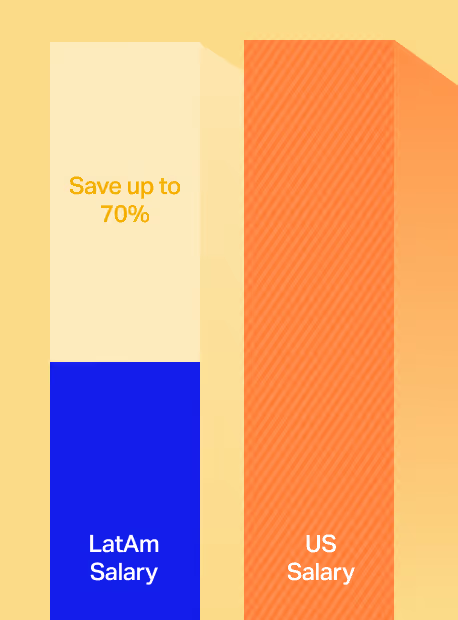
- Nearshoring to Costa Rica gives US companies full workday overlap with US business hours, high English proficiency, and the ability to build a comparable team at 30–70% of the domestic cost, stretching the same hiring budget to fund significantly more senior-level capability.
- Costa Rica excels in IT, customer service, engineering, and financial roles, backed by a tech sector projected to exceed $625 million by 2029 and a talent pool shaped by decades of Fortune 500 presence from Intel, Microsoft, IBM, and Amazon.
- Working with a nearshore staffing firm gives you full-time professionals who integrate directly into your team, using your tools, joining your workflows, and reporting to your managers, rather than a third-party vendor managing a shared workforce on your behalf.
If your offshore team is pushing back on 4 a.m. shifts to cover US hours, or your outsourcing vendor's team never quite feels like part of your company, the problem is the model, not the people. And for many US companies, the answer is Costa Rica.
Nearshoring to Costa Rica gives you full-time professionals working in your time zone, in English, integrated directly into your team. The country operates on Central Standard Time (CST), giving US companies a full workday overlap with no scheduling friction.
Its commercial services exports have grown at an average annual rate of 9.1% since 2005, reaching $16.5 billion in 2024, according to an Inter-American Development Bank analysis of Costa Rica's services sector.
That combination of time zone alignment, English proficiency, talent quality, and cost efficiency is why nearshoring to Costa Rica has become one of the most compelling hiring moves for US companies right now.
This article examines the factors that make Costa Rica a strong nearshoring destination, which roles transfer well, and how to find the right partner in 2026.

What Makes Costa Rica a Great Place for Nearshoring?
Costa Rica is a top nearshoring destination for US companies because of three compounding advantages: full workday overlap on Central Standard Time, a workforce that ranks among Latin America's highest for English proficiency, and salary savings of 30–70% compared to equivalent US hires. The talent pool is deep in IT, finance, and customer support, with professionals who integrate directly into US teams.
Here are six key advantages that have solidified Costa Rica's standing as a top nearshoring destination:
Time zone compatibility
Costa Rica operates on Central Standard Time (CST), giving US teams full workday overlap with no early-morning compromises on either side.
That's crucial because, according to research from Harvard Business School and INFORMS, each additional hour of time zone difference reduces real-time communication by 11%. The study recommends organizing distributed teams along a north-south axis (US to LatAm) rather than east-west, specifically to preserve workday overlap. Costa Rica sits exactly on that axis.
The cost of getting this wrong shows up in Hire With Near's data. Of the US companies switching from offshore models, 30% cite time zone gaps as the primary reason collaboration broke down. One client described the tipping point:
We're prioritizing LatAm now because we want them to work in tandem with our US hires as opposed to off hours.
For US-facing roles especially, same-hours coverage changes how the work gets done: standups happen, decisions don't wait, and issues get resolved the same day. It's one of the core advantages of nearshoring that Costa Rica delivers by default.
Cultural alignment
Time zone overlap gets your team online at the same hours. Cultural alignment is what makes those hours actually productive.
Costa Rican professionals are familiar with US business norms, direct communication styles, and the pace of North American companies. That familiarity reduces the friction that often comes with remote teams: misread expectations, different attitudes toward deadlines, or communication styles that don't translate well.
As Hire With Near co-founder Michael Girdley puts it:
The great thing about Latin America is that it's basically the same time zone, and the cultures are very similar.
Booming IT services market
Costa Rica's IT services market is projected to exceed $625 million by 2029, according to Statista. But the more telling signal is who's already there.
Intel, Microsoft, IBM, Amazon, Oracle, and Cisco have all established R&D centers and tech operations in Costa Rica. San José and Heredia have become the country's main tech hubs, home to shared services centers for companies like Roche, Equifax, and Procter & Gamble. When Fortune 500 companies build long-term operations in a market rather than just sourcing from it, they're validating the talent pipeline from the inside.
For US companies hiring remotely, that multinational presence matters for a practical reason: Costa Rican professionals have already worked inside the delivery standards, compliance frameworks, and engineering cultures of world-class organizations. You'll onboard someone familiar with how US companies operate.
English proficiency
Language barriers create real friction in remote work: delayed feedback, misread requirements, and client-facing roles that underdeliver. Costa Rica ranks 10th in Latin America and 55th globally in the EF English Proficiency Index 2025, placing it in the moderate proficiency band.
For most business roles (technical, operational, and back-office), that level of proficiency supports effective daily collaboration with US teams.
For senior client-facing roles, it's worth screening specifically for communication quality, which any good nearshoring partner should be doing as part of their vetting process.
Stable business environment
The Costa Rican government promotes foreign investment through political stability, a solid legal framework, and direct incentives for international companies. Its free trade zone regime has made the country one of the most attractive service export markets in Latin America.
The Costa Rican Investment Promotion Agency (CINDE) is a private nonprofit that works to attract foreign investors and generate high-quality employment. Costa Rica's commercial services exports have grown at a compound annual rate of 9.1% since 2005, reaching $16.5 billion in 2024, according to an IDB study.
The US government's own assessment reinforces this: Costa Rica maintains an excellent climate for foreign investment, according to the State Department's 2023 Investment Climate Statement.
Educated workforce
Costa Rica's strong emphasis on education produces a high literacy rate and a skilled professional class. With many universities and technical institutes, the country has a constant flow of new talent joining the workforce.
In engineering, for example, the country ranks first in Latin America for engineer availability, a direct result of decades of public investment in education that produces a steady flow of job-ready graduates.
Beyond these five advantages, nearshoring to Costa Rica gives you shorter travel times for in-person meetings when needed, protections under the Central America Free Trade Agreement (CAFTA), and cultural similarities that make professional collaboration feel natural.
In dozens of conversations with Hire With Near's recruiting team this year, the pattern that comes up consistently is how often Costa Rican professionals exceed client expectations on communication and cultural fit: two areas that tend to trip up offshore arrangements.
{{prevetted-banner}}
What Roles Can You Nearshore to Costa Rica?
Costa Rica's educated workforce supports a wide range of specialized roles, from IT and customer service to accounting, engineering, and healthcare.
Here are the main areas where US companies are hiring:
- Information technology: Costa Rica's flourishing IT sector supports a wide range of technical roles, including software development, mobile app development, cybersecurity, and IT support. The presence of Intel, Microsoft, IBM, and Amazon in the country means local professionals are already familiar with US delivery standards.
- Customer service: Strong English proficiency and full US time zone overlap make Costa Rica a natural fit for customer-facing roles. Companies build dedicated support hubs there specifically because the team is available when US customers are.
- Digital marketing: Costa Rica has a growing pool of marketing professionals skilled in SEO, social media management, content writing, and data analysis, roles that benefit directly from real-time collaboration with US teams.
- Engineering: Costa Rica has a well-developed engineering sector with particular strength in industrial, mechanical, and electrical disciplines. The country ranks first in Latin America for engineer availability, according to PROCOMER.
- Design: Web and graphic design are active hiring markets in Costa Rica, particularly for US companies that need creative support integrated with their product or marketing teams during US hours.
- Accounting and financial services: Costa Rican finance professionals handle accounting, bookkeeping, compliance, and tax preparation with strong bilingual ability and familiarity with US financial practices.
- Human resources and administration: HR coordination, onboarding, payroll support, and executive assistance are well-established nearshoring categories in Costa Rica, supported by real-time availability and strong written English.
- Research and development (R&D): Costa Rica has notable R&D capabilities in agribusiness, biotechnology, and environmental sciences, driven by government investment and a mature life sciences sector.
- Legal services: Contract management, legal research, and compliance work are increasingly nearshored to Costa Rica, where qualified professionals can handle complex tasks at a fraction of US rates.
- Healthcare services: Healthcare back-office operations, medical transcription, and billing are growing nearshoring categories, supported by high professional standards and English proficiency.
- Supply chain and logistics: Costa Rica's strategic location and strong trade agreements have made it a hub for logistics and supply chain roles, including procurement, inventory management, and distribution coordination.
How Does Nearshoring in Costa Rica Compare to Other LatAm Countries?
Costa Rica is not the only strong nearshoring option in Latin America, and the right country depends on what your business needs most. Here's how the main destinations compare across the factors that matter most to US companies:
English proficiency rankings: EF English Proficiency Index 2025. Department strengths: Hire With Near's 2026 State of LatAm Hiring Report.
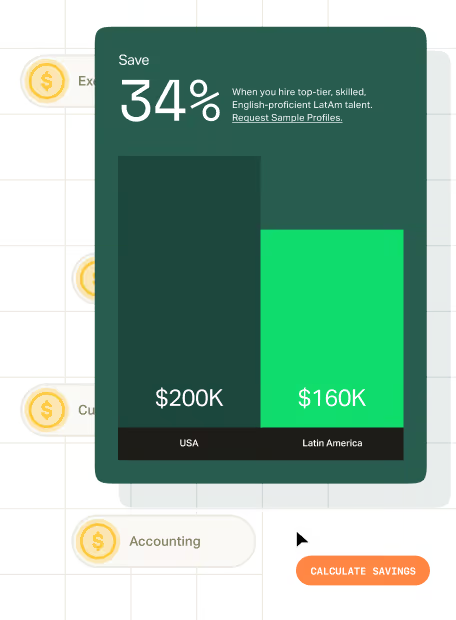
Cost savings across all LatAm countries range from 30–70% vs. US equivalents, depending on role and seniority. See Hire With Near's Salary Guide for role-specific benchmarks.
Costa Rica's clearest advantages are political stability, English proficiency relative to Mexico and Colombia, and a tech talent pool shaped by decades of Fortune 500 presence.
Its main trade-off is talent pool size: Colombia and Brazil have significantly more professionals across most functions, which can mean more candidate options and faster time-to-hire for high-volume hiring.
For US companies prioritizing quality, stability, and IT or engineering depth, Costa Rica is a strong first choice. For companies building large sales or accounting teams quickly, Colombia, now Hire With Near's top hiring destination with 23% of all placements in 2025, often delivers more volume at competitive rates.
The good news: These choices aren't mutually exclusive. Many US companies hire across multiple LatAm countries simultaneously, matching each role to the country where the talent is strongest.
{{latam-hiring-calculator}}
How To Find a Nearshoring Partner for Costa Rica
With nearshoring, you hire a specific person who joins your team, uses your tools, follows your processes, and reports directly to your managers. Choosing the right partner determines how well that works in practice.
Here's what to look for:
- LatAm-specific experience: A generalist recruiter with a global network is not the same as a firm that sources exclusively in Latin America. Ask how many placements they've made in Costa Rica specifically, and in the roles you need.
- A real vetting process: Ask what screening looks like beyond the resume. For roles where communication matters, you want candidates assessed in live conversations, not just on paper.
- Compliance and payroll handling: Costa Rican labor law includes specific requirements around severance, social benefits, and vacation time. Confirm whether the partner handles local compliance and employer-of-record responsibilities, or whether that falls to you.
- A replacement guarantee: Ask how long it applies and what triggers it. The industry standard is 90 days; stronger partners offer 180.
- Transparent pricing: You should know the fee structure, salary benchmarks, and what you owe before you sign anything.
If you're looking for staffing firms that place dedicated talent in the country, the best staffing agencies in Costa Rica article covers the top options.
Final Thoughts
Nearshoring to Costa Rica gives US companies full workday overlap, strong English proficiency, and access to experienced professionals across IT, finance, customer service, and more. The cultural proximity to the US compounds those advantages. Teams integrate faster and collaborate more naturally than with distant offshore models.
The numbers back it up. According to Hire With Near's 2026 State of LatAm Hiring Report, companies save $35,000–$64,000 per hire annually, and 84% of placements are mid-level or senior professionals.
CyberFortress built a 20-person finance team through Hire With Near after struggling to fill senior roles in the US. They filled three director-level positions and saved $1.2M annually. In CFO Seema Chacko's words:
We hired 20 team members who share our core values: great attitude and desire to learn, resourcefulness, and adaptability.
Book a no-commitment consultation to see how Hire With Near can help you build your Costa Rica team.
Frequently Asked Questions
What are the characteristics of professionals based in Costa Rica?
Remote workers based in Costa Rica are typically well educated, bilingual in Spanish and English, and bring strong technical expertise, particularly in IT and engineering.
They also benefit from favorable working-hours overlap with the US, which supports real-time communication and collaboration during standard business hours.
What's the expected cost when nearshoring to Costa Rica?
Nearshoring to Costa Rica is significantly more cost-effective than hiring domestically, with most companies saving 30–70% compared to equivalent US roles.
Costs vary depending on the specific role and seniority level, but Costa Rica's lower cost of living means competitive rates for highly skilled professionals.
Check our full salary guide for role-specific estimates.
What industries are leading when it comes to outsourcing to Costa Rica?
Leading industries nearshoring to Costa Rica include IT, customer service, digital marketing, engineering, financial services, and healthcare. The country's growing tech sector and high level of English proficiency make it particularly attractive for US-facing roles.
How does nearshoring in Costa Rica compare to nearshoring in other Latin American countries?
Costa Rica is the strongest choice for IT and bilingual customer service roles; Mexico offers the closest proximity and minimal time zone gap; Argentina leads for software development and finance; Colombia is strongest for cost-competitive tech and sales talent.
Hire With Near places candidates across all of these markets and help you find the right fit, regardless of country.
What is the difference between nearshoring and outsourcing to Costa Rica?
Nearshoring (as Hire With Near practices it) means hiring dedicated full-time professionals who work exclusively for your company: They join your team, use your tools, and report to your managers.
Outsourcing to a vendor means contracting a third-party company to manage a team on your behalf, where you have limited direct management and the workers' primary relationship is with the vendor.
Both models have a place, but if you need people who feel like genuine teammates and grow with your business, dedicated nearshore hiring is the better fit.
What other Latin American countries are good for nearshoring besides Costa Rica?
Argentina excels in technical roles, particularly software development and finance. Mexico offers proximity to the US with minimal time zone differences. Colombia provides a growing tech sector and competitive costs. Chile is strong in business services.
Each country has different strengths, so the best choice depends on your specific needs, the role type, and your budget.






.webp)
.webp)


%203.svg)
.avif)





%20(1).avif)

%20(1).png)