


%203.svg)
Key Takeaways
- You can hire full-stack developers in Latin America for $36K to $108K a year depending on seniority, against $83K to $184K for the equivalent US hire, with most searches closing in under three weeks.
- A full-stack developer handles both front-end and back-end work, which makes them valuable for startups and smaller teams, but they often specialize more in one area, so hire based on your specific needs and their strongest skills.
- The best full-stack developers write clean, scalable code and understand the business problem behind the ticket, not just the technical requirements.
When you hire a full-stack developer, you add someone who can move the roadmap forward without waiting on another team to catch up. A strong full-stack engineer switches between front end and back end without losing pace, understands how a change to the interface affects the database underneath it, and can own a feature from the UI a user sees all the way to the schema that stores their data.
That range lets a team ship faster, cuts handoffs between front-end and back-end teams, and lets fewer people cover more of the roadmap.
Latin America's tech hubs produce more of these engineers every year: professionals with strong technical range, hours that overlap with US teams, and an easy day-to-day fit on a distributed team.
This guide breaks down what you need to hire one well: LatAm salary bands, the skills to check for at each seniority level, and interview questions that show whether a candidate's range is real or thin on one side. Hire With Near's staffing and recruiting service can put a shortlist of full-stack engineers in front of you within days.
What Is a Full-Stack Developer?
A full-stack developer works across the front end (what users see) and back end (server-side logic) of applications, handling everything from user interfaces to databases and APIs.
One person owning a feature end to end means no handoff between a front-end developer and a back-end developer, and no delay while a ticket sits between them.
Companies hiring a full-stack developer are hiring for exactly that: someone who takes a feature from idea to working product without needing anyone else to finish the other half.
Full-stack is the most common developer role in the market. In Stack Overflow's 2025 Developer Survey, 27% of respondents identified as full-stack developers, more than double the next-largest role, back-end developer, at 14.2%.
The label doesn't mean they're experts in everything. Most full-stack developers lean toward front-end or back-end work, with stronger skills on one side and working competence on the other.
Here's what they typically handle:
- Front-end development: Building user interfaces with HTML, CSS, JavaScript, and frameworks like React, Vue, or Angular. That's the work a dedicated front-end developer owns.
- Back-end development: Creating server-side applications, APIs, and database integrations using languages like Python, Node.js, or PHP, the territory of specialist back-end developers.
- Database management: Designing and maintaining databases, writing queries, and optimizing performance.
- DevOps basics: Deploying applications, managing servers, and handling core infrastructure tasks.
- Problem-solving: Debugging issues across the application stack.
How Much Does It Cost to Hire Full Stack Developers?
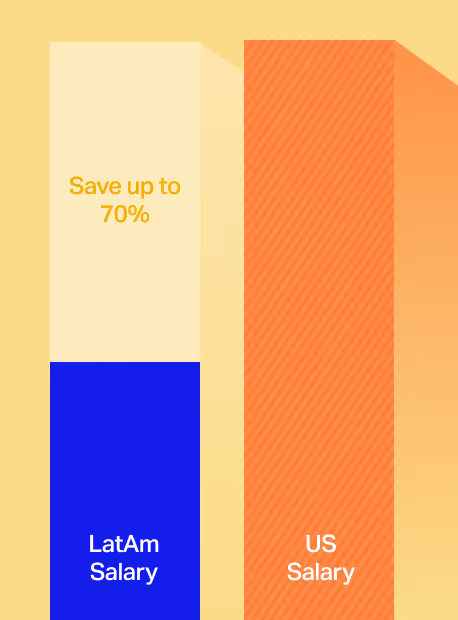
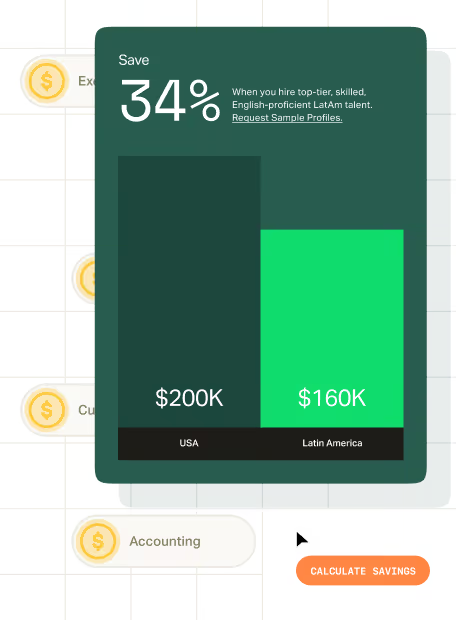
Hiring a full-stack developer in Latin America costs $36K to $108K a year depending on seniority, compared with $83K to $184K for the equivalent US hire, according to Hire With Near's 2026 salary data.
For the most up-to-date figures, see Hire With Near's US vs Latin America Salary Guide.
Four things move a candidate inside those bands: years of genuine end-to-end experience, depth on the side of the stack you need most, the country they're based in, and whether they've worked with US clients before.
That last point is worth paying for: an engineer who has run sprints with a US product team knows the meeting cadence, the documentation expectations, and the communication style, so you skip a ramp-up you'd pay for in delivery time.
These savings aren't about compromising on quality, and they aren't about paying people less than they're worth. They reflect differences in cost of living and local market conditions. The practical effect: hiring a senior full-stack developer in Latin America often costs less than a mid-level US hire.
That pattern holds across our placement data. Across the 2,000+ placements in Hire With Near's 2026 State of LatAm Hiring Report, software engineering roles saved US companies $23,000 to $85,000 a year, or 28 to 59%, depending on seniority.
If you're budgeting for a whole team rather than one hire, our breakdown of what IT roles cost in Latin America compared to the US covers the rest of the engineering org, from QA to DevOps to engineering management.
{{salary-guide-cta}}
What Skills Should You Look For When Hiring Full-Stack Developers?
Screen a full-stack developer on three things: real end-to-end ownership of a shipped application, genuine depth on one side of the stack plus working competence on the other, and the ability to explain their own work to someone who isn't a developer.
In my nearly four years recruiting technical talent at Hire With Near, the hardest part of this role has never been finding people who list the right technologies. It's separating the developers who have owned something from those who've contributed to it. Both look identical on a resume.
That gap is what most hiring teams get burned by. One talent acquisition leader at a mid-market SaaS and compliance company described the pattern this way:
Right now, [our current vendor] is sending us candidates, and their resumes do look good, but when they do make it to our technical assessment and our interview rounds, our hiring team is finding that they're maybe not as senior as we're hoping for. So we're just looking for candidates that are more senior than from what we've seen over the last several months with [them].
Three signals separate a real senior from a titled one:
- They can name a full application they built and walk you through the decisions, not just the stack.
- They can make a technical concept accessible to a product manager without being asked.
- They'll talk about what went wrong on a project without you pulling it out of them. A candidate who can't explain their role in a past project, or who deflects every question about mistakes, is the single most reliable red flag I see.
Seniority is where the market is tightest. According to SignalFire's State of Tech Talent Report 2026, senior individual contributor and staff roles are growing as a share of hiring while new-grad and entry-level hiring is down roughly 65% at the largest tech companies compared to 2019. You're competing for the people everyone else wants, which is why a defined bar per level matters more than a job description asking for everything.
Here's how full-stack developer skills typically progress across experience levels:
Use the level you're hiring for to set the interview bar, the compensation band, and how much mentoring the person will need. Below that, every full-stack developer should show the same core skills.
Hard skills (the must-haves)
- Proficiency in front-end and back-end technologies: Look for candidates comfortable with at least one front-end framework (React, Vue, Angular) and one back-end language (Node.js, Python, PHP, Ruby). They don't need to be experts in everything, but they should show fundamentals in both areas and explain their technology choices.
- Database design and management: Full-stack developers need to understand how to design database schemas, write efficient queries, and optimize performance. Whether it's SQL (PostgreSQL, MySQL) or NoSQL (MongoDB, Redis), they should be able to explain their choices and trade-offs.
- API development and integration: They should know how to build RESTful APIs, handle authentication, and integrate with third-party services. Experience with GraphQL or microservices architecture is valuable for complex projects.
- Version control and collaboration tools: Git proficiency is non-negotiable. They should understand branching strategies, code reviews, and how to collaborate with other developers.
- Testing and debugging skills: Look for experience with unit testing, integration testing, and debugging across the application's layers. They should identify and fix issues quickly without extensive guidance. On larger teams, this sits alongside dedicated QA engineers, but a full-stack developer still owns the quality of what they ship.
Soft skills (equally important)
- Problem-solving approach: The best full-stack developers don't just write code, they solve business problems. I screen for someone who writes clean, scalable, testable code and understands the purpose behind the work.
- Communication across technical and non-technical teams: Full-stack developers often sit between engineers, product managers, and the people paying for the work. They need to explain technical decisions clearly to both developers and business leaders.
- Adaptability and learning mindset: Technology stacks evolve rapidly. The best full-stack developers are comfortable learning new frameworks and adapting to changing requirements.
- Collaborative mindset: They should work with designers, product managers, and other developers, understanding how their work fits into the bigger picture.
- Self-direction and ownership: In remote or distributed teams, full-stack developers need to manage their own time, prioritize tasks, and take ownership of their work without constant supervision.
Federico Bilello, a Software Engineering Recruiter at Hire With Near, screens for that directly:
The main thing I look for is ownership. I always look for developers who have worked in startups or smaller companies, because those are the people who probably have ownership. If you bring them a problem, they won't ask how to solve it, they'll try their own ideas, they'll be creative.
— Federico Bilello, Software Engineering Recruiter, Hire With Near
Nice-to-have skills (the differentiators)
- DevOps and deployment experience: Understanding deployment processes, CI/CD pipelines, and cloud platforms (AWS, Azure, GCP) is valuable for mid-level and senior developers, but not essential for junior roles. If deployment and infrastructure are a bottleneck for your team, that's usually a sign to hire DevOps engineers rather than stretch the full-stack req.
- Specific framework expertise: Deep knowledge of your tech stack (React Native for mobile, Django for back-end, etc.) is valuable, but don't make it a hard requirement if the candidate has strong fundamentals.
- UX/UI design sense: Full-stack developers with design awareness can make better decisions about user experience and work better with design teams.
- Performance optimization: Experience with caching, CDNs, and performance monitoring tools matters more as applications scale and is typically expected at senior levels.
- Security best practices: Understanding common security vulnerabilities and how to prevent them is increasingly important, especially for developers working on user-facing applications.
Where Can You Find and Hire Great Full-Stack Developers?
You have three realistic options: your local market, remote US hiring, and international hiring. For a full-time role, Latin America gives you the deepest qualified pool that still overlaps with your working day.
Deciding between local, national, or global talent
Pick the approach that fits your timeline, your budget, and how much real-time collaboration the role needs:
- Local/in-office hiring offers direct collaboration, easier communication, and simple administration. However, you're limited to your immediate geographic area, which might not have the talent depth you need. Expect to pay premium salaries and potentially face longer hiring cycles.
- Remote US-based hiring opens the search to the whole country while keeping familiar business practices and working hours. You'll reach more candidates but still face competitive salaries and long recruitment processes.
- Nearshoring and offshore hiring open the largest talent pool, at 30–70% below US salaries. For example, hiring Latin American developers gives you engineers who work during your business hours, communicate in English at a technical level, and already know how US product teams run. South and Southeast Asia and Eastern Europe also have deep engineering markets, though the workday barely overlaps a US schedule.
For more on location, start with the best countries to hire remote software engineers and developers.
Choosing how to hire
Once you know where you're looking, you have four ways to hire a full-stack developer, ordered from most work on you to least.
- Source, screen, and hire on your own: You run the whole search. Post the role, work your network, and screen every candidate. Where you look changes the trade-off:
For a hire outside the US, becoming the employer usually means bringing in an employer of record company to handle contracts, payroll, and local compliance. Worth knowing: an EOR handles employment logistics, not recruiting. You're still finding, screening, and closing every candidate yourself, often in a market you don't know.
- Freelance and contractor platforms: Upwork, Toptal, and Fiverr get you a contractor fast, which works for a defined project or a short engagement. They're built for project work, not for someone who'll own your codebase long-term.
- Staff augmentation: A firm places a pre-vetted engineer on your team to work under your direction, while it handles employment, payroll, benefits, and compliance on its side. This fits a defined project or a scaling period where you need capacity without adding permanent headcount.
- A specialist staffing and recruiting partner: You describe the role, the partner sources and vets candidates and hands you a shortlist, and once you hire, they handle payroll, benefits, and local employment requirements. This is the only option that does both jobs, finding the person and employing them, in one relationship, which is usually the faster path for a full-time hire.
The distinction between a contractor and full-time hire is a question I get on nearly every call: is this person working only for me, or juggling other clients at the same time? That's a structural difference between the two models, not a judgment about anyone's integrity.
A contractor's business model rewards running several engagements in parallel, so your sprint competes with everyone else's. It shows up in screening: if a candidate tells me they're holding two or three jobs, that reads as a scheduling risk to flag, not evidence they're in demand.
If you need speed and have bandwidth for vetting, job boards or freelance platforms work well, and the platforms and companies people use to hire developers offshore are a reasonable place to start comparing. For long-term hires or international talent, a specialist staffing and recruiting partner gives you a better balance of quality and speed, and the last section covers what that changes.
How Do You Hire a Full Stack Developer? A Step-by-Step Process
Hire a full-stack developer in three stages: define the stack and the seniority bar before you source, screen with a small real-world task reviewed together on a call, then make a market-accurate offer and close fast.
Stage 1: Define requirements before you start sourcing
Don't just say you need a “full-stack developer.” Define whether you need someone stronger in front-end or back-end, which specific technologies they'll work with, and what type of work they'll focus on most.
Then split that list in two: what's non-negotiable, and what's learnable. Niche framework versions get overweighted in most job descriptions, and a strong engineer who understands core principles picks up your flavor in weeks. Domain complexity, scale experience, and a fundamentally different paradigm are the things that don't transfer quickly.
Some stacks are also thinner in Latin America than others. JavaScript, Python, .NET, PHP, and the mainstream front-end frameworks are deep and easy to hire for. If your product runs on something unusual, say so early so the search gets scoped realistically instead of stalling three weeks in.
Write a job description that attracts the right candidates
Your job description should be specific about technologies, responsibilities, and expectations. Include details about your current tech stack, the type of projects they'll work on, and how they'll collaborate with your team.
Cut the vague phrases. “Rockstar developer,” “ninja,” and “fast-paced environment” tell a candidate nothing about the job and filter out the experienced people who've learned what those phrases usually mean.
Set realistic expectations about scope and timeline
Full stack developers aren't magicians. Be clear about what you expect them to accomplish and in what timeframe. Unrealistic expectations lead to frustrated developers and failed projects.
Stage 2: Verify the candidates can code
Give candidates a small, real-world task, then review it together on a call. That combination is the only screen I've found that consistently separates people who can build from people who can talk about building.
Ask them to complete a small, real-world task like debugging a piece of code, refactoring it to make it more scalable, or implementing a basic API with tests. Live or take-home both work.
What matters is the review call afterward, where you ask why they made each decision and what they'd change with another day. That's where you see how someone reasons, and it's the part an AI-assisted submission can't fake.
Run one more screen on the resume itself: ask for years of professional experience with a specific tool, not years of experience overall. “Eight years in software” and “eight months in the framework you use” are very different answers, and only one of them shows up on the page.
Look for end-to-end ownership experience
Ask candidates about projects where they've built full applications from scratch. The questions worth asking:
- Have you built full applications end to end?
- Do you specialize more in front end or back end, or genuinely balance both?
- Do you prefer one unified stack or mixing frameworks?
- How do you work with design, product, QA, and data when the handoffs get messy?
Evaluate communication and collaboration skills
Full-stack developers need to work with diverse teams. During interviews, pay attention to how they explain technical concepts, ask questions, and discuss their approach to working with designers, product managers, and other developers.
Stage 3: Make competitive offers and close quickly
From what I've seen placing developers, the benefits that matter most beyond salary are work-life balance (flexible hours and PTO), learning and growth opportunities, and having ownership of their work.
I see the same thing on almost every search: too long a process costs you great candidates. Top full-stack developers have options, so cut your process down to the steps that actually change your decision and be ready to move quickly once you find the right person.
If you're hiring internationally, work with someone who understands local market conditions so your offer is competitive without overpaying. Benchmarks, benefits expectations, and notice periods all work differently by country, and our guide to hiring remotely in Latin America walks through those details.
For more on crafting a strong offer, our guide on making a good job offer covers that in full.
{{hiring-remotely}}
Top Interview Questions for Hiring Full Stack Developers That Reveal the Right Fit
Five questions do most of the work: a full stack project walkthrough, how they debug across layers, a time they traded code quality for a deadline, how they decide which new technology to adopt, and a piece of feedback that changed how they work. The right questions reveal how candidates think, not just what they know.
If you want a wider bank to pull from, we also keep a list of 25 tech interview questions you can ask technical talent.
“Can you describe a recent project where you had to design and implement a full-stack solution? What tech stack did you use, and what were some challenges you faced?”
This is the question I always start with. I ask candidates to tell me about a project they've worked on, not just which languages they used, but what their role was and what they did. What matters is whether they can explain their work to someone who isn't a developer. If they can, it tells me a lot.
Look for candidates who can clearly explain their role in the project, the technical decisions they made, and how they overcame obstacles. Strong answers will include specific details about architecture choices, team collaboration, and lessons learned.
“How do you approach debugging an issue that spans multiple layers of an application?”
Full-stack developers need strong debugging skills. Listen for a structured approach: reproducing the issue, checking logs, isolating the problem to specific layers, and using the right tools.
Great candidates will mention collaboration with team members and documentation of their findings.
“Tell me about a time when you had to make a trade-off between code quality and delivery timeline. How did you handle it?”
This question assesses judgment and communication skills. Look for candidates who can weigh the delivery date against test coverage and code review, explain the trade-off clearly to their engineering lead and to product, and come back later to the debt they chose to take on.
“How do you stay current with new technologies and decide which ones to adopt?”
Technology evolves rapidly, and full-stack developers need to be continuous learners. Strong candidates will mention specific resources they use (blogs, conferences, side projects), criteria for evaluating new technologies, and examples of successful adoption.
“Describe a situation where you received feedback that led to a significant improvement in your work or approach.”
I ask about feedback in nearly every screen, because the answer is telling. It reveals self-awareness and a growth mindset. Look for candidates who can discuss specific feedback, how they applied it, and what they learned from the experience.
Want to make sure your candidate is senior and not just carrying the title? Ask these 5 questions to spot a fake senior engineer fast.
Common Mistakes to Avoid When Hiring Full Stack Developers
Five mistakes cost teams the most: hunting for a unicorn who is expert in everything, running a process too long to close anyone, screening only on technical skill, being vague about where the tech stack is heading, and filtering on a computer science degree.
Expecting one person to be an expert in everything
Full-stack developers have broad skills, but they're not masters of every technology.
Avoid the unicorn hunt: expecting one person to be equally skilled in front end, back end, DevOps, design, and project management.
Focus on someone strong in the areas that matter most to your immediate needs.
Making the hiring process too long and complex
What other recruiters and I hear from candidates and clients alike is that “candidates don't want to go through multiple technical assessments.”
Cut your process back to the evaluations you'll act on, and move quickly with strong candidates.
Focusing only on technical skills during evaluation
Technical competence is very important, but not sufficient. Two answers should give you pause: a candidate who “can't explain what their role was in previous projects,” and one who avoids talking about mistakes or challenges.
Our recruiters read both as a lack of experience or self-awareness. Evaluate communication, problem-solving approach, and cultural fit alongside technical abilities.
Being unclear about the tech stack's role in your roadmap
Our recruiters point to one job-description gap more than any other: “not being clear on the tech stack's role in the roadmap.” Is this the current stack, or what you plan to build future features on?
That confusion leads to mismatched expectations and poor hiring decisions.
Dismissing candidates based on rigid degree requirements
I usually recommend that clients don't make a degree a must-have for engineering roles. A lot of the strongest engineers in Latin America started working before they graduated, got a really good job, and never had time to finish. That doesn't make them worse candidates, and filtering on the degree means losing them without ever seeing their work.
Most job postings have already caught up to that. Indeed Hiring Lab found that a small majority of US job postings, 51%, ask for no formal education requirement at all, and only 19.3% required a bachelor's degree or more as of November 2025.
Focus on what candidates can do: their portfolio, problem-solving approach, and ability to learn and adapt. Skills and proven results matter far more than formal credentials in day-to-day development work.
Why Does Working With a Recruiting Partner Make a Difference When Hiring Developers?
A recruiting partner changes two things a hiring team can't fix on its own: reach into a candidate market you don't know, and a filter that runs before you spend interview cycles.
You can hire a great full-stack developer on your own. Plenty of companies build their development teams through direct hiring, referrals, and job boards. But if you're facing time pressure, hiring in an unfamiliar market, or considering international hiring for the first time, a specialized recruiting partner can shorten the search.
It's worth knowing that IT and tech recruiting in Latin America is its own discipline, with market knowledge that doesn't transfer from US sourcing.
Self-sourcing in a market you don't know is where most teams lose time.
A recruiting partner brings five advantages:
- Expertise in evaluating full-stack candidates: A recruiter who fills these roles every week knows which parts of your stack are common in the region and which are thin, so the shortlist matches what you asked for rather than what the market has.
- Access to passive candidates: The best full-stack developers are often already employed and not actively job searching. Recruiters have networks and relationships that can surface these hidden candidates.
- Speed and efficiency: Instead of spending weeks screening candidates, a good recruiter presents you with pre-vetted options who match your technical and cultural requirements.
- International hiring expertise: If you're weighing companies that place LatAm developers, a specialized partner knows local salary benchmarks and notice periods, handles compliance requirements, and makes sure offers land competitively in local markets.
- Market intelligence: Recruiters understand current salary trends, in-demand skills, and the competitive landscape, helping you make informed decisions about offers and positioning.
ParkMobile, part of EasyPark Group, is what those advantages look like with numbers attached. Its back-end and platform engineering had been run by third-party development agencies for years, so every contractor rollover took institutional knowledge of ParkMobile's own systems with it.
The team wanted its own senior platform engineers, back-end developers, and an iOS specialist, but US rates of $148K to $214K per role put that out of reach, and Colombia was a market they had never recruited in.
Working with Hire With Near, ParkMobile hired 9 senior engineers in Bogotá at a 24-day average time to hire, with first shortlists landing inside a week. Our partnership helped them save $1,066,085 a year, a 73% cost reduction.
See how another company hired a senior full-stack engineer who could also lead client-facing technical conversations.
Hire With Near ran sourcing, English screening, and candidate management inside ParkMobile's ATS, and placed more roles than any other channel, including their internal sourcing.
Two months after the first placements, ParkMobile's TA Lead put the working relationship this way:
Hire With Near works today as a valued extension of our internal team, which speaks to their strong partnership approach.
— Akshay Gokarnakar, TA Lead, ParkMobile
You can see his testimony in the video below:
The same approach works whether you need one developer or a group. If you're building a function rather than filling a seat, the process to hire software engineers in Latin America is the same one that filled nine roles at ParkMobile.
Executive search for engineering leadership covers the VP of Engineering or CTO hire when you outgrow an individual contributor.
Final Thoughts
The right full-stack developer moves your roadmap forward instead of adding to the queue. But finding that person means looking past resumes and portfolios to how they think, communicate, and execute. The most successful companies hire developers who can grow with their business, not just close the tickets in front of them.
At Hire With Near, we take the time to understand your tech stack, your team, and what you're building, then help you hire full-stack developers in Latin America who can contribute quickly. They work during your business hours, and salaries in the region run 30–70% lower than comparable US rates.
If that's worth exploring, book a free consultation call with our team. We'll talk through your requirements, give you salary benchmarks, and explain how the process works.
{{latam-hiring-cta-v2}}
Frequently Asked Questions
Do full-stack developers in Latin America speak English well enough for technical work?
Yes, and the part that matters is technical English: explaining why a pull request broke production, writing documentation another engineer can follow, and holding their own in an architecture review.
Screen for it directly rather than trusting a level on a resume. Ask the candidate to walk you through a project they built as if you weren't a developer.
If they can make the decisions and trade-offs clear without hiding behind terminology, they'll be fine on your team's calls and in your docs.
How long does it take to hire a full-stack developer in Latin America?
Most companies hiring through Hire With Near make a hire in under three weeks, with a first shortlist of candidates in 3 to 5 days. ParkMobile's nine engineering searches averaged 24 days each.
Where you land in that range is usually decided on your side. It comes down to how quickly you give feedback on the shortlist, how many interview rounds you run, and how fast you can get to a decision once you've met someone good.
Notice periods in the region are typically shorter than in Europe.
Which Latin American countries have the strongest full-stack developer talent?
Brazil has the largest engineering community in the region, with 6.9 million-plus GitHub accounts as of GitHub's Octoverse 2025, followed by Mexico at 1.9 million-plus, Argentina at 1.1 million-plus, and Colombia at 1 million-plus, all growing at double-digit rates year over year, per GitHub's Octoverse 2024.
Colombia is the most common hiring destination for US companies overall, and Argentina has a long-established engineering market. The right one for you depends on your budget and how much daily overlap you need.
How long do Latin American developers usually stay in the role?
Our placements stay an average of three years, and 80% are still in the role after two years. The mechanism behind that matters more than the number.
Salaries set above the local market, growth opportunities that local employers often can't offer, and benefits on par with what US employees get all reduce the reasons someone starts looking.
Engineering churn is expensive because context walks out with the person, so it's worth asking any partner what their retention data shows before you sign.
What other engineering roles can I hire from Latin America?
Beyond full-stack developers, US companies regularly hire front-end developers, back-end developers, DevOps engineers, and QA engineers across Latin America.
Those four cover most of what a growing product team needs after its first generalist hire: specialist depth on each side of the stack, deployment and infrastructure, and test coverage.
All of them come with the same working-hours overlap and the same cost difference against US salaries.
Which industries hire full-stack developers from Latin America?
Every industry where the product is the business hires full-stack developers in Latin America, not a narrow set of tech companies. Nearshore SaaS recruiting is the most common case, because product teams need people who can move between the interface and the API on the same ticket.
Fintech hiring, healthtech, e-commerce, and mobility platforms look for the same profile. The throughline isn't the sector, but whether the product is the business.







.webp)


%203.svg)
.avif)




%20(1).avif)

%20(1).png)