Key Takeaways
- The 10 best companies for hiring offshore app developers are Hire With Near, Revelo, CloudDevs, Andela, Uplers, Second Talent, Saigon Technology, Innowise, Lemon.io, and Toptal. Each places a developer onto your own team rather than taking the build off your hands.
- Choose between them on how deep the technical screening goes, how much of your working day the developer covers, who employs the developer, and the total cost next to a US hire.
- Costs depend on region and provider: the companies here that publish rates charge $22 to $75 an hour. In Latin America, app developers earn roughly $30K to $120K a year depending on role and seniority, against $73K to $198K in the US.
The best companies for hiring offshore app developers find a developer for your own team and can walk you through how that developer was screened. Below are 10 of them, across Latin America, Africa, Asia, and Eastern Europe, with what each does best and where it falls short.
If you’re here, you probably need more hands on your app and want your budget to go further than one US salary would. Every company on this list will tell you its developers are pre-vetted. When I asked our recruiters what trips people up, they said most companies compare prices and rarely ask how a provider screens.c
So that’s how I compared them: how they screen, where their developers sit, and how you hire through each one, from marketplaces to staff augmentation.
Full disclosure: Hire With Near is on the list, so I’ll be clear about where we fit and where another company is the better call.
What Are the Best Companies to Hire Offshore App Developers?
The ten companies below all place mobile developers and app engineers directly onto your team. A few also sell project work, but I’ve listed them for their placement side: they find the person, you manage the work.
How I picked these 10: every company holds at least 4.5 out of 5 with 50 or more client reviews on an established platform (G2, Clutch, Trustpilot, GoodFirms, or ClearlyRated), and I kept a deliberate spread of regions.
Before writing this, I asked our recruiters what decides these searches most often, and they kept naming the same trade-off: cost against working-hours overlap. The list runs in no particular order.
For the full process, see our guide to how to hire mobile developers.
What separates these ten is where the talent sits, how deep the screening goes, and who employs the developer:
Below, you’ll see the companies with their ratings. I recheck each of them on its review platform regularly and update this list when scores or review counts change.
1. Hire With Near

Website: hirewithnear.com
Headquarters: United States
Rating: 4.9/5 on G2 (155+ reviews)
Services: Nearshore staffing and recruiting, direct hire, staff augmentation, RPO
Focus Regions: Latin America only
Hire With Near is a staffing and recruiting agency that helps US companies hire remote talent from Latin America across all industries and departments. We recruit in Latin America only, so your developer works your hours and joins your stand-ups live.
We’ve helped 950+ companies hire, including Expensify and Deel, and we’re No. 118 on the 2026 Inc. 5000 list.
For a US healthtech startup, we placed seven senior engineers, including a senior React Native mobile engineer, in 14 days on average, while the company kept its full eight-step interview process. It now saves $323,000 a year against US salaries.
Key features:
- First candidates in 3 to 5 days from a pool of 160,000+ pre-vetted candidates (plus active search beyond), and most hires are made in under 3 weeks.
- We fill 97% of the roles we take on, with a 9.1 client satisfaction score, and we handle sourcing, screening, payroll, and compliance.
- A 180-day replacement guarantee, double the industry standard, at no additional cost.
Best for: US teams that want a dedicated app developer in their own hours, and room to hire software engineering talent beyond mobile through the same IT and tech staffing partner.
Limitations: Latin America only. If you want the lowest hourly rate, or engineers in Asia or Eastern Europe, another company here fits better. We don’t do project delivery.
Pricing: Direct hire (one-time fee) or staffing (monthly fee, payroll included). You pay nothing until you hire.
2. Andela
Website: andela.com
Headquarters: United States
Rating: 4.7/5 on G2 (110+ reviews)
Services: Vetted engineer placement, blended teams, AI systems work
Focus Regions: Africa, plus engineers in 135 countries
I included Andela for network depth: 200,000+ technologists trained since 2014 and 650+ enterprise clients.
Key features:
- A multi-step qualification path, including an English test, a technical assessment, and a live interview, before matching.
- Notable clients including GitHub, Goldman Sachs, SoFi, and Capital One.
- Engineers grouped by function: AI application, infrastructure, platform.
Best for: Enterprises staffing AI, platform, or data work, where breadth beats overlap.
Limitations: The positioning leans toward AI engineering, so a straightforward iOS or Android hire isn’t the natural ask, and rates aren’t published.
Pricing: Not publicly listed.
3. Revelo

Website: revelo.com
Headquarters: United States (Miami), founded 2015
Rating: 4.7/5 on G2 (129 reviews)
Services: Nearshore developer placement, payroll and compliance
Focus Regions: Latin America, across 18 countries
Revelo makes the list for scale inside one region: a stated 400,000+ vetted developers and 2,500+ clients.
Key features:
- A 72-hour shortlist, and a stated 14-day average to onboarding.
- A 14-day risk-free trial and month-to-month engagements with no lock-in.
- Payroll, benefits, taxes, and compliance handled where it places.
Best for: US companies wanting nearshore engineers monthly, with a trial first.
Limitations: Revelo also sells project delivery and AI training data, so be clear which relationship you’re buying, and confirm the mobile bench for your stack.
Pricing: Not listed. The company signals 30% to 50% savings versus US hires.
4. Uplers

Website: uplers.com
Headquarters: India
Rating: 4.8/5 on Clutch (127 reviews)
Services: Curated sourcing, full-service hiring, contract talent
Focus Regions: India
Uplers answers one narrow question: how do you hire an Indian engineer without running an Indian recruiting process yourself.
Key features:
- A network of 3.5 million-plus profiles, filtered to what it calls India’s top 1%.
- A 48-hour delivery promise of 3 to 5 matched candidates per role.
- A lifetime free replacement policy, unusually open-ended; read the terms.
Best for: Startups on a fixed engineering budget wanting Indian talent pre-screened.
Limitations: India only, which makes real-time overlap with a US afternoon the hardest here. Its roots are in digital marketing, so ask about app-developer placements.
Pricing: Not listed. Clutch records an average hourly rate under $25.
5. Lemon.io

Website: lemon.io
Headquarters: Not publicly listed
Rating: 4.8/5 on Trustpilot (295+ reviews)
Services: Vetted developer matching, contract or in-house
Focus Regions: Eastern Europe and Latin America, 40+ countries
Lemon.io runs the narrowest filter here: a reported 1.2% acceptance rate into a network of roughly 1,500 active engineers.
Key features:
- A senior engineer interviews every candidate before a client sees a profile.
- One or two interviews to a hire, matched in about 24 hours.
- No minimum duration, for contract or in-house hires.
Best for: Founders who need one strong developer fast, with no headcount commitment.
Limitations: At roughly 1,500 engineers this is the smallest network here, so a narrow stack may have no match waiting, and many Trustpilot reviews come from developers, not clients.
Pricing: No fixed rates and no upfront fees; it bills only for work delivered.
6. CloudDevs

Website: clouddevs.com
Headquarters: Not publicly listed
Rating: 4.9/5 on G2 (163 reviews)
Services: Pre-vetted matching, team augmentation, full-time placement
Focus Regions: Latin America, mainly Mexico, Brazil, Argentina, and Colombia
What I liked about CloudDevs is that it publishes its rates, which only Saigon Technology also does here.
Key features:
- Three-stage vetting: communication, technical skills, and a monitored coding challenge.
- Matched inside 24 hours, two to three weeks to onboard several hires.
- A 7-day risk-free guarantee and no minimum commitment.
Best for: Teams wanting a time-zone-matched developer and a budget number up front.
Limitations: It runs two domains, clouddevs.com and hiredevelopers.com, so confirm which entity you’re contracting with, and employment isn’t included.
Pricing: $45 to $75 per hour, or roughly $4,500 to $9,200 per month by seniority.
7. Toptal

Website: toptal.com
Headquarters: United States, fully distributed
Rating: 4.7/5 on G2 (270+ reviews)
Services: Freelance and full-time developer matching
Focus Regions: Global
Toptal runs one of the strictest filters here and still moves fast: over 200,000 apply each year and fewer than 3% are accepted.
Key features:
- A trial of up to two weeks, pay only if satisfied, with a fresh match if the first misses.
- Hourly, part-time, and full-time contracts from one network.
- 64 developer categories, from Swift and React Native to agentic AI.
Best for: Teams needing senior capacity in days that can absorb premium rates.
Limitations: Toptal sits at the expensive end of this list, and the network is global, so time zone is a preference, not a guarantee.
Pricing: Not listed. Rates are quoted per engineer and vary by seniority.
8. Innowise

Website: innowise.com
Headquarters: Poland
Rating: 4.9/5 on Clutch (73 reviews)
Services: IT staff augmentation, dedicated teams
Focus Regions: Eastern Europe
Innowise has bench depth in stacks that are hard to staff: 3,500+ vetted professionals covering Rust, Go, and C++ alongside iOS, Android, and Flutter.
Key features:
- First CVs in 1 to 2 days, engineers working within 1 to 2 weeks.
- SLA-backed replacement, so a swap is a contractual obligation, not a negotiation.
- You keep day-to-day management; Innowise handles contracts and admin.
Best for: Teams needing European working hours, or a language the usual pools miss.
Limitations: Eastern Europe means little live overlap with a US West Coast afternoon, and Innowise doesn’t publish which countries its engineers work from, so ask.
Pricing: Not listed. It states costs 20% to 50% below US market rates.
9. Second Talent

Website: secondtalent.com
Headquarters: Singapore
Rating: 4.9/5 on G2 (105+ reviews)
Services: Developer hiring, AI training specialists, employer of record
Focus Regions: Ten Asian markets, including Vietnam and the Philippines
Second Talent solves the hiring problem and the employment problem in one relationship, for clients including Adobe and Lululemon.
Key features:
- Matching inside 24 hours from a stated 100,000-plus Asian technologists.
- Employer of record built in, covering compliance and payroll per market.
- A stated 4 to 6 hours of overlap with US hours, the honest regional ceiling.
Best for: Companies hiring in Vietnam or the Philippines that want employment handled.
Limitations: Asia only, and that overlap means the engineer finishes as a US East Coast team starts. Founded in 2023, it has the shortest track record here.
Pricing: Not listed. It advertises no cost until you hire and claims 50% to 70% payroll savings.
10. Saigon Technology
Website: saigontechnology.com
Headquarters: Vietnam
Rating: 4.9/5 on GoodFirms (53 reviews)
Services: IT staff augmentation, dedicated development teams
Focus Regions: Vietnam, with offices in the United States and Australia
Saigon Technology caught my attention for how specific it is about screening: it says the tech lead round is where most candidates fail.
Key features:
- Three independent screening rounds: talent acquisition, tech lead, and HR.
- A two-week risk-free trial on your real backlog before you commit.
- Mobile depth named explicitly: iOS, Android, Flutter, React Native.
Best for: Teams adding senior Vietnamese engineers who want to test fit on real work.
Limitations: It also sells fixed-price delivery, so be explicit that you want augmentation. Its claim of 10 to 12 hours of daily US overlap assumes shifted hours, and review volume is the lowest here.
Pricing: Published rates of $22 to $46 per hour.
{{latam-hiring}}
With the field narrowed to ten, the next decision is which one fits your situation.
How Do You Choose the Right Offshore App Developer Partner?
Choose an offshore app developer partner on four things: how deep the technical screening goes, how many of your working hours the developer covers, who handles employment, and total cost next to a US hire.
When I asked our recruiters where clients go wrong with a partner, they pointed to the same thing: companies compare prices across providers, but rarely compare how each one screens.
Technical vetting
Every company here says it pre-vets developers, so ask each to walk you through the filter and what share of applicants clear it. A real screen verifies professional years on the specific stack, sets a small piece of real work, and reviews it on a call, because the explanation is where seniority shows.
I wanted to get a deeper view and understanding on how this works and what gets asked to make sure this filter is set. So, I went to one of our senior recruiters for development at Hire With Near, Natasha Tarapow.
She described what to look for when it comes to technical stuff:
We always ask candidates to tell us about a project they’ve worked on, not just that they use this language and that one, but what their role was and what they actually did. It’s important that they can explain their work to someone who isn’t a developer. If they can do that, that tells me a lot.
— Natasha Tarapow, Senior Recruiter for Development and Engineering, Hire With Near
Location and working-hours overlap
Location decides how much of your day the developer is available for. The most useful research I found on this is a 2024 study in Organization Science, Working Around the Clock, which tracked 12,038 employees at a multinational.
When time zones pulled teams apart, people kept collaborating by shifting work outside normal hours, and that time came out of their personal lives.
The researchers also found that teams split north-south do better than teams split east-west, because a north-south pairing barely changes the clock.
In practice, an Eastern European engineer’s day ends around late morning US Eastern time, and providers in Southeast Asia quote four to six hours of overlap. Latin America shares most of the US working day: a hire in Mexico City, Bogotá, or Buenos Aires overlaps most of your business hours, whether you run on Pacific, Mountain, Central, or Eastern time.
If you’d rather hear this talked through, this video covers how companies deal with time zone differences when hiring offshore:
For a Latin America-only shortlist, see the best companies to hire top developers in Latin America.
What else to ask before you sign
Three more questions separate providers once screening and time zones look similar:
- Cost: What is a low rate covering for in rework, ramp time, and review hours from your own senior engineers?
- Communication: Do their engineers work written-first and async, or to daily stand-ups?
- Working style: How do they handle a developer who disagrees with a spec? That answer often decides whether the hire still fits your company culture a year on.
Which type of provider fits your priorities
The ten fall into three families, and they aren’t interchangeable.
- Talent marketplaces (Toptal, Lemon.io, CloudDevs) hand you a screened match to contract and pay directly.
- Staff-augmentation firms (Innowise, Saigon Technology, Andela) place bench engineers under their own contracts, so admin and payment sit with them. Nearshore staff augmentation is the same model inside your working hours.
- Full-service recruiting partners (Hire With Near, Revelo, Uplers, Second Talent) find the developer and can also handle payroll and compliance.
For a narrow stack, specialized recruitment firms and software engineer staffing agencies run the same models against a tighter brief. If real-time collaboration is the priority, start with companies that hire Latin American developers.
How Much Does It Cost to Hire Offshore App Developers?
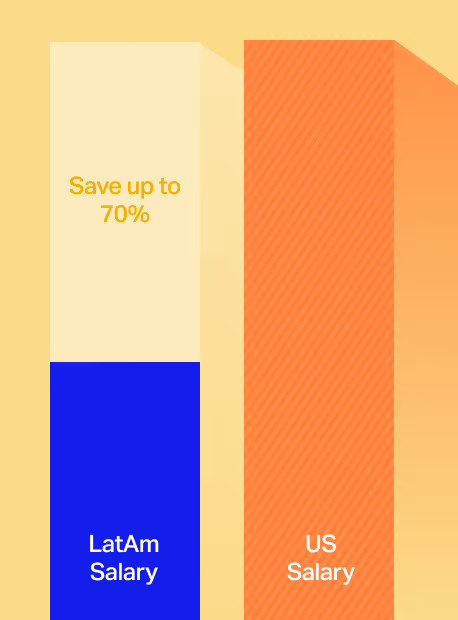
Hiring an app developer in Latin America costs roughly $30K to $120K a year depending on role and seniority, according to Hire With Near’s salary guide, against $73K to $198K in the US.
These are the rates we know, because Latin America is where we recruit. Rates for the other regions on this list vary by provider, so ask each one for its bands by seniority. Where a provider publishes rates, I’ve noted them in its listing.
Here is what each role costs against the equivalent US hire, according to Hire With Near’s salary benchmarks:
For the most up-to-date figures, see Hire With Near’s US vs Latin America Salary Guide.
Read the bottom of each range as junior: budget at the floor and you’re hiring someone one to three years in, who’ll need review time from your own senior engineers.
Mid and senior developers, the ones who have shipped production apps, sit higher in each range and still come in 24% to 62% below US pay.
Julia Guillen, Senior Tech Recruiter at Hire With Near, sees the same reaction on nearly every engineering search:
Clients are consistently surprised with the caliber of talent that’s available in LatAm. They don’t expect to find senior engineers who’ve worked with major U.S. companies, understand modern development practices, and often have more hands-on experience with specific frameworks than candidates they’d find locally.
— Julia Guillen, Senior Tech Recruiter, Hire With Near
Salary isn’t the whole cost: add the provider’s fee, local benefits, equipment, and interview time. For the full breakdown, see our guides to offshore developer rates, US vs. Latin America developer salaries, and hiring remotely in Latin America.
Final Thoughts
If I were shortlisting, I’d ask each company the same four questions:
- How do you screen developers technically?
- How many of my working hours will the developer cover?
- Who employs the developer and handles payroll?
- What will the hire cost in total, next to a US salary?
Ask two or three companies and get the answers in writing. That’s usually enough to see which one fits.
If screening and working hours came out on top for you, that’s where Hire With Near fits. We recruit in Latin America, where developers work US hours, and we help US companies hire app developers from iOS and Android app developers to React Native, handling sourcing, screening, payroll, and compliance.
Book a free consultation, and we’ll share salary benchmarks for the roles you’re hiring and tell you whether we’re a good fit.
{{consultation}}
Frequently Asked Questions
What's the difference between nearshore and offshore app developers?
Nearshore app developers work close to your time zone, like Latin America for US companies; offshore developers work in more distant regions like Asia or Eastern Europe. The differences that matter are how many working hours overlap, how fast feedback loops close, and how easy travel is. If real-time communication matters, look at nearshore software development companies.
Should I consider nearshore development instead of offshore?
Nearshore development is the better choice when real-time collaboration matters more than the lowest hourly rate. It gives you more overlapping working hours and easier travel for on-site visits, usually at a slightly higher cost than Asian offshore rates.
The trade is worth making when your work needs frequent real-time communication, and not when a developer can pick up a ticket overnight and hand it back done.
Can I combine nearshore and offshore developers on the same project?
Yes, and the split that works is by collaboration need: nearshore developers for roles that need close collaboration, like team leads and frontend developers working with design, and offshore developers for independent work like backend or QA.
What types of app developers can I hire from Latin America through Hire With Near?
Hire With Near covers the full spectrum of app developer roles, from iOS developers and Android app developers to React Native developers, Flutter developers, and MERN stack developers, often at 30–70% less than US market rates.
Beyond standard app development, what other technical roles can I hire offshore?
Cloud, ecommerce, database, and blockchain developers are the roles app teams most often add offshore alongside mobile and front-end specialists: a cloud developer for infrastructure, an ecommerce developer if your product sells, a SQL developer for database work, or a blockchain developer for Web3 features.
Hiring several at once is where overlapping working hours compound: the team hands work between each other inside one business day rather than across two.
How do I know if an offshore app developer is any good?
The strongest signal is evidence they’ve shipped production apps, plus the ability to walk you through a past project that went wrong and how they fixed it.
Vetting is where most hiring mistakes happen, and how a developer communicates under pressure is the clearest tell. Through a staffing partner, ask what the screening involves: take-homes, live coding, or architecture reviews.
Further reading: questions tech leaders ask about hiring developers in Latin America
Why are so many US companies looking offshore for developers?
US companies are going offshore because the developers they need, mid-level and senior, are both scarce and expensive in the US.
The Federal Reserve Bank of New York found that recent computer science graduates face a 6.1% unemployment rate, so entry-level talent isn’t scarce. But SignalFire’s 2025 State of Talent Report, built on over 650 million tech profiles, found that since 2023 hiring has concentrated on mid- and senior-level roles, which carry the steepest US salaries.
According to Hire With Near’s own State of LatAm Hiring 2026 Report, 98% of the developers we placed last year were mid-level or senior, exactly the band US companies are short of.
Further reading: How AI and Time Zones Are Driving US Companies to Hire Developers in Latin America
How good is an offshore app developer’s English, and can they communicate technically with my team?
English quality varies by provider and by region, and it’s testable before you hire, so treat any blanket claim about a country’s English as a starting point. The test that works: ask to see the candidate explain a past technical decision to someone who isn’t a developer. That surfaces whether they can defend an architecture choice and flag a release at risk before it slips.
How long does it take to hire an offshore app developer, and when can they start?
Expect two to six weeks from brief to signed offer, then a notice period of anywhere from immediate to 30 days. Two things drive it: how fast the provider produces a shortlist, which ranges from 24 hours to about a week here, and how long your own interview loop runs. The loop is usually the bottleneck.
What happens if the developer doesn’t work out? Is there a replacement guarantee?
Most providers here offer some form of replacement guarantee, but the terms differ enough to get them in writing before you sign.
Ask four things: how long the window runs, whether you get a replacement or a refund, whether it applies if you let the person go for performance, and who absorbs the cost of the second search. Windows commonly run from 30 days to six months.