%203.svg)
Key takeaways:
- The top nearshore software development companies in 2026 include BairesDev, Hire With Near, Andela, Revelo, Innowise, Upwork, and Toptal, each with a different model, region focus, and engagement structure.
- US companies hiring software engineers in Latin America typically save 30–70% compared to equivalent US hires, while gaining full time zone overlap for real-time collaboration. A software engineer who earns $36K–$108K in Latin America costs $100K–$238K in the US.
You need to ship new features fast, but your development team is already at capacity. Hiring locally takes months, costs a fortune, and still might not land you the right expertise.
Meanwhile, your competitors are pushing ahead with their product roadmaps while you're stuck reviewing resumes.
This guide covers the top nearshore software development companies for US teams in 2026, how to hire nearshore developers in Latin America, and how to decide between outsourcing and building your own team.
What Are the Top Software Development Companies for orking with Developers in Latin America?
There are hundreds of skilled, reputable nearshore software development companies. But not all of them will be a good fit for every project or team.
How I determined this list: I only considered companies with at least 50 client reviews on at least one established review platform (G2, Clutch, Trustpilot, GoodFirms, or ClearlyRated, client ratings only) with an overall rating of 4.5 or above.
From those qualifying companies, I evaluated their Latin America development capabilities, service model, roles and specializations, pricing information, and engagement model signals.
Some are nearshore outsourcing firms where you contract a team to build for you. Others are staffing and talent partners that help you hire engineers who join your company directly.
One model gives you speed of execution on a defined project. The other gives you permanent team members who learn your codebase, product, and users.
The right model for your business depends on where you are and where you're trying to go.
All the companies on this list deliver on the core value proposition of connecting you with skilled software development talent.
You get:
- Developers who work in overlapping US time zones
- Engineers with strong English communication skills
- Professionals familiar with agile methodologies and US business culture
These capabilities are table stakes for any top nearshore software development company. What matters are the differences in how they operate, what they specialize in, and how they structure their engagements with you.
I’ve included Hire With Near in this list. In full transparency, that’s us. But we know there’s no single best company for everyone.
Our goal is to provide clear, straightforward information so you can build your own shortlist and decide who’s worth a conversation.
Here's what sets each nearshore software development company apart.
1. BairesDev
Website: bairesdev.com
Headquarters: San Francisco, California (development teams across LatAm)
Review Rating: 4.9/5 on Clutch (60+ reviews) as of July 2026
Services: Staff augmentation, dedicated teams, full-cycle software development, AI/ML, cloud, QA, DevOps
Focus Regions: Latin America
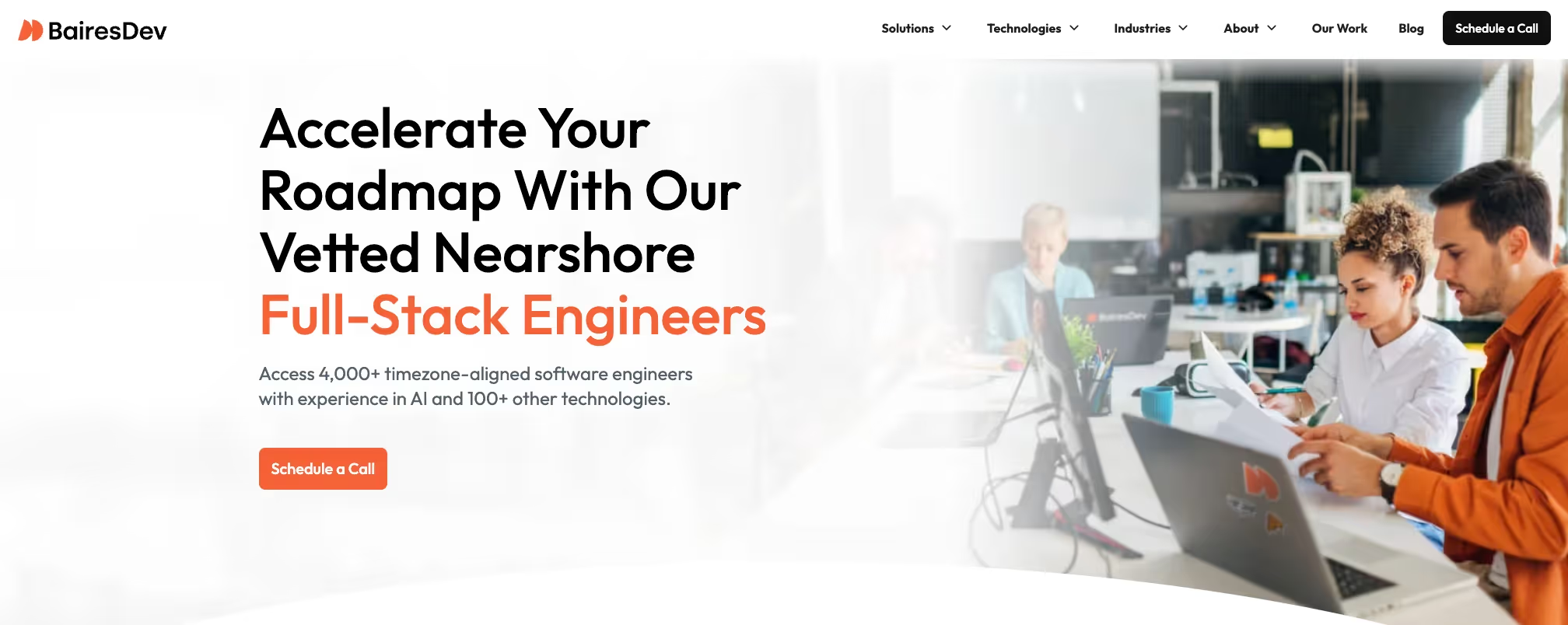
BairesDev is one of the largest nearshore software development companies in Latin America, with 4,000+ senior developers operating in US time zones across 50+ countries.
We've ranked BairesDev high on this list because of their strong third-party validation: a 4.9 Clutch score, recognition as a Top Global B2B Service Provider by Clutch in early 2026, and a client roster that includes Google, Salesforce, Adobe, Pinterest, and Johnson & Johnson.
BairesDev draws from the top 1% of LatAm tech professionals and serves companies across 130+ industries. Their three engagement models (staff augmentation, dedicated teams, and full outsourcing) give clients flexibility depending on how much they want to own versus delegate.
Key features:
- Enterprise-grade scale with LatAm talent: 4,000+ developers across Latin America, serving household-name clients including Google, Salesforce, Adobe, and Pinterest
- Flexible engagement structures: Options including staff augmentation, dedicated teams, or full outsourcing. Choose based on how much you want to own versus delegate.
- Proven retention track record: 96% client retention rate across 500+ active clients signals consistent delivery over time
Best for: Mid-market and enterprise companies that need to scale engineering capacity quickly and want a proven vendor with Fortune 500 experience.
Client perspective: “BairesDev nailed it when it came to fitting into our team. We went with a staff augmentation approach and it felt like they were always part of our team. They were in on all our sprint meetings, just like any other engineer we had.” — Customer review on Clutch.
Limitations: BairesDev's pricing reflects their scale and caliber. Smaller teams with simpler projects may find the engagement overhead high compared to boutique alternatives.
Pricing: Not publicly listed. Custom quotes based on engagement type and team size.
If you’re weighing BairesDev against a dedicated hiring model, our Hire With Near vs. BairesDev comparison breaks down the differences in how each places talent and what that means for your team.
2. Hire With Near
%2012.23.42%E2%80%AFp.%E2%80%AFm..webp)
Website: hirewithnear.com
Headquarters: San Antonio, Texas (team across Latin America)
Review Rating: 4.9/5 on G2 (140+ reviews) as of July 2026
Services: Full-service nearshore staffing and recruiting, RPO, staff augmentation, executive search
Focus Regions: Latin America only
Hire With Near is a full-service staffing and recruiting agency that helps US companies of all sizes hire top-performing remote talent in Latin America across all departments and industries, including software engineering.
We offer something fundamentally different from the outsourcing firms on this list.
Most development outsourcing companies assign a team to build for you. Hire With Near helps you hire top software engineers who work for you, report to you, and integrate into your team. There's no project handoff. There's no contractor who moves on to another client when your sprint ends.
You're building a permanent team, with full control, full visibility, and full ownership of your codebase.
Key features:
• Quality-first approach: Our 97% placement rate and 9.1+ client satisfaction come from obsessing over fit, not just skills, but the drive, readiness, and cultural match to contribute from day one.
• Elite talent for tech positions: We place senior back-end developers, front-end developers, mobile developers, QA engineers, and data/ML engineers every week. Our specialist IT and tech recruiters screen beyond keywords for real-world impact. They understand what it means to own a production system, ship under pressure, and work without hand-holding.
• One partner, one process: Scale across functions, not just engineering, with one dedicated team and a repeatable hiring cadence. We remember what worked last time, and we adapt based on your feedback.
• Talent pool depth + reach: While we maintain a pre-vetted network of 160,000+ candidates, we don’t stop there. Every search includes fresh sourcing until we find talent that meets your exact requirements and expectations. You get the first candidates in 3–5 days with video introductions, and most companies hire in under 3 weeks.
Best for: US companies that want to build a dedicated LatAm engineering team, not rent a contractor or outsource a project.
Client perspective: “The talent Hire With Near provided is incredibly high quality. I worked at Google for 10 years, where the bar for talent is very high, and I would say the people I placed through Hire With Near are comparable to the people I worked with at Google.” — Ashley Black, Founder of Candid Consulting
Limitations: Hire With Near focuses on direct hire and full-time staffing. If you need a firm to own end-to-end delivery of a specific project, a managed development agency may be a better fit.
Pricing: Schedule a free, no-commitment consultation call for full pricing info. No upfront fee: you only pay after making a hire. Two models: one-time placement fee or monthly staffing fee with payroll included.
3. Andela
%203.03.59%E2%80%AFp.%C2%A0m..avif)
Website: andela.com
Headquarters: New York (talent across LatAm, Africa, Europe, and 135+ countries)
Review Rating: 4.7/5 on G2 (110+ reviews) as of July 2026
Services: AI-powered talent marketplace: full-time, contract, and project-based placements; compliance and payments (Andela AOR)
Focus Regions: Global, with significant LatAm and Africa talent base
Andela operates a global AI-powered talent marketplace connecting companies with 150,000+ technologists across 135 countries, with roughly 60% of its talent in Africa and Latin America. Founded in 2014, the company has expanded well beyond its original African development focus into a full AI-native talent platform used by Fortune 500 companies and high-growth scale-ups.
Andela's enterprise client roster (Goldman Sachs, GitHub, Cloudflare, Coursera, and ViacomCBS) reflects its positioning at the upper end of the market. In 2024, Andela launched a formal partnership with GitHub to upskill engineers in GitHub Copilot and introduced Andela AOR, a compliance and payments solution covering 100+ jurisdictions.
The company’s focus has increasingly shifted toward AI-native engineers who work with agentic systems, not just traditional full-stack development.
Key features:
- AI-driven talent matching: The platform uses ML to match company requirements with engineers from a 150,000+ global talent pool, reducing time to first candidate.
- AI-native engineering focus: Active upskilling programs in GitHub Copilot and agentic AI systems, with engineers trained on enterprise AI tooling
- Enterprise-grade compliance: Andela AOR handles legal, tax, and payment infrastructure in 100+ jurisdictions, reducing the operational burden of hiring internationally.
Best for: Enterprise companies that need global engineering talent, particularly AI-native engineers, and want a large-scale platform with built-in compliance infrastructure.
Client perspective: “Andela has customers across the globe and talent from Andela is delivering high-quality work. The support team is also very responsible. The matches and delivery managers from Andela ensure the win both for talent and client.” — Customer review on G2
Limitations: Andela's pricing and minimum contract terms (typically 12 months) make it best suited for enterprises and growth-stage companies. Startups and small teams may find the commitment level and pricing structure more than they need.
Talent spans 135+ countries. If you specifically need LatAm engineers for time zone alignment, you'll want to filter carefully.
Pricing: Not publicly listed. Enterprise pricing with 12-month minimum contracts. Contact for a custom quote.
4. Revelo
Website: revelo.com
Headquarters: Austin, Texas (engineers across Latin America)
Review Rating: 4.7/5 on G2 (125+ reviews) as of July 2026
Services: Staffing/talent platform: full-time LatAm engineers, EOR, and payroll included
Focus Regions: Latin America
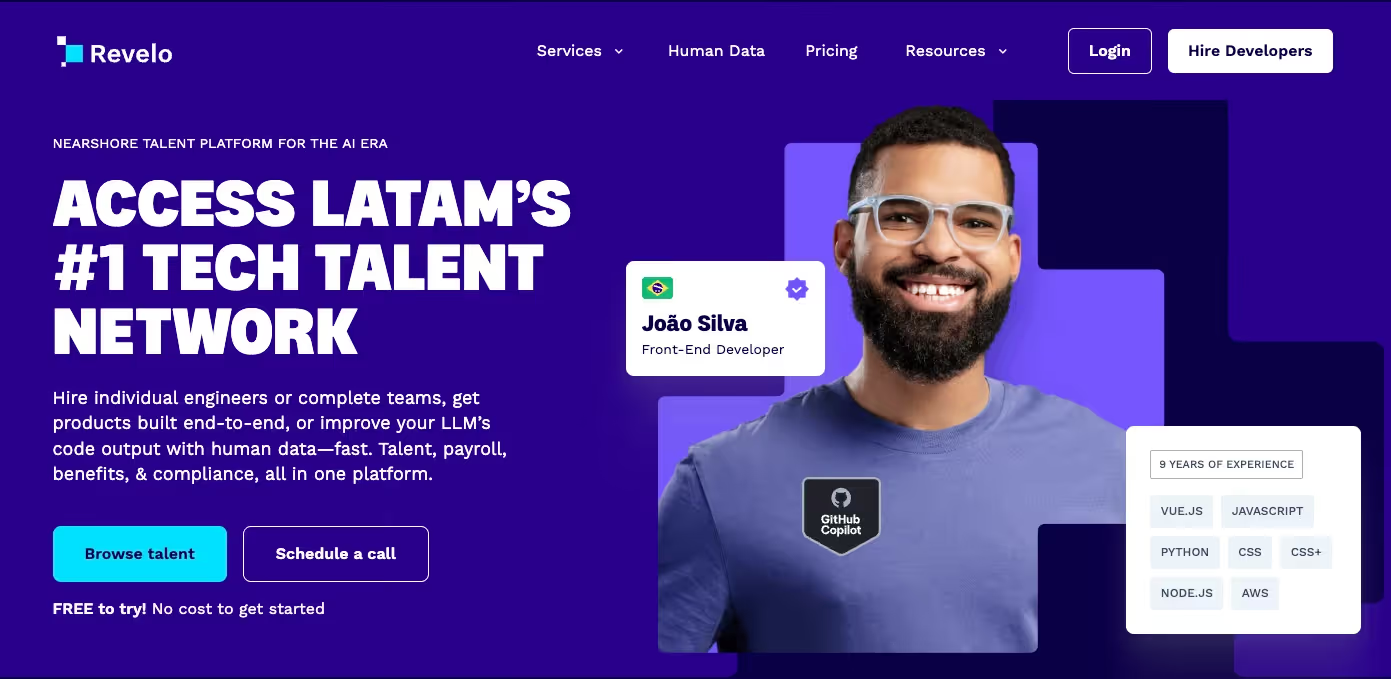
Revelo is a Latin America-focused talent platform that connects US companies with pre-vetted software engineers and handles the full hiring lifecycle: sourcing, vetting, payroll, benefits, taxes, and compliance.
We've included Revelo because they fill a specific gap in the market. They provide fast access to qualified LatAm engineers for companies that want to hire directly but don't want to build out the infrastructure to manage compliance across Latin American countries.
Their claim of getting you a curated shortlist in 72 hours is notable, and their 4.7/5 G2 rating across 125+ reviews suggests that claim holds up in practice for most clients.
They report 2,500+ companies on the platform and a talent pool of 400,000+ vetted engineers across Brazil, Argentina, Colombia, Mexico, and Peru, with only the top 2% passing their assessments.
Key features:
- Speed to shortlist: Curated candidate lists in 72 hours, significantly faster than traditional recruiting timelines
- End-to-end compliance: Revelo serves as an employer of record (EOR), managing payroll, benefits, taxes, and legal compliance across LatAm countries.
- Large vetted talent pool: 400,000+ engineers with only the top 2% passing assessments
Best for: Tech companies and startups that want to hire full-time LatAm engineers quickly without standing up their own compliance and EOR infrastructure.
Client perspective: “What I really like is how the speed of the shortlist changes how we think about hiring timelines. We submitted a role on Monday and had qualified candidates in front of us by Wednesday.” — Customer review on G2
Limitations: Revelo is a talent platform, not a managed development service. You're building your team, not outsourcing execution. If you need a firm to own delivery of a project end-to-end, look at BairesDev or ScienceSoft instead.
Pricing: Not publicly listed.
For a side-by-side look at how Revelo and Hire With Near differ on vetting, pricing, and placement model, see our Hire With Near vs. Revelo breakdown.
5. Innowise
%203.23.32%E2%80%AFp.%C2%A0m..avif)
Website: innowise.com
Headquarters: Warsaw, Poland (nearshore delivery hub in Mexico)
Review Rating: 4.9/5 on Clutch (70+ reviews) as of July 2026
Services: Full-cycle software development, dedicated teams, IT consulting, ERP/CRM, cloud, digital transformation
Focus Regions: Mexico, global
Innowise is an international full-cycle software development company with 18+ years of experience and 2,500+ professionals. They have a dedicated nearshore hub in Mexico for US clients and serve industries ranging from healthcare and finance to ecommerce and education.
We've included Innowise because their Clutch profile tells a consistent story: 70+ verified reviews at 4.9/5, with clients specifically praising effective project management, on-time delivery, and clear communication across time zones.
For US companies evaluating full-cycle development partners, Innowise's combination of scale, nearshore availability, and consistent delivery track record makes them worth a conversation, particularly for companies with complex multiphase projects.
Key features:
- Full-cycle delivery: From ideation through maintenance, capable of owning entire projects, not just specific phases
- Nearshore Mexico hub: Dedicated development capacity in Mexico for US clients, with strong time zone overlap
- Consistent delivery track record: 100% client satisfaction rate from Clutch reviewers, with 90% specifically noting on-time, within-budget delivery
Best for: Companies that need a managed development partner to own a complex, multiphase project from start to finish.
Client perspective: “They automated a lot of the manual processes, making everything from data collection to integration with insurance providers way more efficient. In the end, they delivered a solid, easy-to-use system that checked all the boxes and made a huge difference for our project.” — Customer review on Clutch.
Limitations: Innowise's headquarters are in Eastern Europe (Poland), with their nearshore work routed through their Mexico hub. This hybrid model works well for most clients but may require some expectation-setting around which team is actually handling your work.
Pricing: Not publicly listed. Custom quotes based on engagement scope and team size.
6. Upwork
%203.27.38%E2%80%AFp.%C2%A0m..avif)
Website: upwork.com
Headquarters: San Jose, California
Review Rating: 4.5/5 on G2 (3,205+ reviews) as of July 2026
Services: Freelance marketplace: individual contractors for software, design, writing, marketing, and more
Focus Regions: Global
Upwork is the world's largest freelance marketplace, with filtering tools that let you target developers in specific countries, including LatAm.
For US companies with the time and know-how to run their own vetting process, Upwork can be an appealing option: You post a job, review applicants, run your own technical screening, and hire. The platform handles payments and some contract infrastructure.
We've included Upwork because it represents a genuine model that many early-stage and cost-conscious companies use effectively. It works best when you have an experienced engineering manager or CTO who can run their own hiring process.
If you don't have that capacity, the responsibility of vetting falls entirely on you. On an unstructured platform, that's a meaningful time investment.
Key features:
- Location-filtered search: Filter by country to target LatAm developers specifically, with visibility into hourly rates and work history.
- Flexible contract types: Hourly, fixed-price, or long-term contracts, with high flexibility for variable workloads
- Scale of options: Access to a massive global talent pool with profiles, portfolios, and reviews from past clients
Best for: Companies with in-house hiring expertise that want maximum flexibility and control and are willing to manage their own vetting process.
Client perspective: “Each freelancer I have hired has had strong communication skills and competence in their field of expertise. Upwork’s rating system for freelancers is an excellent start.” — Customer review on G2
Limitations: Upwork isn’t a vetted service. The quality of candidates varies widely, and the responsibility for technical screening, onboarding, and retention sits entirely with the client. For companies that want a managed experience with prescreened talent, a full-service firm will serve them better.
Pricing: Talent sets their own rates. Platform fees apply. No subscription is required to post jobs.
7. Toptal
Website: toptal.com
Headquarters: San Francisco, California
Review Rating: 4.7/5 on G2 (265+ reviews) as of July 2026
Services: Premium freelance talent network: developers, designers, finance experts, product managers
Focus Regions: Global
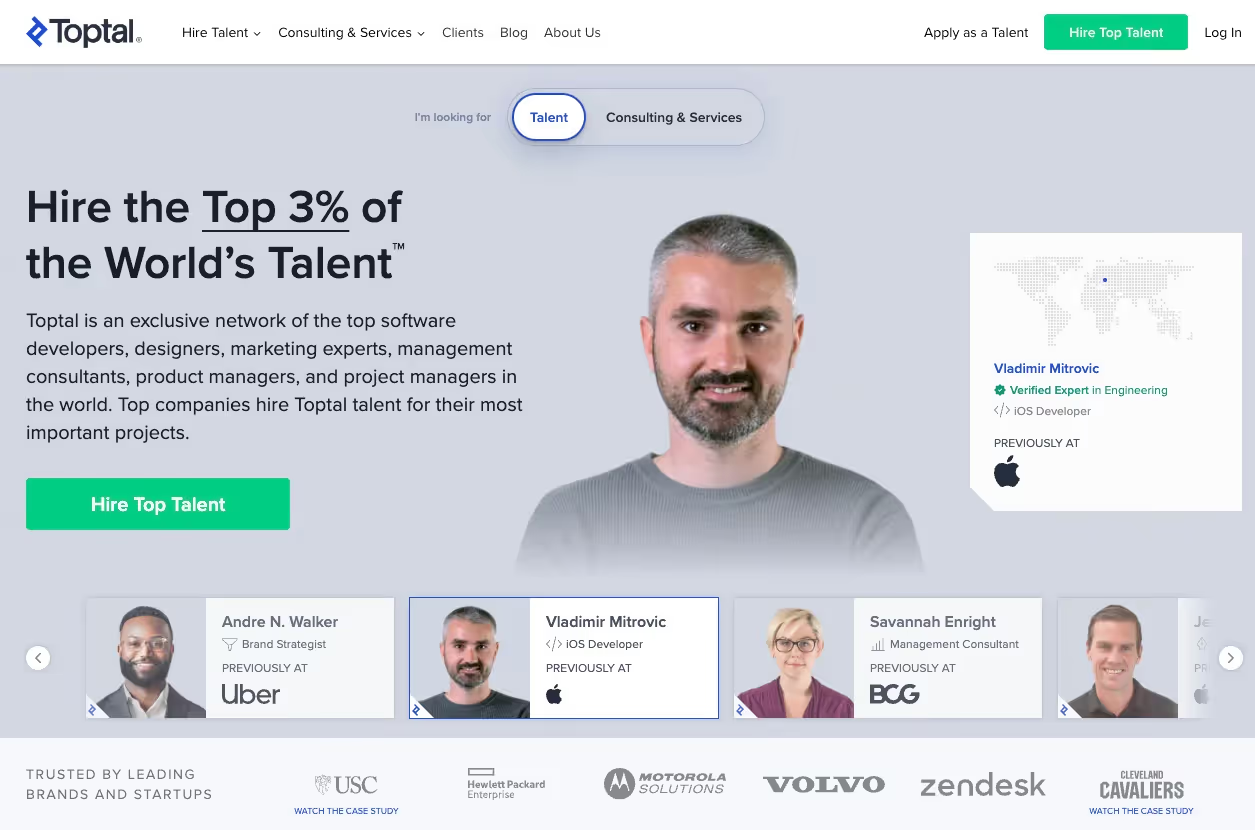
Toptal is a freelance talent platform that assists with hiring the top 3% of freelance talent across development, design, finance, and product management. Their selection process is notably rigorous: Candidates pass language assessments, technical screening, behavioral evaluation, and live screening sessions before joining the network.
We've included Toptal because it solves a specific problem. It provides fast access to pre-vetted senior-level freelancers for teams that need to move quickly and can't wait for a traditional recruiting cycle.
Toptal is useful for augmenting an existing team or filling a specific senior role that would otherwise take months to hire through normal channels. It's not the right model for building a permanent team or for cost-sensitive companies, as Toptal positions itself as a premium option.
Key features:
- Rigorous screening: Multistage vetting process with only the top 3% of applicants accepted, among the most selective screening processes of any platform
- Speed for senior talent: Access to available vetted freelancers quickly, which is useful for teams that need specific expertise without waiting for a traditional search
- Broad professional coverage: Developers, designers, finance experts, and product managers, useful for companies that need help across multiple functions
Best for: Companies that need rapid access to a senior-level freelancer for a specific need and are willing to pay a premium for a pre-vetted professional.
Client perspective: “We’ve been impressed by how quickly Toptal was able to get us a brilliant freelancer. They found someone who could complete exactly what we needed in a very short amount of time.” — Client review on Clutch
Limitations: Toptal provides individual freelancers, not teams. It's not the right fit for building a permanent engineering team or managing an ongoing project. Pricing is significantly higher than LatAm staffing firms or typical freelance marketplaces.
Pricing: Not publicly listed.
If you’re considering Toptal alongside Hire With Near, our Hire With Near vs. Toptal comparison covers how the two models differ on talent quality, fees, and time-to-hire.
What Is Nearshore Software Development Outsourcing?
Nearshore software development outsourcing means partnering with companies in nearby countries to get software built. For US businesses, that means firms in Latin America or Canada, close enough to share most of the working day, with fewer language barriers and stronger cultural alignment than offshore alternatives.
In practice, it takes one of two forms. Some companies contract a firm to deliver a defined project. Others hire engineers who join their own team as full-time, embedded hires. The first keeps you out of the staffing process, while the second builds something you keep. Our free guide to hiring remotely in Latin America walks through how both paths work.
When you’d rather not run the search yourself, nearshore staffing services take on sourcing, vetting, payroll, and local compliance for you.
Either way, a few advantages apply across both models. Here are the main benefits of nearshore software development:
Cost savings
Hiring a nearshore software company can be more cost-effective than building an in-house team. Due to lower costs of living, Latin American engineers have significantly lower salary demands than their US-based counterparts without sacrificing any quality or experience.
Access to development talent
Nearshoring allows companies to overcome talent shortages by tapping into a thriving LatAm software industry, gaining access to skilled developers and specialized expertise that might be scarce or unavailable locally.
Speed to market
Nearshore outsourcing partners can often accelerate development timelines due to their experience, established workflows, and ability to scale teams quickly.
Why Should You Hire a Nearshore Software Development Company?
Nearshore developers in Latin America give US companies something domestic hiring rarely can: engineers who overlap your full working day, at 30–70% below US salary benchmarks.
Here’s why that combination of time zone alignment and cost efficiency makes nearshoring a stronger choice than both onshoring and offshoring:
Easier communication
Offshoring can mean dealing with significant time zone differences, which can delay communication and make real-time collaboration almost impossible.
Time zone distance isn’t a minor inconvenience. It adds up over time.
Research from Harvard Business School and INFORMS shows that each additional hour of time zone difference reduces real-time communication by 11%. The study recommends organizing distributed teams along a north-south axis, such as US-LatAm, to maximize workday overlap.
As one engineering lead told us:
Our senior QA in Sri Lanka is excellent, but we don't get enough overlap to keep quality and throughput high. We often ship without her. The fix is obvious: a tester who is online when we are.
Nearshore companies in Latin America work in similar or fully overlapping US time zones. As a result, daily standups happen live, and urgent bugs get fixed in real time. That's the core operational advantage of nearshore over offshore.
Save time and money
Nearshoring reduces labor costs without trading away quality. LatAm engineers have lower costs of living and significantly lower salary demands than their US-based counterparts.
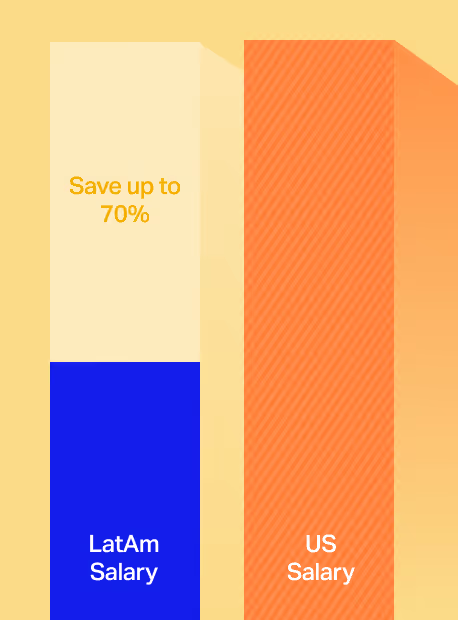
In fact, US companies that hire through LatAm staffing partners consistently report 30–70% cost savings on engineering roles. That’s a meaningful difference in runway and headcount capacity.
The proximity makes travel more feasible and less expensive for in-person meetings, offering additional cost savings. It can also help create a stronger business relationship through occasional face-to-face encounters.
For most companies exploring this model, cost is the primary driver. But cutting corners isn’t the main reason US companies are hiring in Latin America. Instead, it's about extending what your budget can build.
Cultural similarities
Cultural fit matters more than most companies realize before they’ve experienced a poor one. Natasha Tarapow, Recruitment Consultant at Hire With With Near, sees this pattern consistently:
The problem companies have with hiring in Asia isn't technical ability: It's cultural fit. They find people who are very strong technically, and they have more competitive rates compared to the US, but they're not always a strong fit for the company's culture and communication style. We hear from clients all the time that the talent they hire in LatAm tends to be a much stronger cultural fit and a communication style that fits their internal dynamics better.
The proactive communication style that many LatAm developers naturally have is important, especially in engineering, where the difference between a developer who flags a blocker early and one who goes quiet for a week manifests in sprint velocity.
Access to a wider talent pool
You can tap into an extensive network of skilled professionals in neighboring countries through nearshoring, bypassing local tech talent shortages. This allows you to find the right expertise for your project without being limited by the local market.
According to Hire With Near's 2026 State of LatAm Hiring Report, demand for LatAm software engineers grew 250% year-over-year, and 98% of those placements were mid or senior professionals.
This isn't a junior developer market. The depth of experienced engineering talent in Latin America has grown substantially, and Latin America has a thriving software and tech industry.
How To Choose the Best Nearshore Software Development Outsourcing Firm for Your Business
When selecting a nearshore development partner, there are a few key steps you should follow:
1. Check company experience
Look for companies with a solid track record in your industry or that have undertaken similar projects. For example, if you’re in healthcare and have sensitive data, you’ll want to partner with a company that thoroughly understands regulatory compliance like HIPAA.
2. Assess their expertise
Even if they’ve worked with clients in your industry, confirm the team has the technological expertise required for your specific project.
Evaluate their proficiency in the programming languages or frameworks you need—whether it’s front-end technologies like React or Angular, back-end development using .NET or Node.js, or mobile app development for iOS and Android.
3. Check reviews and testimonials
Assess the company’s reputation by looking at what previous clients have said. Look for client testimonials on their website, case studies of past projects, or reviews on third-party platforms like Clutch or GoodFirms. These insights can help you understand the company’s strengths and potential areas of concern.
4. Evaluate their security protocols
Perhaps most important is verifying that the nearshore company adheres to strict security protocols and standards to protect your data and intellectual property.
Ask about their security policies, certifications, and compliance with international standards such as ISO 27001 and GDPR. Ask about their infrastructure, data encryption practices, and how they handle cybersecurity threats.
What Are the Best Nearshore Development Destinations?
Nearshore developers are concentrated in four main markets that stand out for their established tech ecosystems, high levels of education, and cultural compatibility with the United States: Argentina, Brazil, Colombia, and Mexico.
According to the GitHub Octoverse 2025 report, Brazil has 6.9 million developer accounts on GitHub. Country-level figures for the rest of Latin America weren’t released in the 2025 edition, but the 2024 report counted Mexico at more than 1.9 million, Argentina at more than 1.1 million, and Colombia at more than 1 million, each growing at double-digit rates year over year.
Here are four of the most popular development destinations:
Mexico
Mexico’s geographical proximity to the US makes it an excellent choice, with minimal time zone differences and similar cultural nuances. The country has also invested significantly in STEM education, actually graduating a higher percentage of professionals in these fields than the US.
Our full breakdown of nearshore software development in Mexico covers the benefits, challenges, and salary ranges in more detail.
Brazil
Brazil’s booming tech industry has resulted in a huge number of software professionals educated at renowned universities and technical institutes like the Universidade de São Paulo.
The government has also made significant investments in its tech infrastructure, fostering innovation and attracting startups to launch operations in Brazil.
For more on hiring there, see our guide to software development outsourcing in Brazil.
Argentina
Argentina is the LatAm country with the highest English proficiency (which sits ahead of countries like Switzerland and Spain), making communication and collaboration easier with remote teams.
The country’s developers are known for a blend of technical skills and creative problem-solving ability, leading to strong problem-solving and creative design outputs.
Our guide to software development outsourcing in Argentina covers the local engineering talent and how to hire there.
Colombia
The Colombian government has actively promoted the growth of its IT sector through various initiatives and investments in tech education. As a result, the country boasts a young, dynamic, and highly skilled workforce while still maintaining competitive pricing for software development services.
Our guide to outsourcing software development to Colombia walks through how to get started and what to expect.
What Are the Services Offered by Nearshore Development Companies?
Nearshore software companies provide a wide range of services to clients. Here are some of the most common:
Custom software development
Custom software development is the cornerstone service that tech nearshoring is built on. These firms create tailored software solutions that address specific business challenges and requirements.
This process usually involves extensive consultation, iterative development, and continuous feedback to confirm the final product closely matches the client's vision.
Mobile app development
If your business is consumer-facing and you don't have a mobile app in 2026, you may be falling behind competitors who do. Nearshore app development companies provide bespoke mobile development services for both the iOS and Android platforms.
These services encompass the entire development cycle:
- Conceptualization
- Design and development
- Testing
- Maintenance
Nearshore software development teams can craft user-friendly, high-performing mobile applications that enhance user engagement and drive growth.
Cloud migration and management
As businesses increasingly move to cloud-based infrastructures, nearshore firms offer expert migration and management services. These include transferring existing applications, data, and workloads to cloud environments like AWS, Azure, and Google Cloud.
Product design and development
Nearshore development companies excel in product design and development, helping businesses bring their ideas to life. This includes everything from initial concept and market research to prototyping, development, and launch.
With agile methodologies and iterative design processes, these companies help deliver final products that are functional and user-friendly, ready to capture and retain a dedicated user base.
Quality assurance
Quality assurance (QA) is a critical component of software development, and nearshore development teams offer services like:
- Automated and manual testing
- Performance testing
- Security testing
- Usability testing
Working in parallel with internal teams, nearshore testers identify and fix bugs early, helping verify the final product is reliable, secure, and high-performing.
UI/UX design
Nearshore tech companies offer specialized user interface (UI) and user experience (UX) design services that focus on user needs and behaviors. They might create wireframes, prototypes, or high-fidelity designs and integrate user testing and feedback loops to perfect the experience.
Questions To Ask Before Partnering With Nearshore Software Providers
These six questions will help you assess any nearshore software provider before signing a contract:
- What services do you offer? Understanding the full range of services a company offers can help you determine how it may handle the lifecycle of your project, from inception to post-launch support.
- What do you specialize in? Specialization can be in terms of industries, technologies, or types of projects. Knowing a nearshore technology company's specializations can help you gauge its industry expertise and fit for your specific development needs.
- Have you worked on similar projects before? Experience with similar projects can indicate an understanding of potential pitfalls and best practices. Ask for case studies or client references to verify their experience.
- Can you explain what working with you looks like? This question helps you understand the company's process, how it manages projects, its methodology, and how it handles changes or issues that arise.
- How will we communicate, and how often? Effective communication is critical in software development, especially when working with remote software development teams. Discuss the tools the firm uses, the frequency of updates, and the accessibility of the team or project manager.
- Are there other fees that I should know about? Transparency in pricing is important to avoid hidden costs. Ask about additional fees for project management, user training, deployment, or future modifications.
For a deeper checklist before you commit, see the questions tech leaders ask about hiring developers in Latin America.
Why Should You Consider Building Your Own Nearshore Development Team Instead of Outsourcing?
Building your own nearshore engineering team gives you developers who report to you, learn your codebase, and stay in your company, while outsourcing to a dev shop rents you execution that leaves when the contract ends.
For a feature you need to ship once, a dev shop is fine. But if you’re building a product that’s going to be your core business, the people behind it are worth keeping.
A growing number of forward-thinking CTOs are turning to LatAm to build better engineering teams, especially because of ownership.
A dedicated engineer learns your architecture, your product quirks, and your users, and that knowledge compounds sprint after sprint.
A contractor from an outsourcing firm builds what the statement of work asks for, then moves to the next client and takes the context with them.
The real question is whether the work is core enough that losing that person would set you back.
In conversations with our engineering recruiters, the pattern that comes up again and again is companies reaching the point where the dev-shop handoff costs them more than it saves. They get tired of re-explaining the same context, waiting in a vendor’s queue, and watching hard-won product knowledge walk out the door.
What does it cost to build a nearshore engineering team?
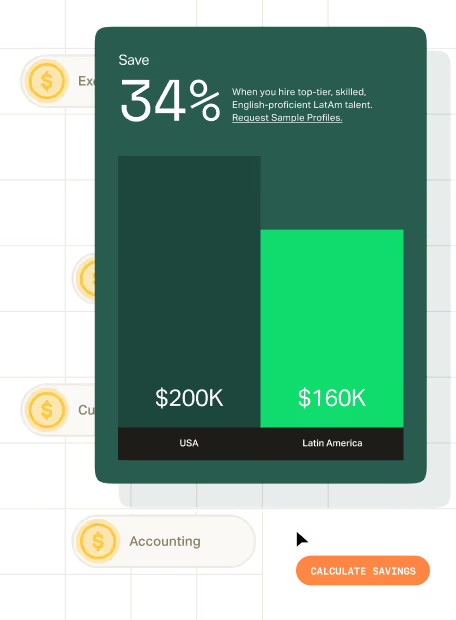
Building a nearshore engineering team costs less than most US leaders expect. The budget for one US-based software engineer often covers a more senior engineer in Latin America, with room to spare.
To put that in concrete terms, here’s how software engineering salaries in Latin America compare to equivalent US hires, according to Hire With Near’s salary benchmarks:
For the most up-to-date figures, see Hire With Near’s US vs Latin America Salary Guide.
These numbers are about capacity. The budget that hires one mid-level engineer in the US can often place a senior engineer in Latin America, with room left to grow the team.
That puts a dedicated engineering team within reach for companies that assumed it was out of budget, and it’s why many decide to hire software engineers directly rather than keep paying a dev shop’s margin.
Companies are already leaving the dev-shop model
In Hire With Near’s analysis of more than 2,000 conversations with US companies exploring Latin American hiring, 12% said they were turning to the region specifically to move off outsourcing agencies and hire in-house, and IT and engineering is one of the top functions driving that switch.
The results back up that decision. When Bonfire, an e-commerce platform for custom merchandise, needed a strong UX engineer, their internal search across LinkedIn and job boards dragged on for two to three months.
Hiring directly in Latin America changed that. Bonfire brought on a dedicated UX engineer in about six weeks, roughly twice as fast, and saved about $53,000 per year compared to a US-based hire. That engineer stayed on the team for over two years.
Thomas Elliott, their VP of Product Management, described the difference this way:
It was shocking to see the difference between the talent Hire With Near brought versus other firms I worked with. Our hires are extraordinary and a great cultural fit.
Building your own team doesn’t have to be all or nothing. If you need to add capacity for a defined project without committing to permanent headcount, nearshore staff augmentation places vetted engineers on your team under your direction while we handle employment and compliance.
When the role you need is an engineering leader rather than an individual contributor, we also handle executive-level search for engineering leadership.
Either way, the people join your team, report to you, and are managed day to day by you.
{{state-latam-hiring}}
Final Thoughts
Most companies start with nearshore development partnerships because they need to move fast. You've got a product to ship, features to build, and deadlines bearing down. A firm like BairesDev or Revelo can get you to execution quickly without the overhead of hiring a full engineering team.
While development partnerships are useful for getting started, they have limitations. When your product becomes core to your business and every feature decision affects your competitive position, you need developers who understand the product deeply enough to make the right call without being asked.
When you want to stop renting developers and start building your own remote engineering team, the smart move is working with someone who’s done it successfully hundreds of times.
Hire With Near helps US companies hire full-time software developers in Latin America who integrate into your existing team and work during overlapping hours for real-time collaboration.
Ready to explore what building your own LatAm engineering team could look like?
Schedule a free, no-commitment consultation call to see how Hire With Near can help you transition from project-based partnerships to a permanent team.
Frequently Asked Questions
What's the difference between nearshore and offshore software development?
Nearshore software development involves partnering with companies in nearby countries (like Latin America for US businesses) for time zone alignment and cultural similarities.
Hiring an offshore development company typically means more distant countries with significant time zone differences, often 8–12 hours, making real-time collaboration difficult.
Further reading: Nearshore Software Development Outsourcing: A Complete Guide
How much can I save by hiring nearshore software developers?
According to Hire With Near’s State of LatAm Hiring Report, US companies typically save 30–70% when hiring from Latin America. A software engineer, for example, earns $36K–$108K annually in Latin America compared to $100K–$238K for a US equivalent, a savings of 52–66% depending on seniority.
For a deeper look at current salary ranges by role and level, see our guide to IT and software engineer salaries in Latin America.
What are the benefits of working with talent in Latin America?
Latin American developers offer time zone alignment for real-time collaboration, strong English proficiency, cultural compatibility with US business practices, and access to growing tech ecosystems.
Many developers also have experience with US companies and understand agile development methodologies.
Read about why more companies are hiring developers in Latin America.
How quickly can I hire nearshore software developers?
Recruiting firms like Hire With Near typically complete placements in under three weeks. Traditional outsourcing engagements can take longer (often four to eight weeks) due to team assembly and project scoping.
The exact timeline depends on role complexity, provider model, and how quickly you can review candidates.
What industries hire nearshore software developers?
Nearshore software developers work across virtually every industry, but demand is heaviest where software is core to the business model.
SaaS companies are among the most active: They're constantly scaling product and platform teams and LatAm gives them experienced engineers without the US price tag. Fintech companies lean heavily on the region for backend and security-focused development.
Healthcare organizations hire for compliance-aware engineering and patient-facing application work.
Manufacturing companies build out digital operations and enterprise resource planning (ERP) integration teams, and AI and machine learning teams are increasingly sourcing from LatAm as the region's ML engineering talent base grows.
The common factor: Time zone alignment and strong technical depth at a price that makes senior-level hiring viable.
What's the difference between hiring a nearshore software company and hiring a nearshore developer directly?
Working with a nearshore software company means contracting an external firm to build for you. They assign a team, own the project execution, and typically move on when the engagement ends.
Hiring a nearshore developer directly means bringing a full-time engineer onto your team. They report to you, work in your systems, and build institutional knowledge over time. The outsourcing model works well for defined projects with clear deliverables.
The direct-hire model works better when you need permanent team members who understand your product and stay invested in it.
Most companies start with outsourcing and eventually realize they need the latter. That's typically the point when they start looking at staffing partners like Hire With Near.
What is a nearshore developer?
A nearshore developer is a software engineer based in a nearby country who works as part of a US company’s team.
For US businesses, nearshore developers are typically based in Latin America, in the same or adjacent time zones, which allows real-time collaboration, daily standups, and same-hour communication that offshore developers in Asia can’t provide.
They work full-time for one employer, not across multiple clients like a freelancer.






.webp)
.webp)


%203.svg)
.avif)





%20(1).avif)

%20(1).png)