


%203.svg)
Key Takeaways
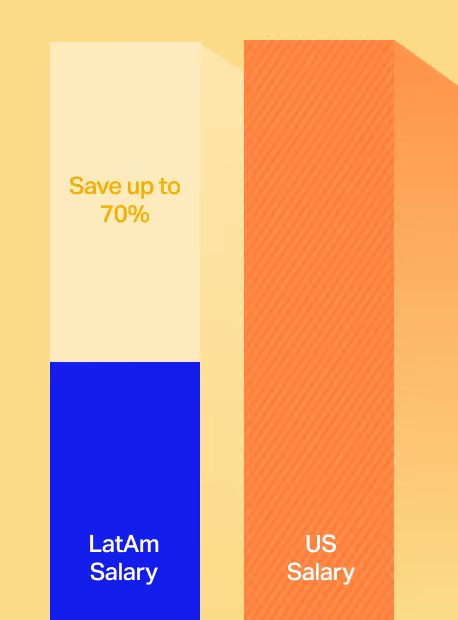
- Nearshore development outsourcing means hiring software developers in a nearby country that shares your workday. For US companies, that's Latin America, where senior engineers work your hours for 30–70% below US salary rates.
- Research from Harvard Business School and INFORMS found that large time-zone gaps force employees to work outside their normal hours just to stay in sync with a distant team. Latin America sits within 0–2 hours of US time zones, so hiring software developers nearshore rather than offshore gets you your answer the same day, not the next morning.
- US companies typically complete nearshore software development hires in Latin America in about three weeks through a specialist recruiting partner, compared to two to three months for a DIY search. Sourcing, vetting, payroll, and compliance are handled in one relationship.
Most US teams exploring nearshore software development outsourcing start from the same place: they need senior engineering capacity, they can't pay US salaries for it, and the last offshore team they tried answered questions the next morning instead of the same afternoon.
Outsourcing software developers to Latin America solves that time-zone problem, since engineers there work inside your business hours. What it doesn't automatically answer is a separate decision: whether you're buying a vendor's delivery team to hand a project to, or hiring software developers in Latin America who join your own team directly.
This guide covers what nearshore software development in Latin America costs, which countries have the deepest developer talent, and how to hire.
What Is Nearshore Development Outsourcing in Latin America and How Does It Work?
Nearshore development outsourcing is hiring software developers in a country close to yours, in the same or a similar time zone, so you can collaborate in real time instead of across an overnight gap. For a US company, that means working with developers in Latin America who work alongside your team during your business hours.
That sits alongside three other models, and the terms are easy to mix up:
- Onshore means hiring developers inside your own country. Full overlap with your workday, but at US market salaries.
- Nearshore means hiring in a nearby country, close enough that your workday still overlaps, at a meaningful cost saving.
- Offshore means hiring in a distant country, typically Asia or Eastern Europe, where the cost savings are real, but the time-zone gap is large enough that overlap with your workday is minimal or nonexistent.
What all three have in common is the time zone advantage over offshore hiring. That’s what the table below shows:
Nearshore development outsourcing can take a few different forms: outsourcing a full project to a development company, using staff augmentation, or hiring your own dedicated developers in Latin America.
The first two are outsourcing in the strict sense: you’re paying a vendor to deliver the work, and the vendor manages the developers. The third is nearshore hiring: the developers become integrated members of your team rather than a vendor’s, even though people often use “outsourcing” loosely to cover all three.
Choosing between paying a vendor to deliver the work and hiring your own developers is the biggest decision in this guide. It gets a full section of its own further down.
For a fuller breakdown of how the three models differ, see our guide to nearshoring vs. offshoring vs. onshoring. The short version: nearshore outsourcing gives you most of the cost advantage of offshore without the time zone misalignment.
Why Work With a Nearshore Software Development Team in Latin America?
The reason to build with a nearshore software outsourcing team in Latin America is simple: you get developers who work your hours and join your team, without the overnight lag of offshore hiring or the salary bill of hiring in the US. It's the middle path: real-time collaboration, at 30–70% below US salary rates.
Nearshore developers work your hours and join your stand-ups
A nearshore developer in Latin America works during your business hours, so they're in your stand-ups, answering messages, and shipping alongside your team, whether your office runs on Pacific, Mountain, Central, or Eastern time, as you can see in the table below:
This is the core advantage over offshore hiring in India or the Philippines, where the workday barely overlaps yours and a question sent in the afternoon waits until the next day for an answer.
The cost of that gap isn't just slower communication. Research from Harvard Business School and INFORMS found that larger time-zone gaps force employees to work outside their own normal business hours just to stay in sync with a distant team, a pattern that creates real strain and contributes to burnout and turnover on the offshore side. That's a hidden cost that shows up later, when the engineer you've spent months onboarding leaves.
The same research found distributed teams perform best when organized along a north-south axis, like the US and Latin America, rather than east to west.
Nearshore developers communicate like your US team
Nearshore developers in Latin America tend to be closely aligned with US business culture and used to US work practices, which Hire With Near's recruiters name as the region's biggest differentiator.
Natasha Tarapow, our Recruitment Consultant, sees it play out in interviews every week. Teams often come to us worried about slow replies and long silences from a remote hire, and this is what she tells them:
In Latin America, we found that talent is not that way. We're very communicative. People really try to go above and beyond in their jobs.
— Natasha Tarapow, Recruitment Consultant, Hire With Near
This is one of the concerns we cover in the article about the most common questions tech leaders ask about hiring developers in Latin America. They want engineers who raise their hand and explain their work, not ones who go quiet for a day.
In the video below, Hayden Cohen, Co-founder and CEO of Hire With Near, explains how to read culture fit from evidence rather than interview answers:
Hiring a senior developer in Latin America often costs less than a mid-level US hire
Demand for developers keeps US salaries high: the US Bureau of Labor Statistics projects 15% growth in software developer jobs through 2034, way faster than most occupations.
Hiring in Latin America is how a lot of teams keep pace: salaries in the region are 30–70% lower than in the US. At those rates, the senior engineer you couldn't justify hiring in the US is often within reach in Latin America.
According to Hire With Near's 2026 State of LatAm Hiring Report, 98% of engineering placements in Latin America were mid-level or senior professionals, a sign that the region's technical talent pool runs deep, not junior.
How Much Does Nearshore Software Development in Latin America Cost?
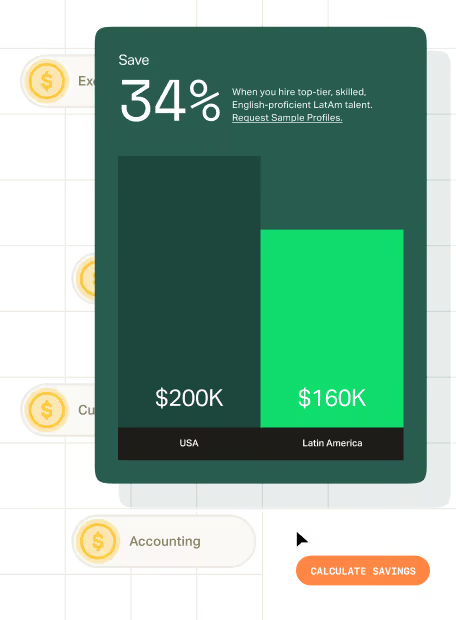
It costs about $30K to $120K a year to hire a software engineer in Latin America, depending on seniority and specialty, while the equivalent US hire runs roughly $66K to $238K.
That gap is the main reason US companies outsource software developers to Latin America in the first place, and it comes from lower costs of living in the region, not from lower standards.
And the gap isn't likely to close anytime soon. SignalFire's 2026 State of Tech Talent Report found that top-of-band staff and principal packages at the largest tech companies now rival or beat director pay, with senior individual-contributor and staff roles growing as a share of hiring.
To give you a feel for developer costs, here’s how salaries in Latin America compare to equivalent US hires, according to Hire With Near’s salary benchmarks:
For the most up-to-date figures, see Hire With Near's US vs Latin America Salary Guide.
What drives the number within those ranges is seniority, the specific stack, and the country you hire from. Specialty moves it too: according to our salary data, mobile developers in Latin America sit at the top of the range, while remote QA engineers sit at the lower end.
If you want a simple way to sanity-check a budget, Hire With Near's COO, Franco Pereyra, gives clients a simple rule of thumb:
A quick reference for what to pay: take whatever you'd spend on a US salary and divide by two. 50% of a US salary tends to be very competitive across the board. For more niche software engineers, you might need to go to 60%. For more commoditized roles, 40% of a US salary still gets you top talent.
— Franco Pereyra, COO and Co-founder, Hire With Near
Our analysis of how much US companies save by hiring in Latin America shows the wider pattern across functions.
{{salary-guide-cta}}
What Are the Challenges of Nearshore Software Outsourcing in Latin America?
The three real risks in nearshore development outsourcing are uneven candidate quality, unclear IP ownership, and communication gaps: the same risks any remote hire carries.
Having a good recruiting partner clears most of them before you ever meet a candidate.
Making sure the work is good
You need to make sure the developers chosen are really good. Checking that starts with the recruiting or staffing partner you choose to source them.
Look for a partner that runs technical assessments and real project walkthroughs, checks references, and only sends you candidates who have cleared those steps.
When the vetting is real, you're interviewing from a short list of highly qualified people who can already do the job.
Protecting your intellectual property
Intellectual property protection is a real concern with any international hire, and nearshore is no exception. The good news is that the same mechanisms that protect you with any employee or vendor apply here too.
Make sure the agreement includes a clear NDA and IP-assignment terms that put ownership of everything your developer builds squarely with your company. A good staffing partner builds these protections into the standard paperwork, so you're not negotiating them role by role.
Beyond the contract, apply the same access controls you'd use for any remote hire: least-privilege access to your codebase and infrastructure, company-managed equipment where possible, and offboarding procedures that revoke credentials immediately.
Keeping communication tight
Communication problems mostly disappear when your team shares your workday, but you still set the habits. Agree on the channels, the meeting cadence, and where decisions get documented from day one.
Because a nearshore team is online when you are, you can run live stand-ups, jump on a quick call, and hand off work in real time, which is exactly the friction offshore hiring can't solve.
Related reading: Avoid These 10 Common Nearshore Outsourcing Mistakes
What Should You Look for in a Latin American Country for Nearshore Software Development?
Choose a nearshore country on five things: workday overlap, English depth, the size and maturity of its developer talent pool, cost, and stability.
Latin America scores well across all five, but the countries differ enough that it's worth matching one to your needs before you start hiring.
The breakdown below explains the specifics:
- Time-zone overlap: The closer a country's working hours are to yours, the more real-time collaboration you get. Every major Latin American hiring hub shares most or all of the US workday, depending on where your team sits.
- English proficiency: You need engineers who can explain a design decision, join an architecture review, and communicate clearly in writing. Countries like Argentina, Costa Rica, and Uruguay are known for strong business English.
- Developer talent pool: Depth matters more than headline size. Look for a mature engineering community with experience on modern stacks and a track record of working with US companies.
- Cost: Rates vary across the region, so weigh cost against seniority and specialty rather than chasing the lowest number.
- Stability: A steady economy and reliable infrastructure keep your team productive, so factor in the country's track record as a hiring destination.
Which Latin American Countries Are Best for Nearshore Software Development?
The best countries for nearshore software development in Latin America are Mexico, Brazil, Argentina, and Colombia, with Costa Rica as a strong supporting option.
According to GitHub's 2025 Octoverse report, Brazil has 6.9 million developer accounts on GitHub. Country-level figures for the rest of Latin America weren't released in the 2025 edition, but the 2024 report counted Mexico at more than 1.9 million, Argentina at more than 1.1 million, and Colombia at more than 1 million, all growing at double-digit rates.
According to the State of LatAm Hiring Report, Brazil, Colombia, and Argentina together make up 58% of all nearshore placements, and Brazil is the top destination for IT and engineering roles specifically.
For a deeper look, our guide to the top software development destinations covers all these countries in detail.
Mexico
Mexico offers the closest workday alignment for most US teams, since it shares the US Central time zone and overlaps nearly the entire day coast to coast.
It has one of the region's largest and most established developer communities, a long track record with US companies, and a deep STEM pipeline.
Mexico also produces a larger share of STEM graduates than the US, where only about 20% of graduates earn a STEM degree, according to Georgetown CSET.
Related reading: How to Hire Developers in Mexico

Brazil
Brazil has the largest developer talent pool in Latin America and is Hire With Near's number one destination for IT and engineering roles. Strength runs across backend, full-stack, and increasingly machine learning and AI, driven by that same enterprise density.
That scale comes with real depth, not just volume. Universities like USP, Unicamp, and UFRJ produce a steady pipeline of engineers, and companies like Nubank, iFood, and Totvs have built enterprise-grade systems that give Brazilian developers production experience most other markets can't match at the same scale.
São Paulo sits one to two hours ahead of the US East Coast, which means Brazilian developers cover most of your business day wherever your team is based. The exact gap shifts slightly depending on where you are in the US and the time of year, since Brazil doesn't observe daylight saving.
Related reading: How to Hire Developers in Brazil
Argentina
Argentina is known for senior engineering talent and some of the strongest business English skills in the region. It ranks 26th globally and 1st in Latin America on the 2025 EF English Proficiency Index, which shows up directly in how smoothly Argentine developers integrate with US teams.
Many of the region's strongest engineers have worked at companies like Mercado Libre, a quality signal recruiters watch for specifically, alongside global outsourcing firms like Accenture and Globant that have built substantial engineering operations in the country. That depth runs across backend, full-stack, and data engineering.
Buenos Aires sits one to two hours ahead of the US East Coast, so Argentine developers' day starts ahead of most US teams, leaving a long shared morning with East Coast offices and a broad afternoon overlap with West Coast ones.
Rates tend to be among the most competitive in the region, which makes it a common choice for senior hires on a budget.
Related reading: How to Hire Developers in Argentina

Colombia
Colombia has become one of the most popular nearshore destinations, with a fast-growing developer community and a working day that overlaps most of yours, whichever US time zone your team runs on.
Bogotá's engineers are used to US business norms, and the country's steady growth as a tech hub has made it a reliable place to build.
Our recruiters flag that Brazil and Argentina tend to offer the most competitive rates, while Colombia and Mexico tend to run slightly higher.
Related reading: How to Hire Developers in Colombia
Costa Rica
Costa Rica is smaller than the four above but earns its place on strong English, political and economic stability, and working hours that overlap with the US Central Time.
Intel, Amazon, and Procter & Gamble have run engineering teams in the country for decades, and many Costa Rican engineers came up inside those operations, so they arrive with production experience on enterprise systems and US business practices already built in.
That pedigree, more than sheer numbers, is what makes the smaller talent pool punch above its size. It's a solid pick for teams that prioritize communication and reliability over the deepest possible talent pool.
Related reading: How to Hire Developers in Costa Rica
Should You Outsource Software Development to a Third Party or Hire Your Own Developers in Latin America?
Outsource to a third party when the work is a bounded project with a defined end date and no need for long-term product knowledge. Hire your own developers in Latin America when it's ongoing product work, where the context an engineer builds up over months is most of what makes them valuable to you.
From the editorial work I do interviewing Hire With Near's engineering recruiters, the teams that get this call right start in the same place: they ask whether the work has an end date.
Here's how the four models compare on the things that decide it:
Hand the full project to a development company
Handing a scoped project to a development company is the right call more often than staffing firms like to admit. If you need a mobile app built to spec, a legacy system migrated, or a one-off integration shipped by a date, a vendor brings a whole team, a project manager, and delivery accountability you don't have to build yourself.
The trade-off is control. The developers answer to the vendor, not to you, and when the contract ends, everything they learned about your product leaves with them.
Our roundup of the top nearshore software development companies is a reasonable place to build that shortlist.
Freelance and contractor platforms
Platforms like Upwork, Toptal, and Fiverr give you fast access to contractors, which works for short-term or project-based work but not for a permanent hire. The talent splits attention across multiple clients, and you carry the full weight of vetting quality and managing retention on your own.
For a full-time developer, specialist staffing delivers better results for full-time hires.
Use staff augmentation
Nearshore staff augmentation places a pre-vetted developer onto your team to work under your direction, while the firm handles employment, payroll, benefits, and compliance.
It sits between a marketplace and a direct hire: more flexible than building permanent headcount, with far more vetting and accountability than a platform.
It fits teams that want to scale up or down, staff a defined project, or add capacity without a permanent commitment.
Hire your own developers
Hiring your own developers is what most teams with ongoing product work end up doing, and it's a measured pattern rather than a sales argument.
Hire With Near's research into why US companies turn to Latin American hiring, an analysis of 2,000+ conversations, found that 12% named switching away from outsourcing to direct hiring as their primary driver. IT and engineering accounts for 16% of that group, one of its top three departments.
The reasons were consistent: the middleman model creates a lack of control, a revolving door of people, and workers who never feel like part of the team.
That last part is the one buyers describe most vividly. A mid-market SaaS company that had run a team through a managed-services agency told us something as small as a sick day took hours to reach them, because it routed through the agency's manager first. The whole arrangement, they said, “ends up not feeling like they're part of the team, like they're an agency that works with us.”
A small US e-commerce company that had hired a remote developer through an agency put the trade-off plainly:
The other company, like everything goes through them and it's just, there was too much back and forth. That was a big issue that I had with them. I also like the idea of us being able to onboard them as our own.
Building your own team isn't the slow route, either. A US healthtech startup needed to scale engineering fast with only two internal recruiters and an eight-step interview process it refused to shorten.
Rather than hand the work to a development vendor, it kept the bar and the engineers in-house while Hire With Near handled sourcing, screening, and candidate coordination.
The startup hired seven senior engineers across backend, DevOps, QA, mobile, and frontend roles at a 14-day average time-to-hire, and saved $323,000 a year against US salaries.
If ongoing product work is what you have, the next question you should ask is how you find and employ those developers.
How Do You Hire Nearshore Software Developers in Latin America?
Once you've decided to hire your own developers rather than outsource the work, you have two realistic paths: source and hire on your own, or work with a specialist staffing and recruiting partner. They differ mainly in how much of the work lands on you.
Our recruiters describe the same arc to me over and over: teams start on the first path, and land on the second once the search stalls somewhere between sourcing and offer.
Option 1: Source, screen, and hire on your own
The most hands-on path is to source candidates yourself and become their employer. You post on a job board for hiring in Latin America or LinkedIn, review applications, and run your own interviews, which gives you full control but eats a lot of time.
For a cross-border hire, you also need a way to employ the person compliantly. An employer of record company can handle contracts, payroll, benefits, and local compliance so you don't have to set up a legal entity.
The catch to name up front: an EOR only covers the employment logistics, not the recruiting. You still have to source and vet every candidate yourself.
You can compare providers in our roundup of the best EOR companies.
Option 2: Specialist staffing and recruiting partner
A specialist staffing and recruiting partner finds and vets the developer and, when you choose a candidate, handles employment, payroll, benefits, and compliance in a single relationship.
This is where most companies hiring full-time remote talent end up, because it closes the gap that every other option leaves open, as a digital product agency told us:
We have been doing it ourselves and it's getting to be a lot of work... I feel like it would be faster, more efficient, and a better use of our time if these candidates were pre-vetted, pre-screened a little better.
That's exactly the difference a partner makes. When Bonfire, a Richmond-based e-commerce platform, had spent two to three months trying to fill a single UX engineer role through LinkedIn and job boards, working with a specialist recruiting partner turned it around.
After reaching out to Hire With Near, they hired a professional in about six weeks, saved roughly $53,000 a year versus a comparable US engineer, and kept that person on the team for more than two years. Their VP of Product Management described the contrast:
It was shocking to see the difference between the talent Hire With Near brought versus other firms I worked with. Our hires are extraordinary and a great cultural fit
— Thomas Elliott, VP of Product Management, Bonfire
With Hire With Near, you describe the role and the stack, and our recruiters source from a pool of 160,000+ pre-vetted candidates plus run fresh sourcing built around what you need, screening for technical depth, communication, and English before anyone reaches you.
We present a shortlist of candidates through our nearshore staffing and recruiting services within 3–5 days, and once you hire, we handle payroll, benefits, and compliance, so you get a dedicated remote developer who joins your team as a permanent member, not a contractor on loan.
We also run executive search in Latin America for leadership tech roles like CTO, VP of engineering, and engineering manager.
If you want to compare our services with other companies’, our roundups of the top software outsourcing partners and the best LatAm outsourcing companies are a good place to start.
Final Thoughts
Nearshore software development outsourcing in Latin America works best when you stop treating it like handing a project to a vendor and start treating it like hiring: building your team with senior developers who work your hours and stay for the long run.
The cost savings are real, but the bigger gain is a developer who learns your codebase, raises blockers early, and ships alongside your team every day.
The fastest way is working with a partner that both finds the talent and handles employment, so you skip the sourcing grind and the compliance setup.
If you want to go deeper before committing, our free guide to hiring remotely in Latin America walks through the whole process. And if you're already past the single-hire stage, our guide to building a nearshore team in Latin America covers what changes when you go from one developer to a squad.
When you're ready, you can hire a dedicated software engineer in Latin America through Hire With Near. Book a free consultation to talk through your requirements. We'll share salary benchmarks, a clear picture of the talent available, and an honest read on whether nearshore hiring fits what you're building.
{{latam-hiring-cta-v2}}
Frequently Asked Questions
What is an example of nearshore software outsourcing?
A common example is a US company hiring a full-time developer in Mexico or Colombia who joins its engineering team, works US business hours, and reports to a US manager, rather than sending a project to an overseas vendor. The developer uses your tools, attends your stand-ups, and ships alongside the rest of the team.
The main operational difference from a local hire is the cross-border employment setup, which a staffing partner handles in the background.
Conversion Logix, a US digital advertising agency, hired 15 Latin American professionals, including a machine learning engineer, through Hire With Near, cutting time-to-hire to 22 days and saving $781,000 annually.
How do you vet nearshore developers technically?
Strong vetting goes well beyond the resume, which matters more than ever now that AI-generated CVs are everywhere. Hire With Near's engineering recruiters run a technical assessment or take-home, then ask candidates to walk through a real project and explain it in plain language, which quickly shows whether someone can build and communicate.
They also verify real years of experience on specific tools rather than trusting a long, implausible list, and evaluate English in the interview itself.
Natasha Tarapow, Hire With Near's Recruitment Consultant, puts it this way: “We always ask candidates to tell us about a project they've worked on — not just that they use this language and that one, but what their role was and what they actually did. It's important that they can explain their work to someone who isn't a developer. If they can do that, that tells me a lot.”
The technical interview is the final filter, and it's where most candidates who look good on paper get screened out.
How good is the English of nearshore developers in Latin America?
Strong business English is standard among vetted developers in Latin America, many of whom already work daily with US clients and teams.
What matters for engineering work is articulation, the ability to explain why a pull request broke production or defend a design in an architecture review, and that's exactly what a good screening process checks for. Accent isn't the same as fluency, and it rarely affects the work.
Countries like Argentina, Costa Rica, and Uruguay are especially known for strong English, so if communication is a top priority, weigh those in your search.
How long does it take to hire a nearshore software developer?
Working with a specialist partner, you can typically hire a nearshore software developer in around three weeks, compared with the two to three months a do-it-yourself search often takes.
The process is simple: a kickoff to define the role, sourcing and screening, a shortlist of pre-vetted candidates, your interviews, and an offer.
The reason it's faster is the pre-vetting. Instead of sorting through 50 unscreened resumes, you interview a handful of people who have already cleared technical and communication checks.
What are the risks of nearshore outsourcing, and how do you reduce them?
The main risks are uneven candidate quality, unclear IP ownership, and communication gaps, and a specialist recruiting partner reduces all three before you hire.
Quality risk drops when a partner technically vets every candidate and only sends you people who pass. IP risk is handled in the contract, with NDA and IP-assignment terms built into the standard paperwork.
Communication risk is smaller to begin with because a nearshore team shares your workday, and it shrinks further when you set clear channels and a meeting cadence from day one.
What industries hire nearshore software developers in Latin America?
Companies across virtually every industry hire nearshore software developers in the region, since software talent is needed almost everywhere.
Adoption is especially high in technology and product companies, where IT and tech teams staff engineering and platform functions, and in nearshore SaaS recruiting for product, infrastructure, and QA hires. Fintech, healthcare, e-commerce, and marketing organizations build engineering teams in the region too.
The common thread is any company that needs to ship software and wants senior developers working in its own time zone.
What is the difference between nearshore and offshore software development outsourcing?
Nearshore software development outsourcing means hiring developers in a nearby country (for US companies, that's Latin America) where time zones overlap with your workday.
Offshore outsourcing means hiring in distant markets like India or Eastern Europe, where a 6–13 hour gap makes real-time collaboration difficult.
Both reduce costs compared to hiring in the US, but nearshore development outsourcing preserves the working-day overlap that offshore arrangements sacrifice.
What happens if a nearshore developer doesn't work out?
If a nearshore developer doesn't work out, a specialist staffing partner replaces them: every Hire With Near placement is backed by a 180-day replacement guarantee, double the industry standard.
In practice, a replacement means the partner re-runs the search using everything already learned about the role, including the criteria used to evaluate candidates, your interview feedback, and the profiles you liked and passed on.
You aren't starting from zero, and you don't repeat the intake work, which is why a replacement search usually moves faster than the original one.
How long do Latin American developers usually stay?
Developers hired through a specialist partner tend to stay for years: Hire With Near's placements stay an average of three years, and 80% stay two or more.
That matters more for engineering than for almost any other function, because the product context a developer builds in the first six months is most of what makes them valuable in month eighteen. A developer who joins your team, rather than rotating in from a vendor's bench, keeps that context where you can use it.
Can you scale from one nearshore developer to a full engineering team in Latin America?
Yes, and going from a first hire to a full team is the most common path we see. One US healthtech startup started with a two-person internal recruiting team and built out seven senior engineering roles spanning backend, DevOps, QA, mobile, and frontend, at a 14-day average time-to-hire.
The reason it works is that one partner can staff five disciplines at once from the same talent pool, without you rebuilding a hiring process for each new seat.
Related reading: How to Extend Your Offshore Software Development Team
What software development roles can I hire in Latin America?
US companies hire the full range of software development roles in Latin America, including nearshore full-stack developers, remote back-end developers, front-end developers in Latin America, nearshore QA engineers, and remote DevOps engineers.
These roles offer technical depth comparable to what you'd expect from US-based talent, with far more overlap with your workday than offshore alternatives and meaningful cost savings. Building across several of them at once is common, since one partner can staff an entire team rather than a single seat.






.webp)
.webp)


%203.svg)
.avif)





%20(1).avif)

%20(1).png)