


%203.svg)
Key Takeaways
- You can hire developers in Guatemala on Central Standard Time year-round, out of a real technical-university pipeline led by Universidad del Valle de Guatemala, at roughly 49% to 68% below the equivalent US salary.
- Guatemala is a newer market for developer hiring specifically: the university pipeline is real, but proven placement volume sits in sales, finance, and operations rather than engineering.
- US companies have four ways to hire, and a staffing and recruiting firm is the shortest path to a permanent developer on your team.
As Central America's largest economy, Guatemala has become one of the region's more established nearshore destinations for US tech companies. It runs on Central Standard Time year-round, with no daylight-saving shift of its own, so it lines up exactly with US Central time in winter and US Mountain time in summer.
The local software market leans toward developers who work directly with US clients rather than through an intermediary: people used to explaining their own decisions, adjusting to agile workflows, and thinking through a product problem instead of just executing a ticket.
This guide covers what you need to hire developers in Guatemala: salary benchmarks, where technical skills are concentrated, the hiring models available, and the local compliance details to plan around. For a broader look at hiring across the region, our page on how to hire software engineers in Latin America covers what the process looks like across markets.
Why Should I Hire Developers in Guatemala?
Guatemala gives US companies three things at once: developers online during your business day, a credible technical-education pipeline, and salaries well below US equivalents. Together, they solve the specific problem most US companies run into when they look outside the US for engineering talent.
Developers online during your business day
Guatemala runs on Central Standard Time (UTC-6) all year with no daylight saving, so a developer there is at their desk during your workday whether your office is on Pacific, Mountain, Central, or Eastern time. Stand-ups can happen live, and code review usually lands the same day.
Overlapping hours only matter if they show up in the actual workflow. Here's how that plays out on a US team's stand-ups:
You can see how the time zone alignment works in the table below:
Hire With Near's research into why US companies turn to Latin America found that 30% were switching away from offshore hiring, and the reason was almost always the time zone.
A credible technical-education pipeline
Guatemala has built a real training base for tech professionals, backed by both government initiative and an active export-services sector. According to AGEXPORT, the country's technology outsourcing sector supports more than 45,000 jobs and roughly 45,000 specialized technicians and professionals.
That workforce isn't built on bootcamps or self-teaching. It runs on formal computer science, systems engineering, and software development degree programs at universities across the country.
Guatemala has also served as a nearshore hub for North American clients for years, which means the workforce is used to working the way US teams work: Agile processes, written documentation, and talking directly to the client instead of through a layer of management.
The result is developers who can walk you through an architecture decision on a call, not just point to the code and say it works.
Salaries well below US equivalents
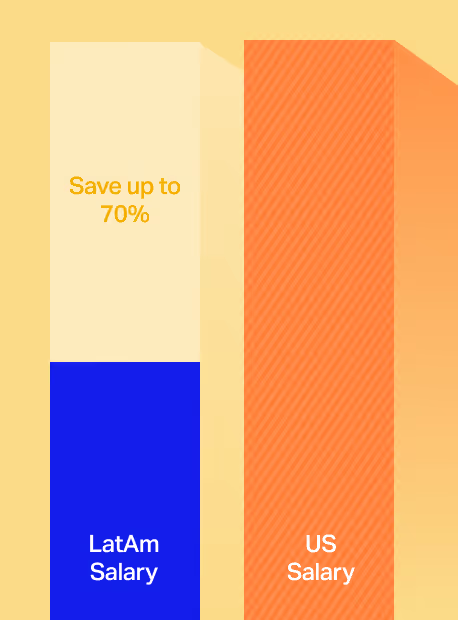
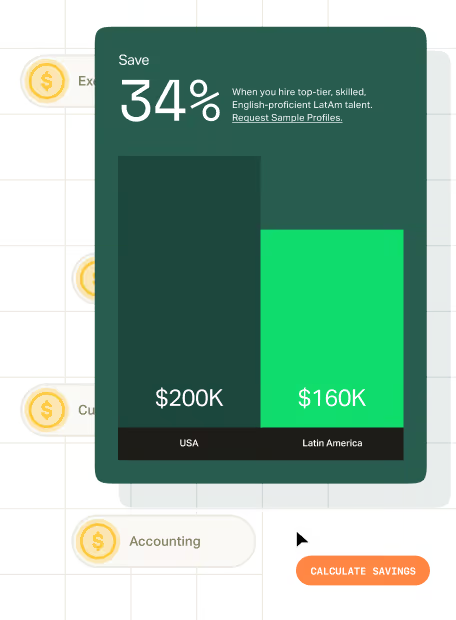
Developer salaries in Latin America run roughly 49–68% below US equivalents, according to our salary data, and that includes Guatemala.
For a US engineering manager, that changes what a given budget buys. The same money that stretches to a mid-level or junior US hire can get a senior developer in Guatemala with 7+ years of experience and real architecture work behind them.
Guatemala's tech market is also smaller than regional hubs like São Paulo or Mexico City, which cuts both ways: fewer candidates overall, but less competition pulling them toward the next offer. Developers there tend to stay with a team longer and build real ownership of the product, rather than moving every year for a raise.
For the country across every department, see Hire With Near's full guide to hiring in Guatemala.
How Deep Is Guatemala's Developer Talent Pool?
Guatemala is a newer market for developer hiring specifically: the technical-education base is real, but the proven engineering track record isn't there yet.
From the editorial work I do interviewing Hire With Near's recruiters, Guatemala comes up constantly, and almost always for sales, finance and accounting, or operations roles. Engineering isn't where the country's track record sits, and no source publishes a Guatemalan developer headcount, so anyone quoting one is estimating.
What is defensible is the foundation. Guatemala has a genuine, multi-university technical pipeline. According to Invest Guatemala, the country's investment promotion agency, more than 18,000 people are currently training for tech-sector professions and over 3,800 already hold engineering or related degrees, spread across one state university, five private universities, and other specialized institutions.

Guatemala City
As the capital and economic engine, Guatemala City accounts for the vast majority of the country's software developers, nearshore IT infrastructure, and bilingual tech professionals.
The city's tech ecosystem is anchored in Cuatro Grados Norte (Zone 4), a dedicated technology and innovation district anchored by Campus TEC, often referred to as the Central American region’s first dedicated tech incubator and software park.
Because major nearshore employers, multinational corporations, and top technical universities are centered here, almost every remote developer search in Guatemala starts and often ends in the capital.

Quetzaltenango
Quetzaltenango, universally known as Xela, is Guatemala's secondary tech hub and the commercial center of the western highlands. While smaller than Guatemala City, Xela holds a growing community of software engineers, local web agencies, and remote developers.
The talent pool here is fed by regional campuses of top national technical universities, producing developers who frequently integrate into distributed nearshore product teams looking for lower salary overhead and high retention rates.
Top universities in Guatemala
Three universities anchor that pipeline:
- Universidad del Valle de Guatemala (UVG): Guatemala's leading private technical university, with a computer science curriculum built around systems architecture, software engineering, and international enterprise standards. Our own recruiting research rates UVG first among Central America's private universities for technology and engineering, and its graduates as strong candidates for software development roles. That's Hire With Near's assessment, not a third-party ranking.
- Universidad San Carlos de Guatemala (USAC): The country's historic public university and the largest single source of systems engineers. Its Escuela de Ciencias y Sistemas covers backend engineering, data structures, algorithm design, and large-scale system infrastructure, which makes it the one to watch for backend work.
- Universidad Galileo: Known for cloud computing, systems engineering, and modern software paradigms. Its graduates are well represented across nearshore technical operations and regional startups.
Two other universities round out the pipeline without the same engineering depth: Universidad Francisco Marroquín (UFM) leans finance and fintech, and Universidad Rafael Landívar (URL) leans business, with a UX/UI slant.
The nearshore professional culture that makes Guatemala strong for US-facing sales and operations work carries into technical roles too, especially ones that need someone who can explain a decision to a client on a call. None of that adds up to a booming tech sector, and the data wouldn't support the claim.
It helps to see Guatemala next to its peers. Developer markets are larger in Mexico, Colombia, Brazil, Argentina, and Chile, and each has its own hiring guide. You can also check the guides for neighboring countries like Honduras, Costa Rica, and El Salvador.
Guatemala's case is narrower: Central time, a credible pipeline, and lower cost, for a company adding one or two engineers rather than building a twenty-person team.
That's the read our recruiters give US companies hiring developers in Latin America for the first time, and it matches what CTOs find when building engineering teams there.
What Technical Skills Do Guatemalan Developers Have?
Guatemalan developers build in the same mainstream stacks as their peers across Latin America. No source ranks stacks by country, so what follows is the regional picture, shaped by what local engineers actually work on: commercial nearshore product engineering, enterprise IT, and regional fintech platforms.
Because local engineers frequently integrate into North American product teams, the demand concentrates on full-stack web technologies, modern API layers, and enterprise backend systems.
The stacks that come up most across the region:
- JavaScript/TypeScript (React & Node.js): The most common stack for nearshore web application development. Full-stack developers who combine React or Next.js on the front end with Node.js microservices on the back end are widely available in the region.
- Python (Django, FastAPI): The most requested language regionally, used across API development, data pipelines, and cloud-native backend services, and growing alongside demand for machine learning and data engineering.
- Java & Spring Boot: Common in banking, telecom, and enterprise work. Java developers in the region bring experience with high-volume transactional backend services and enterprise system integrations.
- PHP & Laravel: Common across web development agencies, e-commerce platforms, and legacy application maintenance.
- Mobile development (Flutter & React Native): Driven by fintech, digital banking, and logistics companies scaling mobile-first platforms.
For a single hire, scope matters more than the stack list, so define what the developer will do most of the week before you write the job post.
Seniority matters more here than the stack list suggests. Across Latin America, Hire With Near's 2026 State of LatAm Hiring Report found that 98% of engineering placements were mid-level or senior, split 47% mid-level and 51% senior. These are experienced professionals who have done the job elsewhere first.
Beyond technical ownership, look for engineers who write clean, testable code, understand the commercial reason behind a feature request, can explain a technical decision to non-technical managers on a live call, and take ownership, as our Software Engineering Recruiter points out:
The main thing I look for is ownership. I always look for developers who have worked in startups or smaller companies, because those are the people who probably have ownership. If you bring them a problem, they won't ask how to solve it, they'll try their own ideas, they'll be creative.
— Federico Bilello, Software Engineering Recruiter, Hire With Near
The most consistent red flags remain universal: candidates who struggle to articulate their precise contribution to a past project, or who refuse to discuss previous technical mistakes.
{{state-latam-hiring}}
What Does It Cost to Hire Developers in Guatemala?
Hiring a developer in Latin America runs roughly 49–68% below the equivalent US salary, including in Guatemala.
Here's what the developer roles you're most likely to hire cost against their US equivalents, according to Hire With Near's salary benchmarks:
For the most up-to-date figures, see Hire With Near's US vs Latin America Salary Guide.
A mid-level software engineer in Latin America sits at $54K to $72K against $115K to $195K in the US. The senior band in the region, $72K to $108K, still lands under the bottom of the US mid-level range. Pay at the top of the band for genuinely senior work; teams that anchor to the bottom tend to lose the hire within months for a better offer.
That salary gap isn't about developers in Guatemala being less skilled. It's about what things cost where they live. A developer's pay tracks the cost of the address, not the quality of the work, the same reason a software engineer in Austin earns less than one in San Francisco despite doing comparable work.
You can see that difference directly in the table below, comparing everyday costs in Guatemala City against San Antonio, Texas:
Source: Numbeo.com
Our breakdown of IT and engineering salaries in Latin America goes role by role.
How Can a US Company Hire Developers in Guatemala?
US companies have four ways to hire developers in Guatemala: freelance marketplaces, direct hiring, a nearshore staff augmentation company, or a staffing and recruiting firm.
The right choice comes down to one question: do you need short-term help on a project, or a long-term, full-time developer on your team? These are the mechanics from our guide to hiring remotely in Latin America, applied to one country.
Option 1: Freelance and contractor platforms
Platforms like Upwork and Toptal get you freelance developers in Guatemala quickly, which is why they work for a defined, short piece of work: a plugin, a migration, a two-week fix. For a full-time developer in Latin America, they work less well: you own quality control and retention, and the developer is splitting attention across other clients.
For a permanent seat, the alternatives to freelance platforms in Latin America are built for full-time remote hires.
Option 2: Direct hiring
Hiring directly means you source and vet candidates yourself and take on the employment relationship. In Guatemala, that comes down to one of two mechanisms:
- Register a Guatemalan subsidiary: This gives you direct control over employment, but it costs accordingly: months of setup, local legal and accounting support, and ongoing filing obligations. It only makes sense at real scale, roughly 50 or more employees in the country. Below that, hiring remote foreign employees through a lighter structure is the usual answer.
- Use an employer of record: An EOR handles the employment side of a cross-border hire: contracts, payroll, tax withholding, statutory benefits, and local compliance. In Guatemala, that includes two mandatory annual payments US companies rarely budget for: Aguinaldo, the 13th-month salary, and Bono 14, the 14th month, which together add roughly a month of pay per employee per year. EOR companies run those calculations as a matter of course. What an EOR doesn't do is recruiting. You still source, screen, and choose every candidate yourself, through your network, a job board for hiring in Latin America, or your own outbound.
Option 3: Working with a nearshore staff augmentation company
A nearshore staff augmentation company places pre-vetted engineers onto your team to work under your direction while the firm handles payroll, benefits, and compliance.
It fits a defined project, a temporary capacity gap, or a team you expect to scale up and then back down. Permanence is the trade-off.
We go deeper on staff augmentation for engineering teams and on software outsourcing and staff augmentation, where some firms sell a whole delivery team instead of individual engineers.
Option 4: Working with a staffing and recruiting firm
This is the simplest option for most US companies looking to hire software developers in Guatemala permanently: one relationship that finds the engineer and employs them, instead of splitting the two across separate vendors.
It's how specialist staffing firms for LatAm hiring work, and it's how Hire With Near operates: we source and vet the candidate, you interview and make the hiring decision, and the employment side (payroll, benefits, compliance, local requirements) runs through our nearshore staffing and recruiting services.
If you'd like to read the specifics on the process of hiring a developer in the region, check our How to Hire Latin American Developers article.
What Do US Companies Need to Know Before Hiring in Guatemala?
Four things change how you budget and plan for a hire in Guatemala: two mandatory annual bonus payments, paid leave rules, a holiday calendar that moves, and what to screen for instead of a degree.
Two annual bonuses are mandatory
Every employer owes two payments, and both are prorated for partial years:
- Aguinaldo, the 13th-month salary, runs on a December 1 to November 30 cycle and is paid in two halves: the first between December 1 and 15, the second by January 30.
- Bono 14, the 14th month, runs on a July 1 to June 30 cycle and is paid in full by July 15.
Paid leave runs for fifteen business days
Paid leave is a minimum of 15 consecutive business days after 12 months of continuous service. That's closer to three calendar weeks once weekends and holidays are counted. Cash in lieu isn't permitted while employment continues.
The holiday calendar moves
Guatemala has 11 public holidays a year, and the Tourism Promotion Law shifts certain secular holidays to the nearest Monday. The calendar isn't fixed the way a US schedule is.
Two dates belong in the sprint plan. Holy Week (Maundy Thursday and Good Friday in particular) functions as a near-total corporate shutdown in our experience of the market. And August 15, Guatemala City's patron saint festival, matters because the capital is where the bilingual technical talent sits.
A degree shouldn't be a hiring filter
A degree requirement is one of the easiest ways to lose a strong candidate in Guatemala. Natasha Tarapow, Hire With Near's Recruitment Consultant, is direct about it:
A lot of the great engineers in Latin America don't have a college degree, and that doesn't mean they're bad candidates. The dynamic here is that many of the best engineers started working before they graduated. They got a really good job and didn't have time to finish. We always recommend to clients that they don't make a degree a must-have, because they might be losing out on some really good candidates.
— Natasha Tarapow, Recruitment Consultant, Hire With Near
English proficiency is moderate
English is the other variable. Guatemala ranks #61 globally on the 2025 EF English Proficiency Index with a score of 510, in the Moderate band and above the global average of 488. That's a country average, not a read on an individual engineer, which is why we screen English candidate by candidate.
How Does Hire With Near Help US Companies Hire Developers in Guatemala?
We run the search end to end, from sourcing through screening and coordination. A shortlist reaches you 3 to 5 days after kickoff, and most roles close in about three weeks from kickoff to accepted offer.
Our recruiters open with a project question: describe a recent project where you designed and implemented a full-stack solution, what stack you used, what broke, and how you got around it. If you want a coding exercise or take-home task added on top, debugging a snippet or building a basic API with tests, we can build that into the process at your request.
Natasha Tarapow, Hire With Near's Recruitment Consultant, explains what that question is testing for:
We always ask candidates to tell us about a project they've worked on, not just that they use this language and that one, but what their role was and what they actually did. It's important that they can explain their work to someone who isn't a developer. If they can do that, that tells me a lot.
— Natasha Tarapow, Recruitment Consultant, Hire With Near
That process is why the search moves fast without lowering the bar. Two examples show what that looks like in practice.
A US healthtech startup kept its own eight-step interview process fully intact, refusing to cut a single stage, and still averaged 14 days to hire. It came out with seven senior engineers and $323,000 in annual savings against US salaries.
Separately, ParkMobile needed senior platform, backend, and iOS engineers fast. Hire With Near placed 9 of them in 24 days, saving the company over $1 million a year against US rates.
Both searches ran across Latin America, not in Guatemala specifically.
If you're filling several seats and want to scale an IT and tech team in Latin America at once, or you need an engineering leadership hire like a VP of Engineering or CTO, that runs through executive search instead. Most readers here are a founder or engineering lead at a product company, which is why we run a dedicated nearshore SaaS recruiting practice.
Final Thoughts
Guatemala is a straightforward case: you get Central Standard Time year-round, a real technical-university pipeline, and developer salaries roughly 49–68% below US equivalents.
What's still building is scale: this is a market for adding one or two strong engineers to a team you already have, not standing up a twenty-person engineering org from a cold start. In that case, larger markets like Mexico, Colombia, Argentina, and Brazil are worth weighing first.
If you’d like to have a look at neighboring countries, our guides to Honduras, Costa Rica, Belize, and Guatemala cover how to hire developers in Central America and the Caribbean.
If Guatemala fits what you're building, book a free consultation and we'll walk you through salary benchmarks and how the process works, so you have what you need to decide.
{{latam-hiring-cta-v2}}
Frequently Asked Questions
How much does it cost to hire a developer in Guatemala?
Budget $48K to $108K a year in salary, depending on seniority. Our salary data puts a mid-level software engineer in Latin America at $54K to $72K and a senior at $72K to $108K, against $115K to $238K in the US.
For the full breakdown by role and seniority, see Hire With Near's US vs Latin America Salary Guide.
Is Guatemala in a compatible time zone with the US?
Yes. Guatemala operates on Central Standard Time year-round with no daylight saving shifts, matching US Central time for half the year and US Mountain time for the other half as US clocks change.
A developer there overlaps through your business day wherever your team is based in the US, with the widest coverage for Central and Mountain teams. The only detail to plan around is that the gap shifts by an hour twice a year when the US changes its clocks.
Do Guatemalan developers speak English well enough for daily standups?
Many do, but English has to be screened per candidate rather than assumed from the country. Guatemala ranks #61 globally on the 2025 EF English Proficiency Index, in the Moderate band.
So we test what decides it for a developer: explaining a technical decision to a non-developer, and walking an architecture choice live on a call.
Are 13th and 14th month salaries required in Guatemala?
Aguinaldo (13th-month salary, paid half in early December and half by January 30) and Bono 14 (14th month, paid in full by July 15) are mandatory under Guatemalan labor law for anyone with employees, whether that's through your own entity or an EOR.
Which local obligations apply depends on how the person is engaged, so confirm the structure with your EOR or counsel; when you hire through a staffing partner, what you pay is their fee rather than these statutory bonuses directly.
Prorated for partial years, together they add about a month of pay per employee for anyone who does carry the obligation.
How long does it take to hire a developer in Guatemala through Hire With Near?
You'll have a shortlist 3 to 5 days after the kickoff call, and most companies go from kickoff to an accepted offer in about three weeks. Seniority, stack specificity, and the speed of your own interview loop move that. Long processes with several technical assessments are the most common cause of delay.
What other developer roles can I hire in Latin America?
Beyond a general developer, US companies hire remote QA engineers, back-end developers, front-end developers, and nearshore DevOps engineers across Latin America, plus specialists like PHP developers.
Most teams start with the role closest to the immediate gap, then add breadth. All of them work your business hours and cost 30–70% less than US equivalents.





.webp)
.webp)



%203.svg)
.avif)





%20(1).avif)

%20(1).png)