


%203.svg)
Key Takeaways
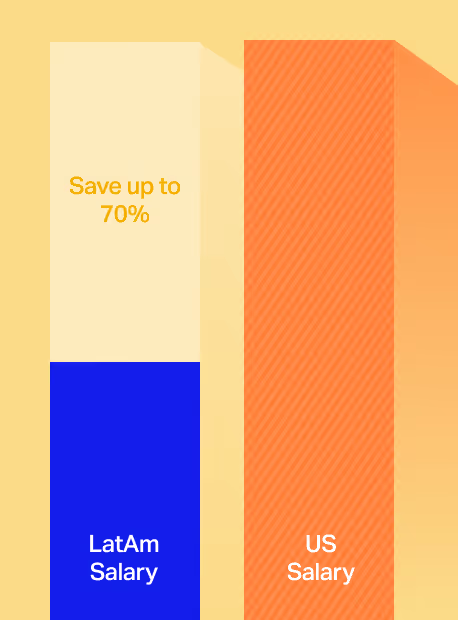
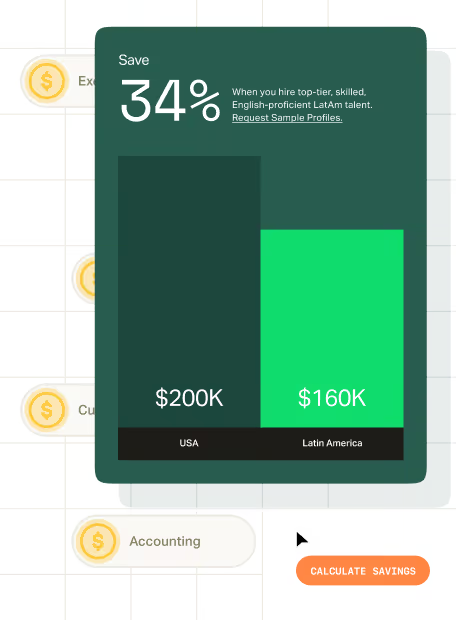
- You can hire developers in Mexico at standard Latin American salary benchmarks, roughly 30–70% below US rates. There are four routes to do it, and a staffing and recruiting partner is the fastest path to a long-term, full-time hire.
- Because Mexico’s major tech hubs align closely with US Central time, a developer there shares the vast majority of your working day, no matter which US time zone your team is in.
- Expect a vetted shortlist in days and a signed hire in about three weeks with a specialist partner, versus the three to six months many of these roles take in the US.
Imagine adding highly qualified developers to your core team who join your morning standups, review code in real-time, and ship production-ready features at salaries 30–70% below US equivalents.
That's not a hypothetical setup. It’s why companies from venture-backed startups to enterprise giants have made Mexico their primary engineering base for years. Backed by decades of trade alignment and a rapidly expanding talent pool of developers, Mexico offers a rare blend of technical depth, cultural proximity, and operational speed.
In this guide, I'll cover exactly how you can take advantage of those benefits and hire developers in Mexico: why the country works, what to pay, where the talent is, the four ways to bring someone on, and crucial information you should know before hiring someone.
Why Should I Hire Developers in Mexico?
Mexico gives US companies developers next door, working your business hours, without the overnight delays that make offshore engineering so frustrating.
When US engineering leaders tell us why they looked south, Hire With Near hears three reasons: time zone, hiring cost, and easy collaboration.
Time zone alignment
Time zone is the clearest edge. Mexico City stays on Central Standard Time year-round, keeping your hires within just zero to two hours of any continental US time zone. You get live standups, fast code reviews, and real-time handoffs while everyone is still at their desk, as the table below shows:
Note: During US standard time (roughly November to March), Mexico City, Monterrey, and Guadalajara align one hour later against the four time zones shown above. Tijuana still observes DST to stay aligned with neighboring California.
That's a huge difference when comparing to offshoring to distant regions like Southeast Asia or Eastern Europe. One engineering lead described the problem after trying to run QA from overseas:
Our senior QA in Sri Lanka is excellent, but we don't get enough overlap to keep quality and throughput high. We often ship without her. The fix is obvious: a tester who is online when we are.
That's what nearshore hiring in Mexico removes for teams that have tried offshore developers and gotten burned on turnaround: the work doesn't stall because someone isn't good enough, it stalls because no one's awake to review it, approve it, or ship it.
It's also the second most common reason US companies switch to Latin America in the first place: in Hire With Near's analysis of more than 2,000 hiring conversations, 30% of companies made the move specifically for the real-time overlap they couldn't get offshore, second only to budget constraints.
Communication and cultural proximity
Mexico has a deep, strongly bilingual professional workforce and close cultural proximity to the US, so developers know how US teams work, and the ones Hire With Near places are vetted for spoken and written English.
One AI startup founder told us what drew him to Latin American engineers: “I love the stereotype of very open and warm and kind and thoughtful and communicative. I really like that. And that's what we would expect in engineers.”
In the video below, Hayden Cohen, Hire With Near's co-founder and CEO, explains why this is another LatAm advantage over offshoring destinations:
Cost savings
Hiring in Mexico typically costs 30–70% less than equivalent US hires. That means the budget that covers one mid-level US hire often funds a senior Mexican engineer, with room left to grow the team.
The savings come from the cost of living, not capability. According to Hire With Near's 2026 State of LatAm Hiring Report, 98% of engineering placements in Latin America were mid-level or senior professionals. Companies aren't turning to the region to fill junior seats. They are using it to access experienced engineers they can't afford to hire domestically.
To ground these numbers, take a look at the comparison between the cost of living in Mexico City, Monterrey, and Guadalajara, and Atlanta, Georgia:
Source: Numbeo.com
That mix of US-hours availability, senior talent, and easy communication is why more teams now hire developers in Latin America as time zones and AI reshape engineering hiring.
If you want a quicker version, our COO Franco Pereyra explains in the video below the benefits of hiring in Mexico:
What Technical Skills Do Mexican Developers Have?
Mexican developers cover the full modern stack, with particular depth in the languages and frameworks most US teams already run on.
- Backend and full-stack: Deep coverage of Java, Python, .NET and C#, and Node.js, with a large pool of engineers who've worked inside enterprise systems for US and Mexican companies alike.
- Frontend: React is dominant, with strong secondary coverage of Angular and Vue.
- Cloud and DevOps: Solid experience across AWS, GCP, and Azure, along with containerization and CI/CD tooling.
- Mobile: Native iOS and Android development, plus cross-platform experience with React Native.
- Data and AI: A fast-growing bench, with engineers increasingly comfortable across data pipelines, applied machine learning, and LLM integration work.
- Rarer skills: Shopify, Amazon e-commerce, and blockchain specialists exist but are harder to source. Plan for a longer search if your role needs one of these.
Since job titles travel badly, name the technologies you need before you interview. A senior developer in one market might mean five years of ownership over architecture decisions, and in another it might mean five years of executing someone else's spec.
What Developer Roles Can I Hire in Mexico?
The roles US companies hire most from Mexico map directly to the stacks Mexican developers are strongest in. Whether you're building your first product or scaling an existing team, here's where most companies start and what each role covers:
- Software engineer: Builds and maintains the core product across the full development lifecycle, from architecture decisions to shipping features. This is typically the first hire for teams building out their engineering function in Mexico.
- Full-stack developer: Works across both front end and back end, which suits lean teams that need range without splitting the hire into two roles. Expect solid coverage of React paired with Node.js or Python on the back end.
- Back-end developer: Owns the servers, databases, and APIs your product runs on. Mexico's depth in Java, Python, and .NET makes it a strong market for senior back-end talent specifically.
- Front-end developer: Builds the interfaces users interact with. React is the dominant framework, with meaningful coverage of Angular and Vue as well.
- React developer: A specialist front-end hire for teams that have standardized on React and want someone who goes deeper than general front-end coverage, particularly useful for complex, component-heavy UIs.
- Data engineer: Builds and maintains the data pipelines your product or analytics depend on. A common addition once a team's data volume outgrows what a generalist backend developer can support.
- Mobile developer: Builds native iOS and Android apps or cross-platform apps with React Native, for teams that need a dedicated app experience rather than a responsive web app.
- Generalist developer: A generalist option if you're not yet sure which specific role fits, or if you want to start with one flexible hire before defining more specialized positions.
Mexican developer salaries fall within Latin America’s broader ranges, which Hire With Near benchmarks across the region. Here’s how those figures compare to equivalent US hires:
For the most up-to-date figures, see Hire With Near's US vs Latin America Salary Guide.
Where Is the Developer Talent in Mexico?
Mexico's developer talent clusters in three hubs: Mexico City, Guadalajara, and Monterrey. Each has a distinct profile, so the right one depends on the kind of talent you're after.
The pool behind all three is large and growing fast. According to GitHub's 2024 Octoverse report, Mexico has more than 1.9 million developer accounts on GitHub, growing 21% year over year, one of the biggest developer communities in Latin America.
The pipeline behind that pool is real too. Mexico's public higher education system awards approximately 37.5% of degrees in STEM disciplines, compared to roughly 20% in the US, according to Mexico's Secretariat of Economy. That steady pipeline is a big reason Mexico can staff senior engineering roles at the volume US companies need.

Mexico City
As the capital and largest city in the country, Mexico City has the largest overall developer talent pool in Mexico and the most active startup ecosystem. It's home to the largest concentration of multinational tech companies operating in the country, alongside a fast-growing base of homegrown startups across fintech, e-commerce, and the SaaS industry.
The city's engineering pipeline is anchored by some of Mexico's strongest universities, including Universidad Nacional Autónoma de México (UNAM), Instituto Politécnico Nacional (IPN), and Instituto Tecnológico Autónomo de México (ITAM). That density means depth across nearly every stack, from backend and full-stack engineers to specialized data and AI talent.
Because the city hosts so many international companies, a large share of its senior engineers already have direct experience working with US teams, which shows up in communication style and familiarity with US-style sprint cycles and tooling.

Guadalajara
Often called Mexico's tech capital, Guadalajara has built its reputation on decades of hardware and electronics manufacturing that gradually pulled software talent into the region alongside it. That history left the city with a dense concentration of engineering graduates and software companies, from large multinational R&D centers to a growing base of homegrown tech firms.
The talent profile here skews toward strong technical fundamentals: backend, embedded systems, and full-stack development are particularly well represented, reflecting the city's manufacturing and hardware roots.
Guadalajara also tends to offer a lower cost of living than Mexico City, which can translate to more competitive salary expectations without any drop in seniority or skill.

Monterrey
Monterrey pairs a strong industrial and manufacturing base with some of the country's most well-regarded engineering schools, including Instituto Tecnológico y de Estudios Superiores de Monterrey (Tec de Monterrey), one of Latin America's top-ranked universities for engineering and computer science, and Universidad Autónoma de Nuevo León (UANL).
That combination has produced a steady pipeline of engineers with strong fundamentals in systems design and enterprise software, shaped by the city's long history as an industrial and corporate hub.
Monterrey is also geographically closer to the US border than Mexico City or Guadalajara, which some companies find useful for occasional in-person collaboration or travel.
Hire With Near's guide to nearshore software development in Mexico goes deeper on hubs and salaries, and our broader guide to hiring remote talent in Mexico covers the wider market.
How Can a US Company Hire Developers in Mexico?
US companies have four ways to hire developers in Mexico: freelance marketplaces, hiring directly, a nearshore staff augmentation company, or a staffing and recruiting firm. The choice comes down to one question: do you need short-term help on a project, or a long-term, full-time developer on your team?
The same four routes apply anywhere you hire developers in Latin America. Mexico is simply one of the strongest markets for them, given the time zone alignment and the depth of talent in Mexico City, Guadalajara, and Monterrey. The options below run from most hands-on to simplest.
Freelance platforms and marketplaces
Freelance platforms give you the fastest access to contractors, but you get people juggling several clients rather than an engineer embedded in your codebase.
Marketplaces like Upwork, Toptal, and Arc are built for short-term, project-based work. For anything ongoing, you carry all the risk on quality and retention yourself.
For a full-time engineer who will learn your codebase and stay, specialist staffing gives fundamentally different results for full-time remote hires.
Related reading: Hire With Near vs. Toptal: Which Is Best for Remote Talent?
Hire directly
Hiring directly means you source and vet candidates yourself and take on the employment relationship. For a cross-border hire in Mexico, that requires one of two mechanisms:
- Set up a legal entity: Registering a Mexican subsidiary gives you full control, but it takes three to six months, carries high upfront legal and accounting costs, and requires ongoing compliance with Mexican labor law, including mandatory profit-sharing and severance obligations. It only makes sense if you're planning on hiring 50-plus people in the country.
- Use an employer of record: An employer of record becomes the legal employer on paper, handling contracts, payroll, and compliance without you needing your own entity. In Mexico specifically, that means managing mandatory benefits like the aguinaldo (year-end bonus), vacation premium, and IMSS social security contributions. The catch: an EOR handles employment logistics, not recruiting. You still source and vet every developer yourself, through job boards for hiring in Latin America or your own network.
Related reading: 10 Best Employer of Record (EOR) Companies
Nearshore staff augmentation
A nearshore staff augmentation company places a vetted engineer on your team for short-term or project-based work while the provider stays the legal employer and handles payroll and compliance.
It fits a sprint push or a fixed-length build where you scale up, then back down.
Worth knowing: most staff augmentation firms are built for short-term rotations, with developers who move between clients every few months, a poor fit when you want someone to stay and own the work.
For the mechanics, see how nearshore staff augmentation works.
Staffing and recruiting firms
A staffing and recruiting firm, like Hire With Near, is the path when you want a long-term, full-time developer who becomes a permanent member of your team. You describe the role, the firm sources and vets candidates, and once you hire, it handles payroll, benefits, and compliance in the background. It’s where most companies hiring full-time remote engineers end up;
Delve, a digital consulting firm, used this model to fill nine positions. By tapping into Hire With Near's network in Latin America, they secured the talent they needed and saved nearly $500,000 in annual payroll compared to hiring in the US, without compromising on quality.
Our long-term nearshore staffing and recruiting placements are built to last: full-time developers who stay, learn your product, and become permanent members of your team. You get a vetted candidate shortlist in 3–5 days and the hire is usually in place within 21 days.
You can compare specialists in our roundups of the best LatAm staffing firms and the best companies to hire developers in Latin America.
What US Companies Need to Know Before Hiring Developers in Mexico
Hiring developers in Mexico is straightforward, and the few things worth knowing up front are easy to manage with the right setup: protecting your IP, a handful of local employment rules, and how to read a resume.
Protecting your intellectual property
Treat this as you would for a US employee: put clear IP assignment and confidentiality terms in the employment agreement so your code belongs to your company. A staffing or employer of record partner's contracts typically include these as standard.
Local compliance
Navigating local labor regulations in Mexico, such as the mandatory year-end bonus (Aguinaldo), annual profit sharing (PTU), and public social security (IMSS), depends heavily on how you choose to structure your working relationship. Under formal employment arrangements, these statutory benefits are mandatory by law. Mexico’s 2021 labor reform also introduced strict rules under the REPSE framework to regulate specialized service providers and protect workforce rights.
You don't need to be an expert in Mexican labor law to navigate this. The right local partner handles the nuances of your chosen hiring model (ensuring proper registration, running localized payroll, and managing applicable statutory benefits) so your developers can focus entirely on delivering for your business.
A degree isn't a hard requirement
Don't screen out a strong candidate just because they don't have a college degree. Natasha Tarapow, Recruitment Consultant at Hire With Near, explains why:
A lot of the great engineers in Latin America don't have a college degree — and that doesn't mean they're bad candidates. Many of the best engineers started working before they graduated. They got a really good job and didn't have time to finish. We always recommend to clients that they don't make a degree a must-have, because they might be losing out on some really good candidates.
Screen for what someone has built and how clearly they can talk about it, not whether they finished school.
For the other questions that come up, our roundup of questions tech leaders ask about hiring developers in Latin America is a useful starting point, while our guide to hiring remotely in Latin America covers the full picture.
How Does Hire With Near Help US Companies Hire Developers in Mexico?
Hire With Near finds, vets, and places senior developers in Mexico and across Latin America, then handles payroll, benefits, and compliance so they work as full members of your team.
You describe the role and stack, and our recruiters source from our pool of 160,000+ candidates plus run fresh sourcing to find exactly what you're looking for, sending a first shortlist in about five days. Most companies make a hire in under three weeks, versus the three to six months many engineering roles take in the US.
Vetting is where the difference shows up, because resumes have never been easier to inflate. One talent leader at a scaling SaaS company described what kept happening with candidates before they came to Hire With Near, when they were sourcing on their own:
Their resumes do look good, but when they do make it to our technical assessment and our interview rounds, our hiring team is finding that they're maybe not as senior as we're hoping for.
Hire With Near's recruiters run first-round interviews that go past the resume: candidates walk through a real project and the decisions behind it, and are screened for English and communication before they reach you. If you want a technical assessment or case study assignment on top of that, we can help administer it and advise on what it should look like.
Natasha Tarapow explains what she looks for:
We always ask candidates to tell us about a project they've worked on, not just that they use this language and that one, but what their role was and what they actually did. It's important that they can explain their work to someone who isn't a developer. If they can do that, that tells me a lot. — Natasha Tarapow, Recruiter at Hire With Near
Every candidate is sourced for your specific role and stack, not pulled from a bench others passed on. That fits the pattern we see most: a company makes one hire, sees the quality, and comes back to build the team, which is how many of the 950-plus companies we have worked with scale.
How Bonfire cut its engineering search time in half
Bonfire, an e-commerce platform for custom merchandise and fundraising, had been sourcing engineering candidates the DIY way: posting on LinkedIn, combing job boards, running the process solo. It took two to three months per hire. Dan Strogiy, their Director of Design and UX, brought the search to Hire With Near instead.
The role closed in six weeks, roughly twice as fast as their previous process, at a cost of about $53,000 a year below a comparable US hire. The engineer stayed on the team for more than two years. Thomas Elliott, VP of Product Management at Bonfire, described the difference:
It was shocking to see the difference between the talent Hire With Near brought versus other firms I worked with. Our hires are extraordinary and a great cultural fit. — Thomas Elliott, VP of Product Management at Bonfire
Final Thoughts
Hiring developers in Mexico gives US companies engineers who work their hours, communicate clearly, and come at salaries well below US rates at standard Latin American benchmarks, with a partner that both finds them and employs them.
With major tech hubs running in near-total time zone alignment with the US, a deep and growing talent pool, and a strongly bilingual workforce, Mexico is one of the most practical places in Latin America to build an engineering team.
When you’re ready to build your team, Hire With Near can help you hire software engineers in Latin America at every level. For senior engineering leadership, we also run executive search in the region.
Book a free consultation to talk through your requirements with our team. We’ll share salary benchmarks and a clear picture of the process, so you have what you need to decide whether it is right for you.
If you're weighing Mexico against other markets in Latin America, our guides to hiring developers in Brazil, hiring developers in Colombia, and hiring developers in Argentina, and hiring developers in Guatemala cover the same ground for each country: costs, skills, and how to hire.
{{latam-hiring-cta-v2}}
Frequently Asked Questions
What is the average salary for a software developer in Mexico?
A software developer in Latin America typically earns about $36,000 to $108,000 a year depending on seniority and stack, commonly 30–70% below the US equivalent. These are standard Latin American benchmarks from Hire With Near's salary data, not Mexico-specific figures, so treat them as a regional starting point.
How long does it take to hire a developer in Mexico?
Expect a first vetted shortlist within days and a signed hire in about three weeks with a specialist partner, far faster than the three to six months many of these roles take in the US. The partner sources and screens against your role from day one instead of starting from scratch.
Do Mexican developers speak English well enough for daily standups?
Yes. Mexico has a large, strongly bilingual professional workforce, and the developers Hire With Near places are vetted for spoken and written English before they reach you, so they can run a standup, walk through an architecture decision, and write clear pull-request notes. Accent varies person to person, but professional and technical fluency is the standard we screen for.
Is it better to hire freelance or full-time developers in Mexico?
Freelance fits short, self-contained projects, while a full-time developer fits when you need someone to learn your codebase and own the work over time. Freelancers start quickly but split attention across clients and rarely stay.
For a role that is core to your product, a full-time hire through a staffing partner gives you a committed engineer plus handled payroll and compliance.
Is outsourcing legal in Mexico?
Yes, outsourcing to Mexico is legal. Mexico's 2021 labor reform restricted subcontracting of a company's core activities and now requires specialized-service providers to register under a system called REPSE, so the practical requirement is to work with a compliant, registered partner that handles registration, payroll, benefits, and local compliance.
What developer roles can you hire in Latin America?
US companies hire the full range of engineering roles in Latin America, well beyond generalist developers. Teams commonly bring on front-end developers, React developers, Python developers, DevOps engineers, and mobile developers, with strong benches for Java and .NET work too. All offer the same US time-zone overlap and cost advantage.






.webp)


%203.svg)
.avif)





%20(1).avif)

%20(1).png)