


%203.svg)
Key Takeaways
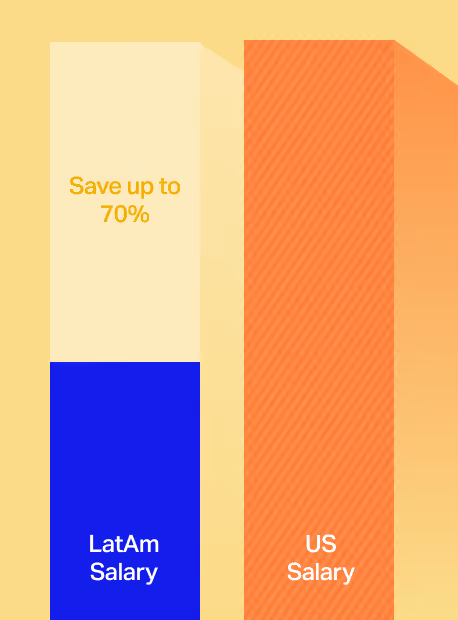
- Nearshore software development in Mexico gives US companies access to a deep technical talent pool at 30 to 70% lower cost than equivalent US hires, with full working-hour overlap and no significant time zone gap.
- Mexico's developer community has grown to 1.9 million GitHub-registered developers with 21% year-over-year growth, supported by a STEM education system where 26% of bachelor's degree graduates are in STEM fields, above the OECD average.
- You can hire full-stack, back-end, front-end, DevOps, QA, and mobile developers in Mexico through several models, from flexible staff augmentation to a dedicated direct-hire team, and a nearshore staffing partner handles sourcing, screening, and compliance so you skip the local red tape.
Finding engineers who work your hours and fit your budget is one of the hardest problems in engineering hiring. US salaries are out of reach for most growth-stage companies, and offshore teams in Asia create a 10–12 hour gap that breaks real-time collaboration. Mexico solves both situations at once.
According to Hire With Near's research on 2,000+ companies exploring Latin American hiring, 14% are specifically turning to Latin America for IT and engineering roles, with engineering ranking as the third most common hire among companies driven by budget constraints. Mexican engineers keep hours that fully overlap with every US time zone: the same standup, the same Slack thread, the same workday.
Mexico's developer community has expanded rapidly, now among the largest and fastest-growing in Latin America. Experienced full-stack, backend, DevOps, and mobile engineers are actively seeking US-client opportunities and already understand how US product teams operate. You can hire mid-level and senior engineers for what you'd pay a junior in the US.
This article covers the real benefits and trade-offs of nearshore software development in Mexico, what you can expect to pay across roles and seniority levels, and how to hire a software engineer in Latin America in 2026 without getting stuck in complex local procedures.
What Are the Benefits of Nearshore Software Development in Mexico?
Mexico offers a combination of technical depth, time zone alignment, IP protection, and developer community scale that makes it one of the strongest nearshore markets for US companies. Here's what each advantage means in practice:
Developed IT infrastructure
Mexico has invested consistently in its IT infrastructure over the past decade: improved internet connectivity, data centers, and telecommunications services that make collaboration with distributed software teams practical.
That infrastructure investment has drawn the attention of global manufacturers and tech firms. Microsoft's $1.3 billion investment in Mexican AI and cloud infrastructure is one of the most visible signals of how seriously US tech companies are treating Mexico as a technology hub. It's part of a broader trend: in 2024, US firms accounted for 45% of Mexico's $36.87 billion in foreign direct investment.
Reliable infrastructure is crucial for remote software development teams because it determines whether real-time collaboration, version control workflows, and deployment pipelines operate without friction.
Mexico's developer community and tech market
Mexico is one of the largest and fastest-growing developer markets in Latin America. The GitHub Octoverse 2024 report confirms 1.9 million developers registered in Mexico, with 21% year-over-year growth, one of the highest rates in the region alongside Brazil, Colombia, and Argentina.
According to Hire With Near's 2026 State of LatAm Hiring Report, software engineer jumped from the 18th most-filled role to the 6th in a single year, with demand growing 250% year over year. That acceleration reflects real market behavior: US companies are actively building engineering teams in LatAm, and Mexico is a primary source.
In the conversations our recruiting team has with US hiring managers about Mexico, the pattern that emerges consistently is this: they expect to find junior developers and instead find mid-level and senior engineers who have already worked with US clients and understand how US product teams operate.
The Mexican IT market hosts the largest number of IT vendors in Latin America, and that competitive landscape extends to individual talent: Mexican engineers who have worked with US-client environments, especially those with Mercado Libre or major multinational experience, tend to be strong candidates for demanding technical roles.
The market also provides a wide range of options for choosing a software development partner, from large, established firms to early-stage startups.
Growing talent pool
Mexico's STEM education system contributes a steady pipeline of technically trained graduates. According to OECD Education at a Glance 2025, 26% of bachelor's degree graduates in Mexico come from STEM fields, above the OECD average of 23%.
Beyond the graduation pipeline, Mexico has several universities known for producing strong technical talent:
- National Autonomous University of Mexico (UNAM): Recognized as one of the most prestigious universities in Latin America, UNAM offers programs in computer science, computer engineering, and telecommunications engineering.
- Monterrey Institute of Technology and Higher Education (ITESM): With campuses across the country, ITESM is known for its technology and innovation focus, including software engineering and information systems programs.
- Instituto Politécnico Nacional (IPN): A leading public research institution with programs in computer science, computer systems engineering, and communications and electronics engineering.
- Universidad Anáhuac, Universidad Iberoamericana (IBERO), Universidad Panamericana (UP), and Universidad Autónoma de Nuevo León (UANL): Each offers specialized technology programs that add to the graduate pipeline. UANL is particularly notable given its location in Monterrey, one of Mexico's primary engineering hiring hubs.
One important nuance for hiring managers: Hire With Near's recruiting team consistently advises US clients not to make a college degree a hard requirement for engineering roles, and this applies across Latin America, not just Mexico. In fast-moving engineering markets, where strong engineers are often self-taught or left school early for competitive opportunities, a degree filter can eliminate some of the strongest candidates in the pool.
Intellectual property protection
IP protection is a real concern for companies considering nearshore development, and Mexico has a solid legal framework here.
As a World Intellectual Property Organization (WIPO) member, Mexico has signed multiple international treaties on protecting IP rights. The United States-Mexico-Canada Agreement (USMCA) directly addresses IP rights in Chapter 20, setting a significantly higher standard than NAFTA did. The treaty affirms compliance with:
- Patent Cooperation Treaty
- Paris Convention
- Berne Convention
- WCT
- WPPT
- Madrid Protocol
- Budapest Treaty
- Singapore Treaty
- UPOV 1991
- Hague Agreement
- Brussels Convention
The USMCA's IP chapter commits all three countries to promoting innovation and creativity, facilitating the diffusion of information, knowledge, technology, culture, and the arts, and fostering competition and open and efficient markets. You can proceed with confidence that nearshore outsourcing to Mexico is backed by a treaty-level framework, not just a local-law assurance.
Time zone proximity
Most of Mexico operates on Central or Mountain Time, meaning your remote engineering team is either in your time zone or within two hours of it. That's materially different from the 8–12 hour lag that comes with offshore development in Asian countries, like India or the Philippines.
This matters beyond scheduling convenience. Research from Harvard Business School and INFORMS on distributed teams recommends organizing them along a north-south axis, and the US–Latin America pairing is close to the ideal setup for maximizing workday overlap. Mexico sits right in that sweet spot.
In practice, overlapping hours mean daily standups happen live, urgent bugs get fixed in real time, and your Mexico-based engineers don't have to choose between their work schedule and their life.
Here are the approximate time zones and flight times to understand proximity to the US for Mexico's main tech cities:
Further reading: Why Companies Are Nearshoring to Mexico: The 2026 Guide for US Businesses
What Are the Challenges of Nearshore Software Development in Mexico?
Three friction points most US companies encounter with nearshore software development in Mexico are: increasing competition for senior engineers, navigating Mexican labor law and tax compliance requirements, and hiring logistics that require local market knowledge to execute well.
Increasing demand for software engineers
Mexico’s popularity as a nearshore software development destination has increased competition for experienced engineers. The best senior developers are often already working for US-based companies, so attracting them requires a competitive offer: interesting technical problems, good compensation, and clear career growth.
Salaries in Mexico are slightly higher than in other LatAm markets like Colombia or Argentina, reflecting the existing US-client demand and English fluency premium. You'll still see 30 to 70% savings versus US rates, though Mexico isn't the lowest-cost option in the region. The trade-off is proximity and existing US market familiarity.
To attract strong candidates, make sure you have an efficient hiring process before you start. Slow response times or unclear technical assessment steps lose top candidates quickly in a competitive market.
Bureaucracy and legal compliance
Navigating Mexican labor law, tax regulations, and data protection requirements is the most common source of delay for US companies going it alone. The key areas to know:
- Labor laws: Mexico has strict regulations on working hours, overtime, and employee benefits. Non-compliance creates financial and legal risk.
- Taxation: Income tax, value-added tax, and payroll tax considerations all affect net costs. Factor these in before building a budget.
- Data protection: Mexico’s data protection laws govern personal data collection, processing, and storage. Companies handling client or end-user data need to implement appropriate safeguards.
- Contractual agreements: Clear contracts covering scope, timelines, payment terms, and IP ownership are essential. Local legal counsel is worth the investment.
Working with a local legal partner, an employer of record, or a staffing agency in Mexico that handles compliance on your behalf saves you time and reduces your exposure.
Complicated hiring procedures
Hiring complexity is the challenge that most often leads US companies to work with a nearshore staffing partner rather than hiring directly. Sourcing through local job boards, running technical assessments in Spanish-language markets, navigating local reference checks, and managing offers denominated in pesos or USD all take time and local knowledge.
Hire With Near's recruiting team works with IT and tech recruiters specializing in this market. They handle sourcing, initial screening, technical assessment coordination, and candidate management. This way, your internal team can focus on final interviews and hiring decisions.
Hire With Near's recruiters also know the local market signals: Mercado Libre experience is a strong quality indicator for Mexico-based engineers. Candidates with parallel employment arrangements (multiple full-time roles simultaneously) are a red flag. And stacks like .NET, C#, PHP, and WordPress are plentiful in Mexico, while Shopify, Amazon e-commerce, and blockchain expertise are harder to find.
What Are the Key Nearshore Development Locations in Mexico?
Mexico has several cities with established software development ecosystems, strong university presence, and well-developed IT infrastructure. For a deeper look at the market behind these hubs, see our guide to hiring remote talent in Mexico.

Mexico City
As the capital and largest metropolitan area, Mexico City is the center of Mexico's tech ecosystem. It's home to numerous technology companies, startups, and innovation centers, giving businesses access to a wide range of technical talent and diverse expertise.
Mexico City's established business infrastructure and international connections make it a practical choice for companies that want easy access to in-person meetings when needed.

Guadalajara
Often called Mexico's technology capital, Guadalajara has become one of the leading nearshore development destinations in the country. IBM, Intel, Dell, HP, and Cisco have a presence in the city, reflecting both the talent quality and infrastructure that major technology companies expect.
Guadalajara's focus on technology education has produced a highly skilled workforce of software developers, engineers, and IT professionals, and the local government actively supports the tech sector's growth.

Monterrey
Located in northeastern Mexico and approximately 140 miles from the US border, Monterrey is a natural nearshore hub for US companies. The city benefits from a well-educated technical workforce, several strong universities with engineering programs, and an industrial culture that has historically attracted serious technology investment.
Monterrey's proximity to the US is a practical advantage for companies that prioritize occasional in-person collaboration.
How Does Mexico Compare to Other Software Development Locations?
Mexico's edge over the other nearshore and offshore options comes down to time zone: it gives you near-real-time collaboration with your US team that offshore Asia and Eastern Europe can't match, at a cost well below hiring stateside. When US companies evaluate nearshore software development, Mexico is rarely the only option on the table, so here's how it stacks up against the most common alternatives. If you're still sorting out the terms, our explainer on nearshoring vs. offshoring vs. onshoring breaks down the models.
Mexico vs. offshore Asia (India and the Philippines)
India and the Philippines remain the most common offshore destinations for US engineering teams, and the reasons are straightforward: large developer communities, strong technical training, and rates that are often lower than Latin America. For companies running asynchronous workflows or working on projects that don't require real-time collaboration, offshore Asia can work well.
The problem surfaces when teams need live coverage. A typical US company running an engineering team in India or the Philippines is operating with an 8–12 hour lag. Code review, sprint planning, and production incidents all require waiting for the next day's overlap window.
A founder in the Web3 space described what that lag costs in practice:
We have a senior QA focused on both manual testing and automation. She's based in Sri Lanka, and I don't get her enough during my day to actually allow keeping that high quality and high throughput for my team.
Latin American engineers tend to close that gap. As Natasha Tarapow, Senior Recruiter for Development and Engineering, puts it:
In Latin America, talent is very communicative. People really try to go above and beyond in their jobs.
That kind of engagement is exactly what pulled Conversion Logix, an Inc. 5000 digital advertising and software agency in Austin, toward Latin America. Local hiring was too expensive, and a previous Philippines-based setup ran across a time-zone gap that pushed feedback overnight and slowed training and workflows.
Working with Hire With Near, they hired 15 pre-vetted Latin American professionals across five departments, including a Machine Learning Engineer and an Automation Specialist. That cut sourcing and interview time in half and saved $781,000 a year (a 43% reduction versus US hires) at a 22-day average time-to-hire. Their Client Services Manager, Tawnya Morse, put the difference this way:
I think the main benefit of Latin American talent is the ease of integration. It's been so easy to work together without really noticing any kind of difference from somebody that's in the States. — Tawnya Morse, Client Services Manager, Conversion Logix
For a deeper look at how these options compare, see offshore vs. nearshore software development.
Mexico vs. Eastern Europe
Eastern European developers, particularly in Poland, Ukraine, and Romania, are often technically excellent and well-regarded in the US market. The time zone gap is smaller than with Asia Pacific, typically 6–8 hours, but still creates some friction for synchronous collaboration.
One technical co-founder of a healthcare AI startup with an existing offshore team in Romania described the situation with unusual clarity:
My goal is to continue to keep my team in Romania. No challenges with that at all. They're doing an awesome job. They're really good engineers. It's just that in order to have good coverage for our U.S. customers, I'm looking for options on the same time zone. So with that thought in mind, I thought maybe I should look at Latin America.
Mexico sits in a different position: equal or near-equal working hours with US teams, shorter travel times, and an established pattern of US-client engagement. For companies that prioritize real-time collaboration over any potential cost advantage Eastern Europe might offer, Mexico is the stronger choice.
Mexico vs. hiring in the US
The cost difference is significant and continues to grow as US engineering salaries rise. For most roles, companies save 30 to 70% compared to equivalent US hires because the same caliber of engineer costs less in a market with a lower cost of living. The timeline difference is equally significant: the average US engineering hire takes 3–4 months, while most Hire With Near placements in Mexico and across LatAm close in under three weeks.
What Are the Salary Ranges for Software Professionals in Mexico?
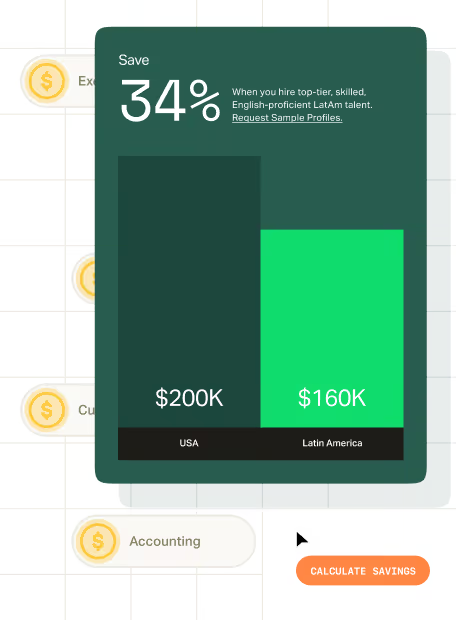
Hiring a software developer in Mexico typically costs $30,000 to $108,000 a year depending on the role and seniority, versus $66,000 to $238,000 for equivalent US hires. Mexico's developer salaries run slightly higher than the LatAm average, reflecting existing US-client demand and stronger English fluency across the market, so expect to land toward the higher end of these Latin America-wide ranges. To put that in concrete terms, here's what hiring software developers in Mexico costs compared to equivalent US hires, according to Hire With Near's salary benchmarks:
For the most up-to-date figures, see Hire With Near's US vs Latin America Salary Guide.
Salary expectations vary by stack and specialty. According to our salary data, engineers with DevOps, cloud infrastructure, and mobile backgrounds typically command higher rates, and engineers with experience in less-common stacks like Shopify, blockchain, or Salesforce are harder to find and may push toward senior-range compensation even at mid-level experience. Either way, the cost advantage over hiring the same role in the US holds at every seniority level.
For a broader view of engineering compensation across Latin America, see the IT roles salary guide for Latin America.
Which Software Development Roles Can You Hire in Mexico?
You can hire the full range of software development roles in Mexico that US teams staff at home: full-stack, back-end, and front-end developers, DevOps and cloud engineers, QA engineers, and mobile developers, plus general-purpose software engineers. In practice, that means you can hire a developer in Mexico for almost any part of your stack, at mid or senior level, in your time zone.
Here are the roles US companies most commonly hire nearshore in Mexico, and what each one owns:
- Full-stack developers: Build features end to end, from the database and API layer through to the user interface.
- Back-end developers: Own the server side: APIs, business logic, databases, and third-party integrations.
- Front-end developers: Turn designs into fast, responsive, and accessible interfaces.
- DevOps engineers: Run CI/CD pipelines, cloud infrastructure, and deployment so releases ship reliably.
- QA engineers: Cover manual and automated testing to catch problems before your users do.
- Mobile developers: Build and maintain iOS and Android apps.
- Software engineers: With broad, cross-stack experience suit teams that value flexibility over deep specialization.
The role title only gets you so far, though. A full-stack engineer who doesn't know your framework isn't the hire you need, so the real question is whether the person knows your specific stack. From the editorial work I do interviewing our engineering recruiters, that is the concern hiring managers raise most.
Here the local market has a shape worth knowing. Hire With Near's engineering recruiters consistently tell us that .NET, C#, PHP, and WordPress talent is plentiful in Mexico, while Shopify, Amazon e-commerce, and blockchain expertise is rarer and tends to command senior-range compensation even at mid-level experience. They also weight practical signals heavily: Mercado Libre or major-multinational experience is a strong quality indicator, and the take-home technical assessment is where most candidates get filtered out. That is the difference between matching a job title and matching your actual technical requirements.
Which Hiring Model Is Right for You?
US companies have four realistic ways to hire software developers in Mexico: build the team yourself, use a freelance platform, use staff augmentation, or work with a specialist staffing and recruiting partner.
For most companies hiring full-time engineers, the partner is the fastest, simplest path, but the right choice depends on whether you need flexible project capacity or a permanent team member. Here they are, from most to least complex to run on your own.
Build the team yourself
You source candidates through job boards, LinkedIn, and referrals, then become their legal employer in Mexico. For a cross-border hire, that means one of two mechanisms.
You can establish a legal entity in Mexico, which gives you full control but carries substantial upfront cost, three to six months of setup, and ongoing legal and accounting overhead; it only makes sense at real scale.
Or you can use an Employer of Record, a third party that becomes the legal employer on paper. It handles contracts, payroll, tax withholdings, benefits, and local compliance while you manage the work day to day, so you don't need a Mexican entity.
The trade-off to name up front: an EOR handles employment logistics, not recruiting. You still have to source, screen, and vet every candidate yourself. That is the single biggest reason companies that start down the DIY path end up looking for help.
Freelance and contractor platforms
Platforms like Upwork, Toptal, and Fiverr give you fast access to contractors for short-term or project-based work. They're built for that, not for building a full-time team: you manage quality and retention on your own, and the talent is usually splitting attention across several clients. When you need a full-time engineer who is fully invested in your product, specialist staffing gives you fundamentally different results for full-time remote hires.
Staff augmentation
Staff augmentation places pre-vetted engineers onto your team to work under your direction, while the firm stays the legal employer and handles payroll, benefits, and compliance. It sits between a freelance platform and a direct-hire partner: more flexible than building a permanent team yourself, with far more vetting and accountability than a marketplace. It fits teams that want to scale up or down, staff a defined project, or add engineering capacity without committing to permanent headcount. This is one of Hire With Near's own paths, through our nearshore staff augmentation service.
A specialist staffing and recruiting partner
A specialist partner does both jobs at once: it finds and vets the talent and handles employment, payroll, benefits, and compliance in one relationship. You describe the role, the partner presents pre-vetted candidates, and once you hire, they handle the rest, so it feels as simple as hiring someone down the street.
This is where most companies hiring full-time remote engineers end up, because it closes the recruiting gap an EOR leaves open and the quality gap a freelance platform leaves open. If you want to weigh options, our roundup of specialist staffing firms for LatAm hiring is a good starting point.
The difference between the last two comes down to permanence. Staff augmentation adds an engineer to your team for flexible or project-based work, and the agency employs them. A direct-hire recruiting partner places someone who joins your team permanently, and you employ them. Hire With Near offers both, so you're not locked into one structure: many companies start with a single hire or a short-term need and scale into a permanent team as the work proves out.
Building Your Nearshore Engineering Team in Mexico: Next Steps
Nearshore software development in Mexico gives US companies a combination of technical depth, time zone alignment, and cost savings that's difficult to replicate elsewhere. Mexico's 1.9 million GitHub developers are building real products today, many already experienced with US clients and working in US-standard stacks.
The main friction point remains hiring logistics. Navigating Mexican employment law, running technical assessments in a market you don't know, and building candidate pipelines without local relationships takes time most US companies don't have.
That's where Hire With Near comes in. We handle sourcing, screening, technical assessment coordination, and candidate management so you can focus on the interviews that matter. For companies at the senior-level stage, our executive search for engineering leadership covers CTO, VP Engineering, and senior technical leader searches.
If you're weighing staff augmentation against a dedicated team, the hiring-models section above breaks down which fits which situation. For the wider picture, our guide to hiring remotely in Latin America covers the fundamentals, and if you want to compare providers, see our list of the best nearshore staffing companies.
If you'd like to explore what hiring in Mexico looks like for your specific roles, book a free consultation. No commitment, just a direct conversation about your engineering requirements and what the Mexico talent market looks like for your stack.
{{latam-hiring-cta-v2}}
Frequently Asked Questions
What is nearshore software development in Mexico?
Nearshore software development in Mexico means hiring full-time or dedicated software engineers and developers based in Mexico to work on your US company's technical projects, with the advantage of overlapping working hours and no significant time zone difference.
Unlike offshore development in India or the Philippines, nearshore Mexico gives you engineers in Central Time who can join your daily standups, respond in real time during your working hours, and travel to your office in less than 6 hours from most US cities.
What are the main benefits of nearshore software development in Mexico vs. hiring in the US?
The main benefits are cost savings of 31–68% versus US equivalent rates, full working-hour overlap with US teams, and access to a developer community of 1.9 million GitHub-registered engineers, growing at 21% per year. Mexico-based senior engineers typically earn $36,000–$108,000 annually versus $100,000–$238,000 for equivalent US software engineer roles. For teams that have previously struggled with the coordination overhead of offshore development, the time zone alignment alone often justifies the shift.
What is the difference between nearshore and offshore software development?
Nearshore software development means hiring from countries in a similar or nearby time zone, typically Mexico and Latin America for US companies. Offshore development means hiring from distant countries like India, the Philippines, or Eastern Europe, where the time zone gap is typically 8–12 hours.
The practical difference shows up in collaboration: Nearshore teams work during your hours and participate in synchronous communication, while offshore teams often require scheduled overlap windows and asynchronous workflows.
For more details, see offshore vs. nearshore software development.
How much does nearshore software development in Mexico cost?
A full-stack or backend developer in Mexico typically earns $36,000–$108,000 per year, depending on seniority, versus $66,000–$184,000 for an equivalent role in the US, a savings range of 20–68%.
DevOps and cloud infrastructure engineers run $30,000–$100,000 per year in Mexico versus $100,000–$197,000 in the US.
Mexico tends toward the higher end of LatAm salary ranges due to existing US-client demand, but the cost advantage over US hiring remains substantial at every seniority level.
What are the best cities in Mexico for nearshore software development?
Mexico City, Guadalajara, and Monterrey are the primary tech hubs. Mexico City has the largest concentration of technology companies and startups. Guadalajara is home to major multinationals, including IBM, Intel, Dell, HP, and Cisco, with strong university-sourced engineering talent. Monterrey's proximity to the US border, approximately 140 miles from Texas, makes it a practical choice for companies that want short travel times alongside nearshore cost savings. All three cities operate on Central Time.
Is intellectual property safe with nearshore development in Mexico?
Yes. Mexico is a WIPO member and party to the USMCA, which includes a dedicated IP rights chapter (Chapter 20) with significantly stronger standards than NAFTA. The treaty framework covers patents, copyright, trademarks, trade secrets, and digital commerce.
For additional protection, make sure your contracts with developers include explicit IP assignment clauses, and consider working with local legal counsel to review agreement terms under Mexican law.
What industries hire the most software developers through nearshore development in Mexico?
SaaS, fintech, healthcare, and AI/ML companies are the most active users of nearshore software development from Mexico: these four sectors account for the majority of engineers placed through LatAm staffing.
SaaS companies are among the most active, hiring full-stack and backend engineers to scale product teams. Fintech companies rely on Mexico-based engineers for backend, security, and compliance-focused development work.
Healthcare companies, particularly digital health and health-tech startups, hire QA, mobile, and backend engineers. AI and machine learning companies are increasingly building in Latin America as demand for ML engineers outpaces the US supply.
What nearshore software development outsourcing models are available through Mexico?
The main options are dedicated full-time hires, nearshore software development outsourcing through a staffing partner, and staff augmentation.
Full-time hires embedded in your team are the most common model Hire With Near supports: the engineer works exclusively for you, follows your processes, and is accountable to your team leads. Staff augmentation uses the same talent pool but is structured as project-based or capacity-based support.
For companies that need help building the team rather than just filling roles, Hire With Near's recruiting team handles sourcing and assessment end-to-end.
What other software development roles can I hire based in Latin America?
Full-stack developers, DevOps engineers, QA engineers, front-end developers, and back-end developers are all commonly placed through LatAm nearshore staffing, with the same time zone alignment and 31–68% cost advantage as software engineers.
Can a US company hire a single software developer in Mexico, or only a full team?
Yes, you can hire a single software developer in Mexico and scale into a full team later with the same partner. Starting with one hire is common: many companies test the model with a single engineer for a specific need, then add roles as the work proves out. A staffing partner handles sourcing, screening, and compliance the same way whether you're hiring one developer or ten, so you're not committing to a headcount you don't need yet, and you're not locked into one structure if your needs grow.
Do US companies need a legal entity in Mexico to hire developers?
No, you do not need a legal entity in Mexico to hire developers there. A staffing partner or an Employer of Record can employ the developer compliantly on your behalf, handling contracts, payroll, tax withholdings, and local benefits while the engineer works as part of your team and reports to you day to day. Setting up your own Mexican entity only makes sense at real scale, with dozens of hires and a permanent in-country presence; for most US companies hiring a handful of engineers, a partner removes that step entirely.






.webp)
.webp)


%203.svg)
.avif)





%20(1).avif)

%20(1).png)