.webp)


%203.svg)
Key Takeaways
- You can hire English-fluent developers in Argentina who work in your own time zone for 30–70% less than US salaries, with most hires closed in under three weeks through a specialist staffing partner.
- Developer salaries in Latin America, including Argentina, run $30K–$108K a year, depending on role and seniority, against $66K–$238K for comparable US hires. That’s a difference that lets most companies hire at a higher seniority level than their US budget would allow.
- The fastest route to a long-term developer is a staffing and recruiting partner that both finds the engineer and handles payroll, benefits, and compliance in one relationship, with a first shortlist in under five days.
Hiring developers in Argentina gives US companies experienced English-fluent engineers who work during your business day, for 30–70% less than US salaries.
It’s one of the best countries to hire developers in Latin America and eliminates the time zone friction involved with hiring in other offshore regions.
If you’ve run an offshore engineering team, you know the tax on it. You send a message at the end of your day and the answer lands the next morning, so a single question costs a full day. Your best people spend their time managing the gap instead of shipping, and the roadmap slides a sprint at a time.
Argentina eliminates that. The country sits one to two hours ahead of the US East Coast (depending on the time of year), which means your Argentine developers are in your standups, in your code reviews, and online when production breaks.
I’ll explain why hiring developers in Argentina is such a great option for companies, and cover what hiring developers costs, what technical skills they bring, the four ways to hire them, and how to get started fast.
Why Should I Hire Developers in Argentina?
US companies hire developers in Argentina for four reasons: real-time overlap with the US workday, strong English, a deep pool of senior engineers, and salaries well below US rates. Time zone is usually what starts the conversation.
Real-time overlap with your US team
An engineer in Argentina works during your business hours, whether your team runs on Pacific, Mountain, Central, or Eastern time, so standups and code review happen live instead of on a 12-hour delay.
Unlike an Asia-based team that logs off as your day begins, an Argentine team stays online across most of your workday, wherever your team sits in the US.
The shift we see most often at Hire With Near is teams moving engineering work off distant offshore setups to get their day back.
Our research on why US companies turn to Latin American hiring found that 30% of them switched from offshore locations to nearshore, largely to close the time-zone gap that was hurting real-time collaboration.
AI adoption and time-zone overlap are steering more US companies toward developers in Latin America generally, and Argentina's overlap with the US workday is part of why it keeps coming up in those conversations.
Deep senior engineering pool
Argentina’s developer community has grown substantially over the past decade, driven by strong public universities and a culture that prioritizes technical education. GitHub counted more than 1.1 million developer accounts in Argentina in 2024, growing at double-digit rates year over year.
JP Morgan has run a technology and operations hub in Buenos Aires since 2014, and now employs roughly 3,500 people there with another 1,500 hires planned over the next five years. Amazon, Microsoft, and Google have also built engineering teams in the country, not because of low rates alone, but because the talent holds up at enterprise standards.
A Mercado Libre background on a resume is one of the strongest quality signals our recruiting team looks for: it functions as a regional proxy for the same bar that a Google or Meta credit carries in the US.
Within Hire With Near’s placements, Argentina consistently ranks among the top sources for senior engineering roles.
Clear communication in English
Argentina ranks 26th globally and first in Latin America for English proficiency, according to the EF English Proficiency Index 2025, placing it in the "High" proficiency band.
That ranking reflects something structural: Argentine families who want their children to access the international job market prioritize English fluency from an early age, alongside strong formal education.
The result is a talent pool that can join your standups, articulate technical decisions clearly, and write documentation your team can use.
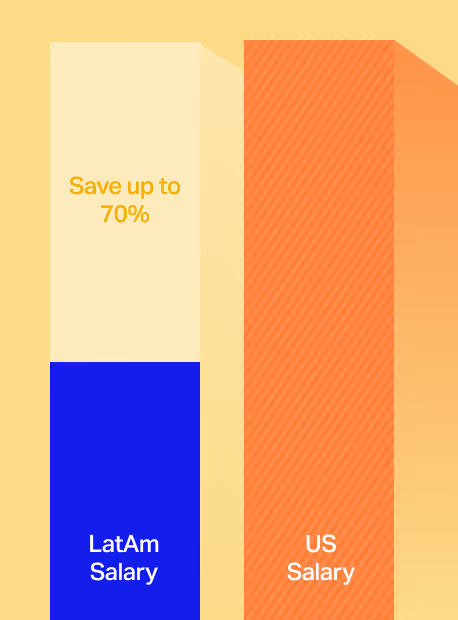
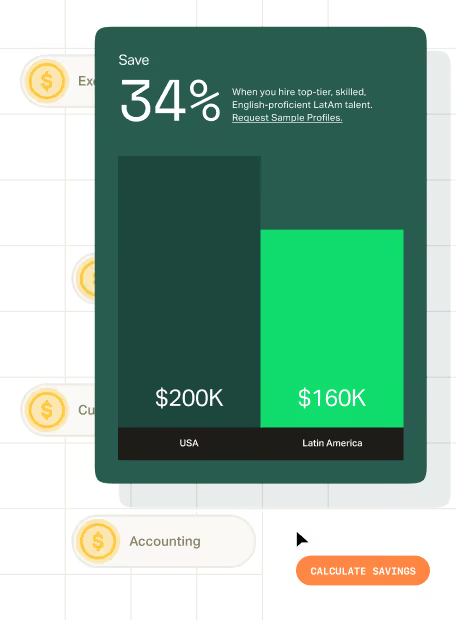
Salaries 30–70% below US rates
According to Hire With Near’s salary data, software engineers in Latin America run $36K–$108K annually, depending on seniority and stack, compared to $100K–$238K for equivalent US hires. That difference compounds across a team.
The gap comes from the cost of living, not capability. An Argentine engineer earning a competitive local salary in US dollars is well-compensated by local standards. The same budget that funds one mid-level US hire can cover a senior Argentine engineer with room left over.
{{salary-guide-cta}}
What Technical Skills Do Argentine Developers Have?
Argentine developers cover the stacks most US product teams run on, with particular depth in backend engineering, data, and cloud infrastructure, areas where the country’s strong computer science programs and exposure to enterprise-scale systems have built a genuinely senior talent pool. The common specializations are:
- Backend and full-stack engineering is where Argentine developers are most consistently strong. Node.js, Python, and .NET are all well-represented at mid and senior levels, and the concentration of engineers who have worked inside large, complex systems at companies like Mercado Libre, Globant, or international firms like Accenture and Capgemini means the talent isn’t just familiar with modern stacks, it’s been tested on them.
- Front-end depth is real but more variable. React and the TypeScript ecosystem are common, and most senior full-stack engineers have solid front-end competence. Dedicated front-end specialists exist, but are a smaller slice of the pool than backend engineers.
- Cloud and DevOps talent has grown quickly, driven by the same enterprise exposure. AWS is the dominant platform, with strong familiarity with containers, CI/CD pipelines, and infrastructure-as-code tooling.
- Data engineering and applied ML is a growing area. Argentina’s universities produce strong quantitative graduates, and the data engineering pipeline, from ETL work through analytics and into applied machine learning, is well-staffed at senior levels.
- AI fluency is increasing across the board, with growing familiarity with LLM tooling and AI-assisted development workflows.
You can hire a remote developer across this range, or narrow it to a software engineer in Latin America, a nearshore full-stack developer, a remote back-end developer, a front-end developer, or even hire a DevOps engineer.
A few practical notes before you write the spec: .NET, C#, PHP, and WordPress talent is plentiful. Shopify, Amazon e-commerce, and blockchain specialists are rarer and will take longer to source.
And a degree is often the wrong filter, as Natasha Tarapow, Recruitment Consultant at Hire With Near, explains:
A lot of the great engineers in Latin America don’t have a college degree — and that doesn’t mean they’re bad candidates. The dynamic here is that many of the best engineers started working before they graduated. They got a really good job and didn’t have time to finish. We always recommend to clients that they don’t make a degree a must-have, because they might be losing out on some really good candidates.
Beyond technical competence, our recruiters also screen for communication ability. An engineer who can’t articulate a decision clearly in a standup or explain a blocker to a non-technical stakeholder creates friction that slows the whole team down, regardless of how good their code is.
That’s what real vetting is for, and it’s where a volume-sourcing platform leaves the risk on you. If you hire in a specific vertical, our nearshore IT and tech recruiting focuses on that overlap of engineering depth and clear communication.
Where Is the Tech Talent? Argentina’s Tech Hubs
Argentina’s developer talent clusters in three cities, Buenos Aires, Córdoba, and Mendoza, each with a distinct profile. According to GitHub’s Octoverse 2024 report, Argentina has more than 1.1 million developer accounts on GitHub, growing at 22% year over year. Most of that activity is concentrated in these three hubs.

Buenos Aires
Buenos Aires is the largest and most internationally connected tech market in the country. It’s where the highest concentration of senior engineers who have worked with US companies is. They’re developers who have built production systems for US clients, worked inside global firms like Accenture, Globant, and Capgemini, or come up through startups explicitly building for US markets.
The city has a mature startup ecosystem and a deep pool of engineers across backend, full-stack, cloud, and data roles. English fluency tends to be highest here, partly because international client exposure is most common, and partly because Buenos Aires attracts the engineers who have actively sought out that kind of work.
For most US companies hiring their first Argentine developer, Buenos Aires is where sourcing starts.
.webp)
Córdoba
Córdoba is Argentina’s engineering center. The city is home to some of the country’s strongest technical universities, including the Universidad Nacional de Córdoba and the Universidad Tecnológica Nacional, which produce a steady pipeline of well-trained engineers each year.
The tech sector has been established there for decades, anchored initially by automotive companies hiring engineers and manufacturing firms building technical teams before the region pivoted heavily toward hiring software engineers.
The talent profile in Córdoba skews toward engineers with strong computer science fundamentals, particularly in backend systems, embedded development, and data engineering.
Several large outsourcing firms have significant operations there, which means many Córdoba-based engineers have experience working on distributed teams for international clients.
Salaries tend to be slightly lower than in Buenos Aires, which makes it a strong sourcing market for companies that want senior-level depth at a more competitive rate.

Mendoza
Mendoza is smaller than the other two hubs but has been growing steadily as remote work has made geography less of a constraint. The city has a younger tech ecosystem, with a mix of developers who came up through local startups and those who moved there from Buenos Aires seeking a lower cost of living while continuing to work for international clients.
The talent pool is narrower: expect more front-end and full-stack generalists than deep specialists. But sourcing from Mendoza can be effective for roles where the stack is common and the priority is communication ability and long-term stability.
Engineers based there tend to have strong motivation to stay, since the city doesn’t have the same density of competing offers that Buenos Aires does, which can work in your favor for retention.
For a fuller picture, our guide to hiring remote talent in Argentina covers cost and logistics.
How Can a US Company Hire Developers in Argentina?
US companies have four ways to hire developers in Argentina: freelance marketplaces, hiring directly, a nearshore staff augmentation company, or a staffing and recruiting firm. The right choice comes down to one question: do you need short-term help on a project, or a long-term, full-time developer on your team?
Freelance platforms and marketplaces
Freelance platforms give you the fastest access to contractors for short, defined work. Marketplaces like Upwork, Toptal, Arc, and Lemon.io can put a developer in front of you within days, which helps when you’re testing an idea or need a one-off build.
The trade-off is contractors juggling several clients, not embedded engineers who learn your codebase, and you own quality and retention. For ongoing product work, the fourth option, specialist staffing, gives you fundamentally different results for full-time remote hires.
Hire directly
Hiring directly means you source and vet candidates yourself and take on the employment relationship. For a cross-border hire in Argentina, that requires one of two mechanisms:
- Set up a legal entity: Registering an Argentine subsidiary gives you full control over employment, but it takes three to six months, carries significant legal, accounting, and HR costs, and requires ongoing compliance. It only makes sense for a permanent presence of 50-plus people. For a handful of developers, it’s overkill. Our guide to hiring remote foreign employees can help you clear up any questions you have.
- Use an employer of record: An employer of record becomes the legal employer on paper, handling contracts, payroll, tax, benefits, and local compliance without you needing your own entity. That matters in Argentina specifically because statutory severance obligations are heavy. The catch: an EOR handles employment logistics, not recruiting. You still source and vet every developer yourself, through job boards for hiring in Latin America or your own network. If you’re comparing providers, EOR companies vary widely on coverage and price.
Nearshore staff augmentation
Nearshore staff augmentation places a vetted engineer on your team who works under your direction while the provider stays the legal employer and handles payroll and compliance. It’s never a build-it-yourself option: the engineer is the provider’s resource, not your permanent hire.
It’s the right model for short-term, project-based needs: extra capacity for a sprint push, a launch, or a fixed-length build. Most staff augmentation companies are built for exactly that, with developers rotating between clients, which is why it works for defined projects but not when you want someone to stay and own the work long-term.
Our explainer on IT staff augmentation covers the model in full.
Staffing and recruiting firm
A staffing and recruiting firm is the right path for a long-term, full-time developer who becomes a permanent member of your team. You describe what you need for the role, the partner sources and vets candidates and presents a shortlist. Then, you interview the candidates and make a decision.
Once you hire, the partner handles payroll, benefits, and compliance in the background. This is where most companies hiring ongoing engineering talent land: it closes the recruiting gap and the compliance gap at once.
See how the field compares in our roundup of the best LatAm staffing firms, and Hire With Near delivers this through our nearshore staffing and recruiting services.
One talent leader scaling a Latin American engineering team reached out to Hire With Near after running into problems with another provider’s vetting process:
Their resumes do look good, but when they do make it to our technical assessment and our interview rounds, our hiring team is finding that they’re not as senior as we were hoping for.
That seniority gap is the risk a real screening process is built to catch, which is why the partner you choose matters as much as the country.
Hire With Near offers both nearshore staff augmentation and long-term staffing and recruiting services. Either way, we get you vetted developers fast, with a first shortlist in about 3–5 days.
The difference is our default: unlike most staff augmentation companies set up for short-term rotations, our placements are built to last. They’re full-time developers who stay, learn your product, and become permanent members of your team.
Related reading: 9 Best Companies to Hire Latin American Developers in 2026
What Does It Cost to Hire Developers in Argentina?
Hiring a developer in Argentina typically costs 30–70% less than a comparable US hire, with most roles landing between $30K and $108K a year in our salary data.
To put that in concrete terms, here’s what hiring developers costs compared to equivalent US hires, according to Hire With Near’s salary benchmarks:
For the most up-to-date figures, see Hire With Near’s US vs Latin America Salary Guide.
These are our standard Latin American ranges rather than Argentina-only numbers. They hold up locally because Argentina’s cost of living sits well below major US cities, which keeps the savings sustainable, as you can see in the table below:
Source: Numbeo.com
The cost savings that Argentina and other Latin American countries provide aren’t a sign of junior talent. According to Hire With Near’s 2026 State of LatAm Hiring Report, software engineer was the fastest-rising role of the year, up 250% to become the sixth most-hired role, and 84% of all placements were mid-level or senior.
The number is budget enablement: the same spend that hires one mid-level US engineer places a senior one in Argentina, so your budget goes further without dropping your quality bar.
What Do US Companies Need to Know Before Hiring in Argentina?
Before you hire in Argentina, three things are worth understanding: working-hour overlap, intellectual property protection, and local compliance. None is a barrier, but knowing what to expect upfront saves friction later (and a staffing partner absorbs most of the work).
Working hour overlap
Working hours are the easy part. Argentina sits one to two hours ahead of the US East Coast, depending on the time of year, which means an Argentine developer is online across most of your business day, regardless of where your team sits in the US.
Set core collaboration hours the way you would for any remote hire (a morning standup, defined review windows, agreed response-time expectations) and stay flexible on the rest.
Intellectual property
Intellectual property is a fair concern when an engineer has repo access, infrastructure credentials, and visibility into proprietary systems. You should manage it the same way you would for any remote employee: a signed NDA and clear IP-assignment clauses written into the contract from day one.
A staffing partner puts these in place as part of the employment agreement, so you’re not drafting them yourself or relying on a freelancer to honor a verbal understanding.
Compliance with local labor laws
Compliance is the area that surprises most US companies hiring in Argentina for the first time.
Argentina's severance formula is straightforward but adds up: one month's salary per year of service (or fraction over three months) for a no-cause dismissal, plus one to two months' notice pay depending on tenure, all due in a lump sum within days of termination.
A March 2026 labor-law reform (Ley 27.802) kept that same one-month-per-year formula but clarified what counts toward the base pay. None of this is a barrier, but it's exactly the kind of detail an EOR or staffing partner should be walking you through before you sign anything.
Currency history is worth a few lines, too, since older guides you might have seen elsewhere still warn about it, but it’s nothing that should put you off hiring now.
Argentina spent years under strict capital controls. Most of those were lifted in April 2025, and that same March 2026 reform also gave employers a clear legal footing to pay Argentine salaries directly in US dollars rather than only in pesos.
The Central Bank reintroduced a narrower rule in September 2025 to close a specific arbitrage loophole, but it applies to individuals' personal dollar purchases, not to a company paying its own team. In practice, most US companies hiring Argentine developers through a staffing or EOR partner were already denominating pay in USD to protect both sides from peso volatility. This reform just gives that common practice a clear legal footing.
A staffing and recruiting partner handles all of these compliance issues in the background: payroll processed correctly, local benefits administered, and compliance with Argentine labor law managed on your behalf, while the developer works as a full member of your team and reports directly to you.
For the wider view, our guide to hiring remotely in Latin America walks through the logistics.
{{prevetted-banner}}
How Does Hire With Near Help US Companies Hire Developers in Argentina?
Hire With Near finds, vets, and places developers in Argentina, then handles payroll, benefits, and compliance in the background. You share the role, we present a vetted shortlist in under five days, and most companies hire within three weeks.
Hire With Near’s tech recruiters source from our pool of over 160,000 candidates, plus run fresh sourcing to find exactly what you are looking for. They also run first-round interviews and will help administer your technical assessments or case study assignments.
Interviews include having candidates walk through a project they completed, evaluating whether the engineer can explain their work in plain language, and assessing their English and overall communication skills.
That last step is deliberate. Our recruiters tell us most rejections come down to communication, not raw coding ability, plus the walk-through is the single best screen for whether someone can own the work.
Compliance is built into the model, so you can hire software engineers in Latin America through one relationship without building an international HR infrastructure.
The pattern we see most is simple: a company makes one hire, sees the quality, and comes back for more. One founder whose sales had outpaced engineering capacity put it this way after a first placement:
We were very pleased with the caliber of talent you were able to find, to the point where we are considering hiring two developers instead of one.
Conversion Logix, an Inc. 5000 digital advertising and software solutions agency, needed to scale quickly while keeping costs under control. Hire With Near placed 15 roles, including a machine learning engineer, reducing their average time to hire to 22 days and saving $781,000 annually compared to equivalent US hires, a 43% reduction in overhead. As Tawnya Morse, their Client Services Manager, put it:
The time savings and quality of candidates have been outstanding. Communication was also seamless, making it easy to work with Hire With Near.
See how one digital product studio used that same vetting process to hire a senior full-stack engineer in Argentina who could also lead client-facing conversations.
When the need runs to leadership rather than individual contributors, we also handle executive search in Latin America for engineering managers, directors, and VPs. You can also see our roundup of the best executive search firms in Argentina.
If you want to go deeper on how the vetting works before you start, our guide to the questions tech leaders ask when hiring in Latin America covers the most common concerns we hear from engineering leaders before their first LatAm hire.
Final Thoughts
Hiring developers in Argentina gives you English-fluent engineers who work in your time zone, at 30–70% below US rates, with most hires closed in under three weeks. The country pairs a deep talent pool with real workday overlap, the combination that offshore hiring never quite delivers.
And hiring with a specialist recruiting and staffing firm that finds the engineer and handles payroll, benefits, and compliance turns a complicated cross-border hire into a straightforward one.
The best next step is to book a free consultation to talk through your requirements with Hire With Near’s team. We’ll share salary benchmarks and walk you through the process so you can decide if it’s right for you.
If you’re weighing Argentina against other markets, our guides to hiring developers in Brazil, hiring developers in Chile, hiring developers in Uruguay, and hiring developers in Paraguay cover the same ground for each country: costs, skills, and how to hire.
{{latam-hiring-cta-v2}}
Frequently Asked Questions
What is the average salary for a software developer in Argentina?
Hiring a software developer in Latin America, including Argentina, typically ranges from about $36K to $108K a year in Hire With Near’s salary data, versus $100K to $238K for a comparable US hire.
Where a developer lands depends on seniority and specialization, and the savings usually run 30–70%, so US teams can hire senior engineers without stretching the budget.
How long does it take to hire a developer in Argentina?
You can expect a first vetted shortlist in about 3–5 days and a completed hire around 21 days, because recruiting, vetting, and compliance run in parallel through one partner. That’s a real contrast with offshore hiring, where notice periods of 60 to 90 days can push a start date out for months.
Do Argentine developers speak English well enough for daily standups?
Yes. Argentina sits in the “High” proficiency band of the 2025 EF English Proficiency Index, where it ranks 26th globally and highest of any country in Latin America.
What matters in practice isn't the accent. It’s whether an engineer can explain why a pull request broke production or hold their own in an architecture review, so require a live technical conversation when you screen
What tech stacks are Argentine developers strongest in?
Argentine developers are strongest in React, Node.js, Python, .NET, and Ruby on Rails, plus full-stack, React Native, cloud and DevOps, and data and machine learning.
Rarer stacks like Shopify, Amazon e-commerce tooling, and blockchain take longer to source, so flag those early if they’re core to the role.
Is it better to hire freelance or full-time developers in Argentina?
Freelance developers fit one-off, short-term projects, while a full-time developer hired through a staffing and recruiting partner fits ongoing product work where you need someone who learns your codebase and owns it. Freelancers start fast but split their attention across clients.
If contractors juggling multiple projects have burned you before, a specialist partner that places full-time engineers is a better alternative.
Does Argentina have strong intellectual property protections?
You can protect your intellectual property in Argentina with the same instruments you use for any hire: a signed NDA and clear IP-assignment clauses that keep ownership of the work with your company.
A staffing partner structures the engagement so those protections are in place from the start. No hire is zero-risk, but these safeguards are well-covered ground and straightforward to put in place.
What’s the best way to hire developers in Argentina?
The best way depends on whether you need short-term project help or a long-term, full-time developer. For short-term work, a freelance platform or nearshore staff augmentation makes sense. For project work, software development outsourcing in Argentina can work. For a permanent engineer on your team, a specialist staffing and recruiting partner that sources, vets, and handles compliance is the fastest, lowest-risk route. Most US companies hiring ongoing engineering talent choose the partner route.






.webp)
.webp)


%203.svg)
.avif)





%20(1).avif)

%20(1).png)