


%203.svg)
Key Takeaways
- You can hire developers in Paraguay four ways: a freelance platform, hiring directly through your own legal entity or an employer of record, a staff augmentation firm, or a staffing and recruiting partner. Latin America-wide benchmarks put a mid-level software engineer at about $54K–$72K a year against $115K–$195K in the US.
- Paraguay’s developer market is real but early: Asunción is the primary hub and Ciudad del Este the secondary one, while Brazil, Colombia, and Argentina hold far more engineers.
- Paraguay scores above the global average and ranks 4th in Latin America on the EF English Proficiency Index. The pool is shallow next to Brazil or Colombia, so plan for one or two hires rather than a ten-person team in a quarter.
When US tech companies hire developers in Paraguay, they’re tapping into one of South America’s newer, most cost-efficient nearshore markets. Developers there work hours that overlap closely with the US workday, close enough for live standups and same-day code review, without the overnight delays a farther offshore team creates.
Paraguay’s talent pool is smaller than regional heavyweights like Argentina or Brazil, but the cost-to-quality tradeoff is real: a young workforce, a stable macroeconomic environment, and one of Latin America’s lowest tax burdens combine to keep developer compensation well below regional averages without sacrificing technical execution.
In this guide, I cover everything you need to evaluate before bringing a developer onto your team in Paraguay: real developer salary benchmarks, where top technical skills concentrate, the primary hiring models available, and the key compliance and legal details to keep top of mind.
Why Should I Hire Developers in Paraguay?
Paraguay is worth a look for three reasons: English above the global average, a government-backed push to build a tech sector in Asunción, and developer salaries well under US rates.
English proficiency sits above the global average
Paraguay scores 531 on the 2025 EF English Proficiency Index, ranked 43rd globally, 4th in Latin America, and above the global average of 488, sitting in EF’s Moderate band, above larger markets like Brazil, Colombia, and Mexico.
The sub-scores matter more for an engineering hire. Paraguay reads at 548 and speaks at 436, so a candidate who writes clear documentation may still need work on a live architecture review.
Our recruiters screen English per candidate against the job, which for a developer means explaining why a pull request broke production to a non-developer.
The government is actively building a tech sector
MITIC, Paraguay’s technology ministry, is building Distrito Innova, a technology park backed by roughly $20 million in investment and financing from the Inter-American Development Bank. The model brings government, universities, and private companies into one physical location, the same “triple helix” approach behind established tech hubs elsewhere.
Construction is underway outside Asunción, with an opening targeted for late 2027. In the meantime, MITIC is also building out a companion digital platform under the same name that will centralize funding calls, startup programs, and innovation ecosystem information before the physical site is ready.
For a company hiring today, that means the sector is real and government-backed, but the infrastructure it’s built around is still years from complete. What already exists is the talent pipeline this investment is meant to support, not a finished innovation district.
Developer salaries run well below US rates
Paraguay’s cost advantage isn’t just currency arithmetic. A young workforce, a stable macroeconomic environment, and one of Latin America’s lowest tax burdens combine to keep developer compensation well below regional averages without a drop in technical execution.
We cover the specific salary ranges by role and seniority later in this guide.
How Deep Is Paraguay’s Developer Talent Pool?
Paraguay’s developer pool is genuine but small: it fits one or two focused placements far better than a ten-person engineering pod built in a single quarter.
What Paraguay truly offers is above-average English fluency, a small but real cluster of established nearshore-services firms already serving Brazil, Argentina, and the US, and far less competition for the strongest individual candidates than a larger market carries.
The tradeoff is exactly what you’d expect from a smaller pool: fewer staff-level architects, less depth in niche frameworks, and a slower search if you’re trying to source a very specific stack on your own.
If you need a hyper-niche stack or immediate enterprise-scale hiring, the region’s larger markets are the better starting point: hire developers in Brazil, hire developers in Colombia, or hire developers in Argentina.
Most of the developers are concentrated in two cities: Asunción, the capital, and Ciudad del Este.

Asunción
As the capital and undisputed primary tech hub of Paraguay, Asunción concentrates the majority of the nation’s software development firms, nearshore service providers, and technical infrastructure.
The city’s growing startup ecosystem and recent investments in data centers and cloud services have anchored it as the central node for enterprise talent.
Almost all formal software development projects, technical meetups, and client-facing engineering agencies operate directly out of the Greater Asunción metropolitan area.
Ciudad del Este
Ciudad del Este represents Paraguay’s secondary tech hub, strategically positioned at the Triple Frontier where Paraguay meets Brazil and Argentina. Known primarily as a commercial giant, its cross-border geography gives local engineers a highly international orientation, driving frequent cross-border trade and tech collaboration.
Just outside the city in Hernandarias, Parque Tecnológico Itaipú has operated for over 17 years, running innovation laboratories, tech incubators, and clean-energy projects that foster technical talent in the region.
It’s backed by Itaipú Binacional, the binational entity that operates the Itaipú hydroelectric dam on the border with Brazil, one of the largest power plants in the world and a major source of both countries’ electricity.
That backing means the tech park isn’t a startup experiment; it’s funded by one of the region’s largest and most stable infrastructure operators.
University pipeline & educational anchors
Paraguay’s academic pipeline feeds directly into its main tech hubs, led by institutions delivering accredited engineering and computer science curricula:
- Universidad Nacional de Asunción (UNA): Founded in 1889, UNA is the country’s oldest and largest public institution, enrolling over 44,000 students. Its five-year computer engineering degree is formally accredited by ANEAES and recognized across South America under Mercosur’s ARCU-SUR framework.
- Universidad Autónoma de Asunción (UAA): A premier private university in the capital running its own ANEAES-accredited computer science and software systems programs, known for emphasizing practical technology management and applied systems engineering.
- Universidad Católica “Nuestra Señora de la Asunción” (UC): Another major academic anchor offering rigorous software engineering and computer science degrees that feed directly into Asunción’s corporate and tech ecosystem.
What Technical Skills Do Paraguayan Developers Have?
While no dedicated national software stack survey exists specifically for Paraguay, local software houses, agency hubs, and engineering talent naturally reflect regional Latin American demand.
Across Latin America, Python stands out as the most requested language for product and data builds, closely followed by JavaScript, PHP, SQL, Ruby, C++, Go, Java, and Rust. On the front end, React remains dominant, with Vue.js as a common second choice. On the back end, development leans toward Django, Node.js, Ruby on Rails, and .NET.
When you hire software developers in Paraguay, this is the broader stack ecosystem you tap into, mapping directly to the core roles US companies hire most: Python and React developers for core product work, nearshore back-end engineers for API architecture and database management, and remote front-end developers for complex interface builds.
However, when interviewing the recruiters who evaluate these candidates daily, one point consistently emerges: a resume’s list of frameworks is the least predictive indicator of developer success.
Rather than focusing strictly on syntax memorization, our technical screeners prioritize clean, scalable, testable code architecture, prior experience collaborating with US engineering teams, and the ability to articulate technical trade-offs to non-technical stakeholders. Two immediate red flags during technical vetting include:
- Candidates who struggle to specify their exact personal contribution to a past team project.
- Candidates who are unwilling or unable to discuss a past technical mistake and how they resolved it.
Federico Bilello, Software Engineering Recruiter at Hire With Near, highlights the single strongest signal when screening technical talent across Latin America:
The main thing I look for is ownership. I always look for developers who have worked in startups or smaller companies, because those are the people who probably have ownership. If you bring them a problem, they won’t ask how to solve it; they’ll try their own ideas, they’ll be creative.
— Federico Bilello, Software Engineering Recruiter at Hire With Near
This emphasis on ownership holds across all our tech and IT recruitment throughout Latin America. Whether a developer works in Python, React, Java, or Go, a candidate’s experience with core engineering principles and product ownership matters far more than their specific framework version.
What Does It Cost to Hire Developers in Paraguay?
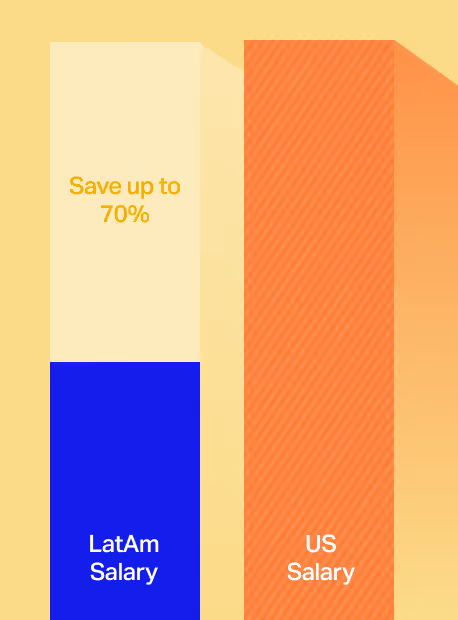
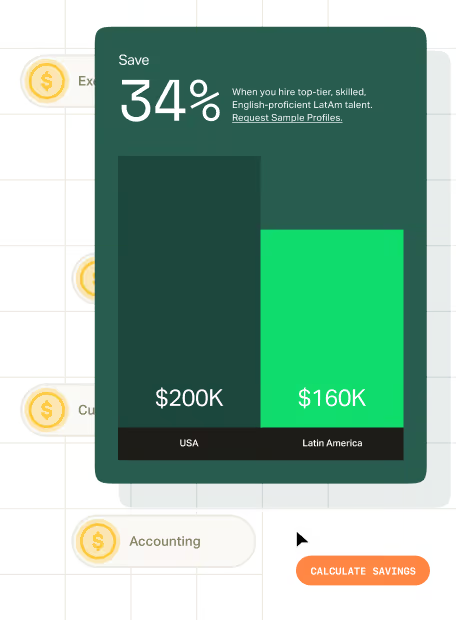
Budget roughly what you’d pay elsewhere in Latin America: a mid-level developer’s salary in Paraguay runs $48K to $72K a year, up to 63% less than the US equivalent, according to our salary data.
These are Latin America-wide benchmarks, not Paraguay-specific figures. Regional benchmarks are the standard we use across smaller markets in Latin America, since they reflect real hiring activity across the countries we work in rather than a single country’s limited data.
Here’s what software engineer hiring in Latin America costs, along with the other common roles, against equivalent US pay, according to Hire With Near’s salary benchmarks:
For the most up-to-date figures, see Hire With Near’s US vs Latin America Salary Guide.
Three things move a candidate from the bottom of a band to the top: years of production experience, prior work with US teams, and whether they’ve owned a system rather than tickets inside one.
Our IT roles salary guide for the US versus Latin America breaks that down role by role.
At those numbers, a company paying a mid-level US engineering salary can hire a more senior engineer in Latin America for the same annual figure. It’s the same cost gap behind how much US companies save by hiring in Latin America, and it holds across the region, whether you hire developers in Costa Rica, hire software developers in Chile, or hire developers in Venezuela
That gap tracks cost of living, not skill. You can see it directly in the table below, comparing everyday costs in Asunción and Ciudad del Este against El Paso, Texas:
Source: Numbeo.com, retrieved August 2026
How Can a US Company Hire Developers in Paraguay?
US companies have four ways to hire developers in Paraguay: freelance marketplaces, hiring directly by setting up a legal entity or using an employer of record, a nearshore staff augmentation company, or a staffing and recruiting firm.
The right choice comes down to your business needs: is it short-term help on a project or a long-term, full-time developer on your team?
If that isn’t settled, weigh when hiring locally versus abroad makes sense first, and the questions about hiring remote talent that come with it.
1. Freelance and contractor platforms
Freelance developers in Paraguay are easiest to reach through platforms like Upwork and Toptal, which give fast access to contractors and work for a defined project with an end date. For a full-time team member, they’re a poor fit: you carry quality control and retention alone, and the developer splits attention across other clients.
For a permanent hire, a specialist staffing firm vets for retention rather than availability.
2. Hiring directly
Hiring directly means you source and vet candidates yourself. Then, you have two options for the employment relationship in Paraguay:
- Register a Paraguayan subsidiary: This gives you full control and makes sense only at real scale. It takes months, carries real legal and accounting cost, and needs ongoing local support. For dozens of hires and a permanent in-country presence, it’s a serious option. For two engineers, it isn’t.
- Use an employer of record: An EOR handles contracts, payroll, tax withholding, benefits, and compliance for a hire you’ve already found. That’s the catch: an EOR handles employment logistics, not recruiting, so you still source, screen, and vet every candidate yourself, through your own network or a job board for hiring in Latin America. It’s also where Paraguay’s statutory costs hit your budget. The aguinaldo, Paraguay’s mandatory thirteenth-month bonus, is the big one. Most EOR companies price it in.
3. Nearshore staff augmentation
A nearshore staff augmentation firm places pre-vetted engineers onto your team to work under your direction while the firm handles payroll, benefits, and compliance. It suits a defined project, a capacity spike, or a team you expect to scale up and down, and how nearshore staff augmentation works goes deeper into it.
4. A staffing and recruiting partner
You describe the role, one of the specialist staffing firms for LatAm hiring sources and vets candidates against it, and you interview and choose. Payroll, benefits, compliance, and local employment requirements are handled through nearshore staffing and recruiting services. The developer joins your team and reports to you.
Hire With Near is a staffing and recruiting partner built for exactly this kind of hire: someone who joins your team permanently, not a rotating contractor.
Two things separate a strong staffing partner from a weak one: how fast they get you a shortlist, and how long the person they place actually stays. Our comparison of the best companies to hire developers in Latin America breaks both down.
{{prevetted-banner}}
What Do US Companies Need to Know Before Hiring Developers in Paraguay?
Four things shape what a Paraguayan hire costs and looks like day to day: a mandatory thirteenth-month bonus, paid annual leave that grows with tenure, the time zone overlap you’re actually getting, and whether to require a college degree at all.
The first two only apply if you’re the direct employer, through your own entity or an Employer of Record. They don’t apply if you hire through a staffing partner that engages the developer as a contractor.
The aguinaldo is a mandatory thirteenth-month bonus
For a direct employee, Paraguay’s labor code requires a thirteenth-month payment called the aguinaldo. It equals one-twelfth of everything the worker earned during the calendar year across every category (salary plus overtime plus commissions, not base salary alone) and it’s due before December 31.
Budget it as one full extra month’s pay, calculated on total earnings rather than the number on the offer letter.
Paid leave scales with tenure
For a direct employee, paid annual leave runs in three tiers under Paraguayan labor law: 12 working days in the first five years of service, 18 days after more than five and up to ten years, and 30 days after more than ten. That top tier is generous by US standards, and worth knowing before you write a leave policy that assumes US norms.
Time zone overlap runs close, but not identical, to the US workday
Paraguay sits on a fixed time zone year-round with no daylight saving, so the overlap with your team shifts by an hour or two depending on the season and which US time zone you’re in. You can see the exact hour-by-hour overlap in the table below:
Don’t make a degree a hard requirement
A degree requirement is one of the easiest ways to lose a strong Paraguayan candidate. Natasha Tarapow, Hire With Near’s Recruitment Consultant, is direct about it:
A lot of the great engineers in Latin America don’t have a college degree, and that doesn’t mean they’re bad candidates. The dynamic here is that many of the best engineers started working before they graduated. They got a really good job and didn’t have time to finish. We always recommend to clients that they don’t make a degree a must-have, because they might be losing out on some really good candidates.
— Natasha Tarapow, Recruitment Consultant, Hire With Near
Neither statutory cost is yours to administer if you go through a staffing partner. Our guides to hiring remotely in Latin America and the questions tech leaders ask about hiring developers in Latin America share more information.
How Does Hire With Near Help US Companies Hire Developers in Paraguay?
Our process starts with an intake on the role, then sourcing and screening against it, and a shortlist of candidates in 3 to 5 days.
The intake separates the stack requirement from the seniority requirement, which for engineering is where most searches go wrong. Our recruiters source and screen against that, run English and technical screens, and send a shortlist.
You interview and make the call. Once you hire, payroll, benefits, and compliance are handled as part of the placement. It’s the same team that fills software engineering roles across Latin America for US product companies, including recruiting for SaaS companies, so the playbook doesn’t change when the country does.
Technical vetting is the part companies want to see into. Every candidate goes through:
- A detailed walkthrough of a recent project: what they built, what stack, what broke, and how they fixed it.
- An explanation of one decision from that project to someone who doesn’t write code.
If you want a hands-on evaluation on top of that, we can build in a small real-world task, a debug, a refactor, or a basic API with tests, reviewed together on a call at your request, rather than a multi-round gauntlet that loses the strongest candidates.
Your own technical bar stays yours.
That’s why companies switch. In Hire With Near’s analysis of 2,000-plus conversations with US companies exploring Latin American hiring, 30% were switching away from offshore locations, and time zone overlap was the reason.
The clearest proof is an engagement with a US healthtech startup that was scaling fast with two internal recruiters and an eight-step engineering interview process it refused to shorten. We took on sourcing, screening, and coordination across every role, and it hired seven senior engineers at a 14-day average time to hire, saving $323,000 a year against US salaries with that process intact.
The same recruiters handle executive search when the role is a VP of Engineering rather than an individual contributor. What we’ve learned running those searches across the region is written up in nine lessons from hiring across Latin America and in the case for leading US companies hiring Latin American talent.
Final Thoughts
Paraguay is a credible place to hire a developer: English above the global average, a tech sector the government is actively building, and salaries well below US rates.
It’s also an early market. If you need three senior engineers on a niche stack next quarter, a deeper Latin American market is the better call.
The fastest route in is a partner already recruiting across the region, so you’re not building a candidate network from scratch. See what it looks like to hire a developer in Latin America by booking a free consultation to talk through your requirements with our team. We’ll give you salary benchmarks and explain the process, so you have what you need to decide whether it’s right for you.
{{latam-hiring-cta-v2}}
Frequently Asked Questions
How much does it cost to hire a developer in Paraguay?
Budget roughly $48K–$72K a year in salary for a mid-level developer and $72K–$108K for a senior software engineer, using Hire With Near’s Latin America-wide benchmarks.
If you’re the direct employer, through your own entity or an employer of record, statutory costs sit on top, including the aguinaldo and paid annual leave that scales with tenure. If you hire through a staffing partner instead, those obligations don’t apply to you directly.
A staffing partner handles payroll, benefits, and local compliance as part of the placement.
Is Paraguay in a compatible time zone with the US?
Yes. Paraguay keeps one consistent schedule year-round without daylight saving shifts, aligning with US Eastern time during the summer and sitting one hour ahead during the winter as US clocks move back.
A developer in Paraguay stays online throughout your business day, joining live stand-ups and answering in real time. Eastern and Central teams get near-total shared hours, while West Coast teams share the morning through early afternoon for stand-ups, code reviews, and handoffs.
Do Paraguayan developers speak English well?
Paraguay ranks 43rd globally on the EF English Proficiency Index with a score of 531, above the global average of 488 and inside EF’s Moderate band. That’s a country average, not a guarantee about any individual. National reading scores run ahead of speaking scores, so screen both against the job: documentation, code review comments, and a live technical conversation are three different skills.
Is a 13th-month salary required in Paraguay?
Only if you’re the direct employer, through your own entity or an employer of record. In that case, Paraguayan labor law requires an aguinaldo equal to one-twelfth of everything the employee earned during the calendar year, including overtime and commissions, not just base salary. It must be paid before December 31, or when the employment relationship ends if that comes first. Splitting it into installments isn’t regulated by law and needs the worker’s agreement.
If you hire through a staffing partner that engages the developer as a contractor, this obligation doesn’t apply to you directly.
What tech stacks are Paraguayan developers strongest in?
Python leads demand across Latin America, followed by JavaScript, SQL, Java, Go, and Rust, with React the dominant front-end framework. That’s regional demand data rather than a Paraguay-specific signal, because none exists. A framework version matters far less than whether the engineer understands the principles underneath it.
How long does it take to hire a developer in Paraguay through Hire With Near?
Expect a shortlist in 3 to 5 days, with most companies making a hire in under three weeks. A recent seven-role engineering build elsewhere in Latin America averaged 14 days to hire. Paraguay is a smaller market, so a niche stack or a very senior profile can take longer than in Brazil or Colombia.







.webp)


%203.svg)
.avif)





%20(1).avif)

%20(1).png)