


%203.svg)
Key Takeaways
- US companies can generally hire developers in Venezuela, and the talent is strong. But sanctions screening, scarce employer of record coverage, and payment rails most US companies cannot use make it unlike any other Latin American market.
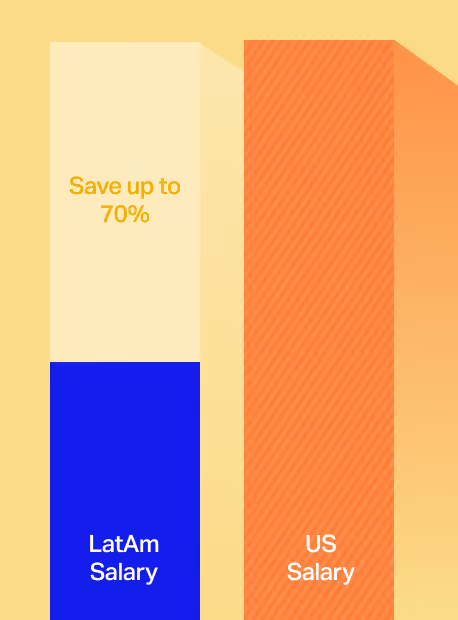
- Mid-level software engineer salaries in Latin America run $54K to $72K a year, up to 68% below US equivalents, per Hire With Near’s salary data.
- Screen every counterparty against OFAC’s sanctions list and involve your own counsel before committing.
Hire developers in Venezuela, and you’re benefiting from a market most companies overlook, largely due to the country’s political and economic situation.
That same situation is exactly why you may be considering it: a deep pool of experienced developers who never got the international attention the rest of the region did, and who have salary expectations below US and even regional Latin American rates.
What the instability does change is how you pay someone and stay compliant. Banking and payments work differently here than anywhere else in the region, mainly because of US sanctions that limit which channels and institutions you can use.
In this guide, I break down what you need to evaluate before you bring a developer onto your team in Venezuela: compensation benchmarks, the engagement and payment models that work here, how to navigate compliance safely, and the infrastructure considerations worth knowing upfront.
Should I Hire Developers in Venezuela?
I know hiring in Venezuela might make many tech leaders raise their eyebrows. In past years, the news about the country’s political and financial situation hasn’t been positive.
But despite that, there are three real reasons you may be exploring if it’s possible: the cost, the overlap with your working day, and a talent pool that’s more experienced with international clients than you’d expect.
A developer’s salary goes further here than almost anywhere else in the region
Salaries in Venezuela run up to 68% below US equivalents, according to our data, and the gap isn’t about the work being worth less. It’s what happens when a country’s currency has been in freefall for years: the cost of living collapses in dollar terms even as skill and experience stay exactly where they were.
The practical result is that the budget for one mid-level US hire can often get you a senior engineer here instead.
Working hours overlap most of your day
A developer in Venezuela shares most of the working day with Eastern and Central teams, and a solid morning-to-midday block with Pacific ones. The table below breaks down the overlap hour by hour, whichever US time zone your team sits in.
Stand-ups happen live, code review lands the same day instead of overnight, and a production issue at 2 PM gets an answer at 2:15, not tomorrow morning, which is a large part of why US companies hiring developers in Latin America choose the region over offshore markets.
Developers here already have years of experience working for international clients
Venezuela’s economic crisis pushed a large share of its skilled workforce toward remote work specifically because it pays in dollars, a shift well documented by platforms like Upwork and organizations tracking the country’s labor market.
That means many Venezuelan developers aren’t new to working with US teams: they’ve been doing it for years, often through the same freelance platforms and remote arrangements you’d expect from any nearshore hiring market, and it’s backed by two universities that have run computing and engineering programs for decades.
Now, the honest part. Hiring in Venezuela is structurally different from hiring in Colombia, Mexico, or Brazil. Sanctions screening is a specific obligation, standard employer of record service is mostly unavailable, and the payment rails (payment methods like wire transfer, ACH, etc.) you already use can’t reach Venezuelan accounts.
The section below covers all of it. Read it before you decide, not after.
What Do US Companies Need To Know Before Hiring Developers in Venezuela?
Hiring a developer in Venezuela can be legal for a US company, and the obligations are specific and checkable. Four things to get right: sanctions screening on every counterparty, a government-ownership rule on top of the US Treasury’s sanctions list, contractor-based arrangements rather than an employer of record, and payment methods unlike the ones you use elsewhere.
Note: This isn’t legal advice. So remember to talk to counsel before you act on any of it.
US sanctions on Venezuela are list-based, not a blanket ban
US sanctions on Venezuela target specific people and entities rather than the country’s population, so hiring a Venezuelan developer isn’t prohibited by itself.
According to the US Treasury’s Office of Foreign Assets Control, the Venezuelan people are not subject to comprehensive US sanctions. Sanctions don’t preclude US persons from transactions involving Venezuela, provided those transactions don’t involve sanctioned individuals or entities, or certain prohibited activities.
What that leaves is a screening obligation. Every counterparty you pay, including any intermediary handling settlement, has to be checked against OFAC’s Specially Designated Nationals and Blocked Persons (SDN) list before money moves.
Since the list changes constantly, recheck as the relationship continues.
Executive Order 13884 blocks anyone the Government of Venezuela owns half of
Under Executive Order 13884, the Government of Venezuela is blocked, along with any entity it owns 50% or more of, directly or indirectly, regardless of whether that entity appears on the SDN list. OFAC confirms this applies even without an SDN listing.
That’s the part companies miss, because a clean SDN-list search isn’t, on its own, a complete check. If you pay through an intermediary or a processor with Venezuelan ownership, the ownership structure is what to verify.
Standard employer of record service is mostly unavailable
Most global employer of record providers don’t currently offer standard EOR service in Venezuela, and contractor-based arrangements are the practical industry norm there.
This is checkable on the providers’ own coverage pages, with EOR-adjacent services there typically working as contractor management rather than true employer of record.
That changes who the legal employer is and where obligations sit. Ask any provider what they cover in Venezuela and what the arrangement legally is, then take the answer to your counsel.
The banking rails most US companies use don’t reach Venezuela
Paying a developer in Venezuela usually can’t be done on the rails you already use, because the country’s banking system is largely disconnected from international financial networks.
The mechanism is widely reported incorrectly. Venezuela wasn’t expelled from SWIFT the way specific Russian and Iranian banks were, and Venezuelan banks retain live BIC codes. What happened was a collapse in correspondent banking. As FTI Consulting documents, most major US and European banks terminated relationships with Venezuelan institutions between roughly 2016 and 2020, leaving limited and fragmented payment channels.
Two specifics you can check yourself: Wise, the international money transfer service, lists Venezuela among the countries where it doesn’t operate, and Stripe’s global availability page, the payment processor most companies already use, shows only Brazil and Mexico in Latin America.
USD stablecoins dominate Venezuelan crypto activity instead: TRM Labs found USDT accounted for roughly 90% of active Binance peer-to-peer listings for bolívar pairs (Venezuela’s currency) in early 2026. Dollar wallets that support the country, such as Airtm, and third-country bank accounts are the other common routes.
The direction of travel isn’t only restrictive. OFAC’s General License 57, issued in April 2026, authorizes financial services transactions involving certain Venezuelan banks and Government of Venezuela individuals.
None of this is a recommendation about how to pay anyone. Every route carries tax and sanctions implications, and each one is worth reviewing with your own advisers before you use it.
Involve your own legal and compliance counsel before you commit
Talk to your own legal and compliance counsel before you sign anything or move money, because the analysis turns on your specific counterparty and the rules are still changing.
The framework shifted substantially in early 2026 after political change in the country. A new executive order followed, along with 15 general licenses easing oil, gas, and mining restrictions, and it keeps moving.
The only durable instruction here is a process one: check OFAC’s own Venezuela-related sanctions page when you make the decision, rather than relying on any guide.
How Deep Is Venezuela’s Developer Talent Pool?
Venezuela’s talent pool is deeper than the country’s current economic size would suggest, for the reason already covered: a generation of experienced engineers moved into remote work for US and European companies over the past decade, and that shift is now the standard path for a technical career here, not the exception.
It’s also worth knowing that a large share of that talent isn’t physically in Venezuela anymore. Nearly 8 million Venezuelans have left the country since 2015, according to UNHCR, one of the largest displacement movements in the world, with most settling elsewhere in Latin America: Colombia hosts the largest number, followed by Peru, Brazil, Chile, and Ecuador.
The strongest Venezuelan engineers you’ll come across in a search are living and banking in one of those countries, not in Venezuela itself.

Where the talent concentrates
Three cities anchor most of the country’s technical talent:
- Caracas, the capital, is the primary hub. As the center for finance, telecom, and corporate tech, it has the highest concentration of senior back-end developers, full-stack engineers, and cloud infrastructure specialists.
- Maracaibo, historically built around the energy and industrial sectors, developed a strong base in systems engineering and industrial automation. Today, its engineers focus mostly on web application development and back-end API work for international clients.
- Valencia, in the central industrial corridor, concentrates on ERP systems, industrial automation, database administration, and custom development for export-focused businesses.
The university pipeline
Three universities anchor the country’s technical education:
- Universidad Simón Bolívar (USB): Its computer engineering program, running since 1973, is one of the region’s longest-standing, offering five-year degrees plus graduate research in software design, algorithms, and distributed systems.
- Universidad Central de Venezuela (UCV): The country’s oldest public university, with a dedicated computing school covering software engineering, networks, databases, and AI from undergraduate through doctoral level.
- Universidad de Los Andes (ULA): Based in Mérida, it produces systems engineers and developers with a strong grounding in computational science.
That said, a strong academic pipeline is a signal, not a checklist item to demand from every candidate. Natasha Tarapow, Hire With Near’s Recruitment Consultant, is direct about it:
A lot of the great engineers in Latin America don’t have a college degree, and that doesn’t mean they’re bad candidates. The dynamic here is that many of the best engineers started working before they graduated. They got a really good job and didn’t have time to finish. We always recommend to clients that they don’t make a degree a must-have, because they might be losing out on some really good candidates.
— Natasha Tarapow, Recruitment Consultant, Hire With Near
Check the infrastructure setup before you rely on it
Hardware and internet redundancy are worth verifying directly with any candidate. Starlink has expanded satellite coverage across the country, giving developers a high-speed option independent of local fixed-line infrastructure.
During screening, ask about primary connection speed, backup power (a UPS, at minimum), and their general remote setup, so you know what you’re relying on before you’re mid-sprint and find out the hard way.
For the broader regional picture, our guides on hiring Latin American developers and how CTOs are building engineering teams in Latin America cover the wider context.
What Technical Skills Do Venezuelan Developers Have?
Venezuelan developers work in the same core languages and frameworks that US companies hire for across Latin America. Python, JavaScript, and SQL lead demand, with React, Django, and .NET among the most requested frameworks.
The fuller picture, from Hire With Near’s 2026 hiring data across Latin America:
- Languages: Python (the most requested), JavaScript, PHP, SQL, Ruby, C++, Go, Java, and Rust.
- Frameworks: React, Django, Vue.js, Ruby on Rails, and .NET.
Be clear on what that list is: region-wide demand patterns, not Venezuela specifically. No Venezuela-specific stack data exists in any source we could verify.
From the editorial work I do interviewing our recruiters, the point that comes up most often is that companies over-specify. Hire With Near’s engineering recruiters consistently tell us that experienced developers adapt across framework versions when they understand core principles. Insisting on a niche version shrinks the pool without improving the hire.
The roles behind those stacks are the ones US teams hire most. A remote software engineer owns a product surface end to end, a full-stack developer suits smaller teams, and a back-end developer fits where the work is services and data.
The same shapes show up across IT and tech recruiting in Latin America.
How Much Does It Cost To Hire Developers in Venezuela?
Published figures for Venezuela disagree by an order of magnitude, from near six figures a year down to monthly contractor rates that annualize to a fraction of that.
The numbers below are Hire With Near’s benchmarks across Latin America as a region, compared to equivalent US hires.
For the most up-to-date figures, see Hire With Near’s US vs Latin America Salary Guide.
One caveat applies to Venezuela and almost nowhere else: what a developer takes home is shaped by the country’s currency instability and the payment constraints described above.
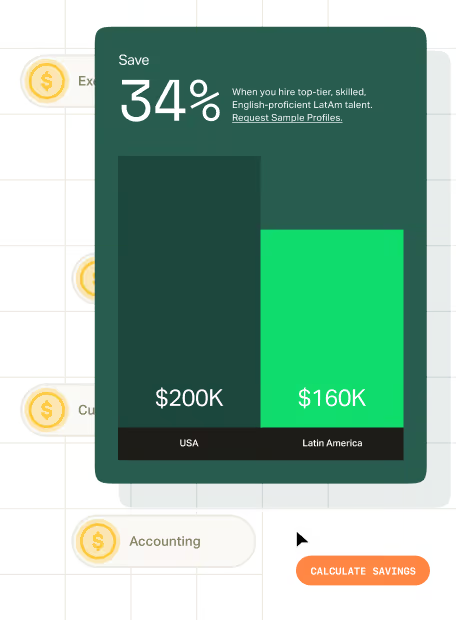
Across the 2,000+ Latin American placements in Hire With Near’s 2026 State of LatAm Hiring Report, US companies saved an average of $35,000 to $64,000 per hire against US salaries, a regional average that Venezuela’s own market dynamics fit well inside.
At $72K to $108K, a senior software engineer in Latin America sits below the US mid-level range in the table above, which changes the seniority level you can hire at.
For a wider role-by-role view, see our IT roles salary guide for the US vs Latin America.
{{salary-guide-cta}}
How Can a US Company Hire Developers in Venezuela?
Most companies hiring remotely in Venezuela end up choosing between three options: freelance platforms and marketplaces, an employer of record, or a staff augmentation firm. A fourth option, a dedicated staffing and recruiting partner, also exists in the market, though it’s worth understanding on its own terms.
One route common everywhere else in this guide, hiring directly, mostly isn’t realistic here, and that’s covered separately below.
Freelance platforms and marketplaces
This is the most common real path into Venezuela today, largely because it routes around the banking gap covered earlier in this article. Payment typically runs through the platform itself or through intermediary services rather than a direct bank transfer, since most Venezuelan accounts can’t receive international payments directly.
The trade-off is the usual one that comes with any freelance arrangement: you carry quality and retention risk, and the person is splitting attention across multiple clients rather than working exclusively for you.
Employer of record
An EOR becomes the legal employer on paper while you manage the work day to day, and it’s the standard cross-border answer almost everywhere else in Latin America.
In Venezuela specifically, most global EOR providers don’t currently offer standard service, and what’s marketed as EOR-adjacent coverage here typically functions as contractor management rather than a true employer-of-record relationship, meaning payment still has to route around the same banking restrictions freelance platforms deal with.
Directories of EOR companies list coverage country by country, and Venezuela is missing from most major lists, so verify directly with a provider rather than reading a regional marketing page as confirmation.
Staff augmentation
A staff augmentation firm places pre-vetted engineers on your team while staying the legal employer, which normally suits project work or a team that needs to scale up and down.
In Venezuela, this model runs into the same banking and compliance realities as the EOR option above, and coverage varies significantly firm to firm.
Don’t assume a provider covers Venezuela without asking directly.
Staffing and recruiting partner
A staffing and recruiting partner sources and vets the candidate, then typically handles employment once you hire. Whether a given firm can support a Venezuela-based hire depends entirely on that firm’s own compliance posture and banking relationships, since the same restrictions covered above apply here too.
Some firms may be able to support a Venezuela-based placement under a recruiting-only structure, where the client pays the candidate directly rather than the firm processing payroll.
This varies enough by provider that it’s worth asking any firm you’re evaluating exactly what they can support.
Why hiring directly mostly isn’t realistic here
In most Latin American countries, hiring directly means registering a legal entity. In Venezuela, that’s a different order of problem entirely, not just slower and more expensive, but structurally harder.
Foreign companies can’t register directly: the process requires a Venezuelan attorney or local agent, since the commercial registry has no public portal and isn’t accessible from outside the country. That agent, and every other local counterparty involved in setting up the entity, has to be sanctions-screened before you can move forward.
This is only realistic for companies with dedicated legal and compliance teams built for exactly this kind of market, the handful of multinationals with the infrastructure to navigate sanctions licensing as a matter of course.
Does Hire With Near Help US Companies Hire in Venezuela?
Here’s where we stand today: Hire With Near’s standard staffing model doesn’t place Venezuela-based candidates. A recruiting-only structure, where the client then takes responsibility for the employment structure , may be possible but something we prefer to avoid given the country’s regulatory risk.
Where we can help is hiring a Venezuelan national who is legally resident and banks elsewhere, as our Sourcing Manager put it:
If someone is Venezuelan but actually lives with legal residency elsewhere (like Argentina), with a local bank account and ID, we can consider them case by case. It’s about where they physically live and bank, not their nationality.
— Lucas Stepanenko, Sourcing Manager, Hire With Near
If you’re set on hiring someone based in Venezuela, the freelance-marketplace route covered above is the more realistic path today.
But if what you need is a developer who overlaps your working day at a strong price, without the compliance complexity this article has walked through, the region has several markets built for exactly that.
Colombia, Mexico, and Brazil are just some examples of where Hire With Near runs its standard sourcing, vetting, and placement process, the one built around a project walkthrough, a live technical conversation, and English screening, the same bar we hold everywhere.
ParkMobile used exactly that process to build an in-house engineering team in Colombia, a market it had never recruited in before: nine senior engineers, a 24-day average time to hire, and $1,066,085 a year in savings against US rates. Their TA Lead put it this way:
Collaboration with Hire With Near is solving the problem of entering a completely new market for us. They have been an invaluable partner in this expansion, helping to successfully close roles quickly. Their deep understanding of the local talent landscape is what allows them to source and vet top-tier candidates efficiently.
— Akshay Gokarnakar, TA Lead, ParkMobile
If any of these markets fit better, our Hire Remotely in Latin America guide covers which roles and countries work best, how to stay compliant, and what working with a staffing partner actually looks like.
Final Thoughts
Venezuela has a developer talent pool at salaries up to 68% below US equivalents, but anyone thinking about hiring there faces real constraints no other Latin American market carries. Weigh both.
If you go ahead, two things are crucial: screen every counterparty against OFAC’s current sanctions list before money moves, and have your own legal and compliance counsel sign off on the structure first.
If those constraints rule Venezuela out for now, the same technical depth exists in markets where standard employment and payment rails work. Our guides to hiring developers in Argentina, Costa Rica, and Chile are a good place to start.
To talk through any of those markets, book a free consultation with our team. We’ll give you salary benchmarks and walk you through how hiring there works.
{{latam-hiring-cta-v2}}
Frequently Asked Questions
Is it legal for a US company to hire a developer in Venezuela?
Yes, generally. US sanctions on Venezuela are list-based, targeting specific people and entities rather than prohibiting US companies from working with Venezuelan nationals.
Two obligations follow. Screen every counterparty against OFAC’s Specially Designated Nationals (SDN) list before money moves.
Then account for Executive Order 13884, which blocks the Government of Venezuela and anything it owns 50 percent or more of, listed or not.
Ask your counsel to confirm.
Can you use a standard employer of record in Venezuela?
Mostly no. Most global employer of record providers don’t currently offer standard EOR service in Venezuela, and contractor-based arrangements are the practical industry norm there. Where EOR-adjacent services exist, they generally function as contractor management rather than true employer of record.
If company policy requires an employment relationship, that may rule Venezuela out. Ask any provider what they cover, and your counsel what it means.
How do US companies actually pay developers in Venezuela?
Usually not through the rails they already use. Venezuela’s banking system is largely disconnected from international networks after most major US and European banks ended correspondent relationships with Venezuelan institutions between roughly 2016 and 2020. Wise doesn’t operate there and Stripe isn’t available.
The routes in common use are USD stablecoins, Binance peer-to-peer, dollar wallets such as Airtm, and third-country bank accounts, each with tax and compliance implications worth reviewing with your advisers.
How much does it cost to hire a developer in Venezuela?
Mid-level engineering salaries across Latin America run roughly $48K to $72K a year, with senior software engineers at $72K to $108K, according to Hire With Near’s salary data.
No reliable Venezuela-specific benchmark exists, so treat the regional numbers as your starting point.
Currency instability and payment constraints also affect what a developer takes home.
Do Venezuelan developers speak English well?
Venezuela scores 520 on the 2025 EF English Proficiency Index, ranking 51st globally, which places it in the Moderate band. That’s a country-level average across the whole adult population, and engineers who already work with US teams typically sit well above it.
Test English on the job task rather than trusting a ranking: ask a candidate to walk you through an architecture decision and explain the trade-offs to someone non-technical.
What tech stacks are Venezuelan developers strongest in?
Python, JavaScript, and SQL lead the demand list, with React, Django, Vue.js, Ruby on Rails, and .NET the most requested frameworks. PHP, Ruby, C++, Go, Java, and Rust are in regular use. Those are region-wide demand patterns, not Venezuela-specific figures, because no Venezuela-specific stack data exists.
See also the questions tech leaders ask about hiring developers in Latin America.


.webp)



.webp)


%203.svg)
.avif)





%20(1).avif)

%20(1).png)