


%203.svg)
Key Takeaways
- Colombia is Latin America's top nearshore hiring market, with senior engineers who work a full day alongside US teams at 30–70% below US salary levels.
- Colombia sits at UTC-5 year-round, giving Eastern and Central US teams near-total overlap and Mountain and Pacific teams most of the workday, while developers placed through a vetted partner are conversational in English for daily standups.
- The fastest path to a long-term hire is a staffing and recruiting partner that sources, vets, and places a full-time engineer and handles payroll and compliance, with a first shortlist in three to five days.
In 2025, Colombia became the country US companies turn to most for nearshore talent: 23% of all placements according to Hire With Near's 2026 State of LatAm Hiring Report. For nearshore engineering talent specifically, Colombia ranks #2 in the region, behind only Brazil.
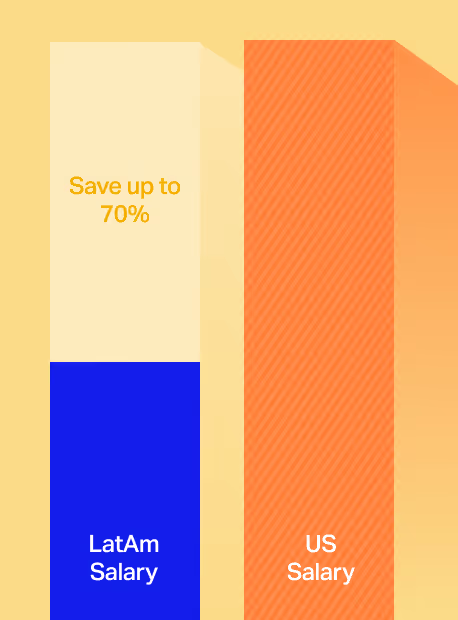
Ask founders why Colombia is such a great place to hire developers, and the same reason keeps coming up: highly-skilled engineers who overlap your entire workday, at salaries 30% to 70% below US rates.
That gap is why companies switch, and our own data backs it up. In Hire With Near's research on why US companies are hiring in Latin America, 30% of companies moving to the region are leaving offshore providers specifically to get real-time overlap, while 41% name budget constraints as their top reason for making the move. Their engineering budget simply doesn't stretch far enough to hire in the US.
Colombia fits this perfectly: it gives you the overlap and the budget relief in one country. This guide covers why you should hire developers in Colombia: what its professionals are strong at, where to find them, the four ways to hire, what it costs, and what to know before you sign.
Why Should I Hire Developers in Colombia?
Hiring developers in Colombia gives US companies engineers who work a full day alongside their team, at 30% to 70% below US salary levels, in the market that has become Latin America’s top nearshore hiring destination. Three things drive that: overlap, scale, and cost.
Colombia gives you true real-time overlap
Colombia sits at UTC-5 year-round and doesn’t shift its clocks for daylight saving, so a developer there is online almost through your entire workday, no matter whether your office runs on Eastern, Central, Mountain, or Pacific time. You can see the details in the table below:
Colombia matches the US East Coast in winter and sits one hour behind during US daylight saving time. Eastern and Central teams get close to a full working day of overlap and Mountain and Pacific teams share most of the afternoon.
Standups can happen live, urgent bugs often get fixed in the same hour instead of waiting overnight, and handoffs land while people are still at their desks.
Colombia is Latin America’s top nearshore hiring market
According to Hire With Near’s 2026 State of LatAm Hiring Report, Colombia made up 23% of all placements in 2025, surpassing Argentina and nearly doubling its prior-year share.
That scale shows up in the talent pool too. According to GitHub’s Octoverse 2024 report, Colombia has more than 1 million GitHub developer accounts, with double-digit year-over-year growth, making it one of the fastest-growing developer communities in the region.
A pool that large and growing that fast is what lets a partner surface strong candidates in days rather than months.
{{state-latam-hiring}}
The same budget hires more senior talent in Colombia
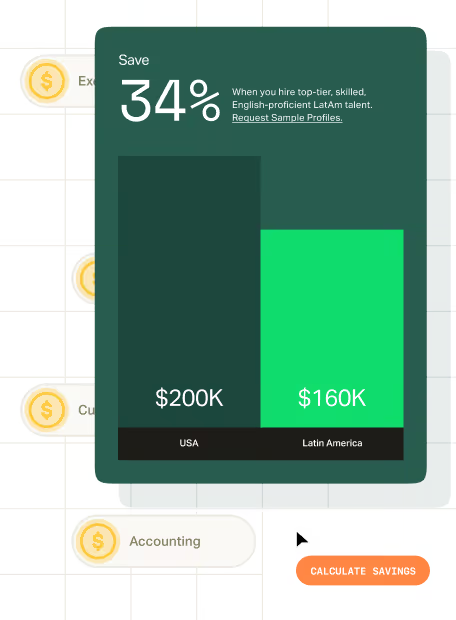
A senior software engineer in Colombia earns $72,000–$108,000 a year, while the same role in the US runs $140,000–$238,000, according to Hire With Near's salary benchmark. That means the budget that covers one US hire often funds two senior Colombian engineers, with room left to grow the team.
The savings come from a lower cost of living, not a discount on skill, so Colombia’s fast-growing tech scene and strong English don’t cost you collaboration quality.
To put that in concrete terms, here’s how daily costs in Bogotá and Medellín compare to Houston, Texas:
Source: Numbeo.com
That cost gap is why most companies hiring in Colombia aren't filling junior seats: they're using the budget advantage to access experienced engineers they couldn't afford to hire domestically. According to the 2026 State of LatAm Hiring Report, 98% of engineering placements in Latin America were mid-level or senior professionals.
None of this is unique to Colombia. The same overlap-and-cost case is driving US teams toward hiring developers across Latin America as a whole. Colombia is just where the volume has concentrated first.
Related reading: Should You Outsource Software Development to Colombia?
What Technical Skills Do Colombian Developers Have?
Colombian developers work across the same modern stacks US teams build on, with particular depth in JavaScript and TypeScript, Python, and Java. Front-end, back-end, cloud, and DevOps, mobile, and a fast-growing data and machine learning bench round out the talent profile.
The tech-stack list looks a lot like a US engineering org chart:
- JavaScript and TypeScript are Colombia’s deepest bench, especially React, Node.js, Angular, and Vue.
- Python shows up constantly in data and web work, from Django and Flask APIs to the country’s growing machine-learning teams. Our Python developers page has more on what’s available.
- Java and C#/.NET cover most of the enterprise back ends built for larger US clients.
- Cloud and DevOps is a fast-growing niche: DevOps engineers comfortable with AWS, Azure, GCP, CI/CD, Docker, and Kubernetes are easy to find in Bogotá and Medellín.
- Mobile development spans iOS, Android, React Native, and Flutter, and Hire With Near regularly places mobile developers for this work.
- Data engineering and machine learning is Colombia’s fastest-growing bench, drawing on the same universities that produce its enterprise engineers.
From the editorial work I do interviewing our recruiters, one pattern comes up in almost every conversation: the strongest Colombian engineers aren’t just fluent in a stack, they can explain why they built something the way they did.
Hire With Near's developer recruiters consistently look for engineers who write clean, testable code, can connect what they’re building to the business goals behind it, and can walk a non-developer through a technical decision without hiding behind jargon.
Hayden Cohen, co-founder and CEO of Hire With Near, explains why that communication advantage runs deeper than English proficiency:
That communicative, product-minded style is part of why US founders like hiring in the region. As one founder of an AI document-intelligence startup told us:
One of the reasons I like hiring in Latin America is that I love the stereotype of being very open, warm, kind, thoughtful, and communicative. That's what we would expect from engineers.
To see which technologies US companies ask for most, see the most in-demand developer skills in Latin America.
What Developer Roles Can I Hire in Colombia?
The roles US companies hire most from Colombia map directly to the stacks where Colombian developers are strongest:
- Software engineer: Covers the full development lifecycle, from architecture decisions to shipping features, and is the most in-demand role across the board.
- Full-stack developer: Works across both front end and back end, which suits lean teams that need range without splitting the hire into two roles.
- Back-end developer: Handles servers, databases, and APIs, drawing on Colombia’s depth in Java, Python, and Node.js.
- Front-end developer: Builds the interfaces users interact with. React is dominant, with Angular and Vue also well-represented.
- React developer: A specific hire when your stack is already built on React and you need someone who can step in without ramp-up time.
- DevOps engineer: Keeps deployments reliable and infrastructure costs in check, with strong AWS, GCP, and Azure coverage.
Salaries for these roles follow the same regional benchmarks, which Hire With Near tracks across Latin America:
For the most up-to-date figures, see Hire With Near’s US vs Latin America Salary Guide.
Where Is the Tech Talent? Colombia's Tech Hubs
Colombia's developer talent clusters in Bogotá and Medellín, with growing pools in Cali and Barranquilla. For remote hiring, that works in your favor: you hire from a national pool, not one crowded market.

Bogotá
Bogotá is Colombia's largest tech hub and holds the deepest concentration of senior engineers and enterprise experience in the country. Global firms like Accenture, IBM, and Globant have significant operations here, which means a large share of Bogotá's engineers have worked inside complex, US-facing systems.
Universidad de los Andes is the most consistently strong engineering university in the country and shows up regularly on senior candidates' resumes.
The capital also leads Colombia in data science and AI talent, driven by the concentration of enterprise clients that need that kind of work done at scale.
Medellín
Medellín has built one of Latin America's most deliberate innovation ecosystems around the Ruta N district, a city-backed initiative that has attracted tech companies, accelerators, and startups over the past decade.
The result is a city with a genuine product and startup culture: engineers here tend to have more experience building for US audiences and working in fast-moving, iterative environments.
EAFIT University is the strongest technical institution in the city and produces a consistent pipeline of software engineers with strong fundamentals.
Medellín also ranks highly in English proficiency among Colombian cities, which shows up in the quality of communication during technical interviews.
Cali and Barranquilla
Cali and Barranquilla are smaller pools but are worth knowing about.
Cali has a growing tech sector anchored by Universidad del Valle and a cluster of software firms building for regional clients.
Barranquilla, on the Caribbean coast, has invested heavily in tech infrastructure and free-trade zone incentives that have attracted BPO and software development firms, producing a talent base with strong experience in US-facing client work.
Both cities tend to have lower salary expectations than Bogotá and Medellín, which can work in your favor for roles where the stack is common.
How Can a US Company Hire Developers in Colombia?
US companies have four ways to hire developers in Colombia: freelance marketplaces, hiring directly, a nearshore staff augmentation company, or a staffing and recruiting firm.
The right choice comes down to one question: do you need short-term help on a project, or a long-term, full-time developer on your team?
I'll walk you through them from the most complex to the simplest option.
Freelance platforms and marketplaces
Freelance platforms like Upwork, Toptal, and Arc give you fast access to contractors, which works when you have a defined, short project.
The trade-off is that you are hiring people who juggle several clients at once, not embedded engineers who learn your codebase and stay with it. You also own quality control, retention, and every bit of the vetting yourself.
Related reading: The Best Alternative to Freelancing Platforms for Hiring Full-Time Talent in Latin America
Hire directly
Hiring directly means you source and vet candidates yourself and take on the employment relationship. For a cross-border hire in Colombia, that requires one of two mechanisms:
- Set up a legal entity: Registering a Colombian subsidiary gives you full control, but it only makes sense if you’re planning on hiring 50 or more people in the country, with in-house legal and HR to run it. It takes months to stand up and carries ongoing legal, tax, and accounting costs. For a handful of engineering hires, it’s overkill.
- Use an employer of record: An employer of record becomes the legal employer on paper and handles payroll, tax, benefits, and local compliance while you manage the work day to day. In Colombia, that compliance includes a mandatory mid-year and year-end bonuses every employee is owed, a severance fund the employer sets aside each year, and standard social security contributions. An EOR takes those off your plate, but not recruiting. You still source and vet every candidate yourself through a job board for hiring in Latin America or another sourcing channel.
If you want to compare providers, our roundup of EOR companies breaks down the field, and our guide to hiring remote foreign employees covers the wider mechanics an EOR leaves to you.
Nearshore staff augmentation
A nearshore staff augmentation company is the model for short-term, project-based needs: extra engineering capacity to augment your existing team for a sprint push, a launch, or a fixed-length build, then scale back down when it is done.
Through a nearshore staff augmentation service, the firm employs the engineer and handles the infrastructure while the engineer works on your team, under your direction. It's never a build-it-yourself option.
Be clear-eyed about how most of these firms are built, though. Most staff augmentation companies run on short-term placements, with developers on rotation who move between clients every few months. That’s a good fit when short-term is genuinely what you need, and a poor one when you want someone to stay, learn your product, and own the work.
If you are weighing the model, our explainers on what nearshore staff augmentation is and on IT staff augmentation lay out where it fits.
Staffing and recruiting firm
A staffing and recruiting firm is the best path when you want a long-term, full-time developer who becomes a permanent member of your team.
The partner sources and vets candidates to your requirements, presents a shortlist, and once you hire, handles payroll, benefits, and compliance in the background. It’s the one option that does both jobs, finding the talent and employing it, in a single relationship.
Hire With Near operates on this model. Through our nearshore staffing and recruiting services, we get you vetted developers fast, with a first shortlist in about three to five days.
Our placements are built for the long term: they're full-time developers who stay, learn your product, and become permanent members of your team.
Do you want to understand why forward-thinking tech leaders are embracing this model? Here's how CTOs are building engineering teams in Latin America.
You can also see how the field compares in our roundup of the best staffing agencies in Colombia and specialist staffing firms for LatAm hiring.
What US Companies Need to Know Before Hiring Developers in Colombia
Before hiring in Colombia, plan for three things: IP protection, local employment compliance, and a few Colombia-specific hiring realities that catch first-time buyers off guard.
IP and data security deserve real attention when an engineer has access to your source code, credentials, and sensitive data. The standard protection is an NDA plus an IP-assignment agreement so that everything the developer builds belongs to your company.
A good partner builds these into every placement from day one, so you're not negotiating them role by role.
Colombia's employment framework is the part that most companies underestimate. Colombian labor law sets specific rules: bonuses, the severance fund, and mandatory social security contributions.
You don’t have to become an expert in any of them. A staffing partner or employer of record handles all of it in the background: contracts, payroll, local benefits, and filings. Your job is managing the engineer. Theirs is keeping the employment compliant.
English proficiency varies more than in Argentina. Bogotá and Medellín produce engineers with strong English, particularly at the senior level, but proficiency drops off in other cities and at lower seniority levels. Screening for communication ability early, not just technical skill, is what separates a smooth hire from a frustrating one.
For a full picture of what the hiring process looks like end to end, our guide to hiring remotely in Latin America covers the logistics in detail, and our guide to the questions tech leaders ask when hiring in Latin America addresses the concerns that come up most before a first hire.
How Hire With Near Helps US Companies Hire Developers in Colombia
Hire With Near sources, vets, and places full-time developers in Colombia and handles the payroll, benefits, and compliance behind them.
You describe the role, we run the search, screen the candidates, and present a shortlist of people who fit within 3–5 days. Our placement data shows software engineering roles filling in about three weeks, against the three to six months a US search often takes.
The vetting is where the value sits, because resumes have never been easier to inflate. Natasha Tarapow, Hire With Near's Recruitment Consultant, describes the core screen:
We always ask candidates to tell us about a project they've worked on, not just that they use this language and that one, but what their role was and what they actually did. It's important that they can explain their work to someone who isn't a developer. If they can do that, that tells me a lot.
That filter exists because the gap between a strong resume and a strong hire is real. One talent leader at a compliance SaaS company scaling a Latin America engineering team described what happened when candidates from a different vendor reached their own technical assessment:
Right now, our current vendor is sending us candidates, and their resumes do look good, but when they do make it to our technical assessment and our interview rounds, our hiring team is finding that they're maybe not as senior as we're hoping for.
Hire With Near's screening closes that gap earlier in the process, through fresh sourcing and a first-round interview built around the project walkthrough above. If you want a technical assessment or case study assignment added on top, we can help administer it and advise on what it should look like.
How ParkMobile built a nine-engineer team in Bogotá in under 30 days
ParkMobile, a global parking platform operating in 4,200+ cities across 21 countries, needed to replace agency-dependent engineering with a permanent, in-house team in Colombia.
Hire With Near placed nine senior engineers across platform, backend, and iOS in Bogotá, delivering the first shortlists within a week of kickoff.
Eight of the nine roles closed in under 30 days, at an average time to hire of 24 days, saving EasyPark $1,066,085 annually, a 73% reduction compared to equivalent US rates.
ParkMobile's TA Lead, wrote afterward:
Collaboration with Hire With Near is solving the problem of entering a completely new market for us. They have been an invaluable partner in this expansion, helping to successfully close roles quickly. Their deep understanding of the local talent landscape is what allows them to source and vet top-tier candidates efficiently.
— Akshay Gokarnakar, TA Lead, ParkMobile
If you'd prefer, you can watch his testimonial here:
The pattern we see most often is simple: a company makes one hire in Colombia, sees the quality, and comes back for more. The country is our strongest and highest-volume nearshore market, so it’s usually the first place we look when a US team wants to build.
For leadership roles like a director of engineering or VP of technology, we also run executive search in Latin America, so you can build the top of the organization chart the same way you build the rest.
You can also see the wider field in our roundup of the best companies to hire developers in Latin America.
Final Thoughts
Hiring developers in Colombia is one of the clearest budget-enablement moves a US tech team can make: the same engineering spend hires more senior talent, working your hours, without the overnight delays that made offshore hiring frustrating.
The country's depth, its fast-growing tech scene, and its full-day overlap are why it has become the highest-volume nearshore market for US companies.
The simplest way to get there is to let a partner do the sourcing, vetting, and compliance for you. If you want to explore recruiting and staffing in Latin America, a quick call is enough to get you salary benchmarks, a clear picture of the process, and a sense of the talent available.
Book a free consultation with our team today.
If you’re weighing Colombia against other markets, our guides to hiring developers in Brazil, hiring developers in Argentina, hiring developers in Peru, and hiring developers in Panama cover the same ground for each country: costs, skills, and how to hire.
{{latam-hiring-cta-v2}}
Frequently Asked Questions
How much does a software developer make in Colombia?
A software developer in Latin America, Colombia included, typically earns between $30K and $108K a year, depending on role and seniority. That's 30 to 70% less than the US equivalent.
These are region-wide benchmarks rather than Colombia-only figures, and the lower pay reflects a lower local cost of living, not a discount on skill.
How long does it take to hire a developer in Colombia?
Most companies hiring a developer in Colombia through Hire With Near get a first candidate shortlist in three to five days and make a hire in under three weeks, a fraction of the typical three-to-six-month US engineering search.
The speed comes from a 160,000+ pre-vetted talent pool and recruiters who screen to your specific stack before candidates reach your interview loop, so you spend interview time on genuine fits.
Do Colombian developers speak English well enough for daily standups?
Yes, English proficiency is a genuine strength among Colombian developers, especially in the Bogotá and Medellín tech scenes. The developers we place are vetted for English and fully conversational for standups, code reviews, and written communication.
We screen for the ability to explain technical work clearly to both engineers and non-engineers, so the language holds up under a live architecture discussion, not just a scripted intro.
What tech stacks are Colombian developers strongest in?
Colombian developers are strongest in JavaScript and TypeScript, Python, and Java, with deep benches in React, Node.js, front-end and back-end web development, cloud and DevOps, and mobile, plus a fast-growing data and machine-learning community.
Because a full-stack title can mean very different things, we source to your specific stack and seniority rather than the job title, so you get someone who has shipped in the frameworks you run.
Is it better to hire freelance or full-time developers in Colombia?
Hire a freelancer when you have a short, defined project. Hire a full-time employee when you need an engineer who learns your codebase and stays with it.
Freelance platforms are fast but give you contractors splitting attention across clients, with quality control left to you.
A staffing partner gets you a full-time, vetted engineer and handles payroll and compliance, which is why most US companies building a product choose the full-time route.
How do you protect IP and data security when the developer is in another country?
Developers sign NDAs and IP-assignment agreements with clear data-handling terms before they start, so everything they build belongs to your company and access is governed by real legal protection.
This is the same framework you’d use for any remote engineer, applied consistently to every placement. Combined with standard access controls on your side, it keeps a Colombia-based hire no riskier than a US-based remote one.
What other engineering roles can I hire from Latin America?
Beyond general developers, US companies hire a wide range of engineering roles from Latin America, including nearshore React developers, remote Python developers, DevOps engineers in Latin America, and nearshore mobile developers.
Talent in these roles typically offers the same technical depth as US-based professionals, with full working-day overlap and significant cost savings, so you can staff most of an engineering team from the same market.







.webp)


%203.svg)
.avif)





%20(1).avif)

%20(1).png)