.avif)


%203.svg)
Key Takeaways
- Hiring remote foreign employees requires one of three approaches: establishing a legal entity in their country, partnering with an Employer of Record, or using a staffing company.
- Choosing between establishing an entity, using an EOR, or partnering with a staffing company depends on how many people you’re hiring and whether you need recruiting help.
- Hiring international remote workers expands your talent pool dramatically and reduces overhead costs by $35,000 to $55,000 annually per hire compared to US-based employees.
Hiring remote foreign employees isn’t complicated—but there are specific steps you need to follow to do it correctly. You can’t just post a job on LinkedIn and start onboarding someone from another country. Employment laws, payroll, taxes, and compliance requirements all work differently when you’re hiring foreign remote employees.
But you have several practical options, and US companies are successfully hiring overseas workers every day. We’ve helped over 700 companies build remote teams across Latin America, and we’ve seen what works for different business needs.
This guide walks you through how to hire remote foreign employees: your three main hiring options and when each makes sense, how to pay international workers, which regions to consider (offshore vs. nearshore), and which companies can help you hire and pay overseas workers. We’ll also break down the benefits—beyond cost savings—and which roles work best for remote international hiring.
Whether you’re hiring your first remote accountant from Argentina, hiring a VA in the Philippines, or building out an entire engineering team in Colombia, this is the practical guide you need.
Can US Companies Hire Remote Workers from a Foreign Country?
Yes, US companies can hire remote foreign workers legally. However, in most cases, you cannot hire remote workers as direct employees unless you have a legal entity in the workers’ country of residence or hire through another company.
Many companies worry about employee sponsorship. However, unlike hiring someone to work in the US (which requires visa sponsorship), hiring remote workers who stay in their home countries doesn’t trigger immigration requirements. They’re working from abroad, so you’re not bringing them into the US labor market.
This opens up the possibility of hiring offshore talent in countries like Argentina, Brazil, Colombia, and the Philippines—where you’ll find skilled professionals you can hire for significantly less than US-based hires.
The catch isn’t immigration—it’s employment structure. You’ll need a compliant way to pay offshore remote workers, handle taxes in their country, and manage benefits. But that’s a solvable problem, and we’ll walk through your options further below.
Important: International hiring involves country-specific employment laws, tax regulations, and compliance requirements. This guide provides a general framework, but you should work with legal and tax professionals familiar with your target countries to ensure compliance.

What Are the Main Benefits of Hiring International Remote Workers?
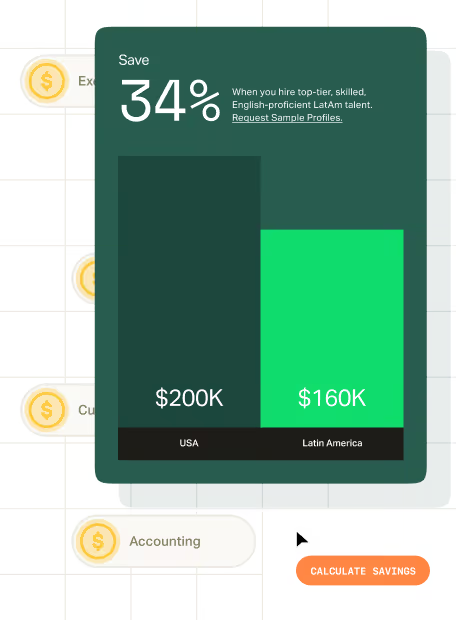
The main benefits of hiring international remote workers are that it expands your talent pool dramatically, so you can find the skills you need, and it reduces overhead costs by $35,000 to $55,000 annually per hire on average compared to hiring in the US.
If you’re already leaning toward hiring internationally, you probably know this makes sense. But if you’re still weighing the decision, here’s what hiring international workers from overseas actually delivers:
1. Access to the skills you need
When you’re limited to hiring locally, you’re competing for the same talent pool as everyone else. And given that, according to research from Manpower, 75% of employers struggle to find the talent they need, companies need more options.
Expanding your search globally—especially into regions like Latin America—gives you access to highly qualified professionals that you wouldn’t have been able to find (or perhaps afford) otherwise.
This isn’t about settling for "good enough." It’s about finding the right person with the exact qualifications and experience you need, whether that’s a specialized data analyst, a bilingual customer support rep, or a senior full-stack engineer.
2. It’s good for branding
Having a multicultural workforce is great for branding and attracting future candidates. Working with people from different countries can create a vibrant and stimulating work environment, helping you develop your employer brand.
This cultural exchange shows that you value diversity, collaboration, and a diverse approach to problem-solving and creativity.
3. Time zone flexibility that works for your business
Time zones can either be a massive advantage or a frustrating constraint—it depends on what you need.
If you’re looking to offer 24/7 coverage or extend your business hours with a "follow the sun" model, hiring in regions like Asia or Eastern Europe makes sense. Teams can hand off work at the end of their day, and another team picks it up immediately.
But if real-time collaboration is critical—daily standups, quick Slack check-ins, overlapping hours for project coordination—then Latin America is increasingly the go-to choice for US companies. You get near-complete overlap with US time zones, which means you can work together in real time without anyone logging on at 3 a.m.
4. You can save on salary costs compared to hiring in the US
One of the major benefits of hiring remote foreign workers is that their salary expectations are often lower than those of domestic employees due to their lower cost of living. Depending on the country, living costs can be significantly less than in the US.
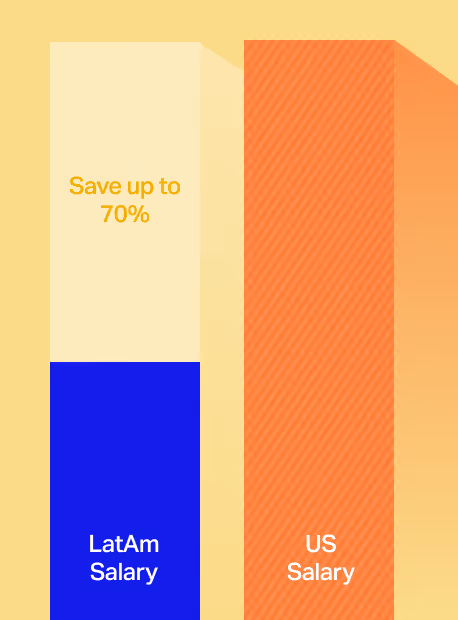
For example, US companies hiring remote foreign workers in LatAm can save anywhere from 30 to 70% of what they would pay a US employee.
According to Near’s State of LatAm Hiring Report, which analyzed 2,000 placements across 500 companies, US companies save an average of $35,000 to $55,000 annually per LatAm hire.
.avif)
You can take advantage of these cost savings by investing in a talented foreign workforce while reallocating resources to other areas, such as marketing, product development, or customer service.
5. Diverse work culture and new perspectives
When you employ overseas workers, you’re not just filling a seat—you’re bringing in someone with a different professional background, different problem-solving approaches, and different market insights.
This matters more than you might think. A team member who’s worked with European clients brings a different perspective to customer service. Someone trained at a Big Four firm in Brazil understands international accounting standards inside and out.
This variety of experiences can help your team avoid groupthink and approach challenges from multiple angles.
6. Multilingual capabilities for market expansion
If you’re expanding into international markets—or even just serving a more diverse US customer base—hiring team members who speak multiple languages fluently is a competitive advantage.
For example, we’ve seen this firsthand with clients like LifeSource Water Systems, who hired bilingual sales assistants through Near. One new team member set eight sales appointments in just eight days. You can check out their full case study to see how they cut costs by 60% while expanding their sales coverage to reach their Spanish-speaking clients.
7. Strong work ethic and motivation
Here’s something we see often: LatAm professionals often bring an exceptional level of commitment and drive. They’re motivated by the opportunity to work with US companies, they take pride in their work, and they’re not bringing the entitlement or burnout that sometimes comes with tight US labor markets.
This isn’t about exploiting wage differences. It’s about working with professionals who genuinely value these opportunities and deliver exceptional results because they want to grow alongside your company.

How Can a US Company Hire Remote Foreign Employees?
You have three main options for how to hire a remote foreign employee: establish a legal entity in their country, partner with an Employer of Record (EOR), or work with a specialist staffing company that handles both recruitment and compliance.
Here’s what each option means for your business:
1. Establish a legal entity
Setting up a legal entity means registering your business in the employee’s country so you can hire them directly as an employee of your company.
This requires establishing a subsidiary or branch office, which involves navigating local business registration requirements, obtaining licenses and permits, and setting up compliant payroll and benefits systems. You’ll also need to understand and follow local employment laws (like how much vacation or maternity leave is obligatory), tax regulations, and labor standards.
This approach gives you complete control over your international operations and makes sense if you’re planning to build a significant presence in that market—think dozens of employees, not just one or two hires.
The reality? This option is typically only viable for larger companies with dedicated legal and HR resources. The upfront costs are substantial, the timeline can stretch 3–6 months, and you’ll need ongoing legal and accounting support to maintain compliance as regulations change.
For most US companies looking to hire a few remote employees in Latin America or Asia, this is overkill.
2. Use an Employer of Record (EOR) company or platform
An Employer of Record is a third-party company that becomes the legal employer of your international workers on paper, while you maintain day-to-day management and oversight.
The EOR handles everything on the back end: employment contracts, payroll processing, tax withholdings, benefits administration, and ensuring compliance with local labor laws. You pay the EOR, and they pay your employee according to local requirements.
Think of it as outsourcing the legal and administrative complexity of international hiring. You get to hire and manage the talent you need without setting up a legal entity or becoming an expert in Argentine labor law.
Popular EOR platforms include Deel, Globalization Partners, Remote, and Oyster. These services typically charge a monthly fee per employee (for example, Deel charges $599 per employee per month) on top of the employee’s salary.
This is a solid middle-ground option if you’re hiring contractors or employees in multiple countries and want a standardized system for managing international payroll and compliance. You can read our comprehensive guide to using an Employer of Record to understand exactly how they work, or check out our article on the top EOR companies to find the best fit for your needs.
The trade-off? You’ll still need to source and vet candidates yourself—the EOR just handles the employment logistics.
3. Work with a specialist staffing company for remote offshore hiring
This option is the simplest for most companies: You partner with one of the specialist staffing and recruiting companies for offshore hiring, like Near, that handles both talent acquisition and all the employment logistics in one package.
For example, Near doesn’t just find you qualified candidates—we also manage payroll, benefits, compliance, and local employment requirements through our EOR services. You tell us what role you need to fill, we present you with pre-vetted candidates, and once you make a hire, we handle everything else so the process feels as seamless as hiring someone in the US.
This approach makes sense when you want both recruiting expertise and hands-off compliance management. You’re not spending time sourcing candidates on LinkedIn or navigating the nuances of Brazilian employment contracts. You’re getting a complete solution.
This is why this option has become so popular with US companies hiring internationally. The advantage of working with a specialized staffing partner for hiring remote international talent is getting access to qualified talent without having to become an expert in international hiring practices or employment regulations. The specialist staffing firm handles the entire process from start to finish.
This approach makes the most sense when you need both recruiting expertise and hands-off compliance management, and you want to focus on growing your business rather than becoming an international HR expert.
Which Option Is Right for You?
The option you choose depends on your growth plans, internal resources, and whether you need help with recruiting or just employment logistics.
- If you’re building a large international operation with plans to hire 50+ people in a specific country, establishing a legal entity might make sense long-term.
- If you’re hiring across multiple countries and already have candidates identified, an EOR gives you a streamlined way to manage international employment logistics.
- If you need help finding top-tier talent AND want someone to handle payroll and compliance so you can focus on growing your business, a specialist staffing company is your best bet.
No matter which route you take, the key is choosing a solution that lets you focus on what matters—building a great team that helps your business grow—rather than getting bogged down in international employment law.

9 Common Questions About Hiring Remote Workers in Other Countries
It’s essential to have a complete understanding of the process of hiring remote employees in other countries.
Here are some of the most frequently asked questions about how to hire overseas workers.
1. Does a remote worker in another country have to pay US taxes?
No, not necessarily. Generally, remote workers are only required to pay taxes in the country where they reside and work. However, some countries may require that you withhold taxes from a foreign employee’s paycheck or submit tax documents on their behalf.
Here is a list of documents you may be required to submit if your worker is an employee and not a contractor:
- A completed Form I-129, Petition for a Nonimmigrant Worker, and the filing fee
- An IRS 1099 Form documenting forms of payment
- Evidence of a valid employer-employee relationship (if they are not a contract worker)
- Evidence of the foreign worker’s qualifications for the position
- Proof that hiring a foreign worker will not adversely affect working conditions or wages of similarly employed US workers
For contractors, use Form W-8BEN, also known as a Certificate of Foreign Status of Beneficial Owner for United States Tax Withholding and Reporting. International contractors must fill this out to prove their foreign classification with the IRS.
It is always best to consult an attorney to ensure accuracy and compliance with all applicable laws and regulations.
You should also use an attorney’s advice when determining if a worker is an employee or a contractor, as misclassifying your workers could lead to penalties down the road.
2. Do I need to worry about paying taxes in an overseas worker’s home country?
Yes, when you hire a remote worker in a foreign country, it is important to consider the taxation laws of their home country.
Depending on the specific employment regulations in that country, you may be responsible for paying taxes on behalf of your employee. However, if you partner with a remote hiring agency or an EOR provider, they will likely take care of this process for you.
3. Do I have to take care of overseas remote workers’ benefits like health insurance?
It depends. If you are hiring remote foreign workers as employees, you need to account for remote workers’ benefits, such as health insurance. Depending on the country you are hiring in, you may have to meet certain legal requirements to offer a fair and legal employment package to your remote worker.
However, if you plan on hiring your remote foreign workers as remote contractors, you are not required to pay for benefits. However, many companies will still offer some benefits to contractors, such as paid time off (PTO), as benefits play an important role in retention.
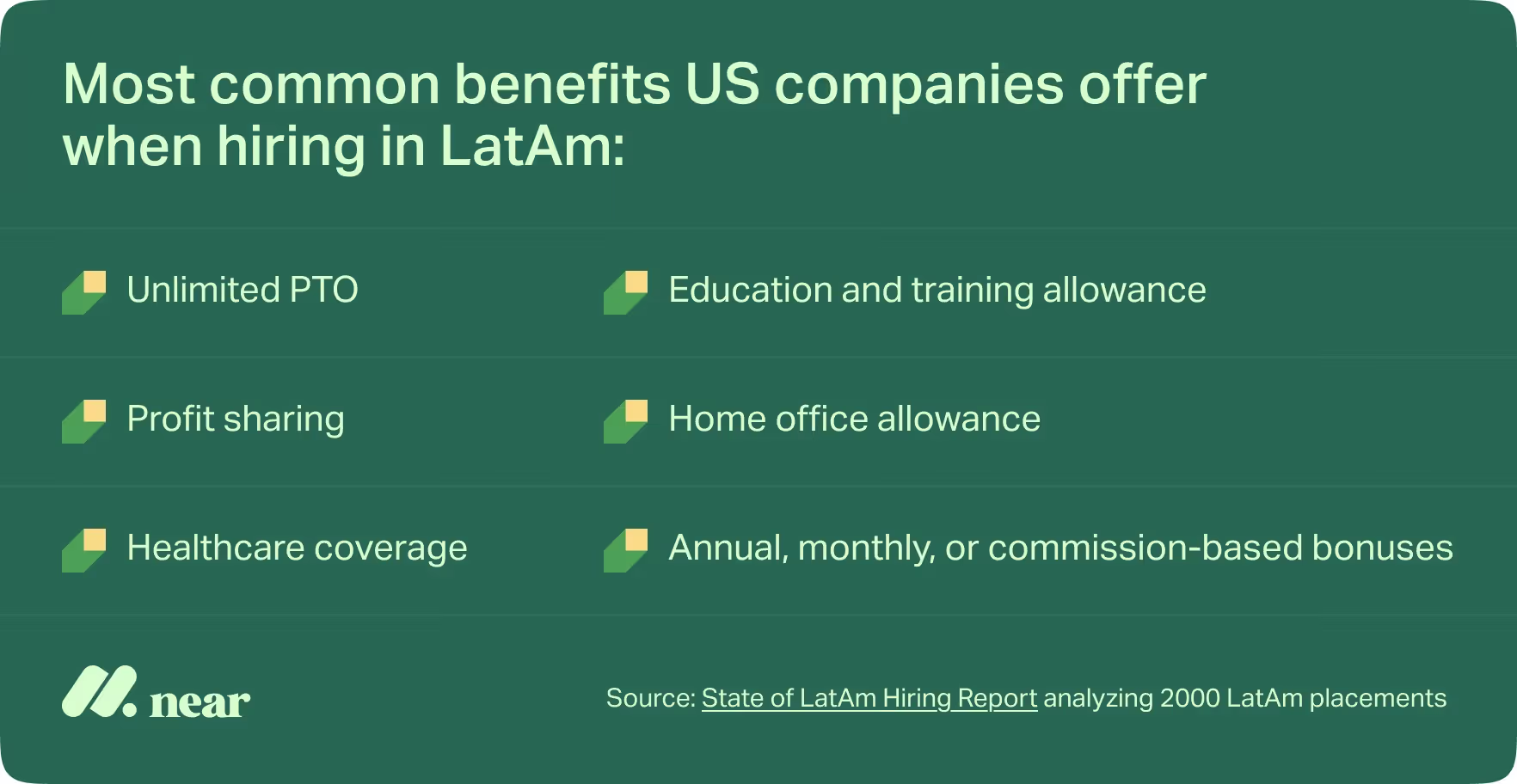
For example, the companies we work with choose what benefits they offer their hires, but often they include PTO, profit sharing, training allowance, commissions, healthcare stipends, and home office allowances.
Further reading: 12 Benefits and Perks You Can Offer Remote Talent
4. Are remote foreign workers independent contractors?
It depends. Generally, you should hire foreign remote workers as independent contractors if they provide services independently and without direction from your business. Nevertheless, it’s always best to consult with a legal expert where you plan to hire remote foreign workers as contractors rather than employees before making any decisions.
5. How does the remote foreign contractor model work?
Hiring remote workers as contractors is a popular way to bring on remote workers from other countries because it allows you to hire individuals on a freelance basis rather than having them as full-time employees.
This can provide flexibility and cost savings regarding taxes and payroll administration. Additionally, it offers flexibility and, often, better salaries for remote contractors.
In this model, you contract with an individual or company to do specific tasks for your company remotely. As part of this arrangement, the contractor agrees to take on a certain amount of work or number of hours per week and to return specific deliverables.
You pay for these services directly without having to manage the employee’s taxes.
6. Does an international remote worker need a visa?
No, when you hire offshore employees for remote work that they will do from their country, they do not need a work visa. Foreign remote workers don’t require visas because they are based outside of the US.
7. Should I pay for remote workers’ equipment?
This usually depends on the working relationship. If your foreign remote worker is an employee, you should pay for the necessary equipment they need to do their job. Depending on the specific job role, this could include a computer, software licenses, or other tools.
It’s important to ensure your foreign employee has everything they need to be successful and productive working from home. However, if you are working with contractors, you are not normally expected to pay for their equipment.
8. Do remote foreign employees have good internet service?
The speed and reliability of internet service have improved significantly in many parts of the world in recent times. However, if you’re hiring remote employees in a country with less developed infrastructure, there may be bandwidth and connection speed issues.
Make sure to research the country’s local internet access before making any remote hires. You can also assess this when you conduct virtual screening interviews, or there are many platforms you can use to conduct internet speed tests.
9. How can I retain top remote international talent?
Retaining skilled talent is essential when hiring remote foreign employees. To ensure the best results, provide competitive compensation and benefits tailored to their country’s job market.
You should also offer a comprehensive onboarding process and stay in touch with your workers by setting up regular check-ins and providing ongoing feedback about their performance. Finally, offering career growth opportunities such as training programs or promotions can help keep your remote team motivated and engaged.
Further reading: How to Make Remote Hires Feel Like Part of the Team
{{offshore-talent}}
How Can a US Company Pay Remote Foreign Workers?
Payment depends on whether you’re hiring international employees or contractors: employees are paid through your hiring structure (legal entity, EOR, or staffing company), while contractors are paid through international payment platforms like Deel, Payoneer, or Wise, or through freelancer marketplaces.
If you’re hiring someone as a remote foreign employee, payment logistics are already covered by whichever option you chose above—whether that’s your legal entity, an EOR, or a specialist staffing company. EoRs and staffing companies handle payroll, tax withholdings, and compliance automatically. If you have a local entity, you’ll be making payments within the country using something like bank transfers.
But if you’re hiring foreign contractors—think freelance graphic designers, short-term consultants, or specialists for project-based work—you have more flexibility and fewer regulatory requirements, so you might not hire through a third-party. Contractors manage their own taxes and benefits, which simplifies things on your end.
Here’s how to pay international contractors:
Direct payment platforms
Several platforms specialize in international contractor payments and make the process straightforward:
- Deel - While Deel is known for EOR services, they also offer contractor management that handles contracts, invoicing, and payments for independent contractors across multiple countries.
- Payoneer - A payment platform that lets you pay contractors in their local currency. Contractors receive payments directly to their Payoneer account or local bank account.
- Wise (formerly TransferWise) - Offers low-fee international transfers and lets you pay contractors in their local currency. Good for one-off or recurring payments to independent contractors.
These platforms typically charge a small transaction fee but handle currency conversion and compliance documentation (like tax forms) on your behalf.
We go into more depth on these options in our article 7 ways to pay international contractors.
Freelancer Platforms
If you’re hiring through freelancer marketplaces, payment is built into the platform:
- Upwork - Connects you with freelancers globally and handles all payment processing, invoicing, and contractor agreements through their platform.
- Toptal - Specializes in top-tier tech and finance talent, with built-in payment processing and contractor management.
- Fiverr - Best for smaller projects and specific deliverables, with integrated payment systems.
The advantage of these platforms is that they streamline the entire process— contracts, project management, and payments—all in one place. The trade-off is you’re limited to talent on their platform, and they typically charge service fees on top of the contractor’s rate.
Regardless of the platform you choose for paying your international workers remotely, conduct thorough research to find the best solution for your business needs.
Which Roles Are Suitable for Hiring International Remote Workers?
Any role that can be performed remotely is suitable for hiring overseas employees, including software engineering, customer service, financial analysis, accounting, sales, administrative support, and virtual assistance.
Remote work is well-suited to a wide range of roles. Here are just a handful of roles in which remote workers are highly successful:
- Administrative support
- Virtual assistants
- Customer service
- Financial analyst
- Accountants
- Outbound sales reps
- Software engineering
With proper planning and organization, remote foreign hires can thrive in a variety of roles in your business. We consistently see that if the role can be done remotely, there is no reason to limit yourself to hiring in the US.
Further reading: Offshoring Explained: Is There a Role You Could Be Offshoring?

Should You Hire Offshore or Nearshore Remote Workers?
Nearshore hiring (Latin America for US companies) is better for roles requiring real-time collaboration and customer interaction, while offshore hiring (Asia, Africa) works for asynchronous work where time zone overlap isn’t critical.
Your biggest hiring decision when hiring remote employees in other countries isn’t just how to hire remotely—it’s where those remote workers will be based, because geography determines a lot about how you’ll work together.
A quick note on terminology: Throughout this article, we use “offshore” broadly to describe any international hiring outside the US. But in this section, we’re making a specific comparison between two types of offshore hiring—distant offshore regions (like Asia or Eastern Europe with significant time zone differences) versus nearshore ( Latin America with overlapping working hours).
Before you dive into sourcing candidates and evaluating platforms, you need to understand the practical differences between offshore and nearshore hiring. The wrong choice here can turn what should be seamless teamwork into a logistical headache.
Hiring offshore remote workers
Hiring offshore employees involves recruiting talent in countries in a distant geographical location, such as hiring in the Philippines or India. This approach often offers the lowest labor costs, allowing businesses to save on operational expenses.
However, time zone differences hinder real-time communication and collaboration, making coordination more challenging. Cultural and language barriers might also arise, which can affect team cohesion and effectiveness.
Hiring nearshore remote workers
Nearshore outsourcing or hiring involves working with individuals from countries closer to your location, such as those in Latin America for US companies. This approach provides more overlap in working hours, facilitating smoother communication and more efficient collaboration.
Cost savings may not be as pronounced as with offshore options in Asia. However, the balance between cost and operational efficiency often makes nearshore hiring the more attractive choice.
What this means in practice:
- You can have actual conversations during your workday—no waiting 24 hours for responses
- Team members can attend standups and collaborate in real-time
- Problems get solved in hours, not days
- Your developers, account managers, or support reps are available when your US customers need them
Plus, Latin American professionals often have strong cultural alignment with US business practices, excellent English proficiency, and experience working with American companies. You’re building integrated team members, not managing a distant satellite operation.
We think nearshore hiring is the best way for US companies to cut costs and scale. But it depends on what your business is looking for.
If you’re primarily looking for work that can be done asynchronously (like certain development tasks that don’t require constant collaboration), and you’ve got systems in place to handle significant time zone differences, offshore hiring to distant regions could work.
But if you need real-time collaboration, customer-facing roles, or simply want to avoid the complexity of managing teams 12 hours away, nearshore hiring gives you the best of both worlds: significant cost savings with the operational simplicity of working in overlapping hours.
Further reading: Why More US Businesses Are Hiring in Latin America: What We Learned from Talking to 2,000 Hiring Managers
{{salary-guide-cta}}
How do I find qualified candidates when hiring overseas?
To find qualified candidates when hiring overseas, you can either source candidates yourself through international or specialist job boards and LinkedIn, or work with a recruitment partner who already knows the talent landscape in your target region—many companies choose the latter to save months of trial and error.
If you’re sourcing overseas candidates yourself, here’s the process:
- Step 1: Create a detailed job description. Write a clear job description that includes required skills, experience level, and specific working hours expectations. Be explicit about time zones—for example, "Must be available 9 am to 5 pm Eastern Time" or "Requires 4+ hours overlap with US Pacific Time." See how to write a job description for remote talent.
- Step 2: Post on region-specific job boards. Different countries have different dominant job platforms. Popular boards in Latin America include CompuTrabajo and Get on Board. LinkedIn works globally but may require premium recruiting tools for effective outreach in specific markets.
- Step 3: Source and screen candidates. Review applications with an understanding of local credentials—what constitutes a "top university" or "reputable company" varies by country. For example, a degree from Universidad de Buenos Aires or Tecnológico de Monterrey carries weight in LatAm the same way a Stanford degree does in the US.
- Step 4: Conduct assessments and interviews. Use skills assessments relevant to the role, and conduct video interviews to evaluate communication skills and cultural fit. Pay attention to English proficiency if that’s critical for the role.
See the best interview questions to ask remote workers. - Step 5: Verify credentials and conduct background checks. Research which background check providers operate in your target country. International background checks can take 2 to 4 weeks.
This DIY approach works, but it’s time-intensive and requires significant learning about each country’s talent market, credential standards, and hiring norms.
Working with a recruitment partner to find and hire international employees
Most US companies hiring international employees work with specialized recruitment firms that already know the talent landscape. Global staffing agencies or regional specialists have established relationships with top candidates, understand which universities and companies produce the best talent, and can surface qualified candidates in days rather than months.
For example, Near delivers curated shortlists of pre-vetted LatAm candidates within 5 days because we’ve spent years building relationships in these markets and understand exactly what "qualified" looks like in Argentina, Brazil, Colombia, and Mexico.
There are many benefits of working with a recruitment partner. But one of the main reasons it has become standard for companies hiring international employees is that it eliminates the trial-and-error phase of learning new markets while you’re trying to fill urgent roles.
What Companies Should You Consider for Easily Hiring and Paying Remote Overseas Employees?
Three types of companies help with hiring overseas employees: specialist staffing firms like Near that handle recruiting, payroll, and compliance for permanent hires; freelancer marketplaces like Toptal for project-based work; and EOR providers like Globalization Partners for compliance management when you’ve already identified candidates.
There are dozens of companies that can help you hire and pay overseas workers, but to get you started, we’re highlighting three options that cover the main approaches: a recruiting and staffing firm for permanent hires, a freelance marketplace for project work, and an EOR for compliance management.
Below, we highlight three reputable firms that can help you hire remote workers in other countries, depending on which method you choose.
1. Near
Near specializes in helping US companies build permanent teams with top LatAm talent. We handle everything from sourcing and vetting to payroll and compliance, finding A-players that companies wouldn’t have surfaced on their own. We deliver curated shortlists within 5 days, and most clients hire in under 3 weeks. As part of our white-glove service, we’ll even source equipment and office space if that’s what you need.
Best for: Companies seeking to build permanent, high-performing teams with LatAm talent who want a full-service partner to handle recruiting, compliance, and ongoing support.
2. Toptal
Toptal operates as a premium freelance talent marketplace connecting companies with elite professionals worldwide. They specialize in software development, design, finance, and project management, with rigorous vetting that accepts fewer than 3% of applicants. Toptal handles payroll and compliance through their platform, offering flexible engagement options with trial periods.
Best for: Companies needing specialized expertise quickly for short-term projects or ongoing contract work, rather than building permanent teams.
3. Globalization Partners
Globalization Partners offers a suite of services aimed at simplifying global employment. Their client list includes large household names like Kraft, Hertz, and Hard Rock Cafe. Known for its EOR capabilities, it enables companies to onboard and manage remote foreign employees quickly and compliantly.
Best for: We think Globalization Partners is best for large companies with an in-house recruitment team that is already skilled at international hiring and just needs EoR services.
{{prevetted-banner}}
Final Thoughts
Now you know your options for hiring workers from overseas—entity, EOR, freelance platforms, or staffing partner—and how each one works. The right choice depends on your specific situation: how many people you’re hiring, what roles you need to fill, and how much recruiting bandwidth your team has.
If you’re considering working with a staffing partner to handle both recruiting and compliance, we’re happy to walk you through what that actually looks like. On a quick call, we can share salary benchmarks for the specific roles you need to hire, explain our process and typical timelines, and answer any questions about how this works in practice.
We’ve helped over 700 companies build teams in Latin America—from single hires to entire departments—and we know the questions that come up. Whether you’re ready to move forward or just exploring your options, we can give you the information you need to make the right decision for your business.
Schedule a free, no-commitment consultation call to discuss your hiring needs and get specific salary data for the roles you’re looking to fill.
Frequently Asked Questions
What if I need a specific technical role?
You can hire specialized technical roles the same way—nearshore or offshore, depending on how much real-time collaboration the work requires.
For example, many US companies hire offshore web developers for cost-focused, asynchronous work, or bring on mobile app developers nearshore when the project needs tighter collaboration. If Mexico's overlapping time zones and bilingual talent pool fit your needs, see our breakdown of nearshore software development in Mexico.
How long does it take to hire a remote employee in another country?
Most companies can hire a remote foreign employee in two to four weeks when working with a specialized staffing partner, compared to two to three months going it alone.
The timeline depends heavily on how you source: posting on international job boards and vetting candidates yourself takes the longest, while a partner with an existing pre-screened talent pool can share a shortlist within days. Compliance setup (contracts, payroll, EOR paperwork) typically runs in parallel and doesn't add meaningful delay if you're working with the right partner.
How do I make sure a remote hire integrates well with my US team?
Treat them like any other core team member from day one—same tools, same meetings, same context, not a separate "remote" tier.
Give them access to your Slack, project management systems, and recurring standups immediately, and assign a point person for questions during onboarding. Companies that treat international hires as fully embedded team members, rather than outsourced support, see far better retention and collaboration than those who keep them at arm's length.







.webp)


%203.svg)
.avif)






%20(1).avif)

%20(1).png)