%20(1).avif)


%203.svg)
Key Takeaways
- Outsourcing software development to Colombia gives you a team on US hours at a lower cost base than a US hire: mid-level engineers have salary expectations of about $26 to $35 per hour ($54,000 to $72,000 a year) against $115,000 to $195,000 in the US, and any vendor quote sits above that floor.
- Colombia sits at UTC-5 all year, so most US teams share most of their workday with a Colombian team, a common reason companies move work away from offshore teams in Asia-Pacific.
- Colombia has a fast-growing talent base (1.7 million GitHub developer accounts, up 37% in a year) concentrated in Bogotá, Medellín, Cali, and Barranquilla, and the engagement model you choose matters as much as the country.
Hiring senior software engineers in the US usually takes 3–4 months, costs $150K+ in salary, and puts you in direct competition with every funded startup in your market. Meanwhile, outsourcing to India or the Philippines is technically solid, but out of sync with your workday.
There’s a closer option that answers both problems: software development outsourcing to Colombia.
Colombia is where a growing share of that nearshore software work is going. The country had 1.7 million developer accounts on GitHub as of Q1 2026, according to GitHub’s Innovation Graph, and it sits at UTC-5 all year, within an hour of US Eastern and Central time. On cost, our salary data puts software engineers in Latin America at 26–35 an hour, against 55–94 in the US.
In this article, I cover what you need to know about outsourcing software development to Colombia: the costs, how the country compares to other Latin American options, what to watch out for, and for many companies, an even better alternative: hiring software engineers in Latin America without the typical US recruiting timeline.
What Does the Software Development Market in Colombia Look Like?
Colombia's software development market is large and growing: the country has a developer community growing 37% a year, according to GitHub's Innovation Graph, and an ICT market estimated at more than $12 billion in 2025.
For US companies weighing outsourcing or hiring in Colombia, that means a deep, expanding talent base to draw from, concentrated in a handful of major cities.
Before getting into the details, here's how Colombia compares with other common software development outsourcing destinations on the factors that shape day-to-day collaboration:
Sources: GitHub Innovation Graph, Q1 2026 (developer community) and EF English Proficiency Index 2025 (English proficiency bands, mapped from EF's official score ranges).
A fast-growing developer community
Colombia had about 1.7 million developer accounts on GitHub in the first quarter of 2026, up 36.9% year over year, according to GitHub’s Innovation Graph.
That’s the fastest growth among the region’s largest developer communities, ahead of Brazil (36.4%), Mexico (35.1%), and Argentina (30.7%).
Rising US demand for software developers
US demand for software developers keeps climbing. The US Bureau of Labor Statistics projects employment of software developers, QA analysts, and testers to grow 10% from 2025 to 2035, much faster than the average for all occupations. That works out to about 106,100 openings a year on average, according to the BLS Occupational Outlook Handbook.
At the same time, 69% of US employers report difficulty finding the skilled talent they need, according to ManpowerGroup's 2026 Talent Shortage Survey.
That combination of growing US demand and an expanding Colombian talent base is why software development outsourcing in Colombia keeps growing, with most of the work landing in Bogotá, Medellín, Cali, and Barranquilla.
Education and English skills
Colombia has been widening access to higher education and pushing bilingualism. The country's gross tertiary enrollment ratio reached 59.3% in 2022, the latest year available, up from 54.8% in 2015, according to World Bank data.
The government has also invested in English education, and many high schools and universities now set English proficiency benchmarks for students before graduation.
English is strongest in the tech hubs. Colombia's national score falls in the Low band of the EF English Proficiency Index 2025, but Bogotá, Medellín, and Barranquilla score in the Moderate band. That's where most of the country's software engineers work, and it's why screening individual candidates is more important than solely relying on the national average.
Government support for the tech sector
Colombia's government actively promotes the technology sector. ProColombia, the country's official trade and investment promotion agency, has positioned Colombia as a technology destination through campaigns like “Bring IT On.”
The sector has kept growing since: Colombia's ICT market reached $10.28 billion in 2023 and an estimated $12.34 billion in 2025, according to the US International Trade Administration, which also notes that the local software industry has numerous development firms, many expanding regionally.
Why Outsource Software Development to Colombia?
US companies outsource software development to Colombia for three main reasons: a lower cost base than a US team without lowering the seniority bar, overlapping working hours, and senior engineers familiar with US business norms.
Lower costs without lowering the seniority bar
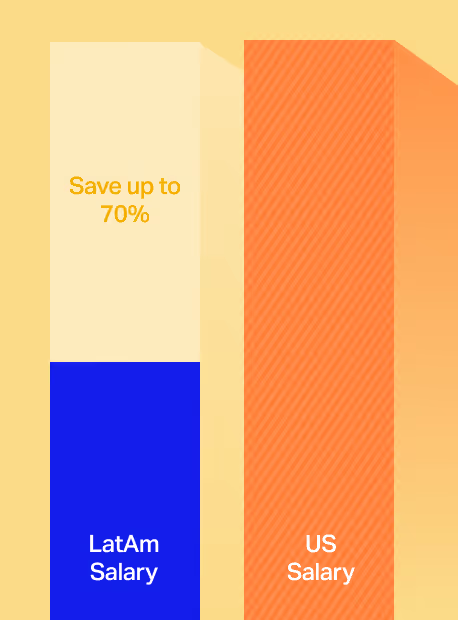
According to our benchmark, Colombian software engineers earn 30–70% less than comparable US engineers, and that gap comes from a lower cost of living, not from lower skill levels. You can hire experienced mid-level and senior developers for less than a US hire at the same level would cost.
You also avoid US hiring overhead: recruiting fees, benefits packages priced for a US cost of living, and the weeks of lost productivity that come with a 3–4 month hiring timeline.
I'll share cost and salaries in a later section.
Real-time collaboration during your workday
Colombian developers are online during your business hours, whether your team runs on Pacific, Mountain, Central, or Eastern time.
Colombia roughly aligns with US Eastern Standard Time and doesn't observe Daylight Saving Time, so the gap with your team shifts by an hour when US clocks change, but most US teams still get a full working day of overlap, as you can see in the table below:
That overlap is a big part of why companies move work out of Asia. A study by researchers at Harvard Business School, Georgetown, and Rice, published in Organization Science, found that real-time communication drops as the time difference between colleagues grows. The researchers suggested that companies favor north-south distributions of their workforce, which keeps teams in the same or nearby time zones.
In practice, daily standups happen live, code reviews don't wait until the next morning, and urgent bugs get fixed the same day. It's one of the most common questions tech leaders ask about hiring developers in Latin America, and the answer is yes: they can join your standups.
The caliber of Colombian engineering talent
Colombian engineers bring senior-level experience and familiarity with how US teams work. Colombia shares many business practices with the US and has long been exposed to US markets, so developers there tend to know US norms around direct communication, project management tooling, and iterative development. That often shortens onboarding.
I've talked to Hire With Near's recruiting team this year and the same observation comes up: US clients expect to find good developers and end up finding engineers with deeper experience than they planned for. Julia Guillen, a Senior Tech Recruiter at Hire With Near, sees it constantly:
Clients are consistently surprised with the caliber of talent that's available in LatAm. They don't expect to find senior engineers who've worked with major U.S. companies, understand modern development practices, and often have more hands-on experience with specific frameworks than candidates they'd find locally.
— Julia Guillen, Senior Tech Recruiter, Hire With Near
Hire With Near's engineering recruiters also find that the strongest Colombian developers are proactive communicators. They flag blockers early, keep their managers updated, and raise problems before they turn into missed deadlines.
What Are the Major Tech Hubs for Outsourcing Software Development in Colombia?
Colombia's four major tech hubs for software development outsourcing are Bogotá, Medellín, Cali, and Barranquilla. Bogotá and Medellín hold the deepest engineering talent pools, while Cali and Barranquilla are smaller, growing markets. Connectivity is also strongest in these major cities, which matters for full-time remote work.
Bogotá

Bogotá is Colombia's largest tech market and the main destination for foreign technology investment. The city has attracted 60% of all foreign direct investment projects in software and IT entering Colombia over the past six years, generating more than 42,000 jobs in these sectors, according to a 2025 report from Invest in Bogotá, the city's investment promotion agency.
Invest in Bogotá also reports that the city is home to 39% of the country's bachelor's graduates in software and systems-related fields and holds Colombia's largest pool of bilingual talent.
Bogotá scores in the Moderate band on the EF English Proficiency Index.
Medellín
Medellín has built its tech scene around a deliberate innovation strategy. Ruta N, the city's innovation and business center, was established in 2009 by the municipality and local utility and telecom companies, and Medellín has since been designated a Special District of Science, Technology and Innovation.
Medellín posts the highest English proficiency score of these four hubs on the EF English Proficiency Index 2025, within the Moderate band.
Cali

Cali is Colombia’s third-largest city and its main software hub in the southwest. It’s home to ParqueSoft, a software technology park that helped launch dozens of local companies, and local firms work across corporate systems, cybersecurity, IoT, AI, and big data.
English proficiency there sits in EF’s Low band, so English screening is especially important for client-facing roles.
Barranquilla
Barranquilla, on Colombia’s Caribbean coast, is a smaller but growing tech market. Its tech community centers on software and fintech startups, and CaribeTIC, the Caribbean region’s tech industry cluster, is based in the city.
English proficiency score is in EF’s Moderate band, close to Bogotá and Medellín.
What Is the Cost and Salary Comparison for Software Development Roles in Colombia?
When you outsource software development to Colombia, you pay a vendor’s rate. That rate is what the engineer earns plus the vendor’s recruiting, benefits, management, and margin, and it’s billed hourly, monthly, or per project.
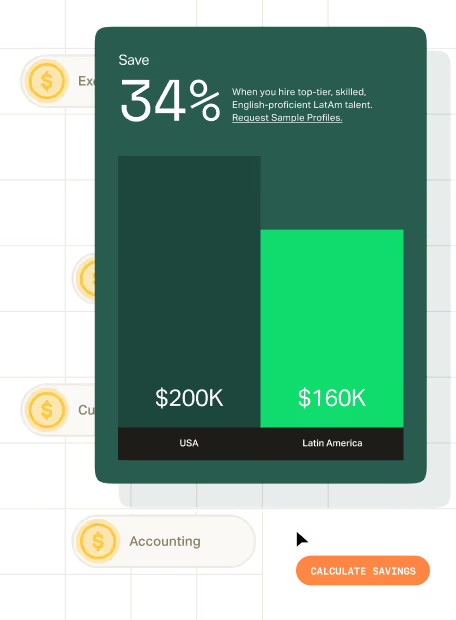
Our IT roles salary data shows what Colombian developers earn, which sets the floor under any vendor quote. According to our data, a mid-level software engineer in Latin America, including Colombia, earns $4,500 to $6,000 ($54K–$72K a year, about 26–35 an hour at full time), compared with $115K–$195K a year for a comparable US hire.
Here’s what developers in the core roles earn in Latin America compared with their US equivalents, according to Hire With Near’s salary benchmarks:
For the most up-to-date figures, see Hire With Near's US vs Latin America Salary Guide.
Many outsourcing vendors quote hourly, so here’s the same salary data as hourly figures for mid-level roles. They show what the developer earns, not what a vendor bills, so use them as a floor when you compare quotes:
Hourly figures are full-time salary equivalents (annual salary divided by 2,080 working hours), not vendor billing rates. Savings reflect salary differences only, and a vendor’s margin reduces them.
A vendor’s quote always lands above those figures. If a quote is far above the floor, you’re paying a large markup. If it’s at or below it, ask what the vendor is cutting, because the developer still has to be paid.
What you pay on top depends on how you outsource or hire:
- A project vendor builds its margin into a fixed price or an hourly rate.
- A staff augmentation firm bills an hourly or monthly rate with a markup on the engineer’s pay.
- A staffing and recruiting partner charges a fee on top of the engineer’s salary, and the engineer then joins your own team.
Because salaries in Colombia sit 30–70% below US levels, there’s room for a vendor’s margin and still a cost below a US hire, but the gap narrows as the margin grows. That’s why the all-in cost per engineer is the number to compare across providers.
At salary level, hiring two to three mid-level engineers in Latin America often costs about the same as one comparable US hire.
These savings don’t come from junior developers. According to Hire With Near’s 2026 State of LatAm Hiring Report, 98% of the engineering placements we made were mid-level or senior, so the ranges above reflect experienced engineers. Seniority is what drives where a hire lands within each range.
{{state-latam-hiring}}
Colombia vs. Other Latin American Countries for Software Development Outsourcing
Colombia is one of the strongest Latin American choices for software development outsourcing when real-time collaboration with a US team matters most. Mexico, Brazil, and Argentina are also very good options, each with strengths of its own.
If you're comparing the best countries for software development outsourcing, here's how Colombia stacks up against each, and against offshore alternatives like India and the Philippines.
Colombia vs. Mexico
Mexico has a larger developer community (2.9M vs. 1.7M) and lines up roughly with US Central time, which makes it a natural fit for companies in the Central states. Colombia roughly aligns with US Eastern Standard Time, though the gap shifts by an hour in summer because Colombia doesn't observe Daylight Saving Time.
On English, Colombia scores higher than Mexico on the EF English Proficiency Index 2025 (480 vs. 440), which can matter for client-facing engineering work.
Colombia and Mexico price higher within Latin America than Argentina or Brazil, but outsourcing to any of the four still costs well below what a comparable US team would.
Related reading: Outsourcing to Mexico: Pros, Cons, and Best Roles to Outsource in 2026
Colombia vs. Brazil
Brazil is a great option too, and our guide to software development outsourcing in Brazil covers it in depth. It has the largest developer community in Latin America by a wide margin. If raw talent pool size is the priority, Brazil wins.
The largest cities in the country run one to two hours ahead of US Eastern, depending on the time of year, so East Coast teams share most of the day, while West Coast teams get a shorter window than they would with Colombia or Mexico.
Brazil and Colombia land in the same EF English Proficiency band (Low) nationally, so in both countries the English level of the individual engineer matters more than the national average. If you need daily communication and overlap across all US time zones, Colombia is often the better fit.
Colombia vs. Argentina
Argentina stands out for English: it scores in the High band on the EF English Proficiency Index 2025, ranking 26th worldwide and first in Latin America, well ahead of Colombia. It also has a developer community of 1.6M on GitHub (close to Colombia's 1.7M) and is often among the lower-cost options in the region.
Colombia wins on time zone overlap. Like Brazil, Argentina runs one to two hours ahead of US Eastern, depending on the time of year, so teams on the West Coast share less of their day with Argentine developers than with Colombian ones.
If English is your top priority and your team sits in the Eastern or Central states, Argentina is worth a close look.
Colombia vs. India and the Philippines
This is where the difference is sharpest, and it's about the working model, not the engineers. India and the Philippines have large, skilled developer communities, but their workday barely overlaps a US schedule. A question sent in your afternoon waits until the next day, and a bug found at 3 p.m. can sit overnight.
One founder described what the India time zone gap costs in practice:
I'm literally ticked off yesterday... You lose a day every single time just from a message. I can't do that anymore. They're 12 hours away.
A Colombian developer is at their desk during your business hours, so the same question gets answered the same day. For teams that ship continuously, that difference compounds across every sprint.
What Are the Challenges of Outsourcing Software Development to Colombia?
The main challenges of outsourcing software development to Colombia are uneven vendor quality, team turnover on your project, communication and workday overlap, data security and IP ownership, connectivity outside major cities, and contract terms. All six are manageable when you vet the vendor carefully and put the answers in the contract.
Here’s what to plan for:
Vendor quality varies
Colombian development firms range from large, established companies to small shops, and a polished website doesn’t show which one you’re dealing with.
Check client reviews on G2 or Clutch, ask for references on projects like yours, and start with a small, scoped first phase before committing to a larger engagement.
Our roundup of software development outsourcing companies is a good place to start comparing.
Team members can change mid-project
Vendors can move engineers between accounts, so the people you meet during the sales process may not be the ones doing the work six months later.
Ask who will be assigned to your project, how long they’re expected to stay, and what happens if someone leaves.
Get named engineers, a replacement process, and a handover plan into the contract, and keep documentation in your own repositories so the knowledge stays with you.
Communication and workday overlap
Colombia runs on UTC-5 all year, so it lines up with US Eastern time and sits within an hour of Central. West Coast teams share a shorter window.
Ask the vendor to commit to core overlap hours in the contract. Also ask to speak with the engineers who will do the work, not only the account manager or sales lead, so you can judge their English and how they explain technical decisions for yourself.
Data security and IP ownership
The vendor’s engineers will have access to your code and systems, so security and ownership need to be written into the contract from day one. Colombia has its own data protection law, Law 1581 of 2012, which companies handling personal data need to follow. If you handle data on EU or California residents, GDPR and CCPA can apply too.
Require NDAs, encrypted communications, least-privilege access, and no client data on personal devices, and make sure the contract states that your company owns the code and that the repositories sit in your accounts.
Connectivity varies outside major cities
Major cities like Bogotá and Medellín have stable internet infrastructure. However, some remote areas may experience connectivity issues, which can affect productivity and communication.
Ask the vendor where its engineers work and what backup internet and power they have, so an outage doesn’t stall a sprint.
Contract and compliance terms
One of the common outsourcing mistakes is leaving contract and compliance terms vague. Ask the vendor to explain in writing who employs the engineers and who handles their local labor and tax obligations.
Check which country’s law governs the contract and how disputes get settled, and have a lawyer review the agreement before you sign.
Clear answers to those questions up front prevent most of the surprises that show up later as unexpected costs or disputes.
Which Engagement Model Fits Your Software Development Needs in Colombia?
The right engagement model for software development in Colombia depends on how much of the work you want to own. If you want a vendor to run delivery, choose project outsourcing or a vendor-managed dedicated team. If you want flexible capacity working under your direction, choose staff augmentation.
There’s also a fourth option: hiring permanent engineers you keep long term through a staffing and recruiting partner. If you’re still deciding whether to hire an in-house developer or outsource, the models below run from most hands-off to most integrated.
Here's how the four models compare:
Project outsourcing
With project outsourcing, you hand a defined build to a vendor, and the vendor owns delivery. It works for fixed-scope projects you don't need to maintain long term, and many Latin American outsourcing companies offer it.
The downsides are less control, an extra layer between you and the engineers, and knowledge that leaves with the vendor when the contract ends.
The founder of an early-stage consumer AI app startup described where that model broke down for them:
We've been working with a boutique company that does — they're a one-stop shop, they do all types of the full tech stack, UI/UX, AI prompting, engineering. But they're a little expensive for the work that they're doing. They're not meeting deadlines. The app isn't working as specified. So that's why I'm looking to hire either a part-time transitional engineer... or a full-time senior engineer slash AI developer, someone that understands how to work with AI, to help us optimize the app so that it's stable.
Dedicated team
A dedicated team is a group of engineers a vendor staffs for you long term, while the vendor stays their manager. It gives you ongoing capacity, but you're still working through an agency layer.
That middleman layer is why many companies eventually move on. In our sales calls with US companies hiring engineers in Latin America, 15% were leaving a development outsourcing firm, and another 30% were leaving an offshore team in a distant time zone. That’s 45% leaving another model, and only 26% came primarily for cost savings.
Our guide to the outsourced development team model covers how these arrangements are usually structured.
Staff augmentation
With staff augmentation, pre-vetted engineers join your team and work under your direction, while the partner handles employment, payroll, benefits, and compliance.
It's a fast way to add capacity for flexible or project-based needs without building a hiring operation in Colombia.
Plenty of staff augmentation firms operate in Latin America and many keep a bench of talent ready to deploy, though turnover tends to be higher when assignments end.
Our comparison of staff augmentation vs. outsourcing for software development explains where each one fits.
Direct hire through a staffing and recruiting partner
Direct hire means permanent engineers who join your team, report to your managers, and own your codebase long term. You can do it yourself by sourcing candidates on job boards and LinkedIn, then employing them through your own Colombian legal entity or an employer of record (EOR). An EOR handles contracts, payroll, and local compliance, but it doesn't find or vet candidates for you, so the recruiting is still on your plate.
A staffing and recruiting partner does both jobs at once. It sources and vets candidates, and once you make a hire, it handles payroll, benefits, and compliance. It's the simplest path to hiring Latin American developers directly, and it's the model behind our guide to how to hire developers in Colombia.
The job descriptions US companies sent us for engineering roles show what they want instead of a vendor team. Of the job descriptions we analyzed, 51% ask for ownership, 56% ask for autonomy or a self-starter, and 76% ask for communication skills. That describes an engineer who joins your team, not one working to a vendor’s brief.
ParkMobile, a global mobility and parking platform, made exactly this shift. Its back-end and platform work had been handled by third-party agency developers for years, and its Head of Engineering for Mobile Payments and Billing saw the risk clearly: “From a business viability perspective, it creates a huge risk for us.”
ParkMobile wanted to hire in Colombia, a market it had never recruited in, so we helped them. We ran sourcing, English screening, references, and compliance, and placed 9 senior engineers across platform, backend, and iOS at a 24-day average time-to-hire, saving more than $1 million a year (a 73% reduction vs. US rates).
Akshay Gokarnakar, ParkMobile’s TA Lead, explains how the collaboration worked in the video below:
ParkMobile then expanded the program and began hiring team leads in Colombia.
{{prevetted-banner}}
How to Outsource Software Development to Colombia, Step by Step
To outsource software development to Colombia, define what you need built, shortlist Colombian development firms, assess the team’s technical and communication skills together, then agree terms and plan the kickoff.
1. Define the project and the engagement model
Before you contact any vendor, write down what you need built: the scope and deliverables, the tech stack, the timeline, and your budget. Vendors can only quote accurately against a clear brief, and a vague one is the fastest way to get a price that changes later.
Decide how you want the work structured too. A fixed-scope project suits a defined build with an end date. A dedicated team or ongoing retainer suits work that keeps changing after launch. The engagement models section above covers which structure fits each situation.
2. Find and shortlist Colombian development firms
Compare at least three vendors before you commit. The main places to find them:
- Colombian and nearshore development firms: The direct route. Look for firms with experience in your stack and your kind of project.
- Review platforms and directories: Clutch and G2 publish client reviews, and Clutch lets you filter by location. Look at the rating, the review volume, and what clients say about communication and delivery, not only the score.
- Staff augmentation companies: These place pre-vetted developers on your team while the firm handles employment, a good fit for flexible capacity (see the engagement models section above).
- Freelance platforms: Upwork or Toptal work for short, self-contained projects. You handle all vetting yourself, and freelancers often split their time across several clients.
- Personal referrals: Ask founders and CTOs you know who have outsourced to Colombia. A referral from someone who has run a project with a vendor tells you more than a sales deck.
A vetted roundup is a faster starting point than a cold search. Our list of Latin American outsourcing companies covers the firms US teams work with and what each is good at.
If what you want is your own developers instead of a vendor’s team, that’s a different route, covered in the alternative below.
3. Assess technical and communication skills
Vetting a vendor means testing the people who would do the work, not only the company selling it. A portfolio and a polished proposal aren’t enough, so test technical skill and communication in the same process.
Ask the vendor to bring a senior engineer or technical lead onto the call, not only sales, and to name the engineers who would work on your project so you can speak with them directly. Then, ask the question our recruiters rely on most: have them walk through a recent project, what their role was, and what they actually did. From the editorial work I do interviewing our engineering recruiters, that’s the signal they trust most.
Natasha Tarapow, Hire With Near’s Recruitment Consultant, describes how she runs that conversation with candidates:
We always ask candidates to tell us about a project they’ve worked on, not just that they use this language and that one, but what their role was and what they actually did. It’s important that they can explain their work to someone who isn’t a developer. If they can do that, that tells me a lot.
— Natasha Tarapow, Recruitment Consultant, Hire With Near
It works just as well on a vendor’s engineers. It shows who owns their work and who only executes instructions, and it brings out English ability naturally.
Treat vagueness about past projects, or an unwillingness to talk about mistakes, as red flags. So is an engineer spread across many accounts. Ask how many other clients your team would be assigned to this quarter, and how long engineers typically stay on one account.
For the technical side, a short paid pilot works better than a long series of tests. Give the vendor a small, scoped piece of real work, such as a feature or a slice of your bug backlog, and review the code yourself. It shows you code quality, communication, and how the team handles feedback before you commit to the full engagement. Keep it brief so evaluation doesn’t eat the weeks you’re trying to save.
Screening for both skills at once is what many vendor evaluations miss. A managing director setting up a Latin American service center for a US-managed IT services company described the problem:
We do have specific requirements in terms of the experience for these positions. And when we do find someone with the technical skills, they don’t have the English level to communicate with the U.S.-based clients. They either focus on the technical skills or the language. Most of the time, [they have] the technical skills, and they have challenges with communication. So I believe they’re too focused on the technical part. And we haven’t found the balance.
Whatever the vendor says it has already vetted, keep your own conversation with the engineers in the process.
4. Agree terms and plan the kickoff
Before work starts, put the commercial and legal terms in writing:
- The scope and deliverables
- The pricing model (fixed price, time and materials, or a monthly retainer)
- Milestones and the payment schedule
- NDAs and IP assignment to your company
- Named engineers and a replacement process
- Committed overlap hours
Have a lawyer review the agreement before you sign.
Then, plan the kickoff. Set up access to repositories and project tools under your own accounts with least-privilege permissions, agree on a communication cadence such as daily stand-ups and a weekly demo, and confirm how progress gets reported. A clear first milestone gives you an early read on how the vendor works.
What's Next for Software Development in Colombia? 2027 Outlook
The biggest trends to watch heading into 2027 are rising demand for AI skills, a shift toward companies owning their core engineering work instead of renting it from vendors, and continued growth in Colombia's developer community.
AI skills are driving demand
AI is now companies' top area of technology investment for the next two years, named by half of all companies in the McKinsey Global Tech Agenda 2026 survey of 632 technology leaders. The same survey found that nearly a third of companies struggle with AI-related talent and capability gaps.
That puts engineers who can build with AI, including machine learning engineers and AI developers, among the most sought-after profiles in Colombia's market.
Companies are pulling core engineering closer
Harvard Business Review argues that AI is changing the economics of outsourcing: companies will keep buying specialist expertise, but the strategic question is shifting from where work can be done most cheaply to which parts of it they should own.
As HBR puts it, “Much of the work that was outsourced will come back in-house.” For software teams, that points toward dedicated engineers who own the product, rather than vendor teams billed by headcount.
Our sales calls point the same way: 45% of the US companies we spoke to who were hiring engineers in Latin America were leaving an offshore team or an outsourcing firm, and only 26% came primarily for cost savings.
Colombia's talent base keeps expanding
With a developer community growing 37% a year and a steadily growing ICT sector, the talent pool behind Colombian software outsourcing and hiring gets deeper each year.
For more data on where the market is heading, see our roundup of software development outsourcing statistics.
Is Colombia the Right Software Development Outsourcing Destination for Your Team?
If you need strong software engineering talent, real-time collaboration, and salaries 30–70% lower than comparable US salaries without compromising on quality, Colombia is one of the most practical options.
The bigger decision is how you engage that talent. Outsourcing software development as a project hands the work to a vendor; adding dedicated developers to your team keeps the engineers, the knowledge, and the accountability with you.
If you’d prefer more control over the developers and their work, that’s what we do at Hire With Near: we place dedicated developers on your team, with a pre-vetted shortlist in 3 to 5 days and most hires made in under three weeks. Our IT and tech recruiting team covers software engineers, DevOps engineers, QA engineers, and technical leads based across Latin America, and we run executive search for CTOs, VPs of Engineering, and engineering managers.
Book a frefe consultation to talk through your engineering requirements. Our team will share salary benchmarks for the roles you need in Colombia and walk you through how the process works, and we’ll tell you plainly whether a vendor or a team of your own fits better.
{{latam-hiring-cta-v2}}
Frequently Asked Questions
How much does it cost to outsource software development to Colombia?
A vendor’s quote, billed hourly, monthly, or per project, sits above what its engineers are paid, because it adds recruiting, management, and margin. Mid-level software engineers in Latin America, including Colombia, have salary expectations of $54,000–$72,000 a year (about $26–$35 an hour at full time), compared with $115,000–$195,000 for a comparable US engineer, according to our salary data. Use those figures as the floor when you compare quotes.
Senior engineers have salary expectations of $72,000–$108,000 a year (vs. $140,000–$238,000 in the US), and junior engineers $36,000–$54,000.
How much does it cost to hire an AI engineer in Colombia?
A mid-level machine learning engineer in Latin America, including Colombia, typically earns $4,000–$6,000 a month ($48K–$72K a year), according to our salary data.
Across all seniority levels, machine learning engineers earn $30K–$108K in Latin America vs. $105K–$262K in the US, and AI developers earn $42K–$108K vs. $116K–$224K. Colombia's AI/ML talent pool is growing, so look for hands-on experience training and deploying models, not just theory.
Our comparison of where to hire AI engineers covers other regions.
Do Colombian developers speak English fluently?
Many Colombian developers in major tech hubs speak strong professional English, and proficiency in Bogotá, Medellín, and Barranquilla runs above the national average. Colombia's national score falls in the Low band of the EF English Proficiency Index 2025, but that reflects the general population, not engineers in urban tech hubs.
Hire With Near's recruiters assess English directly, in the same conversation as technical skills, focusing on whether candidates can explain technical decisions, write clear documentation, and hold their own in an architecture review. We reject candidates who can't communicate clearly with a US team, regardless of their technical credentials.
What time zones do Colombian developers work in?
Colombian developers work during US business hours, so they overlap your team's day whether you're in Chicago, Denver, Seattle, or Boston.
Colombia roughly aligns with US Eastern Standard Time and doesn't observe Daylight Saving Time, so the gap with your team shifts by an hour when US clocks change. West Coast teams still share most of their workday with Colombian developers.
Unlike offshore teams in Asia, there's no overnight wait for answers, so standups, code reviews, and urgent fixes happen in real time.
Are there legal risks in outsourcing software development to Colombia?
Yes, outsourcing software development to Colombia carries legal risks, but they're manageable with the right contracts and compliance setup.
Use IP assignment and NDA clauses written to hold up across borders, follow Colombia's data protection law (Law 1581 of 2012), and give developers least-privilege access to your systems. Local labor and tax rules also apply, which a staffing partner or an Employer of Record can handle for you.
This isn't legal advice, so have local counsel review your contracts.
How do you find and vet a Colombian software development company?
Compare at least three vendors, check their reviews on Clutch and G2, speak with the engineers who would be assigned to your project, and start with a small paid pilot before committing. The step-by-step guide above covers each of these.
If you’d rather have your own developers than a vendor’s team, Hire With Near’s recruiters source from our pool of 160,000+ candidates, plus run fresh sourcing to find exactly what you’re looking for. They also run first-round interviews and can help administer your technical assessments or case study assignments. With a partner, you can expect a shortlist in 3 to 5 days, and most of our clients hire in under three weeks.
What are the best companies for a US company to hire software developers in Colombia?
The best companies for hiring software developers in Colombia are partners that show you how they vet technically, screen English directly, handle compliance, and back placements with a replacement guarantee.
Our roundups of staffing firms in Colombia and the top companies for outsourcing software development compare the main options. Hire With Near is one of them: we place dedicated developers on your team, and every placement is backed by a 180-day replacement guarantee (double the industry standard).
What types of software projects work best with Colombian developers?
Colombian developers cover most remote software engineering work: backend development, frontend development, full-stack web applications, mobile development (iOS and Android), DevOps and cloud infrastructure, API integration, and QA and software testing. Common needs include mobile app developers, cross-platform Flutter developers, Python development, and web developers.
Supply is deep for Python, JavaScript/React, Java, .NET, and PHP, and thinner for Shopify and blockchain. If your stack is niche, ask a staffing partner how deep the supply is before committing.
Is Hire With Near a software development outsourcing company?
No. Hire With Near is a staffing and recruiting partner that places dedicated developers on your team rather than delivering projects as a vendor. Your developers work your hours, report to your managers, and follow your internal processes and standards.
What types of companies hire software developers in Colombia?
Companies across virtually every industry hire software developers based in Colombia, with the highest concentration in industries where software is core to the business.
SaaS companies, a core focus of our SaaS recruiting in Latin America, hire Colombian engineers to scale product and platform teams. AI companies, which we support through AI and machine learning recruiting in Latin America, increasingly source data engineers and ML engineers from the region.
Fintech companies rely on Latin American back-end engineers for financial infrastructure, healthcare companies hire across QA, backend, and DevOps for compliance-sensitive software, and manufacturing companies hire engineers for ERP integration, automation, and analytics work.







.webp)


%203.svg)
.avif)





%20(1).avif)

%20(1).png)