Key Takeaways
- Outsourcing software development for startups usually gets you a working product faster at a lower cost than building an in-house engineering team. It’s the right call when the work has a defined scope and a finish line.
- To effectively outsource software development, clearly define project requirements, vet potential partners for compatibility, and establish strong communication practices.
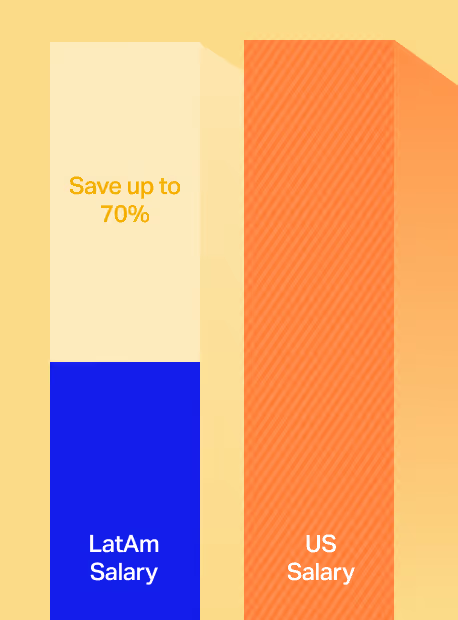
- Outsourced software development costs vary based on factors like project complexity, developer location, and required expertise: hiring a software engineer in Latin America runs $36K–$108K a year against $100K–$238K in the US, according to our 2026 salary data.
Outsourcing software development for startups is how most early teams ship a first product without carrying permanent engineering payroll. It's the right model when the work has an end date, typically running from $10,000 for a simple build to $150,000 or more for a full application.
Every week the product sits half-built is a week you can't demo to customers or show investors, and US engineering salaries rarely fit inside a seed budget.
This guide will walk you through outsourced software development for startups: the key benefits, where to outsource, what it costs, the three engagement models to choose from, and how to tell when it's time to hire developers of your own instead.
Once the work stops having a clean end date, Hire With Near helps US startups hire their own developers in Latin America.
What Are the Challenges Startups Face With Software Development?
Startups run into five recurring problems when they build software with a lean team: budget overruns, missing in-house technical expertise, launch timelines that slip, no easy way to scale the team up or down, and quality assurance nobody owns.
Skilled developers can create the kind of product that makes a startup stand out, but getting there with limited people and limited runway is where most early teams stall.
Here's what each of the challenges looks like:
- Budgeting issues: Staying within budget is a common struggle. According to a March 2026 CB Insights analysis of 431 venture-backed companies that failed, 70% of them ran out of capital.
- Scaling and flexibility: A two-person build team is the right size for an MVP and the wrong size the moment a funding round lands and the roadmap triples. Hiring fast enough to match that jump is hard without a pipeline already in motion, and cutting back just as fast when a feature ships or a round takes longer than expected is just as hard in the other direction. Most startups don't have the sourcing relationships or the cash flow to flex either way on short notice.
- Lack of technical expertise: Without an engineer on the founding team, nobody in the room can judge whether a candidate or a vendor is any good, so a bad hire or a bad contract usually surfaces months later in the code.
- Time constraints: Every week spent screening developers is a week the product isn't shipping, and the founders doing the screening are usually the same people building the product.
- Quality assurance: A small team under deadline pressure tends to test the features, not the edge cases, because there's no one whose job is specifically to break things before a customer does. Bugs that would get caught by a dedicated QA process instead surface in production, which costs more to fix and costs more in customer trust than catching them earlier would have.
As a solution to these challenges, you can turn to software developer recruitment agencies or other outsourced providers. Outsourcing to the right service providers offers five concrete benefits for startups, which we'll cover below.
Why Should Your Startup Outsource Software Development?
Outsourcing software development for startups connects you with skilled developers without the high labor costs and time commitment of hiring an in-house team, letting you scale the team up or down as your needs change.
Here are five reasons why outsourcing software development can be such a smart move:
Access to in-depth tech knowledge and experience
Outsourcing lets you work with experts who bring specialized knowledge and experience to your software development projects. With this kind of support, your startup can bypass the trial-and-error process often faced by new developers and gain insight from professionals familiar with the latest development methodologies and tools.
Access to senior developers outside your local market
Outsourcing expands your reach to talent worldwide. The best countries to hire external engineers offer different benefits depending on your needs.
For instance, offshoring to regions in different time zones can support a 24/7 development cycle, while nearshore software development outsourcing provides similar working hours and cultural alignment.
The opportunity to gather an entire team faster
With outsourcing, you can quickly assemble a full team, including developers, designers, and QA experts. That matters most when the alternative is a US engineering hiring cycle that commonly runs three to six months per role, before anyone writes a line of code.
Effective communication within the team
Choosing the right software development outsourcing partner can help you facilitate effective communication among your team members. For example, partnering with nearshoring companies for startups allows for real-time collaboration and faster response times, so teams stay in sync and can address issues quickly.
Flexibility and scalability
Outsourcing provides the flexibility to scale your team up or down based on project demands. It allows your startup to stay agile, control costs, and respond to changes without being locked into long-term commitments.
What Are the Software Development Outsourcing Models for Startups?
Startups outsource software development through three models: staff augmentation, a dedicated team, or project-based work billed at a fixed price or on time and materials. They differ on who employs the developers, how you're billed, and how much of your own management time the arrangement takes.
In the conversations our recruiters have with founders, the pattern I keep hearing is that people arrive knowing their budget, but not knowing which of the three they should buy.
Staff augmentation
A staff augmentation firm places pre-vetted professionals onto your team to work under your direction, while the firm stays the legal employer and handles payroll, benefits, and local compliance. Billing is normally a monthly rate per person.
It fits a startup that needs to add capacity for a defined stretch without committing to permanent headcount.
Dedicated team
A dedicated team is a ring-fenced group, often including a project manager, working only on your product for the length of the engagement. You typically pay a fixed monthly rate for the team rather than per hour.
It fits a sustained roadmap where the work is continuous, but you aren't ready to hire permanently. Bear in mind that you're usually managing through the vendor rather than talking directly to the engineers writing the code.
An outsourced development team can be stood up in weeks.
Project-based and time and materials
Project-based work means a fixed scope for a fixed price. Time and materials means you're billed for hours worked at an agreed rate. Fixed price protects your budget and penalizes changes of mind; time and materials absorbs changes and puts the budget risk on you.
The decision rule across all three is the same: if the work has a defined end, project-based or time and materials is usually right. If it's continuous product work, staff augmentation or a dedicated team keeps the same people on it, and at some point hiring your own developers becomes the best answer.
How To Outsource Software Development for Your Startup
Outsourcing software development for your startup takes eight steps, from defining your project requirements to planning post-launch support. Follow them in order:
1. Define your project requirements
Begin by clearly outlining your software project's goals, scope, and technical requirements. List the core features, preferred technologies, and timeline to help potential partners understand your product vision.
2. Research and select potential partners
Research potential outsourcing firms by reviewing their portfolios, client feedback, and industry experience. Narrow down your choices to partners that best align with your project's requirements and values.
Starting from a vetted list is faster than researching each firm cold, since someone else has already done the portfolio and reputation check for you. Our roundup of the best LatAm outsourcing companies covers the firms US teams work with most and what each one is good at, a starting shortlist for the research this step is asking you to do.
3. Evaluate expertise and compatibility
Judge a provider on three things: years of hands-on experience with the exact tools your project needs, a live technical assessment you can watch, and whether their developers can explain past work to a non-engineer.
Look past the company's portfolio for how it holds up on real projects like yours, since a strong-looking case study page doesn't guarantee the specific engineers assigned to you have that same depth.
That's why the real evaluation happens at the individual level, not the company level. Ask for the specific developers who'd work on your project to show years of professional experience with the actual tool you need, not total years in the industry.
Then, test the other two criteria directly with those same developers. Watch someone solve a problem in real time instead of reading about it, then ask the developer to walk a non-engineer through something they built and maintained, such as a CI/CD pipeline they set up and how they kept it reliable.
Those are the screens Hire With Near's engineering recruiters run, and they're reasonable to ask of any provider. Federico Bilello, Software Engineering Recruiter at Hire With Near, adds one more filter:
The main thing I look for is ownership. I always look for developers who have worked in startups or smaller companies, because those are the people who probably have ownership. If you bring them a problem, they won't ask how to solve it; they'll try their own ideas, they'll be creative. That's the main thing.
— Federico Bilello, Software Engineering Recruiter, Hire With Near
4. Establish clear communication protocols
Set up communication channels and plan regular updates, meetings, and issue resolution. This keeps both sides aligned throughout the project.
5. Start with a smaller project
Consider starting with a smaller project or trial phase to evaluate your partner's capabilities. This minimizes risk and gives you a chance to make adjustments before moving on to larger projects.
6. Foster a collaborative environment
Promote open communication and transparency to build trust remotely. A collaborative atmosphere enhances teamwork, improves productivity, and keeps everyone aligned on project goals.
7. Monitor progress and provide feedback
Stay involved by tracking project milestones and providing constructive feedback along the way. Regular check-ins also allow you to address any issues or adjustments early, helping avoid costly delays or scope changes.
8. Plan for support and maintenance
Make sure that your contract includes support and maintenance provisions to cover any post-launch needs. This keeps your software up to date and functioning smoothly after deployment, reducing risks and improving long-term success.
How Much Does Outsourcing Software Development for Startups Cost?
Outsourcing software development for startups usually runs from $10,000 for a simple first build to $150,000 or more for a full application, and the biggest variable in that range is where your developers are based.
Software development costs add up quickly when your budget is measured in runway. Business.com puts a minimum viable product (MVP) at $10,000 to $70,000, while an average-scale app runs between $25,000 and $150,000.
That project fee is one number, paid to a vendor for a defined scope. It's a different number entirely from what it costs to bring a developer onto your own team, which is measured in salary, not a project quote.
According to Hire With Near's 2026 State of LatAm Hiring Report, which analyzes more than 2,000 placements, software engineer roles filled in Latin America save US companies $23,000 to $85,000 a year compared with US equivalents, a reduction of 28–59%.
To put the labor side of that in concrete terms, here's what the most commonly hired software roles cost in Latin America compared with equivalent US hires, according to Hire With Near's salary benchmarks:
For the most up-to-date figures, see Hire With Near's US vs Latin America Salary Guide.
The high end of any Latin America range, for example, the $108K ceiling on a Software Engineer, is a senior engineer who has shipped production systems for US companies, and hiring that person often costs less than hiring a mid-level engineer in the US. For a startup, that difference decides how senior your first two engineers can be.
Coming in under the band is the expensive way to save. Below-market offers lengthen the search, and the developers who accept them are usually the ones without other options, which you pay for later in rework.
There's a third cost that never shows up on a rate card: paying hourly for expertise with no fixed scope and no end date. Unlike a project fee or a salary, this arrangement has no natural stopping point: you keep buying hours indefinitely, and the meter often gets more expensive once you exceed whatever block you originally purchased.
Keep in mind the factors that influence the cost of outsourcing software development for startups:
Project complexity
Simple apps with fewer features are less costly to develop, whereas advanced applications with integrated systems, custom designs, or complex back-end functionalities increase expenses.
Complex projects require specialized skills and additional development time, which adds to the overall budget.
Development team size
The size and structure of the development team are also major factors. A small outsourced team or even an individual developer might suffice for an MVP, while a larger tech team with project managers, QA testers, and developers is often necessary for more comprehensive projects.
Adding specialists increases costs but can accelerate development timelines.
Tech stack
Different technologies come with different price tags. Open-source technologies like Python and PHP are generally less expensive than licensed technologies.
If your project requires expertise in emerging tech like AI or blockchain, expect higher costs due to the limited number of skilled developers in these fields.
Location
Where you choose to outsource plays a big role in pricing. Latin America (LatAm), for instance, has skilled developers who work at competitive rates compared with US-based professionals.
As a comparison, our 2026 salary data puts a junior back-end developer at $30K–$46K a year in Latin America against $66K–$121K in the US, a difference of 55–62%. Professionals in Latin American countries can offer these rates due to a generally lower cost of living, which is why the savings hold up without asking anyone to compromise on the quality of the work.
For the full role-by-role picture, see how developer salaries in Latin America compare with the US, or read our guide to what it takes to hire Latin American developers directly.
{{latam-hiring-calculator}}
Where To Outsource Software Development for Startups
Where you outsource decides how much of your workday you share with the people building your product. And that's crucial: the larger the time zone gap between two colleagues, the more of their work gets pushed outside normal business hours for one side of the pair, leading to delayed answers, meetings nobody's fully awake for, and decisions that wait a full day instead of an hour. That's what researchers at Harvard Business School, Georgetown, and Rice found after studying 12,038 employees at one Fortune 100 company for a 2024 paper in Organization Science.
The table below shows some of the most common outsourcing destinations and how much workday overlap you'd get:
Stack Overflow's 2025 Developer Survey reports a median annual compensation for back-end developers of $175,000 in the US and $22,086 in India.
Our own data puts a back-end developer in Latin America at $30,000 to $108,000 depending on seniority, according to Hire With Near's salary benchmarks. For a role-by-role breakdown, see our IT roles salary guide for the US vs. Latin America.
A few country details are worth knowing:
- Brazil is the country we source the most software engineers from.
- The Philippines has strong English proficiency and a deep services sector spanning software development, customer service, and business process outsourcing.
- Poland and Romania both have well-developed tech industries, and Romania's alignment with EU standards matters if you have regulatory requirements to meet.
Choosing between them comes down to one question: do you need real-time collaboration, or the lowest hourly rate you can find? If your developers have to join standups, get unblocked the same day, and ship against a roadmap that keeps moving, the difference between nearshore and offshore outsourcing is the whole decision. If you're handing over a fixed specification and collecting a deliverable in eight weeks, overlap matters less.
When Should You Hire Developers Instead of Outsourcing?
Outsource when the work has a defined scope and a finish line. Hire your own developers when the work is continuous, the codebase is your product, and the person writing it needs full context on why the product exists.
Signals it's time to hire your own developers
The signals that you've crossed that line are concrete:
- You're paying by the hour for work that never finishes.
- Your contractors go quiet in the middle of a roadmap and reappear when the invoice does.
- You're relaying requirements through a project manager instead of talking to the person writing the code.
- The developer you depend on is splitting attention across three other clients.
You wouldn't be alone in making that switch. Hire With Near analyzed more than 2,000 conversations with US companies exploring why US companies are hiring in Latin America. Of those companies, 12% were specifically moving from outsourcing to hiring their own people. IT and engineering was tied with sales as the second most common function making that move, at 16% each.
Your three options if you hire
If you choose to make the switch, you'd have three paths to follow:
- Freelance and contractor platforms like Upwork and Toptal are good at one thing: fast access to contractors for defined project work. You post a job, review bids, and pick someone, often within days. What you don't get is any vetting done on your behalf, any guarantee the person sticks around past this project, or anyone but you managing quality and deadlines.
- Building it yourself means running the entire process solo: writing the job posting, sourcing candidates in a country you may not know well, screening technical skill without necessarily having the technical background to judge it, then handling the legal side of employing someone abroad, contracts, payroll, tax withholding, benefits, compliance, either through your own entity or an employer of record.
- A specialist staffing partner does the sourcing and vetting for you, before you ever see a resume, then handles the employment side once you hire: payroll, benefits, and local compliance, while the developer works under your day-to-day direction. That's what the fee buys: the two hardest parts of option two, done by someone who already knows the market.
Strong developers tend to prefer the third option too, and not just because of the work itself. Hayden Cohen, Hire With Near's CEO and Co-founder, explains why in the video below:
Point that at Latin America and the difference shows up in your calendar: your developers are online during your business day, wherever your team sits in the US, so standups happen live and the question you ask in the afternoon gets answered that afternoon.
Speed to hire is the usual argument for outsourcing, but it doesn't hold up as well as founders expect once you compare it against hiring directly.
A US healthtech startup came to Hire With Near with two internal recruiters and an eight-step engineering interview process it refused to shorten. We took over sourcing and screening, and they hired seven senior engineers across backend, DevOps, QA, mobile, and frontend, averaging 14 days to hire with the full process intact and saving $323,000 a year against US salaries.
If that's where you're heading, you can hire full-time software engineers in Latin America without wading through the hundreds of resumes a single posting usually pulls in. We do that filtering for you, run the technical and English screens, and hand you a shortlist of three to five candidates who are actually worth an interview, not everyone who applied.
Most startups begin with one or two senior software engineers who own the codebase, then add specialists as the product grows.
Final Thoughts
Outsourcing is the right answer for a defined build with a finish line, and the wrong one once the work becomes continuous and the codebase becomes your product. When you cross that line, the fix isn't finding a better vendor, it's hiring someone who stays.
That's the model Hire With Near runs on. We place remote LatAm developers who join your team directly and stay on your codebase, not a rotating vendor bench, and as nearshore tech recruiters, we do that across fintech, healthtech, and SaaS.
ParkMobile is a good example of what that looks like. The mobility and parking platform had run its backend and platform work through third-party agency developers for years and wanted its own senior engineering team instead.
We placed 9 senior engineers across platform, backend, and iOS at a 24-day average time to hire, and ParkMobile now saves $1,066,085 a year against US rates, a 73% reduction.
Our guide to hiring remotely in Latin America covers how the process works end to end, and a VP of Engineering or CTO hire runs through executive search in Latin America.
If you want help working out which side of that line your next build sits on, book a free consultation. We'll share salary benchmarks, explain how our hiring process works and answer all your questions.
{{latam-hiring-cta-v2}}
Frequently Asked Questions
What is outsourcing in software development?
Outsourcing in software development means paying an external company or contractor to build software for you instead of employing the developers yourself. The provider supplies the engineers, manages them day to day, and bills you monthly, hourly, or by project. Startups use it to ship a first product without carrying permanent engineering payroll.
How much does it cost to outsource software development?
Outsourcing software development typically costs $10,000 to $70,000 for a minimum viable product and $25,000 to $150,000 for an average-scale app, according to Business.com.
Four things drive your number: developer seniority, the country and model you choose, the engagement type, and whether the provider's fee sits inside the rate or on top of it.
What pricing models do outsourcing companies offer for startups, like time and materials or project-based rates?
Outsourcing companies offer three pricing models: fixed-price project work, time and materials billed against hours worked, and a monthly rate per person for staff augmentation or a dedicated team.
Fixed price suits a scope you can define upfront, time and materials suits scope that will change, and monthly rates suit continuous work. Ask every provider whether their fee is inside the rate or added to it.
What types of recruitment agencies can help startups with outsourced development?
Startups have several options when looking for recruitment support beyond general outsourcing firms. Specialized recruitment agencies for startups understand the unique challenges of early-stage companies, including limited budgets, rapid scaling needs, and the importance of cultural fit.
These agencies typically have experience placing technical talent in high-growth environments and can help you find developers who thrive in startup settings. They often offer flexible pricing models and understand that every hire has an outsized impact on small teams, making them better equipped to find candidates who are versatile, self-directed, and comfortable with ambiguity.
What types of technical roles can startups outsource beyond general software development?
Beyond general software developers, startups commonly outsource specialized technical roles to build well-rounded engineering teams.
This includes remote front-end developers who focus on user interfaces, nearshore back-end developers who handle server-side logic and databases, full-stack developers based in Latin America who can work across the entire development stack, remote mobile developers for iOS and Android applications, DevOps engineers in Latin America to manage infrastructure and deployment pipelines, and nearshore QA engineers who protect product quality through systematic testing.
Each role brings specific expertise that can accelerate your product development while keeping costs manageable.
Should I hire specialized developers or generalists for my startup?
Hire generalists first and add specialists as your product gets more complex. Early-stage startups often benefit from full-stack developers who can handle multiple aspects of development, reducing the need for a large team. As you scale and your product grows more complex, specialized roles become valuable. For instance, a React developer for your web app, a Python developer for backend services and data processing, or a Node.js developer for real-time features.
Many successful startups start with versatile generalists and gradually add specialists as specific technical challenges emerge and the codebase matures.
Do developers in Latin America work during US business hours?
Yes. Developers in Latin America work during US business hours, so they overlap your team's day whether you're on the West Coast, in the Central states, or on the East Coast. The exact gap depends on where you are and the time of year, since most Latin American countries don't observe daylight saving, but a question you ask in the afternoon still gets an answer that afternoon.
The questions tech leaders ask about hiring developers in Latin America go deeper into standups and management overhead.