%203.svg)
Key Takeaways
- An outsourced development team is a group of software engineers employed by a third-party vendor and contracted to build software for you. The real decision is whether to rent that capacity or hire your own engineers and keep the knowledge in house.
- The three engagement models are staff augmentation (you direct the work), a dedicated team (you share direction with a vendor lead), and full project outsourcing (the vendor directs everything).
- A vendor rate covers the engineer's pay plus the vendor's recruiting, management, bench, and margin. Hiring your own engineers in Latin America runs $30K to $108K a year across common software roles, against $66K to $238K in the US.
An outsourced development team is the engineering capacity you rent. A vendor employs the engineers, assigns them to your work, and hands the output back to you. The real question is whether to keep renting that capacity in the long term or to hire developers in Latin America who join your own team.
One two-person software company we talked to had its whole product built by an outside contracting group. Then, they went quiet. In their words, the developers “kind of disappeared or fell off the map to us.” What’s left is a codebase nobody on their side understands.
That situation is common enough to be a pattern: in our analysis of more than 2,000 conversations with US companies exploring Latin American hiring, 12% were leaving an outsourcing arrangement to hire their own people.
This guide covers what an outsourced development team is, its three models and how to choose one, what it costs, and when building your own team is the better answer.
What Is an Outsourced Development Team?
An outsourced development team is a group of software engineers employed by a third-party vendor and contracted to build software for another company. The vendor hires, pays, and manages the engineers. The client defines what gets built and pays a rate or a project fee instead of a salary.
Your contract is with the vendor, not the people writing the code. That's what makes an outsourced team fast to start and fast to stop. It's also why the vendor, not you, decides who is on your project next quarter.
SaaS and product companies buy this most often, usually when the release calendar is moving faster than the hiring plan. So do agencies carrying more client work than staff, and larger organizations with a legacy system nobody wants to own.
The difference from freelancing is what's behind the person: a freelancer works alone, while an outsourced development team is backed by a company handling employment and replacement.
What Are the Benefits and Risks of an Outsourced Development Team?
An outsourced development team gets you working engineers in days or weeks instead of months. What you trade for that speed is control: over who is assigned, how long they stay, and what knowledge is left when the contract ends.
What you gain
- Speed to capacity: A vendor staffs from an existing bench, so an engineer can start in days.
- Flexibility in both directions: You can scale a team down at the end of a project without a layoff.
- A skill you need once: For a mobile build or a migration off an unfamiliar framework, a three-month engagement usually beats a permanent hire.
- No recruiting overhead: Sourcing and screening are the vendor's problem, which is calendar time back for a team without a recruiter.
Distributed engineering is normal now, which is part of why this model has grown. In the Stack Overflow Developer Survey 2025, 45% of US developers reported working fully remote and only 16.2% were fully in office, across roughly 49,000 respondents.
What you give up
- Attention you don't control: In some models, the engineers are dedicated to you, and in others, they're split across several clients. Nobody volunteers which one you're buying.
- A say in who stays: Reassignment is normal inside a vendor's staffing model, and you usually hear about it after the decision.
- Knowledge that walks out at the end: The people who understand why the code works the way it does go back to the vendor. Documentation helps. It doesn't replace them.
- Quality that varies by vendor, not by person: You're judging a company's ability to pick and keep good individuals, which is harder than judging an individual.
The split-attention question is the one buyers raise most. As one fintech founder who had worked with outsourced teams at a previous employer put it:
I don't want an outsourced team. We want someone who's actually part of the team and is solely working in our company as opposed to someone who can be shifted around different jobs.
Ask it directly: “Is this engineer allocated to us full time, and will that be in the contract?” A vendor that won't put a named person and a percentage in writing has already answered you.
What Are the Three Models for Outsourcing Development Work?
The three models are staff augmentation, a dedicated team, and full project outsourcing. Which one fits depends on two questions: who directs the work day to day, and who holds the code knowledge when the engagement ends.
Staff augmentation
Staff augmentation means a vendor places individual engineers onto your existing team. They work in your repo, your sprints, and your stand-ups, taking direction from your engineering lead while the vendor stays their employer.
You direct the work, so you keep the most control and carry the most management load. It fits teams that already have their own process and need more hands or one specific skill.
Hire With Near works the other side of this arrangement. We recruit engineers based in Latin America who join your team as your own hires and work during your business hours. Our nearshore staff augmentation page walks through how that differs from a vendor arrangement.
Dedicated teams
A dedicated team is a group the vendor assembles to work only on your product, usually with its own lead or delivery manager. They aren't rotating across accounts, so over months they build real context in your domain.
Direction is shared: you set priorities while the vendor's lead runs the day to day. That's the appeal for companies without the bandwidth to manage individual engineers. The trade is that the team's shared understanding lives inside the vendor's organization, and it leaves as a unit when the contract ends.
Full project outsourcing
Full project outsourcing means handing over a defined project with requirements, a budget, and a deadline. The vendor staffs it, runs it, and delivers the result, so you're buying an outcome rather than capacity.
The vendor directs everything, which is both the point and the risk. It works when the scope is bounded and you can write down what done means. It goes badly when requirements are still moving, because every change becomes a commercial negotiation.
Here's how the three compare on who directs the work and what each one fits:
The comparison of staff augmentation and outsourcing for software development goes deeper on the first two models. For vendor names, the best LatAm outsourcing companies is a starting list of third-party providers serving US teams.
How Do You Choose an Outsourced Development Team?
Choose an outsourced development team on five things: scope, working-hours overlap, how the engineers were vetted, what the contract says about IP and access, and how a paid trial goes. Work through them in that order. A scope you can't write down is the one problem the other four can't fix.
Start with a scope you can hand over
Write down what you want built, what it integrates with, what done looks like, and when you need it. If you can't write that down, you don't have a project to outsource. You have a role to fill.
Check the working-hours overlap first
Overlap decides how the relationship feels day to day. Software development is about as synchronous as work gets. Our own reading, as a company that places engineers across the Americas, is that this points to Latin America for US teams.
Engineers in that region are at their desks during your business hours wherever you sit in the US, while an offshore team in Asia is finishing as your day starts.
Vet the engineers you would actually work with
With a vendor, you're buying a team rather than screening individuals, so ask for visibility into how they screen.
In my nearly four years recruiting technical talent at Hire With Near, the most useful screen I run isn't a coding test. I ask an engineer to walk me through a project: what their role was, what they built, what broke. I want to hear them explain it to someone who isn't a developer.
The resumes I read most carefully come from the big outsourcing firms. Some of those engineers are excellent. Others spent three years on a narrow slice of one client's system and can't tell you what the system did. Two answers make me stop: a candidate who can't describe their own contribution to a project, and one who won't talk about a mistake.
So ask to interview the engineers who would be assigned. Ask how many years each has with the tools you use, rather than in the industry. Ask what the assessment looks like. The ones that work are small and real, like debugging code or building a basic API with tests, reviewed together on a call.
Get IP, data access, and offboarding in writing
Your contract needs NDAs and IP-assignment terms signed by the individuals doing the work, not only the vendor entity. Get a written answer on where your code and data live, plus a defined offboarding process.
Cross-border enforcement is slow, though, so operational controls carry most of the real protection: scoped repository access, no production credentials by default, and separate environments.
Run a paid trial on real work
Run a two- to four-week paid trial on a real backlog ticket before committing. You should watch for three things:
- Does the code hold up in review?
- Do questions come early, or after a week of building the wrong thing?
- Is the person you interviewed the person doing the work?
Our list of the top nearshore software development companies is a useful place to start that shortlist.
How Much Does an Outsourced Development Team Cost?
An outsourced development team costs a vendor rate: an hourly or monthly price per engineer that sits well above what that engineer takes home. The rate also covers the vendor's recruiting, management, benefits, bench time, and margin.
Four things drive most of the variation. Seniority is the biggest. The gap between a junior engineer and one who can make architectural calls unsupervised is wider than most rate cards suggest.
Geography changes both the rate and the overlap you get for it. The model matters too, because a full project engagement prices in delivery management and risk that a staff-augmentation rate doesn't. And engagement length moves the number both ways.
An hourly rate on its own is close to useless for comparison, which is the argument behind our Hourly Rates Don't Tell the Whole Story When Outsourcing to Developers article. For the current ranges by region and seniority, see offshore developer rates.
The costs buyers routinely miss
- Ramp-up: New engineers aren't productive on day one, and you pay full rate while they learn your domain. Budget two to six weeks.
- Your own management time: Somebody on your side runs the relationship and reviews the work, usually out of your senior engineer's week.
- Knowledge transfer at exit: Getting context out of a departing team and into documentation takes weeks, and only happens if you pay for it.
- Rework: Code written by people who don't fully understand the product needs a second pass, and that bill arrives two quarters later.
How the commercial structures differ
Time and materials bills for hours worked. It's honest for scope that will move, and uncomfortable if you need budget certainty.
Fixed price gives you a number up front and transfers delivery risk to the vendor, but it works only when requirements are locked.
Monthly dedicated capacity means you pay a set fee for a set number of engineers. You get a stable team, and you pay for the seat whether or not you keep it busy.
Direct-hire placement works differently: a staffing and recruiting partner vets an engineer who becomes your employee, so you pay a salary rather than a rate.
Whatever the structure, get the exit terms in writing: notice period, what happens to work in progress, and who owns repository access on the last day.
Then, compare the vendor rate against the loaded cost of your own hire. According to the US Bureau of Labor Statistics, median pay for software developers was $133,080 a year as of May 2024. Payroll taxes, benefits, equipment, and recruiting put the true cost well above that.
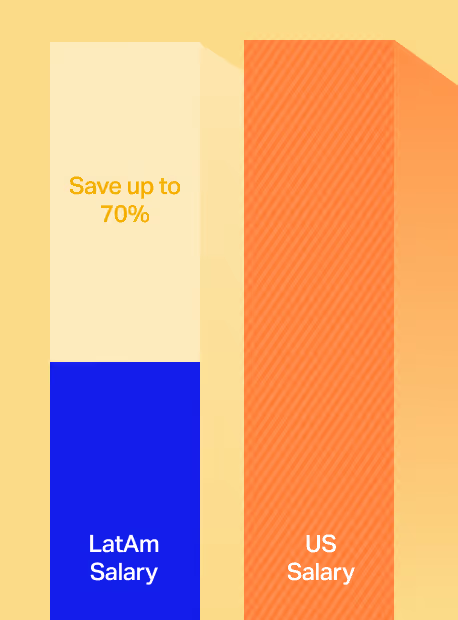
Our data on how much US companies save by hiring in Latin America puts typical savings at 30–70% against comparable US salaries, with no vendor margin on top.
How Do You Manage an Outsourced Development Team?
Managing an outsourced development team comes down to four things:
- One owner on your side: A single named person who sets priorities, answers questions, and approves work. Split ownership is the fastest way to get a team politely building the wrong thing.
- One written source of truth for scope and priorities: Whatever tracker you use has to be where decisions are recorded. Decisions made on calls and never written down are how scope disputes start.
- Real-time overlap for the work that needs it: Stand-ups, code review, and incident response should happen live during your business day. Everything else can be asynchronous.
- A review cadence tied to shipped work: Review what got merged and what it does, not hours logged. Hours are the metric a vendor can optimize without helping you.
That's most of the value in four bullets. For the longer version of how to manage an outsourced development team, our guide to best practices for outsourcing developers covers onboarding, documentation standards, and running the relationship over quarters rather than sprints.
Should You Build Your Own Development Team Instead of Outsourcing?
Outsource when the work has a defined end. Hire your own engineers when the code has to outlive the engagement. That's the decision rule, and almost everything else is downstream.
Outsourcing fits a bounded project, a temporary capacity spike, and a skill you need only once. In those cases, the knowledge leaving at the end is the point, not the cost.
Own the team when the software is your product, or when the codebase will still be running in three years. Any time the cost of that knowledge walking out exceeds the cost of keeping it, hire.
Our comparison of whether to hire an in-house developer or outsource works through the borderline cases.
How do US companies build their own engineering team in Latin America?
There are four routes, from most work on your side to least.
- The first is to source and screen candidates yourself, then handle employment through an employer of record. The EOR manages contracts, payroll, local benefits, and compliance, while the engineer works as part of your team under your day-to-day management. The gap there is recruiting: an employer of record handles employment logistics, not sourcing or vetting.
- The second route is a freelance platform. It's the fastest to start and the least suited to permanent work, because the contracts are project-based and the talent divides attention across clients.
- The third route is staff augmentation, where an agency employs pre-vetted engineers who work on your team under your direction.
- The fourth is a direct-hire staffing and recruiting partner, the simplest for most companies because it does both jobs at once. A partner like Hire With Near vets the candidates and handles contracts, payroll, benefits, and compliance, so you interview a shortlist and make the hire.
Most companies build an in-house engineering team in Latin America role by role, and leadership hires go through executive search in Latin America.
If you're comparing providers, look at the best LatAm staffing firms on how they source and what happens after placement, using our criteria for choosing a software developer recruitment agency.
Here's what it costs to hire software engineering roles, according to Hire With Near's 2026 salary benchmarks:
For the most up-to-date figures, see Hire With Near's US vs Latin America Salary Guide.
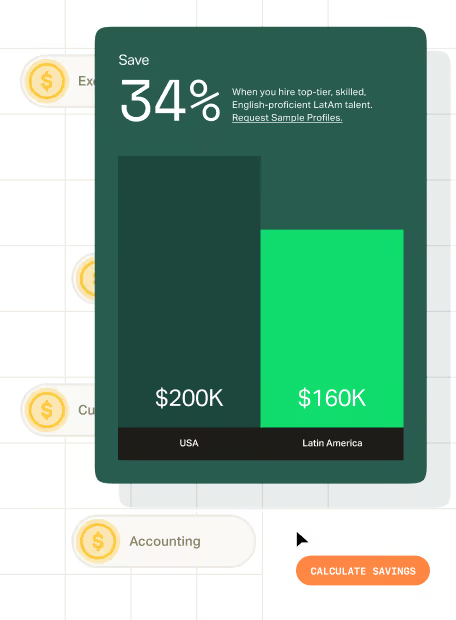
According to our salary data, hiring a senior software engineer in Latin America costs roughly 49% to 55% less than a US senior salary.
Where you land inside a range tells you what you're hiring. At the bottom, someone early in their career who'll need direction. At the top, an engineer who has shipped and maintained production systems at scale.
Our IT roles salary guide breaks these out by seniority, and our guide to hiring developers in Latin America covers countries and timelines.
Building your own team also doesn't mean trading vendor-grade senior engineers for junior ones. According to Hire With Near's 2026 State of LatAm Hiring Report, 98% of the engineering placements we made in our most recent placement year were experienced professionals. The split was almost even: 47% mid-level and 51% senior.
How Is a Staffing and Recruiting Partner Different From an Outsourcing Vendor?
A staffing and recruiting partner finds and vets engineers who join your team, report to you, and are managed by you. An outsourcing vendor employs the engineers and runs the work on your behalf.
Hire With Near is the first kind: we don't run development teams, we don't sell projects, and we don't sit between you and the person writing your code. We source from a pre-vetted pool of 160,000+ candidates and put a shortlist in front of you in 3 to 5 days.
That difference decides what you're left with. With a vendor, you get an outcome and the team goes back to the bench. With a recruiting partner, the engineer, the working relationship, and the knowledge all stay on your side. You interview the candidates, and you say yes or no.
Most clients make a hire in under three weeks, and we fill 97% of the roles we take on. Every placement carries a 180-day replacement guarantee, double the industry standard.
As an IT and tech staffing agency, our recruiters screen for the stacks and seniority you're hiring for, not keyword matches.
No filter is perfect, and that's worth being honest about. Federico Bilello, Recruiter, Software Engineering at Hire With Near, puts it this way:
Even though I do everything I can to verify a candidate's skill set before they get to the client, there's always a small percentage who make it through to the technical interview. The only way to truly find out if someone is proficient is that technical interview. That's where the truth comes out.
— Federico Bilello, Recruiter, Software Engineering, Hire With Near
For the short version of the vendor-versus-your-own-team decision, our team talks through dev shop versus direct hire here:
Retention is where the two models separate most sharply. Reassignment is routine inside a vendor's staffing model, so the person who learned your system can be rotated off it without your input. Our placements stay an average of three years, and 80% stay two years or more. They're part of your team rather than a name on someone else's bench.
One US healthtech startup shows what that looks like. Scaling fast with two internal recruiters, they were running an 8-step interview process and refused to lower the bar to move faster. We took over sourcing and screening. They kept the full 8-step process and still averaged 14 days to hire. They added 7 senior engineers across backend, DevOps, QA, mobile, and frontend, saving $323,000 a year against US salaries.
Final Thoughts
Every model in this guide comes down to the same variable: the engineers doing the work, and whether they stay once the project ends. That’s the part a vendor keeps and a recruiting partner hands to you.
If you’re weighing your own roles against a vendor’s rate card, book a free consultation. We’ll talk through the engineers you need, what they’d cost in Latin America, and how the hiring process works.
Not ready to talk yet? See pre-vetted engineers in Latin America and get a sense of who's available before you commit to a call.
{{latam-hiring-cta-v2}}
Frequently Asked Questions
How quickly can an outsourced development team start?
An outsourced development team can usually start within days, because the vendor assigns engineers from an existing bench. Hiring your own engineer takes longer and produces someone who stays. At Hire With Near, you get a shortlist in 3 to 5 days, and most clients hire in under three weeks. What matters more is how long the person is still there a year later.
What happens if it doesn't work out?
Both routes give you a replacement, and the clause that defines it is the one to confirm before you sign.
With an outsourcing vendor, the remedy is usually a replacement engineer from the same bench within a defined notice period, so ask what that period is and who decides the swap.
With a recruiting partner, the remedy is a replacement hire. Hire With Near backs every placement with a 180-day replacement guarantee, double the industry standard and a fair benchmark for any provider.
We tried offshore development before and the time zone gap killed us. Is nearshore different?
Yes. Engineers based in Latin America work during your business hours, whether your team runs on Pacific, Mountain, Central, or Eastern time. Stand-ups happen live, and an afternoon question gets an afternoon answer.
The exact gap depends on where you and they sit and on the season, since most of Latin America doesn't observe daylight saving.
The difference from an offshore arrangement in Asia is that the workday overlaps yours instead of ending as it begins.
Our roundup of questions tech leaders ask about hiring developers in Latin America covers the rest.
How do I know the engineers a vendor calls senior really are senior?
You verify it yourself, and any provider that resists letting you is answering the question for you. Three checks do most of the work. Ask for years of experience on the specific tools you use, rather than in the industry. Ask the engineer to walk you through a past project in plain language. Then give them one small real-world task, reviewed together on a call.
Our five-question test for spotting a fake senior developer has the exact questions.
Can I start with an outsourced development team and hire my own developers later?
Yes, and plenty of companies do. They use a vendor to ship the first version, then build their own team once the product proves out. What makes the transition survivable is set up on day one: repositories under your accounts, documentation written as the work happens, and architecture decisions recorded somewhere your future engineers can read. Undocumented context takes the longest to rebuild.
What other software engineering roles can I hire in Latin America?
Beyond general developers, US companies hire the full range of software engineering roles in Latin America, including nearshore software engineers, full-stack developers, QA engineers for test automation, and DevOps engineers for CI/CD and infrastructure.
Most teams start with one role and expand once the first hire lands, which is why QA and DevOps often follow a first developer. All of them work during your business hours, at salaries 30–70% below comparable US rates.







.webp)


%203.svg)
.avif)





%20(1).avif)

%20(1).png)