


%203.svg)
Key Takeaways
- You can hire developers in El Salvador who work through your business day year-round, since the country stays on Central Standard Time (UTC-6) with no daylight saving shift. They’re paid in US dollars and earn49–63% less than an equivalent mid-level or senior US engineer.
- San Salvador holds most of the country’s professional technology talent, anchored by Universidad Don Bosco, which runs software engineering, cybersecurity, and UX/UI design programs.
- Four ways to hire exist there: freelance platforms, direct hiring, nearshore staff augmentation, or a specialist staffing and recruiting firm, the simplest route to a long-term full-time developer.
As US engineering teams seek cost-efficient nearshore talent, El Salvador remains one of Latin America’s most overlooked yet highly practical software engineering markets: the country has senior engineers who work US business hours, are paid in US dollars, and earn much less than a US hire.
Salvadoran software engineers are known for working closely with US clients, communicating clearly, and taking ownership of the product rather than just executing tickets.
If you’re considering hiring developers in Latin America, this guide covers everything you need to evaluate before targeting your search to El Salvador: real developer salary benchmarks, where top technical skills concentrate, the primary hiring models available, and the key compliance and tax factors to keep top of mind.
Why Should I Hire Developers in El Salvador?
Three things make El Salvador worth a look for engineering hires: developers stay online through your working day all year, the country runs on the US dollar with no exchange-rate risk, and English proficiency sits above the regional average.
Developers online through your workday, year-round
El Salvador runs on Central Standard Time (UTC-6) and doesn’t observe daylight saving. A developer in San Salvador is online through your working day wherever your team sits in the US. Expect six or seven hours of live overlap for an East Coast team and closer to eight for a West Coast one. During US standard time, San Salvador is on Chicago’s clock.
A fully dollarized economy
El Salvador adopted the US dollar as its official currency in 2001. There’s no local currency in between, no conversion, and no exchange rate to track. The salary you agree to pay is the exact amount your developer receives, every time, without either side losing money to a currency swing in between.
That predictability runs both ways. Your developer isn’t watching a local currency lose value against the dollar and wondering if this month’s paycheck buys less than last month’s. And you’re not exposed to a foreign exchange rate that could move against you over the life of the engagement.
English proficiency above the regional average
El Salvador scores 523 on the 2025 EF English Proficiency Index, 5th in Latin America, 47th globally, and in EF’s Moderate band, ahead of the global average of 488. San Salvador itself scores higher than the national number, at 534, one of the stronger capital-city scores in the region.
That’s a starting point, not a substitute for screening. Ask any candidate to walk you through a past technical decision in plain language before you make an offer. A strong country average tells you the market has the depth; it doesn’t tell you this specific developer has it.
Cost is what starts most of these conversations
Hire With Near’s research into why US companies turn to Latin America found budget is the number one driver, cited by 41% of companies. IT and engineering make up 14% of the roles those companies hire.
That’s the pattern behind hundreds of US companies hiring talent in Latin America. It’s also why CTOs are building engineering teams in Latin America instead of signing another agency contract.
Sharing a currency with the US doesn’t mean sharing US prices. El Salvador’s cost of living is well below the US average, so a competitive local salary, paid in the same dollars, still stretches further for a Salvadoran developer than it would for someone in the US. I’ll talk about this in detail in a later section.
{{state-latam-hiring}}
How Deep Is El Salvador’s Developer Talent Pool?
El Salvador is a smaller engineering market than the region’s larger hubs, and its case rests on three things: full time-zone alignment, a dollarized economy, and a tech sector that’s been actively building toward US enterprise standards.
Worth being direct about this upfront: Hire With Near regularly recruits for customer support, sales, and back-office roles in El Salvador, but direct engineering placements there are still selective. If you need a deep bench across niche stacks, Colombia, Brazil, Mexico, and Argentina offer more volume. For a specialized or tightly integrated role, El Salvador’s market has real advantages the bigger markets don’t.

Where does the talent concentrate?
- San Salvador: The capital is the country’s main technology and nearshore services hub. The industry took shape in 2004, when Dell and Sykes opened operations there, followed by Teleperformance, Concentrix, and Foundever.
- Antiguo Cuscatlán: Just southwest of the capital in the La Libertad department, this city anchors a corporate and tech corridor within Greater San Salvador, home to several universities and corporate headquarters.
Where do the graduates come from?
El Salvador’s technical pipeline runs through four main universities:
- Universidad Don Bosco (UDB): Known for its engineering programs, with software design and enterprise systems built into the curriculum.
- Universidad Centroamericana José Simeón Cañas (UCA): Strong on analytical training, producing engineers grounded in systems architecture and algorithms.
- Universidad Tecnológica de El Salvador (UTEC): Through its Facultad de Informática y Ciencias Aplicadas, UTEC trains a large share of the country’s systems engineering and network infrastructure graduates.
- Universidad de El Salvador (UES): The national public university and the broadest source of foundational computer science education in the country.
Government backing for the tech sector
El Salvador’s Law for the Promotion of Innovation and Technology Manufacturing, passed in 2023, gives qualifying tech companies up to 15 years of exemption from income tax, municipal taxes, and import duties on equipment.
In 2023, Google Cloud signed a seven-year agreement with the Salvadoran government to build out cloud infrastructure and support digital government, healthcare, and education, the kind of investment that keeps local engineers working with current tools rather than legacy ones.
Julia Guillen, Senior Tech Recruiter at Hire With Near, sees the same pattern play out with clients across the region, El Salvador included:
Clients are consistently surprised with the caliber of talent that’s available in LatAm. They don’t expect to find senior engineers who’ve worked with major U.S. companies, understand modern development practices, and often have more hands-on experience with specific frameworks than candidates they’d find locally.
— Julia Guillen, Senior Tech Recruiter, Hire With Near
What Technical Skills Do Salvadoran Developers Have?
Salvadoran developers work in the same modern stacks as their peers across North and Latin America. Because the local IT ecosystem is shaped heavily by enterprise software services, nearshore staff augmentation firms, and digital banking platforms, the talent pool concentrates on robust full-stack web technologies, modern APIs, and mobile frameworks.
Here are the primary tech stacks in El Salvador:
- JavaScript/TypeScript (Node.js, React, Angular): The foundation of El Salvador’s software service ecosystem. Developers routinely pair Node.js or Express backends with React, Angular, or Vue on the front end to build scalable web applications and SaaS platforms.
- PHP (Laravel): Highly prevalent across local engineering teams, e-commerce platforms, and digital agency builds. Laravel is a primary backend choice for fast-growing regional platforms.
- Java & .NET / C#: Deeply rooted in El Salvador’s financial sector, telecom infrastructure, and enterprise software systems. Developers working in these environments bring experience with large-scale relational databases (PostgreSQL, MS SQL), microservices architectures, and legacy system migrations.
- Python (Django, FastAPI): Increasingly popular for API development, cloud-native services, and data integration pipelines. Python adoption continues to grow alongside local cloud migration initiatives.
- Mobile Development (Flutter & Swift/Kotlin): Driven by the push for financial inclusion, digital wallets, and mobile banking applications across Central America, mobile engineering capacity is strong.
One of the first things US companies hiring developers in Latin America usually consider is the tech stack, but it’s rarely what decides the hire. From the editorial work I do interviewing Hire With Near’s engineering recruiters, the stack list is usually the easy part.
What separates a strong senior developer from a good resume is clean, testable code. The other half is being able to explain a technical decision to someone who isn’t a developer. Our Recruitment Consultant Natasha Tarapow screens for that:
We always ask candidates to tell us about a project they’ve worked on, not just that they use this language and that one, but what their role was and what they actually did. It’s important that they can explain their work to someone who isn’t a developer. If they can do that, that tells me a lot.
— Natasha Tarapow, Recruitment Consultant, Hire With Near
What Does It Cost to Hire Developers in El Salvador?
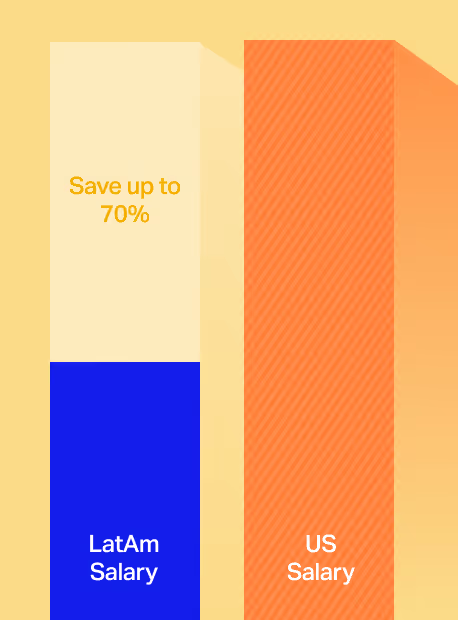
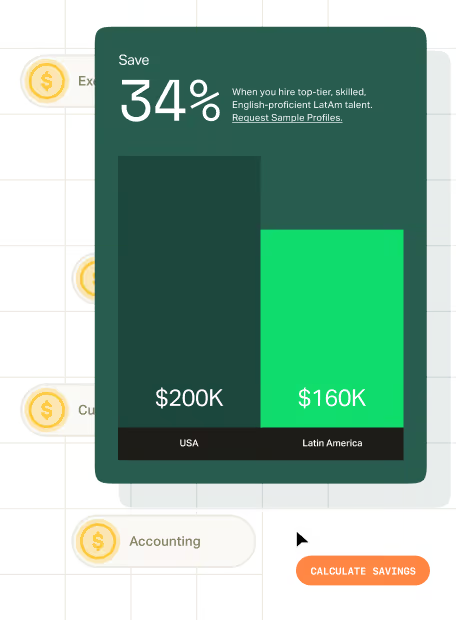
A mid-level software engineer in Latin America runs $54K to $72K a year, against $115K to $195K for an equivalent US hire. A senior runs $72K to $108K against $140K to $238K.
Here’s the fuller picture across the developer roles US companies hire most, according to Hire With Near’s salary benchmarks:
For the most up-to-date figures, see Hire With Near’s US vs Latin America Salary Guide.
The seniority mix is the part people miss. According to Hire With Near’s 2026 State of LatAm Hiring Report, 98% of our engineering placements last year were mid-level or senior. Software engineer demand grew 250% year over year.
One caveat if you’re budgeting to hire software developers in El Salvador: these are Latin America-wide benchmarks from our salary data, not verified El Salvador market rates. Treat the table as a negotiating band. Our IT Roles Salary Guide breaks the same data out by role.
The instinct is to anchor at the bottom of that band, but a below-market offer means a longer search and a weaker shortlist, and it’s how you lose the engineer you wanted at the offer stage. Hiring a senior software engineer at $72K to $108K instead of the $140K to $238K a US equivalent commands still pays a strong professional wage where the person lives.
That salary gap between El Salvador and the US comes down to cost of living, not skill. You can see the difference directly in the table below, comparing everyday costs in San Salvador against Tucson, Arizona:
Source: Numbeo.com
Our guides to hiring developers in Guatemala and hiring developers in Honduras cover two others in a similar band.
How Can a US Company Hire Developers in El Salvador?
US companies have four ways to hire developers in El Salvador: freelance marketplaces, direct hiring, a nearshore staff augmentation company, or a staffing and recruiting firm.
The right choice for your business comes down to one question: do you need short-term help on a project, or a long-term, full-time developer on your team? In conversations with Hire With Near’s recruiting team, that’s the question I’ve seen settle the decision fastest. Teams that get it wrong usually pick a short-term option for a permanent seat.
Our guide to hiring remotely in Latin America covers the mechanics behind all four.
Route 1: Freelance and contractor platforms
Freelance developers in El Salvador are easiest to reach on platforms like Upwork and Toptal, which let you engage someone quickly. That works for a defined project or a few weeks of overflow.
For a full-time developer, they’re a weak fit: you own quality control and retention alone, and the person is splitting attention across clients. Specialist staffing gives fundamentally different results for full-time remote hires.
Route 2: Direct hiring
Hiring directly means you source and vet candidates yourself and take on the employment relationship. In El Salvador, that comes down to one of two mechanisms:
- Register a local entity: This gives you full control, but it only makes sense at real scale, roughly a 50-plus person presence. In El Salvador, that means incorporating a Sociedad Anónima de Capital Variable (S.A. de C.V.), opening a local bank account, and enrolling with the Salvadoran Social Security Institute. For a handful of engineers, that’s months of setup for an outcome you can reach in weeks.
- Use an employer of record: An EOR handles contracts, payroll, tax withholding, benefits, and local compliance for a person you’ve already chosen. That’s useful in El Salvador, where two obligations catch US companies off guard: a mandatory 30% cash premium on top of salary for the 15 days of annual leave, and a tenure-scaled Aguinaldo, or 13th-month payment.
Worth knowing up front: EOR companies employ, but they don’t source or vet. The search is still yours to run, whether through your own network or a job board for hiring in Latin America.
Route 3: Nearshore staff augmentation
Nearshore IT staff augmentation adds a pre-vetted developer to your team for project-based or flexible capacity, with the firm handling contracts, payroll, and compliance. It fits a hard deadline or a defined build, not a permanent seat, and it’s the model teams weigh in software outsourcing vs. staff augmentation. An augmented engineer works inside your process and joins your standups; an outsourced project happens outside it.
How nearshore staff augmentation works covers the mechanics.
Route 4: Work with a staffing and recruiting firm
A specialist staffing and recruiting firm does both jobs in one relationship: it sources and vets the developer, then handles payroll, benefits, and local compliance once you hire. For a long-term engineer, this is the simplest path.
Hire With Near works this way through our nearshore staffing and recruiting services: we place permanent, full-time developers directly onto your team, with payroll, benefits, and compliance included in the placement, not as an add-on.
If you’re comparing firms, we’re one of the specialist staffing firms for LatAm hiring worth putting side by side with the rest.
{{prevetted-banner}}
What Do US Companies Need to Know Before Hiring Developers in El Salvador?
Four things shape what an offer in El Salvador costs and when your team will be offline: the vacation premium, the Aguinaldo, the public holiday calendar, and the benefits that make an offer competitive.
Not all of them apply to you, though. Which ones do depends on how you structure the hire: they’re mandatory if you employ the person directly, through your own entity or an employer of record, and they don’t apply if you hire through a staffing partner that engages the developer as a contractor.
Annual leave and the 30% premium
Annual leave is 15 consecutive calendar days after 12 months of continuous service, with a minimum of 200 days worked that year. A mandatory 30% cash premium on the salary covering those days is paid before the leave begins. Cash in lieu isn’t permitted while the person is employed, and that premium is the detail that most often surprises US employers.
The Aguinaldo
The Aguinaldo, El Salvador’s 13th-month payment, scales with tenure: 15 days’ salary at one to three years of service, 19 days at three to ten, and 21 days at ten or more. It’s paid between December 12 and 20 and prorated for a partial year.
Many international employers voluntarily pay a full 30 days to stay competitive.
If you hire through a staffing partner instead, this doesn’t apply to you directly, though it’s worth knowing that Salvadoran developers factor it into how they think about total compensation.
Public holidays and San Salvador’s August pause
There are 11 public holidays a year, paid at double rate if worked. San Salvador adds an extra Fiestas Agostinas pause on August 3, 5, and 6, while the rest of the country observes only August 6. Since most professional remote talent lives in the capital, plan sprints around that three-day gap.
Private health insurance
Private health insurance isn’t legally required, but it’s the most valued non-salary benefit when candidates compare offers.
Our How to Hire in El Salvador guide covers these in detail.
How Does Hire With Near Help US Companies Hire Developers in El Salvador?
Our team starts the hiring process with a scoping call where you describe the role, the stack, and the seniority you need. Our recruiters source and screen against that brief, run an English check in a live conversation, and put every candidate through a project walkthrough before anyone reaches you.
You get a shortlist of three to five vetted candidates within three to five business days, and you run the final interviews and make the hiring decision yourself. Most companies go from that first scoping call to an accepted offer in two to three weeks.
Vetting is where most of the work sits. Every candidate walks through a recent build: what they shipped, what their own role was, and how they defend the tradeoffs to someone who isn’t a developer.
If you want a hands-on evaluation on top of that, we can build in a small real-world task, debugging a piece of code, refactoring for scalability, or building a basic API with tests, reviewed together on a call at your request. Keep it to one task if you do, since strong candidates drop out of long, multi-round processes.
How that looks in practice: A real case that saved $1 million
That process holds up in markets we’re entering for the first time, which is where an El Salvador hire puts you. ParkMobile, a global mobility platform, wanted to replace its agency developers with its own senior engineers in Colombia, a country it had never recruited in.
Hire With Near ran sourcing, English screening, and candidate management inside ParkMobile’s own ATS. Nine senior engineers were hired across platform, backend, and iOS at a 24-day average time to hire. That saved $1,066,085 a year, a 73% reduction against US rates.
Their TA Lead described what the partnership solved:
Collaboration with Hire With Near is solving the problem of entering a completely new market for us. They have been an invaluable partner in this expansion, helping to successfully close roles quickly. Their deep understanding of the local talent landscape is what allows them to source and vet top-tier candidates efficiently.
— Akshay Gokarnakar, TA Lead, ParkMobile
Those placements were in Colombia, not El Salvador. What ParkMobile shows is the pattern, and the answer to whether one hire turns into a team. After the first engineers landed, leadership expanded the program to team leads.
We hire software engineers in Latin America for companies at every stage, and nearshore SaaS recruiting is a large slice of that work.
For a first engineering lead or a VP-level hire, engineering leadership searches run differently.
Final Thoughts
El Salvador gives US teams something specific: developers who work your hours, are paid in dollars, and cost roughly half of an equivalent US engineer. The country has spent two decades training its workforce to US-facing standards.
If you’re weighing it, book a free consultation to talk through your requirements with our team. We’ll give you salary benchmarks for the roles you’re hiring and walk you through how the search works. We’ll also tell you honestly whether El Salvador or another market fits what you’re building.
{{latam-hiring-cta-v2}}
Frequently Asked Questions
How much does it cost to hire a developer in El Salvador?
Hiring a developer in El Salvador typically costs $36,000 to $108,000 a year in salary, against $100,000 to $238,000 for a US equivalent. A mid-level engineer sits around $54K to $72K and a senior around $72K to $108K, according to our salary data. Those are Latin America-wide benchmarks.
Is El Salvador in a compatible time zone with the US?
Yes. El Salvador keeps a steady schedule year-round without daylight saving shifts, aligning with US Central time in the winter and US Mountain time in the summer. A developer in San Salvador works through your regular business day wherever your team is based in the US, giving you full real-time overlap for stand-ups, pairing, and code reviews.
That’s the opposite of the overnight lag behind most questions about hiring remote talent offshore.
Do Salvadoran developers speak English well enough for daily standups?
Yes, when the candidate has been screened for it, which is the part that decides the outcome. El Salvador ranks #47 globally on the 2025 EF English Proficiency Index, in the Moderate band. That’s a general-population figure, and it says little about an individual engineer.
Hire With Near screens English on every candidate before a shortlist goes out. The bar for a developer is specific: can they explain a technical decision clearly to a non-developer?
Is a 13th-month salary required in El Salvador?
Yes. El Salvador requires a mandatory 13th-month salary, called the Aguinaldo, paid between December 12 and December 20 each year.
The amount scales by tenure: 15 days of salary for 1–3 years of service, 19 days for 3–10 years, and 21 days for 10 or more years. For employees with less than one year of service, the Aguinaldo is calculated on a pro-rata basis.
US companies should factor this into annual compensation budgets before making an offer: it effectively means annual compensation is 13 months of pay, not 12.
How long does it take to hire a developer in El Salvador through Hire With Near?
You’ll have a shortlist within three to five business days of kickoff, and an accepted offer usually follows two to three weeks in. The start date then depends on the candidate’s own notice period. That’s typically shorter in Latin America than the 60 to 90 days common in some offshore markets.
What other developer roles can I hire from Latin America?
Beyond generalist developers, US companies regularly hire nearshore full-stack developers, remote back-end developers, and front-end developers based in Latin America, along with DevOps engineers, QA engineers, and mobile developers.
Most teams start with one senior generalist and specialize as the roadmap firms up. Every one of these roles carries the same working-day overlap and salary gap.






.webp)
.webp)


%203.svg)
.avif)





%20(1).avif)

%20(1).png)