


%203.svg)
Key Takeaways
- El Salvador runs on Central Standard Time (CST, UTC-6) year-round and doesn’t observe daylight saving time. This consistency gives both US coasts a highly collaborative six to seven hours of daily real-time overlap, allowing teams to schedule standups, client calls, and project reviews without any special arrangements.
- El Salvador combines a US dollar economy, year-round Central Time alignment, and a workforce shaped by two decades of US-facing BPO operations. Three advantages that are hard to find together in a single Latin American market.
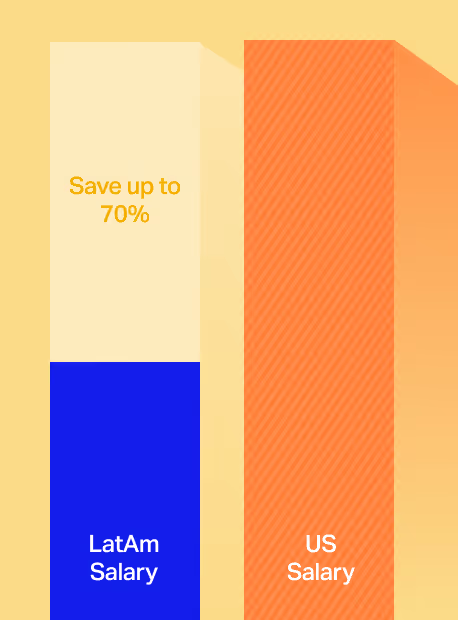
- Hiring in El Salvador typically costs 30–70% less than the equivalent role in the US, driven entirely by the lower local cost of living, not any gap in skills or output.
For years, nearshore recruitment strategies followed a predictable playbook: source software developers from São Paulo, accountants from Buenos Aires, and customer success managers from Bogotá.
But now, hiring managers are increasingly looking at San Salvador. El Salvador’s BPO sector took off around 2004 when Dell and Sykes opened the country’s first major delivery centers, and it hasn’t stopped growing since.
That two-decade runway has produced a professional class trained specifically on US accounts, US communication standards, and US business expectations, at a fraction of domestic hiring costs.
The dollarized economy adds another layer: you’re paying in US dollars, receiving invoices in US dollars, and there’s no exchange rate to track or hedge.
In this guide, I cover everything a US company needs to know before hiring in El Salvador: who the talent is, what you’ll pay, which roles US companies fill most, and why hundreds of US companies are turning to El Salvador and other Latin American countries to build high-performing remote teams.
Why Are US Companies Hiring in El Salvador?
El Salvador gives US companies access to BPO-trained, English-speaking professionals who work in Central Standard Time, in a fully dollarized economy, at salaries that typically run 30–70% lower than US equivalents.
Here are the core advantages in detail:
Time zone alignment
El Salvador sits on Central Standard Time (CST, UTC-6) and stays there year-round. No daylight saving time adjustments.
The US does observe daylight saving time, which creates a slight seasonal shift in the overlap. From November through March, San Salvador and Chicago are on the same clock. From March through November, El Salvador runs one hour behind Chicago and two hours behind New York.
Either way, East Coast companies get six to seven hours of a shared working day. West Coast companies get closer to eight. There’s no early-morning-only call window to manage, no team members signing off before your afternoon kicks in.
The dollarized economy
El Salvador adopted the US dollar as its official currency in 2001 and hasn’t looked back.
This means US companies pay in dollars, the hire earns in dollars, and there’s no currency exposure to manage. The salary you agree on is the salary you pay, with no exchange rate risk built into the arrangement.
It also means El Salvador is one of the few Latin American markets where purchasing power parity doesn’t require translating between currencies to make sense of. A $30,000 annual salary is a $30,000 annual salary, and it provides strong purchasing power in San Salvador.
The BPO advantage
San Salvador has been a delivery hub for US-facing customer operations for close to two decades.
Major players like Foundever, Concentrix, Teleperformance, and Allied Global set up offices there and built training infrastructure, management pipelines, and English communication programs that have run tens of thousands of Salvadoran professionals through the specific demands of US client work.
These professionals know how US companies communicate in meetings, what they expect from a support interaction, and how sales conversations are structured.
English proficiency
According to the 2025 EF English Proficiency Index, El Salvador ranks 47th globally with a Moderate proficiency score.
That’s a general population figure. Among BPO-trained professionals in customer support, sales, admin and operations roles, English proficiency runs considerably higher.
In any case, Hire With Near screens every candidate for professional English communication as part of the vetting process, so the people you meet are confirmed at the level the role requires.
Candidates who reach the top of our recruiting shortlists are fully conversational in English on calls, in written communication, and in real-time standups.
Cost savings
El Salvador’s dollarized economy makes the savings math unusually clean.
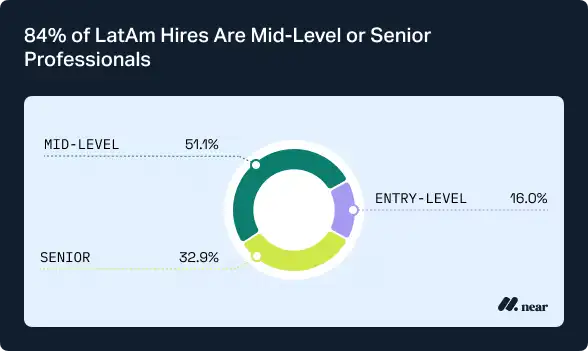
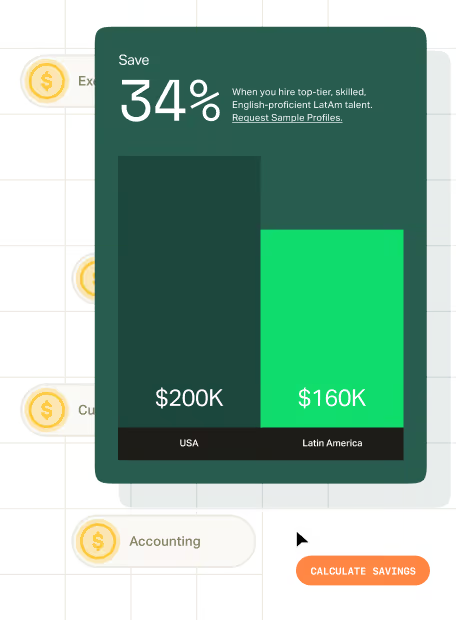
According to Hire With Near’s 2026 State of LatAm Hiring Report, companies hiring in Central and South America save an average of $35,000–$64,000 per hire annually compared to US equivalents, with 84% of those placements being mid or senior-level professionals.
In El Salvador specifically, you’re paying in dollars, which means the number you agree on is the number you pay.
How Can a US Company Hire in El Salvador?
US companies have three paths to hiring in El Salvador: set up a local legal entity, use an employer of record, or work with a specialist staffing and recruiting firm.
The right answer depends on how many people you’re hiring and how fast you need to move. Let’s move from the most to the least complex option:
Option 1: Establish a legal entity
Registering a local entity in El Salvador means establishing a legal subsidiary, typically a Sociedad Anónima de Capital Variable (S.A. de C.V.), opening a local bank account, registering with the tax authority, and enrolling with the social security system (ISSS).
From there, you’re responsible for running compliant local payroll, filing taxes, and staying current with the country’s Labor Code on an ongoing basis.
It’s the right structure if you’re committing to a substantial, permanent presence with dozens of employees, dedicated in-country HR and legal support.
For a company hiring two or three remote professionals, the setup costs, registration timelines, and ongoing compliance overhead make it a poor trade.

Option 2: Use an employer of record (EOR)
An employer of record is a third-party company that employs your hire on paper, handling the legal employment relationship, contracts, payroll processing, tax withholdings, and benefits administration, while you direct the person’s day-to-day work.
From your hire’s perspective, they have a proper employment arrangement with all the legal protections that entail. From your perspective, you skip the complexity of setting up a local entity entirely.
El Salvador has a few specifics worth understanding before you engage one, like the mandatory 13th-month salary, the 15 consecutive days of paid vacation annually, plus a 30% premium on top of their regular pay for those days. A good EOR tracks and handles all of this automatically.
Popular EOR companies include Deel, Globalization Partners, Remote, and Oyster. Our comprehensive guide to hiring remote foreign employees covers how these arrangements work in practice.
One thing an EOR doesn’t do: find you the right person. Sourcing and vetting candidates (through LinkedIn, a job board for hiring in Latin America, or wherever you look) remains your responsibility.
Option 3: Work with a specialist staffing and recruiting company
This is where search and logistics come together.
You partner with one of the specialist staffing firms for LatAm hiring, like Hire With Near, that handles both talent acquisition and the employment structure in one package.
Here’s an example of how it works. Hire With Near finds you the right person through our nearshore staffing and recruiting services, and then we also handle everything that sits between you and your new hire, like payroll, compliance, and benefits, so you don’t need to become an expert in Salvadoran employment law to make it work.
The process ends up feeling as straightforward as bringing on someone in the US.
The fundamental difference from freelance platforms is commitment. Specialist staffing finds someone fully embedded in your business, not a contractor dividing their time across multiple clients.
What Can US Companies Expect When Hiring Salvadoran Talent?
Salvadoran professionals are particularly strong in customer-facing, sales, and finance-adjacent roles. Most active candidates from San Salvador are conversational to fluent in English for business purposes, and their working hours align directly with the US Central and East Coast business day.
For a broader look at what the hiring process involves, our guide covering the common questions US companies have about hiring remote talent offshore covers the practical details.
Customer support and client-facing roles
Customer support is the role category El Salvador is most associated with in the nearshore market, and it’s earned. Nearly two decades of BPO investment in San Salvador have built a workforce specifically trained on US client management: handling inbound queues, running outbound sequences, and communicating in English at a professional level.
If you need to hire a customer support representative or scale a customer success function, that institutional foundation is what you’re drawing on. Candidates who come through that pipeline already know what US customers expect and how to deliver it.

Sales and business development
The same workforce that powers El Salvador’s BPO sector has produced a deep bench of professionals who are genuinely good at sales. The research is consistent on this: Salvadoran professionals are known for relationship-building, persistence, and the ability to handle objections in English-language environments, skills that transfer directly into SDR and BDR roles for US companies.
If you need to hire an SDR or BDR who can run US outbound sequences from day one, El Salvador’s Central Time alignment and sales-oriented talent pool make it a strong fit. You’re not training someone on how US business conversations work. They already know.
As Lucia Atensia, Sales Recruiter at Hire With Near, puts it:
A lot of our candidates have already been working with US clients — they know the business, they know European and US markets. That makes them much easier to integrate into global teams. They also tend to have a strong work ethic and resilience, which is crucial in fast-paced, target-driven environments.
Finance and back-office operations
This is where El Salvador stands apart from other Central American markets. The country’s dollarized economy has produced a professional class that works natively in USD.
The financial services sector in El Salvador has grown significantly, with major banks including Citibank, Banco Agrícola, and BAC Credomatic running substantial operations in San Salvador.
Professionals who’ve built careers in those environments understand US-adjacent financial standards, are familiar with compliance requirements in dollar-denominated operations, and are well-suited for back-office, accounting, and financial analysis roles.
Lucas Stepanenko, Sourcing Manager for Finance & Accounting at Hire With Near, puts it this way:
LatAm finance professionals often have Big Four exposure and training under global accounting standards — things US clients don’t always expect but immediately recognize when they see the work.
If you need to hire a financial analyst or executive assistant with a strong finance background, El Salvador’s banking sector alumni are worth a close look.
Top universities to recognize on a resume
University background is a useful signal when reviewing Salvadoran candidates’ resumes. These are the institutions most associated with the talent US companies hire from:
- Universidad Centroamericana José Simeón Cañas (UCA): Finance, macroeconomics, corporate law, and computer science. A prestigious Jesuit institution widely recognized as the top academic and intellectual authority in the country. Graduates are analytically strong and excel in corporate consulting, finance, and business operations.
- Universidad de El Salvador (UES): Civil engineering, mechanical engineering, hard STEM, and accounting. The only public university in the country and its largest academic institution. Produces technically rigorous professionals with strong foundational training.
- Universidad Don Bosco (UDB): Software engineering, cybersecurity, and UX/UI design. The country’s premier technology-focused institution. Graduates integrate well into modern DevOps and agile environments.
- Universidad Dr. José Matías Delgado (UJMD): International business, digital marketing, product management, and public relations. Emphasizes bilingual communication and executive presence. Graduates are well-suited for account management, client-facing, and business operations roles.
Related reading: How to Hire Developers in El Salvador: Salaries, Skills, and the Ways to Hire
What Are the Salary Ranges for El Salvador Hires?
Hiring in El Salvador typically costs 30–70% less than hiring the same role in the US. Here’s what that looks like across the roles US companies hire most:
Source: Hire With Near 2026 compensation benchmarks
The salary gap between Latin American nations and the US is driven entirely by what money buys locally, not any difference in experience or work quality.
To put these figures in context: a one-bedroom apartment in central San Salvador rents for around $325 per month, compared to around $2,820 in Miami, Florida.
Here’s how San Salvador compares to Miami on everyday costs:
Source: Numbeo.com
For the full role-by-role breakdown, see our 2026 US vs. Latin America Salary Guide.
What Do US Companies Need to Know Before Hiring in El Salvador?
El Salvador’s labor law includes a few line items that don’t appear in the monthly salary figure but are important when you’re budgeting for a hire.
The two that catch most US companies off guard are the vacation premium and the Aguinaldo’s tenure-based scaling, neither of which works the way US employers expect.
These obligations apply to formal employment relationships under El Salvador’s Labor Code. The structure most US companies use when hiring through Hire With Near works differently, but knowing what Salvadoran candidates factor into their offer expectations is worth understanding before you start a search.
PTO and statutory leave
El Salvador’s vacation entitlement is straightforward: 15 consecutive calendar days of paid leave after completing 12 months of continuous service with the same employer. To qualify, an employee must have worked a minimum of 200 days in that year.
There’s also a vacation premium that surprises most US companies: employers are legally required to pay a 30% cash bonus on top of the regular salary for those 15 days, paid before the leave begins.
Vacation must be physically taken while the employment relationship is active. Unused leave and the corresponding premium can only be paid out upon termination or resignation.

Public holidays
El Salvador observes 11 national public holidays per year. On official holidays, employers can’t require work. If an employee agrees to work on a holiday, they must be paid at double their standard daily rate.
Fixed national holidays
- January 1: New Year’s Day
- May 1: Labor Day
- May 10: Mother’s Day
- June 17: Father’s Day
- September 15: Independence Day
- November 2: All Souls’ Day
- December 25: Christmas Day
Moving religious holidays
- Maundy Thursday (Spring, date varies)
- Good Friday (Spring, date varies)
- Holy Saturday (Spring, date varies)
El Salvador also observes the Fiestas Agostinas in August, honoring the patron saint Divino Salvador del Mundo. The dates differ depending on location:
- In San Salvador: August 3, August 5, and August 6 are observed as a full operational pause.
- In the rest of the country: August 6 only.
Since the majority of professional remote talent is concentrated in the San Salvador metropolitan area, US companies should plan for a full operational pause on August 3, 5, and 6.
Mandatory 13th-month salary (Aguinaldo)
El Salvador requires a mandatory 13th-month salary, called the Aguinaldo, governed by the Labor Code. Unlike countries where the bonus equals exactly one month’s pay, El Salvador uses a tenure-based scaling calculation:
Many international firms in El Salvador voluntarily pay a full 30 days of salary as a year-end bonus to stay competitive with the broader market. It’s worth asking your recruiter what candidates at each level typically expect.
The Aguinaldo must be paid between December 12 and December 20 of each year. For employees with less than one year of service, it’s calculated on a pro-rata basis.
US companies should factor this into annual compensation budgets before making an offer: think in terms of 13 months of pay, not 12.
Private health insurance
El Salvador operates a public social security system that faces the same challenges common across the region: long wait times, limited specialist access, and intermittent supply shortages. Most white-collar professionals with any financial flexibility rely on private insurance for primary care.
Private health insurance is the most valued non-salary benefit you can offer a Salvadoran professional. Offering this coverage meaningfully improves offer acceptance and retention, particularly for senior-level candidates who expect family coverage to be included.
{{salary-guide-cta}}
How Does Hire With Near Help US Companies Hire in El Salvador?
Hire With Near works with US companies that are serious about building remote teams in El Salvador and across Latin America. Not just filling a single role, but finding the right person for it.
Before a candidate is shortlisted, your dedicated recruiter invests real time understanding the role: the team it sits in, the manager it reports to, what good looks like at 90 days, and what’s gone wrong with similar hires in the past.
The process moves fast. A kickoff call gets everything on the table. Within three to five business days, you have a shortlist of pre-vetted candidates with video introductions: people your recruiter has already spoken with and believes fit what you’re looking for.
You interview, run a skills assessment if the role calls for it, and make your decision. Most clients go from kickoff to accepted offer in about three weeks. The equivalent search in the US typically takes three to six months.
Once your hire is in place, Hire With Near handles payroll, benefits administration, and compliance on an ongoing basis. You manage the person, while we handle everything that sits between you and them.
A case in point: 16 hires, $587K saved, 19 days to hire
Snap Diagnostics, a sleep apnea testing company based in Illinois, needed to scale fast. They’d grown over 30% in a year and were struggling to fill customer sales support and accounting roles in a competitive US labor market. Previous attempts with offshore providers hadn’t worked out.
They came to Hire With Near. Within weeks, Snap Diagnostics had hired 16 professionals across customer sales support and accounting functions, cutting hiring costs by 67% and reducing their average time to hire to 19 days.
Susan Simmermon, their HR Manager, put it simply:
The caliber of talent we received was awesome. Hire With Near really listened to our needs and asked the right questions to ensure they provided the perfect candidates for our team.
If you’re ready to explore hiring in El Salvador, book a free consultation with our team. We’ll walk you through salary benchmarks and what the process looks like for the specific role you’re trying to fill.
For companies filling director-level or leadership positions, Hire With Near also handles executive search in Latin America across all departments.
If you're also interested in learning about the process in other Latin American countries, check our How to Hire in Peru and How to Hire in Costa Rica guides.
{{latam-hiring-cta-v2}}
Frequently Asked Questions
Is El Salvador in a compatible time zone with the US?
Yes. El Salvador runs on Central Standard Time (CST, UTC-6) year-round and doesn’t observe daylight saving time.
During US Standard Time (November to March), El Salvador and Chicago share the same time. During US Daylight Saving Time (March to November), El Salvador is one hour behind Chicago and two hours behind New York.
In practical terms, both East and West Coast companies get a highly collaborative six to seven hours of real-time overlap each day.
Standups, client calls, and project reviews require no special arrangements.
Is a 13th-month salary required in El Salvador?
Yes. El Salvador requires a mandatory 13th-month salary, called the Aguinaldo, paid between December 12 and December 20 each year.
The amount scales by tenure: 15 days of salary for 1–3 years of service, 19 days for 3–10 years, and 21 days for 10 or more years. For employees with less than one year of service, the Aguinaldo is calculated on a pro-rata basis.
US companies should factor this into annual compensation budgets before making an offer: it effectively means annual compensation is 13 months of pay, not 12.
What roles do US companies most commonly hire in El Salvador through Hire With Near?
Customer support is the most common category, driven by El Salvador’s deep BPO talent pool. Customer support representative and customer success manager roles are placed regularly.
Sales roles, including SDRs and BDRs, are a strong second category, drawing on the same workforce that powers the BPO sector’s outbound and client-facing operations.
Finance and back-office roles round out the most common placements. El Salvador’s dollarized economy and established banking sector have produced professionals well-suited for financial analyst and accountant roles that require working natively in USD.
What level of English can US companies expect from Salvadoran professionals?
It depends on the candidate’s background. Professionals who have come through El Salvador’s BPO sector are typically conversational to fluent in English for business purposes: handling US customer calls, participating in standups, and communicating in writing without friction.
Among candidates without BPO backgrounds, English proficiency varies more widely.
Hire With Near screens every candidate for professional communication skills as part of the vetting process, so the candidates you interview are confirmed at the level the role requires.
How long does it typically take to hire through Hire With Near in El Salvador?
For most roles, Hire With Near presents a shortlist of pre-vetted candidates within three to five business days of the kickoff call.
Total time from kickoff to accepted offer typically runs two to three weeks, depending on role seniority and how quickly the client moves through interviews.
Does El Salvador have strong intellectual property protections?
El Salvador is a member of the World Intellectual Property Organization (WIPO) and adheres to major international IP agreements. Its legal framework covers software, creative works, and proprietary business information.
For roles involving access to sensitive code, data, or confidential processes, Hire With Near recommends including IP assignment and confidentiality clauses in the service agreement as standard practice.
Which industries hire in El Salvador?
Nearshore financial services recruiting and nearshore fintech hiring are an increasingly strong fit. El Salvador’s dollarized economy and established banking sector have produced professionals familiar with USD-denominated operations, compliance workflows, and back-office financial functions that integrate naturally with US teams.
SaaS and technology companies draw on El Salvador’s BPO-trained talent pool for customer success and support roles that require real-time collaboration, strong English communication, and deep familiarity with US client expectations.
Marketing and advertising firms hire for account management, campaign coordination, and client-facing roles where Central Time alignment and strong written English are baseline requirements.
Logistics and supply chain companies hire regularly for coordination and operations roles that need to run in sync with US business hours, something El Salvador’s fixed CST time zone makes straightforward year-round.





.webp)




%203.svg)
.avif)





%20(1).avif)

%20(1).png)