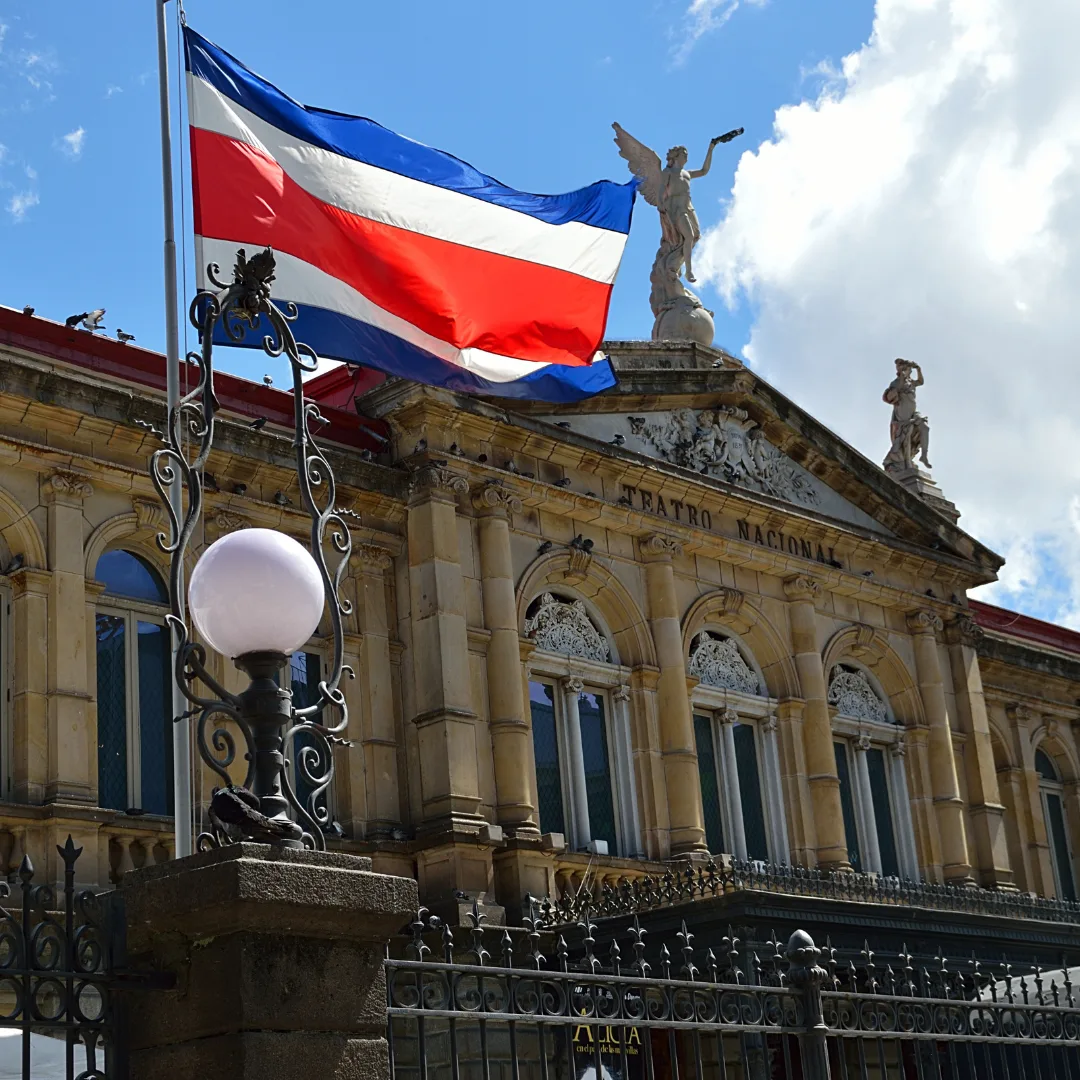


%203.svg)
Key Takeaways
- Costa Rica ranks 55th globally and 10th in Latin America on the 2025 EF English Proficiency Index, but its white-collar tech and operations workforce, trained inside companies like Intel, Amazon, and P&G, consistently outperforms that national average in professional settings.
- The country has built a reputation as Central America’s premier shared services destination, with nearly 200 multinational corporations running regional delivery hubs there. A large share of available candidates has already worked in English, on US systems, for US-facing teams.
- Costa Rica runs on UTC-6 year-round, aligning with US Central Standard Time in the winter and sitting one hour behind it during US daylight saving. This provides East Coast companies with six to seven hours of real-time working-day overlap, depending on the season.
Costa Rica tends to come up when US companies are looking to expand their teams with a specific workforce combination: bilingual professionals, time zone alignment, and talent that’s already been shaped by years of working alongside multinational teams.
The country has built its reputation not on size (it’s a small market by Latin American standards) but on concentration. San José and its surrounding metro area house an unusually dense cluster of tech, finance, and operations talent that has grown up working inside the same companies that US employers already know.
If you’re sourcing bilingual customer success professionals, software engineers, or operations specialists who can step into a US-facing role from day one, Costa Rica has a deeper bench than most people expect.
This guide covers everything you need before making your first Costa Rican hire: how the talent pool is structured, what you’ll pay, what the compliance picture looks like, and how to set yourself up for a hire that sticks.
Why Are US Companies Hiring in Costa Rica?
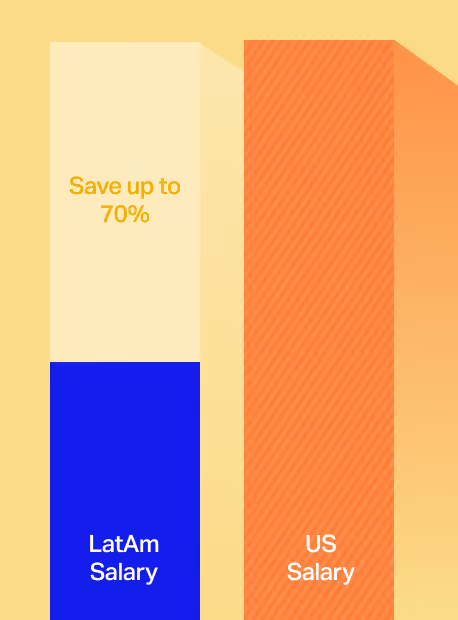
Costa Rica gives US companies access to a bilingual, professionally trained workforce at salaries that typically run 30–70% below US equivalents. These are professionals who have already worked inside the same systems and workflows that US teams use, in a time zone that makes real-time collaboration practical every day.
The country’s defining advantage is its concentration of multinational experience. Nearly 200 global companies operate shared services, GBS (Global Business Services), or regional delivery hubs in Costa Rica.
That means a large share of the available talent pool has already spent years working in English, on US-facing teams, using tools and processes that map directly to what your company needs. That’s a different starting point than most offshore hiring markets offer.
Time zone alignment
Costa Rica runs on Central Standard Time (UTC-6) year-round and doesn’t observe daylight saving time.
During US Standard Time (November–March), East Coast companies share seven hours of working day overlap with San José, which dips slightly to six hours during US Daylight Saving Time (March–November).
West Coast companies enjoy six to seven hours of overlap, depending on the season, which is more than enough to hold standups, review work, and collaborate on time-sensitive tasks without either side starting at unusual hours.
English proficiency
Costa Rica ranks 55th globally and 10th in Latin America on the 2025 EF English Proficiency Index. That national ranking lands in the Moderate Proficiency band, but it understates what you’ll really find when sourcing mid and senior-level professionals from San José’s tech and corporate sectors.
The country has a strong bilingual education infrastructure and a workforce shaped by decades of working inside English-operating multinationals.
At the mid and senior levels in tech, finance, and operations, professional working English, on client calls, in written reports, and during daily standups, is the norm rather than the exception.
A workforce shaped by multinationals
Costa Rica has established itself as Central America’s shared services capital.
Intel runs one of its largest global chip design and engineering facilities in the country. Amazon is among the largest private employers in Costa Rica. P&G operates its San José Intelligence Hub, one of its biggest global IT and corporate services centers. So do Microsoft, IBM, Oracle, Citibank, Bank of America, Boston Scientific, and roughly 200 other multinationals.
The practical effect: a large, accessible pool of professionals who have already been trained inside enterprise-grade systems and processes, in English, alongside US teams. The learning curve that other offshore markets require simply doesn’t apply in the same way.
As Julia Guillen, Senior Tech Recruiter at Hire With Near, puts it:
Clients are consistently surprised with the caliber of talent that’s available in LatAm. They don’t expect to find senior engineers who’ve worked with major U.S. companies, understand modern development practices, and often have more hands-on experience with specific frameworks than candidates they’d find locally.
If you want to read more about Costa Rica as a nearshoring destination before making any decisions, Why Nearshoring to Costa Rica Works: Benefits and How to Get Started covers the broader picture.
How Can a US Company Hire in Costa Rica?
US companies have three options for hiring in Costa Rica: establish a legal entity, use an employer of record (EOR), or work with a specialist staffing and recruiting company. For most businesses, the third is the fastest path to a great hire. We’ll cover them in order from most to least complex.
Option 1: Establish a legal entity
Setting up a legal entity means registering your business in Costa Rica so you can hire employees directly under your company’s name. Companies choosing this path need to establish a subsidiary or branch office, navigate local business registration requirements, and set up compliant payroll and benefits systems.
This gives complete control over operations and makes sense if there are plans for a significant local presence with dozens of employees.
In practice, this option is only viable for larger companies with dedicated legal and HR resources. The upfront costs are substantial, the process can stretch three to six months, and you’ll need ongoing legal and accounting support to stay compliant as Costa Rican labor regulations evolve.
For most US companies looking to make a handful of remote hires, this creates more overhead than it’s worth.

Option 2: Use an employer of record (EOR)
An employer of record is a third-party company that becomes the legal employer of your hire on paper, while you maintain day-to-day management and oversight. The EOR handles employment contracts, payroll, tax withholdings, benefits administration, and compliance with local labor law.
In Costa Rica, that includes some specifics worth knowing. Formal employees are legally entitled to a mandatory 13th-month salary paid in December and employers must make contributions to the country’s social security system, which carries a combined employer-employee contribution rate of over 26%. An EOR manages all of this automatically.
Popular EOR companies include Deel, Globalization Partners, Remote, and Oyster. For a full breakdown of how EOR arrangements work, this guide to hiring remote foreign employees covers the details.
The trade-off: an EOR handles the employment logistics, not the recruiting. That means you’ll need to rely on LinkedIn or a job board for hiring in Latin America to source candidates on your own, then bring in the EOR to manage their employment.
Option 3: Work with a specialist staffing and recruiting company
This is the simplest option for most US companies. You partner with one of the specialist staffing firms for LatAm hiring, like Hire With Near, that handles both talent acquisition and all employment logistics.
Hire With Near finds the right candidate through our nearshore staffing and recruiting services, then manages payroll, benefits, and compliance on an ongoing basis. You describe the role you need to fill, we present pre-vetted candidates, and once you make a hire, we handle the rest.
The process is as simple as bringing on someone in the US: one partner and a team member who attends your standups and builds institutional knowledge of your business.
Another option available is using freelance platforms like Upwork or Toptal. However, specialist staffing gives you fundamentally different results for full-time remote hires: a dedicated team member fully focused on your business, not someone splitting their time across clients.
What Can US Companies Expect from Costa Rican Professionals?
Costa Rican professionals are particularly strong in technology, bilingual customer success, and operations roles. Most mid and senior-level candidates in those fields are fully conversational in English, and their working hours align directly with US business hours, making day-to-day collaboration easy.
The country’s talent profile is shaped heavily by its shared services and GBS sector. With many Costa Ricans having built their careers inside multinationals, the adjustment period that often comes with a first offshore hire is shorter here than in many other markets.
Technology: the pipeline Intel and Amazon built
Intel’s engineering facility in San José has been one of the most consequential forces in shaping Costa Rica’s tech talent pool. For decades, it has recruited directly from the country’s top universities and trained engineers on production-grade systems. The result is a generation of mid and senior-level software engineers, DevOps professionals, and IT support specialists who have worked in enterprise environments, in English, on US-facing projects.
Amazon’s Costa Rican operation reinforces the same pipeline, with a particular depth in cloud infrastructure, customer-facing engineering, and technical support roles.
If you need to hire a software engineer in Latin America, Costa Rica’s combination of engineering education and multinational training gives you access to production-ready talent at the mid and senior levels.
But what sets Costa Rican engineers apart isn’t just their technical credentials; it’s how they operate. A workforce shaped by multinational environments tends to produce professionals who take ownership, handle ambiguity, and solve problems without waiting to be told how. That’s exactly what Hire With Near’s recruiters screen for.
As Federico Bilello, Software Engineering Recruiter at Hire With Near, puts it:
The main thing I look for is ownership. I always look for developers who have worked in startups or smaller companies, because those are the people who probably have ownership. If you bring them a problem, they won’t ask how to solve it — they’ll try their own ideas, they’ll be creative. That’s the main thing.
Further reading: How to Hire Developers in Costa Rica: Cost, Skills, Challenges, and the Four Routes
Bilingual customer success and support
Costa Rica’s bilingual workforce is its best-known export in the shared services world. Companies like Foundever (formerly Sykes) and Conduent have built large customer experience operations there specifically because of the combination: high English proficiency, cultural familiarity with US consumers, and a work ethic that produces strong client satisfaction metrics.
If you’re looking to hire a customer success manager or build a bilingual support team, Costa Rica tends to be a strong starting point.
Operations and finance
The same multinationals that shaped Costa Rica’s tech and customer support workforce have also produced a strong pipeline of operations, finance, and shared services professionals.
P&G, Citibank, Bank of America, and Deloitte all run significant back-office and finance delivery operations in the country, which means experienced professionals in financial analysis, accounting, and operations management are available at salaries well below US equivalents.
For companies filling operations analyst or finance support roles, Costa Rica offers a combination that’s harder to find: professionals who understand US workflows, communicate comfortably in English, and come with practical experience from within enterprise environments.
If you’re working through the hiring process for the first time, we’ve put together answers to common questions US companies have about hiring remote talent offshore.
Top universities to recognize on a resume
University background is a useful signal when reviewing Costa Rican candidates’ resumes. These are the institutions that consistently produce strong professionals in the roles that US companies frequently hire:
- Universidad de Costa Rica (UCR): The country’s top-ranked public research university and the primary pipeline for finance, economics, and legal professionals. UCR’s depth in quantitative disciplines makes it a strong signal for financial analysts, economists, and data-focused roles.
- Instituto Tecnológico de Costa Rica (TEC): The country’s premier public engineering school, built specifically to serve the tech sector. TEC graduates are the talent pipeline that Intel, Microsoft, and IBM recruit from most directly. The go-to credential for software engineers, DevOps professionals, and cybersecurity specialists.
- Universidad Nacional (UNA): A major public institution with particular strength in international relations, public policy, and environmental sciences. UNA produces analytical, bilingual professionals who excel in operations, compliance, and international commerce roles.
- INCAE Business School: Founded in partnership with Harvard Business School, INCAE is consistently ranked among the top two or three business schools in Latin America. Its graduates are fully bilingual, high-caliber corporate professionals, being strong candidates for finance leadership, executive operations, and product management roles.
- Universidad Latinoamericana de Ciencia y Tecnología (ULACIT): The top-ranked private university in Costa Rica, known for a fully bilingual, project-based curriculum. ULACIT graduates are particularly valued by multinationals for digital marketing, tech management, UX/UI, and client-facing roles.
- Universidad Cenfotec: A specialized private institution built entirely to serve the global tech sector. Its agile curriculum updates continuously to reflect modern development practices, making its graduates especially well-prepared for cloud architecture, cybersecurity, and full-stack development roles.

What Are the Salary Ranges for Costa Rican Hires?
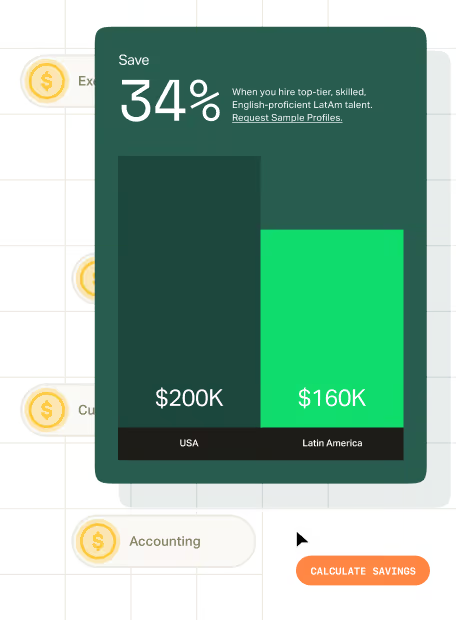
Hiring in Costa Rica typically costs 30–70% less than hiring the same role in the US. That gap isn’t driven by junior talent: according to Hire With Near’s 2026 State of LatAm Hiring Report, 84% of hires made through LatAm staffing are mid-level or senior professionals, with average annual savings per hire running between $35,000 and $64,000.
Here are compensation benchmarks for the roles most commonly filled from Costa Rica:
Source: Hire With Near's 2026 US vs. Latin America Salary Guide
The gap makes more sense when you look at the cost-of-living context. A mid-level software engineer earning $54,000–$72,000 in San José is living very well by local standards. The same role in a US city starts at over $115,000. That difference is driven entirely by what money buys locally, not by any difference in skills or output.
Here’s how San José compares to Houston, a benchmark US city with a comparable role mix, on everyday costs:
Source: Numbeo.com
For the full role-by-role breakdown, see the US vs. Latin America Salary Guide.
What Do US Companies Need to Know Before Hiring in Costa Rica?
Costa Rican professionals are accustomed to certain statutory benefits under local labor law, like a mandatory 13th-month salary and a two-tier public holiday system. Whether these apply to your hire depends on how you structure the engagement.
Either way, they’re worth understanding: Costa Rican professionals know exactly what the local market provides, and they factor it into their compensation expectations. Planning for both upfront makes for a smoother offer conversation.
PTO and statutory leave
Every worker is legally entitled to two weeks of paid vacation for every 50 weeks of continuous employment, effectively one full year of service. In practice, that translates to 10 working days per year for a standard Monday-to-Friday schedule.
If a national holiday falls during an employee’s approved vacation period, that day doesn’t count against the vacation balance. Employers are legally required to grant the vacation within 15 weeks of the employee’s 50-week anniversary. Rolling vacation over into a second consecutive year is prohibited by law unless there’s a documented business necessity.
One other thing worth knowing: Costa Rica doesn’t allow employees to trade their statutory two weeks for a cash payout while still employed. The only exception is on termination, when unused vacation must be included in the final settlement.
Public holidays
Costa Rica splits its official public holidays into two legally distinct categories, which work differently from each other:
Mandatory payment holidays
On these days, employees are legally entitled to a paid day off. If an employee agrees to work, they must be paid double their regular daily wage:
- January 1: New Year’s Day
- Maundy Thursday and Good Friday (dates vary by year)
- April 11: Juan Santamaría Day
- May 1: Labor Day
- July 25: Annexation of Guanacaste Day
- August 15: Mother’s Day/Assumption of Mary
- September 15: Independence Day
- December 25: Christmas Day
Non-mandatory payment holidays
For monthly and bi-weekly paid employees, these days are automatically included in their salary. For weekly-paid employees, these days are only paid if the employee works them (at the standard rate, not double):
- August 2: Feast of Our Lady of the Angels
- August 31: Day of the Black Person and Afro-Costa Rican Culture
- December 1: Army Abolition Day (marking Costa Rica’s 1948 abolition of its military)
Most US companies with Costa Rican hires handle this by offering a set number of local floating holiday PTO days, letting their team member decide which to observe without tying the team’s schedule to a calendar that may not align with the business.
The 13th salary (Aguinaldo)
A 13th-month salary is mandatory in Costa Rica for all employees, known nationally as the Aguinaldo. It’s a protected right and it can’t be withheld or delayed under any circumstances.
The calculation period runs from December 1st of the prior year through November 30th of the current year. The payout equals one-twelfth of all gross compensation earned during that window (base salary, overtime, commissions, and bonuses included). It must be paid in full between December 1st and December 20th. A single day late triggers legal penalties.
The practical implication: when budgeting for a Costa Rican hire, think in terms of 13 months of pay rather than 12: that’s 12 regular monthly salaries plus the Aguinaldo at the end of the year. That’s the benchmark local professionals use when comparing offers.
{{salary-guide-cta}}
Private health insurance
Costa Rica has a universal public healthcare system that covers all formally employed workers through mandatory payroll contributions. The system is comprehensive but faces chronic overcrowding for non-emergency care, with specialist appointments sometimes running weeks or months out.
As a result, private health insurance is the most valued non-salary benefit among white-collar professionals in Costa Rica. Mid-level hires typically expect either full employer coverage of a private plan or a co-investment model.
For senior-level and executive roles, full coverage extending to immediate family members is standard in competitive offers.
Offering private health coverage isn’t a legal requirement for independent arrangements, but it’s a meaningful retention tool, particularly for the mid and senior talent who have options.
How Does Hire With Near Help US Companies Hire in Costa Rica?
Hire With Near has placed professionals across Costa Rica's main hiring markets, primarily San José and the surrounding metro, in tech, bilingual customer success, operations, finance, and marketing roles.
A process built for quality and speed
Costa Rica is a market where speed is a real advantage. Our data shows the country is among the fastest-sourcing markets for certain roles, with some positions filled within a week of the search launching.
Our recruiters know this market well: which universities produce the strongest engineering and finance talent, what mid and senior-level professionals expect to earn, and where the highest concentration of bilingual multinational-trained candidates is. That knowledge eliminates the guesswork on your end.
Here's what working with Hire With Near typically looks like:
You describe exactly what you're looking for on a kickoff call with your dedicated recruiter. Within five days, you receive a shortlist of pre-vetted candidates with video introductions.
You interview the ones you want to meet and make a pick. Total time to hire, from kickoff to accepted offer, typically runs two to three weeks.
We also know how to structure offers that win. Costa Rican professionals factor in local market expectations when deciding what they'll accept. Our recruiters help you put together an offer that reflects that, so you're not losing a strong candidate to something easy to address.
Acceptance rates and retention on our placements are consistently high because expectations are set on both sides before an offer is made.
What happens after you hire
Once you've made your hire, we handle payroll, benefits administration, and ongoing compliance. Companies that reach that stage typically see the quality we can find for them and expand from there.
One client that reflects the typical outcome: Conversion Logix, a digital marketing agency that moved from offshore Asia to Latin America after persistent communication and quality issues, ultimately hired 11 roles through Hire With Near and saved $781,000 annually.
While that placement spanned multiple countries, it illustrates the pattern that our clients experience when they make the switch: more experienced professionals, better communication, stronger retention.
For companies filling director-level or executive positions in Costa Rica, Hire With Near also handles executive search in Latin America across all departments and industries.
If you’re ready to explore hiring in Costa Rica, book a free consultation to talk through your requirements with our team. They’ll explain salary benchmarks, role availability, and what the process looks like, so you have what you need to decide if it’s right for you.
If you're also considering hiring in other Latin American countries, check our How to Hire in Peru and How to Hire in El Salvador guides.
{{latam-hiring-cta-v2}}
Frequently Asked Questions
Is Costa Rica in a compatible time zone with the US?
Yes. Costa Rica runs on Central Standard Time (UTC-6) year-round and doesn’t observe daylight saving time. That means East Coast and West Coast companies get six to seven hours of real-time overlap during standard business hours.
Is the 13th salary required in Costa Rica?
Yes. The Aguinaldo is mandatory for all formal employees. It equals one-twelfth of all gross compensation earned between December 1st of the prior year and November 30th of the current year. It must be paid between December 1st and December 20th.
For independent arrangements, it isn’t a legal obligation in the same way, but Costa Rican professionals at the mid and senior level will factor the equivalent into their compensation expectations. Thinking in terms of 13 months of annual pay is the right budgeting benchmark.
What roles do US companies most commonly hire in Costa Rica?
Based on Hire With Near’s placement data, the strongest demand from Costa Rica centers on technology, bilingual customer success, and operations roles. Software engineers and DevOps professionals are the most requested tech roles, driven by the depth of the engineering pipeline Intel and TEC have built.
Customer success managers and bilingual support professionals are in strong demand from US SaaS and services companies. Operations analysts and finance professionals are also placed regularly.
What level of English can US companies expect from Costa Rican professionals?
Costa Rica ranks 55th globally on the 2025 EF English Proficiency Index, in the Moderate Proficiency band. That national average understates what you’ll find at the mid and senior levels in San José’s tech and corporate sectors. The country has a strong bilingual education tradition and a workforce shaped by decades of working inside English-operating multinationals.
Most professionals Hire With Near places from Costa Rica are fully conversational in business English: client calls, written communication, and daily standups are all handled comfortably.
Hire With Near screens for English proficiency on every placement.
How long does it typically take to hire through Hire With Near in Costa Rica?
For most roles, Hire With Near presents vetted candidates within 7–14 business days of starting the search. Total time to hire, from kickoff to accepted offer, typically runs two to three weeks, depending on role seniority and how quickly the client moves through interviews.
Costa Rica is among Hire With Near’s faster sourcing markets for tech and bilingual support roles specifically.
Does Costa Rica have strong intellectual property protections?
Costa Rica is a signatory to the Berne Convention and the TRIPS Agreement, and its IP framework is broadly consistent with international standards for software, creative work, and proprietary business information. For roles involving access to sensitive code, processes, or confidential data, Hire With Near recommends including IP assignment and confidentiality clauses in the employment or service agreement as standard practice.
What industries hire most in Costa Rica?
Costa Rica is a popular destination for technology and IT recruiting due to the strong engineering pipeline Intel and TEC have built. SaaS and software companies hire regularly for software engineering and customer success roles. Healthcare organizations use Costa Rican professionals for both technical and operations functions, taking advantage of the country’s strong medical devices and life sciences sector.
Finance firms and accounting practices hire for financial analysis, bookkeeping, and shared services roles. Marketing recruitment is increasingly popular to source bilingual content, digital marketing, and creative professionals from San José’s growing creative sector.



.webp)





%203.svg)
.avif)





%20(1).avif)

%20(1).png)