%203.svg)
Key Takeaways
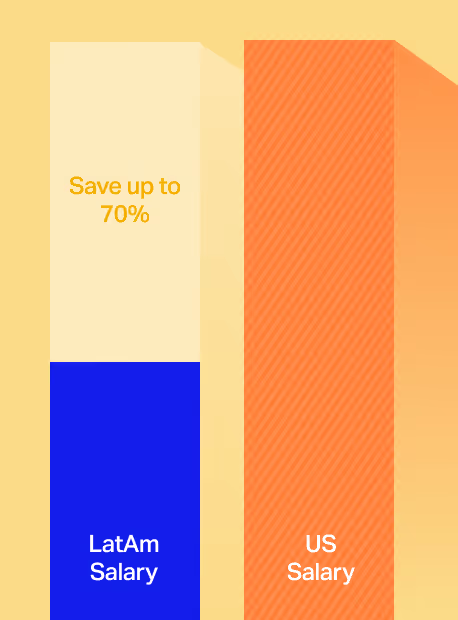
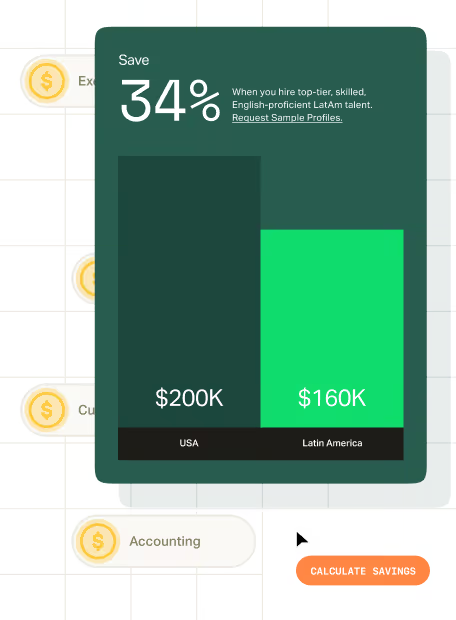
- Outsourcing software development to Costa Rica gives US companies experienced, English-speaking engineers who work through the US business day, usually at 30 to 70% less than comparable US salaries.
- Costa Rica software development typically costs from about $30K to $108K a year per engineer depending on role and seniority, well below US rates for the same experience.
- The best providers combine real technical vetting, strong English communication, US time-zone overlap, and verifiable third-party reviews; shortlist on those criteria, not on price alone.
Costa Rica has become one of the most practical places for US companies to outsource software development: senior, English-fluent engineers who work your business hours, at a fraction of what the same experience costs in the US.
If you've run an offshore team before in Asia or Eastern Europe, you know the problem this solves. You send feedback at 4 p.m., the team on the other side of the world is asleep, and you lose a full day waiting on a reply a same-workday engineer would have handled in minutes. Stretch that across a sprint and the roadmap starts slipping.
Costa Rica sits in the same working-hours band as the US, and hiring software engineers there is now a mainstream move. This guide covers what it costs, how deep the local talent and tech ecosystem really are, how to choose and vet a provider, and which companies to shortlist.
Why Are US Companies Outsourcing to Costa Rica?
US companies outsource software development to Costa Rica for four practical reasons: engineers who work through your business day, a lower cost per hire, strong cultural and communication alignment, and a stable, business-friendly environment.
The pull toward nearshore is well documented. Hire With Near's research on why US companies are hiring in Latin America found that 30% of companies that turned to Latin American hiring did so to switch from offshore teams to nearshore ones for real-time, same-workday collaboration. Costa Rica is one option in the wider market for hiring developers in Latin America, and it consistently ranks among the strongest.
Time-zone overlap that matches your workday
A software developer in Costa Rica works during your business hours, so they can join your daily stand-ups and give you same-day feedback, wherever your team sits in the US. Costa Rica runs on Central time year-round, so it shares nearly the entire working day with US teams and keeps strong overlap with both coasts, which is why real-time collaboration feels natural rather than forced.
That is the opposite of the offshore experience many teams describe. One founder who had run an engineering team in India explained the friction that finally pushed them to change:
They did a pretty decent job refactoring a lot of code, to be honest. It's just that you lose a day every single time, just from a message. If I go to bed and wake up, your day's already done, so you wait another day to check on it.
The problem there is the working-hours gap, not the people. Nearshore software development closes that gap: a question sent in the afternoon gets answered the same afternoon, not overnight. If you want the fuller comparison, see how offshore outsourcing differs from nearshore and onshore models.
Lower cost per hire
Hiring in Costa Rica costs meaningfully less than hiring the same experience in the US, because salaries there reflect a lower local cost of living. The skill level is the same. That savings is a big part of why companies explore hiring remotely in Latin America in the first place. We break the numbers down in the cost section below.
Cultural and communication alignment
Costa Rican professionals tend to be closely aligned with US business practices and communication styles, which keeps day-to-day collaboration smooth. Shared norms around meetings, documentation, and feedback mean less time spent translating expectations and more time shipping.
Political and economic stability
Costa Rica is one of the most stable countries in Latin America, with strong political rights and civil liberties and a solid legal framework, which is part of why multinationals like Intel and HP have long operated there, and why it consistently ranks among the best countries to hire developers. That stability makes it a dependable base for long-term technical work. For the full picture of hiring remote talent in Costa Rica beyond software development, including other functions and roles, our country guide covers it in depth.
Is Costa Rica a Tech Hub? Software Developer Skills and Ecosystem
Yes, Costa Rica is one of Latin America's established tech hubs, with a university-fed talent pool, a multinational tech footprint, and engineers working in the same modern stacks US teams use.
Costa Rica invested early in STEM education, and its universities graduate a steady supply of software, cloud, and data engineers. That pipeline supports companies like Intel and HP, which have run engineering and operations there for years, and it feeds a local market of experienced developers who have shipped for US clients.
Across the editorial work I do turning Hire With Near's recruiters' expertise into guidance for hiring managers, the point they raise most about Costa Rican and wider Latin American engineers is how often the seniority surprises US clients. As Julia Guillen, a Senior Tech Recruiter at Hire With Near, put it:
Clients are consistently surprised with the caliber of talent that's available in Latin America. They don't expect to find senior engineers who've worked with major U.S. companies, understand modern development practices, and often have more hands-on experience with specific frameworks than candidates they'd find locally.
— Julia Guillen, Senior Tech Recruiter, Hire With Near
On the technical side, you will find engineers working in JavaScript and TypeScript, React, Node, Python, and the major cloud platforms, across web, back-end, and DevOps roles.
English proficiency is strong enough for full technical collaboration. Costa Rica scores above the global and regional average on the EF English Proficiency Index 2025, placing it among the stronger English-speaking markets in Latin America, though behind Argentina and Chile.
What matters more for engineering hires than a national ranking is whether a specific developer can explain a technical decision clearly, so treat communication as something to test directly during hiring.
Here's a quick look at what sets Latin American engineers apart from other offshore regions:
How Much Does It Cost to Outsource Software Development Services in Costa Rica?
Outsourcing software development to Costa Rica typically costs from about $30K to $108K a year per engineer, depending on the role and seniority, which is well below US rates for the same experience.
To put that in concrete terms, here is what hiring software development roles in Latin America costs compared to equivalent US hires, according to Hire With Near's salary benchmarks:
For the most up-to-date figures, see Hire With Near's US vs Latin America Salary Guide.
{{salary-guide-cta}}
For a fuller breakdown by role, our IT and developer salaries in Latin America guide compares pay across the department. These savings reflect a strategic decision about where to hire, and the quality of the engineering holds up. Hiring a senior engineer in Costa Rica often costs about what you would pay for a mid-level engineer in the US.
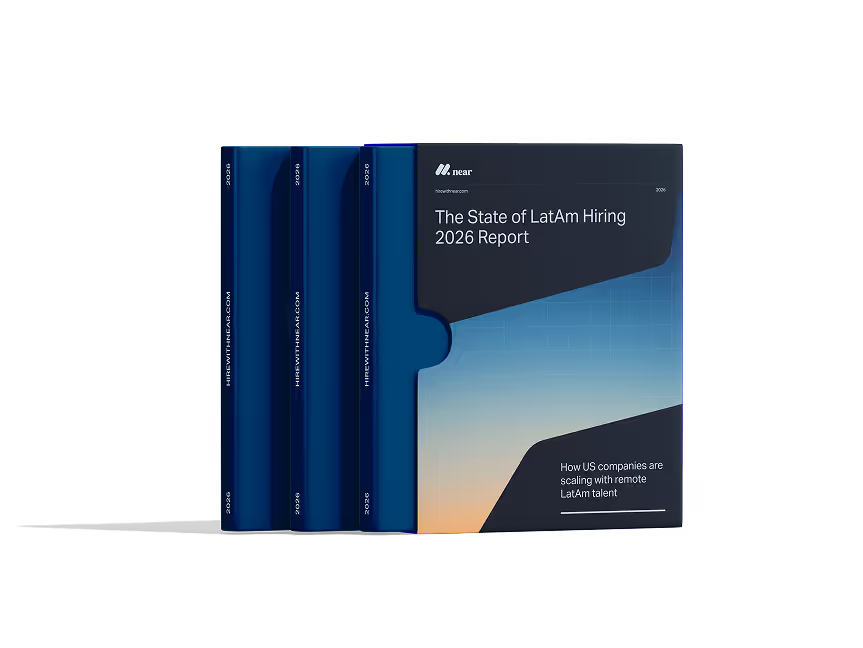
That point matters, because the biggest misconception about nearshore hiring is that low cost means junior talent. It does not. According to Hire With Near's 2026 State of LatAm Hiring Report, 84% of our Latin American placements are mid-level or senior, and among engineering roles specifically, 51% are senior. Outsourcing to Costa Rica means hiring experienced engineers at a lower cost than in the US.
A few factors move the number up or down:
- Experience level: Senior engineers and niche specialists command higher salaries than mid-level generalists.
- Project complexity: Custom or advanced work needs specialists, which raises the rate.
- Role type: Back-end developers, front-end developers, and DevOps engineers carry different pay expectations.
- Engagement model: Hourly, fixed-price, and dedicated-team arrangements price differently.
- Technology stack: In-demand or specialized stacks push rates higher.
Ask any provider to walk you through total cost, not just a headline rate. A trusted software engineer staffing agency or software developer recruitment agency should give you transparent pricing and match you to the exact experience level you need.
How Do You Choose a Software Development Partner in Costa Rica?
Choose a Costa Rica software development partner on three things above all: how rigorously they vet engineers technically, whether those engineers can communicate in English, and which engagement model they offer. Two more are worth confirming but simpler to check: real time-zone overlap (covered above) and clear handling of IP and security.
The vetting bar is where most of the risk sits. Resumes are easy to inflate, and AI-generated CVs are everywhere, so you need a provider whose screening proves an engineer can actually build and explain their work before they touch your codebase. Ask exactly how they assess candidates: a technical assessment or project deep-dive, a walk-through of past work, and a communication screen.
Look for vetting that tests real work, not just a resume
Strong technical vetting goes past listing languages and asks an engineer to account for what they built. Hire With Near's developer recruiters describe the filter this way. As Natasha Tarapow, Senior Recruiter for Development and Engineering at Hire With Near, explains:
We always ask candidates to tell us about a project they've worked on, not just that they use this language and that one, but what their role was and what they actually did. It's important that they can explain their work to someone who isn't a developer. If they can do that, that tells me a lot.
— Natasha Tarapow, Senior Recruiter for Development and Engineering, Hire With Near
Confirm the technical and English balance
The hardest candidates to find are the ones who are strong on code and communication, and a good partner screens for both. One managing director at a managed IT services company described the exact gap a weak process leaves open:
When we do find someone with the technical skills, they don't have the English level to communicate with the U.S.-based clients. They either focus on the technical skills or the language, and most of the time it is the technical skills. So I believe they're too focused on the technical part, and we haven't found the balance.
A partner that only tests code will hand you engineers who cannot survive an architecture review or write a clear pull-request description. Make sure their process checks both.
Understand your engagement options
Once you know what to screen for, decide how you want to bring the talent on. Most companies weigh three paths.
Freelance and contractor platforms like Upwork or Toptal give you fast access to contractors, but they are built for short-term, project-based work. You manage quality and retention yourself, and the talent is usually splitting attention across several clients, so they are a weak fit for a core engineering role you want filled full-time.
Nearshore staff augmentation places pre-vetted engineers onto your team to work under your direction, while the firm employs them and handles payroll, benefits, and compliance. It fits teams that want to scale up or down or staff a defined project without committing to permanent headcount.
A specialist staffing and recruiting partner is the simplest path for most companies hiring full-time. You describe the role, and the partner sources and vets candidates, then hands you a shortlist to interview.
Once you choose someone, you can employ them directly or have the partner handle payroll, benefits, and local compliance, so the engineer works as part of your team while the logistics run in the background. This is what Hire With Near does through its nearshore staffing and recruiting services: one relationship covers finding and vetting the engineer and, if you want it, managing employment.
On IP and security, confirm the basics before you sign: clear IP assignment, NDAs, and sensible access controls. A reputable partner will have these ready and will explain them plainly.
Most Popular Outsourcing Hubs in Costa Rica
Costa Rica's software development activity clusters in four hubs, each with its own strengths.
- San José: The capital is home to many multinational corporations, top universities, and the country's densest tech community.
- Heredia: A tech-friendly city with several business parks and IT firms, close enough to San José to share its talent pool.
- Alajuela: A fast-growing hub with a favorable business environment and a skilled workforce, made convenient for international teams by its proximity to the airport.
- Cartago: One of the oldest cities in the country, Cartago pairs a strong engineering focus with respected universities.
Knowing where the talent concentrates helps you understand the market, but with a remote team the hub matters less than the vetting and fit.
Which Companies Are Best for Outsourcing Software Development to Costa Rica?
For US companies outsourcing software development to Costa Rica, the strongest options combine confirmed Costa Rica or pan-Latin American delivery, verifiable third-party reviews, and real technical vetting.
Hire With Near, EX Squared, and Tecla have the clearest Costa Rica track record; the others below deliver across Latin America and are worth weighing as broader nearshore options.
If you want to widen the shortlist past Costa Rica, our roundups of the top nearshore software development companies and the best LatAm outsourcing companies compare providers across the region.
Every company here meets one of two bars: at least 50 client reviews on an established platform (G2, Clutch, or Trustpilot) with a 4.5-or-higher rating, or a verifiable roster of large enterprise clients, a signal of delivery quality that review platforms don't always capture.
The companies below are in no particular order; the right fit depends on your roles, budget, timeline, and how you like to work.
Hire With Near
A nearshore staffing and recruiting partner that recruits full-time, pre-vetted software engineers based in Latin America, including Costa Rica, and places them on US teams for the long term. You can employ the engineer directly, or have Hire With Near handle payroll, benefits, and local compliance for you, so you get a permanent team member rather than a rented project team. It draws on a talent pool of 160,000+ pre-vetted candidates, fills 97% of the roles it takes on, and holds a 4.9/5 rating on G2 (140+ reviews). Best fit for companies that want a permanent hire, or a whole remote software development team.
EX Squared
Nearshore staff augmentation with an enterprise client roster that includes Coca-Cola, KFC Costa Rica, and Kimberly-Clark. No third-party star rating is published; the enterprise roster is the signal.
BairesDev
One of the largest Latin American software outsourcing firms, delivering across the region including Costa Rica. Clutch rating: 4.9/5 (60+ reviews).
Tecla
Builds remote Latin American development teams and runs a dedicated Costa Rica hiring page, so its Costa Rica delivery is well established. Trustpilot rating: 4.8/5 (70+ reviews) as of July 2026.
Revelo
A Latin American developer talent marketplace and staffing platform spanning the region, including Costa Rica. G2 rating: 4.7/5 (125+ reviews) as of July 2026.
BEON.tech
Places vetted Latin American engineers, sourced across roughly two dozen countries including Costa Rica, embedded on US teams. Clutch rating: 4.9/5 (65+ reviews) as of July 2026.
AgileEngine
An award-winning software design and development firm with Latin American delivery. Its named delivery centers are in Colombia, Argentina, Brazil, and Mexico, so treat it as a broader nearshore option rather than a Costa Rica-based provider. Clutch rating: 5.0/5 (60+ reviews) as of July 2026.
Cheesecake Labs
A product engineering studio with Latin American roots in Brazil, with offices in San Francisco and Florianópolis. Consider it a broader Latin American option rather than a Costa Rica-based provider. Clutch rating: 4.9/5 (about 60+ reviews) as of July 2026.
Final Thoughts
Costa Rica remains one of the strongest nearshore options for US companies outsourcing software development: experienced engineers, real overlap with your workday, and meaningful savings on every hire.
The move from offshore to nearshore is exactly what worked for Conversion Logix, an Inc. 5000 ad-tech and software agency. After the distance and time-zone gap of a Philippines-based team created communication and integration friction, it switched to pre-vetted Latin American talent through Hire With Near, filling 15 roles across five departments, including a Machine Learning Engineer, at a 22-day average time-to-hire and saving $781,000 a year. Their Client Services Manager, Tawnya Morse, described the difference this way:
I think the main benefit of Latin American talent is the ease of integration. It's been so easy to work together without really noticing any kind of difference from somebody that's in the States.
Whether you want to build a software development team from scratch or add a single engineer, Hire With Near can help, including executive search for senior engineering leadership. To explore it, book a free consultation to talk through your requirements with our team. You will get salary benchmarks and a clear walk-through of the process, so you have what you need to decide whether it fits.
{{latam-hiring-cta-v2}}
Frequently Asked Questions
Is Costa Rica a good place to outsource software development?
Yes, Costa Rica is a strong choice for US companies outsourcing software development, thanks to experienced engineers, US business-hours overlap, and costs 30 to 70% below US rates. The country has a university-fed talent pool, a long multinational tech presence including Intel and HP, and a political and business climate stable enough for long-term work. It is best suited to teams that value real-time collaboration and cultural alignment over round-the-clock offshore coverage.
Is English widely spoken by Costa Rican software developers?
English is widely spoken among Costa Rican software developers, and the country scores above the global and regional average on the EF English Proficiency Index. It sits among the stronger English markets in Latin America, though a notch behind Argentina and Chile, so proficiency varies by individual.
For engineering hires, what matters most is whether a specific developer can run an architecture review, write clear documentation, and explain a technical decision, so test communication directly during hiring rather than relying on the national ranking.
How long does it take to hire a software developer in Costa Rica?
A good partner can present pre-vetted software developers within a few weeks. Latin American engineers also tend to have shorter notice periods than the 60-to-90-day windows common with offshore hires, so a candidate can often start soon after you decide.
Most companies that work with Hire With Near make a hire in under three weeks; Conversion Logix, for example, averaged a 22-day time-to-hire across 15 roles. The exact timeline depends on how specialized the role is and how quickly your team can interview and decide.
What happens if a developer doesn't work out, is there a replacement guarantee?
Reputable staffing and recruiting partners back their placements with a replacement guarantee, so if a hire does not work out within a set window, they source a replacement at no extra fee. Hire With Near backs every placement with a 180-day replacement guarantee, double the common industry standard. When you compare providers, ask two things: how long the guarantee runs, and whether it covers a replacement search rather than only a partial refund.
What software development roles can I hire from Latin America?
US companies hire the full range of software development roles from Latin America, including full-stack developers, back-end developers, front-end developers, DevOps engineers, and cloud developers. Latin American talent in these roles typically brings the same technical depth as US-based engineers, with far better time-zone overlap than offshore alternatives, at a meaningfully lower cost.
How is hiring in Costa Rica different from offshore outsourcing to Asia?
Hiring in Costa Rica differs from offshore outsourcing to Asia mainly in working-hours overlap: a Costa Rica engineer is online during your business day, while an offshore team in Asia works while your US office is closed. That means live stand-ups, same-day answers, and real-time handoffs instead of overnight delays on every question. The talent is excellent in both regions; the difference is the model, and for teams that need day-to-day collaboration, the nearshore overlap is what makes Costa Rica work.





.webp)
.webp)


%203.svg)
.avif)





%20(1).avif)

%20(1).png)