

%203.svg)
Key Takeaways
- The most in-demand developer skills in Latin America are JavaScript, Python, and React, each named in about a third of the job descriptions US companies sent Hire With Near, followed by TypeScript and SQL at 19.2% each.
- Among cloud platforms, AWS leads by roughly four to one over Azure, and among databases, PostgreSQL leads by nearly three to one over MySQL.
- The most-requested skill isn't a technology at all. 76% of these job descriptions ask for communication, more than any technical practice. On the technical side, half name five or more technologies, so the strongest postings separate what a hire needs on day one from what they can learn on the job.
The most in-demand developer skills in Latin America are JavaScript, Python, and React, with AWS and PostgreSQL as the stack underneath them. The figures come from Hire With Near’s own data: more than 400 IT and engineering job descriptions from more than 110 US companies between September 2025 and September 2026.
We calculated the technology percentages on the postings that came with full requirement text, so they show what US companies asked for when hiring software engineers in Latin America.
If you're drafting a job description and wondering which technologies belong on it, this article gives you a ranked reference to check your list against. If you'd like to read the full findings, our MAIN REPORT goes deeper into the topic.
Which Programming Languages Do US Companies Hire For in Latin America?
In the job descriptions US companies sent Hire With Near, JavaScript and Python lead, named in 33.3% and 32.7% of US postings for Latin America. TypeScript and SQL follow at 19.2% each, and no other language reaches 11%.
The table below ranks the languages that appear most often in the postings and shows what each one usually does on a team:
JavaScript and TypeScript for front-end and full-stack roles
JavaScript runs in every browser, so it shows up in front-end postings, in full-stack roles, and in back-end roles built on Node.js. If your product has a user interface, JavaScript is likely on your list, and you can hire a dedicated JavaScript developer in Latin America to cover it.
TypeScript adds type checking on top of JavaScript, which helps when several engineers work in the same codebase. It appears in 19.2% of postings, roughly 14 points behind JavaScript. If your codebase is already typed, hire a TypeScript developer rather than a general JavaScript one.
Python for back-end, data, and automation roles
Python is widely used for back-end services, data pipelines, and automation scripts, which keeps it within a percentage point of JavaScript. Full-stack job descriptions name Python and TypeScript at roughly double the rate of job descriptions for general software engineer roles.
If you need back-end depth, you can hire a Python developer in Latin America. If you need one person to cover both the front end and the back end, look at a full-stack developer.
SQL for the data layer
SQL appears in 19.2% of postings, usually next to a named database such as PostgreSQL. It's the language of reporting, analytics, and the data layer behind most applications, so it turns up in back-end, data, and engineering leadership roles alike. When the data layer is the main job, hire a SQL developer.
Java, C#, and PHP for established business systems
Java (7.7%), PHP (7.1%), and C# (5.1%) account for fewer postings than the top group, but they run a large share of established business software: enterprise back ends, internal tools, and content-driven sites. Companies maintaining those systems still need engineers who know them well.
Our engineering recruiters find PHP, .NET, and C# candidates quickly, so a Java developer, a C# developer, or a PHP developer is a realistic search.
HTML/CSS for web builds
HTML/CSS appears in 10.3% of postings. It's the markup and styling behind every web page, so it matters most in front-end and website roles. If that's the job, you can hire a front-end developer in Latin America.
Which Frameworks Are Most In-Demand?
Across the same job descriptions, React is the most in-demand framework, named in 32.7% of US postings for Latin America. Node.js (12.8%), Next.js (10.9%), and FastAPI (7.1%) come next. Among postings for developer roles only, React reaches 46.2%.
A framework is the layer a team builds on top of a language, so these numbers show how US companies structure their products. The table below ranks the frameworks and runtimes that appear most often and shows which layer of the stack each one covers:
React and Next.js lead the front end
React dominates the front end, and Next.js, which adds routing and server rendering on top of React, is the second most-named front-end tool. Next.js (10.9%) appears more often than Vue and Angular combined (5.8%).
Because Next.js is built on React, hiring for one often means hiring for the other. If that's your setup, you can hire a React developer or a Next.js developer in Latin America. If your app runs on Vue or Angular, Vue.js developers and Angular developers are available too.
Node.js and FastAPI lead the back end
Node.js runs JavaScript on the server, so it's the natural back end for teams that already write JavaScript on the front end. FastAPI is the Python equivalent for building APIs, and it's named more often (7.1%) than Django and Flask combined (4.4%). APIs matter beyond any one framework: REST APIs appear in 14.7% of postings, more than any back-end framework.
For a Microsoft stack, .NET appears in 7.1% of postings, and you can hire a .NET developer for it. If you're building a JavaScript back end, hire a Node.js developer.
Which Cloud Platforms and Infrastructure Tools Come Up Most?
In the job descriptions US companies sent Hire With Near, CI/CD and AWS lead the cloud and infrastructure tools, named in 25.6% and 24.4% of US postings for Latin America. Docker follows at 12.2%, then Google Cloud and Kubernetes at 9.6% each.
The list covers two kinds of tools. Cloud platforms (AWS, Google Cloud, Azure) are where software runs. Infrastructure tools (CI/CD pipelines, Docker, Kubernetes, GitHub Actions, Terraform) are how a team packages, deploys, and automates it.
The table below ranks both and shows what each one does:
AWS leads the cloud platforms
Among cloud platforms, AWS leads at 24.4%, roughly four to one over Azure (6.4%), with Google Cloud at 9.6%. It also leads for developers worldwide: in the 2025 Stack Overflow Developer Survey, 45.9% of professional developers reported using AWS, ahead of Azure (27.2%) and Google Cloud (24.3%).
The order below AWS differs, though. In the job descriptions, Google Cloud is named more often than Azure, the reverse of the Stack Overflow survey.
Delivery tools appear about as often as the cloud platforms
CI/CD (25.6%), Docker (12.2%), and GitHub Actions (8.3%) belong to how a team ships software. They appear alongside the cloud platforms in many postings because the same engineer is often expected to keep releases flowing.
If delivery and infrastructure are a large part of the job, hire a DevOps engineer instead of adding these to a general developer posting.
Kubernetes and Terraform are specialist requests
Kubernetes (9.6%) and Terraform (4.5%) appear less frequently. They describe a specific kind of infrastructure work, running containers at scale and defining servers as code, so most postings leave them out. List them only if the engineer will run that infrastructure.
Which Databases and Data Tools Do Job Postings Ask For?
Among the tools US companies list in their job descriptions, PostgreSQL is the most-named database and data tool, in 16.7% of US postings for Latin America. ETL and data pipelines come second at 12.2%. Among databases only, PostgreSQL leads by nearly three to one over MySQL (5.8%), the next database listed.
The list covers two kinds of tools. Databases (PostgreSQL, MySQL, SQL Server, Redis, MongoDB) store an application's data, while data tools (ETL pipelines and warehouses such as BigQuery) move that data and prepare it for reporting.
The table below ranks both and shows what each one does:
Relational databases lead the list
PostgreSQL, MySQL, and SQL Server are all relational databases, and together they account for most of the named databases in the table.
The ranking matches what developers report: in the 2025 Stack Overflow Developer Survey, PostgreSQL was the most used database among professional developers at 58.2%, followed by MySQL at 39.6%. The same two sit at the top of the postings.
A relational database is the safe default for most applications, and a database developer can cover it.
Redis and MongoDB cover specific needs
Redis (5.1%) and MongoDB (3.2%) show up where an application needs fast caching or flexible, document-style data. MongoDB is a good example of the gap between use and requests. 24.3% of professional developers in the Stack Overflow survey use it, but only 3.2% of postings name it, which suggests that teams use it without listing it as a hiring requirement.
If your product truly depends on one of them, name it. Otherwise, it can stay off the posting.
Data pipelines are a second kind of request
ETL and data pipelines (12.2%) describe a different job: getting data from where it's created to where it's analyzed. Warehouses like BigQuery (2.6%) sit at the end of that path.
These postings usually belong to data roles, so if that's the work, hire a data engineer rather than adding pipeline tools to a general back-end posting.
How Many Technologies Does a Typical Job Posting List?
In the job descriptions US companies sent Hire With Near, the median posting names five technologies, and 50.6% name five or more. Only 17.3% name ten or more, and languages stay narrower still: 43.6% of postings name two or more, and 19.2% name three or more.
Five is typical. Once a posting lists ten, it's asking for a combination few engineers actually have. Federico Bilello, a Software Engineering Recruiter at Hire With Near, sees the same pattern in resumes:
A big red flag is when a candidate claims proficiency with an enormous variety of tools, to the point where it just doesn't make sense. There's no way someone has six years of experience with six different languages. I look for equilibrium: someone proficient with specific tools but with a background using different frameworks, so I know they're resourceful, not just a jack of all trades.
— Federico Bilello, Software Engineering Recruiter, Hire With Near
A long requirements list makes it harder to tell who actually fits. Split it in two: the technologies the hire will use from week one, and a shorter nice-to-have list.
Here's what that looks like for a sample back-end role:
- Required: Python, FastAPI, PostgreSQL, and AWS.
- Nice to have: Docker and Redis.
The four required items cover the work, and the extras tell candidates where the role can grow. A candidate with strong Python and PostgreSQL who has never touched Docker still belongs on your shortlist.
For the full process, see our guide to hiring Latin American developers.
Which Technologies Barely Appear in Job Postings for Latin America?
Go, Rust, and Swift barely register in the job descriptions. Go appears in 3.8% of postings, Rust in 0.6%, and Swift in none.
- Go: 3.8% of postings.
- Rust: 0.6% of postings.
- Swift, Scala, Dart, and Elixir: no postings.
A technology that's rare in postings can still be easy to find among candidates. ParkMobile, part of the global mobility platform Arrive, runs a parking app used in over 4,200 cities across 21 countries. Through Hire With Near, it hired nine senior engineers across platform, back-end, and iOS roles, and their profiles include Java and Spring microservices and a Go migration.
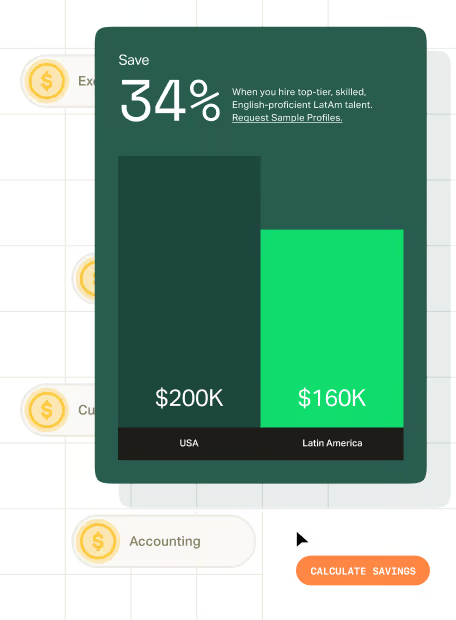
The average time to hire was 24 days, and the team saves more than $1 million a year compared with US rates.
Final Thoughts
Before you post the role, write down the three or four technologies the hire will use from week one and check them against the tables above. If they sit inside the stack most US teams ask for (JavaScript or Python, React, AWS, PostgreSQL), you can write the posting with confidence. If one is unusual, you know to say so up front. That list is also the most useful thing you can hand a recruiter. At Hire With Near, our IT and tech recruiters start from the stack. They ask each candidate how many years of professional experience they have with every required tool, so the profiles you see match the work, not only the keywords on a resume.
To see what that looks like for your stack, request pre-vetted candidates from our talent pool of 160,000+ pre-vetted professionals. We'll send you profiles of two to three sample engineers, with their experience, skills, and English level. No meeting required, and no commitment.
{{prevetted-banner}}




.webp)
.webp)




%203.svg)
.avif)





%20(1).avif)

%20(1).png)