Why US Companies Are Switching Engineering Models to Hire in Latin America
We spoke to 300 US companies hiring engineers in Latin America. 45% are looking for a better solution to an offshore team or a development agency.

Across every non-technical department we work with, the primary reason US companies give for hiring in Latin America is cost savings. Software engineering is the exception.
In hundreds of sales calls with US companies looking to hire IT and software engineering roles, the reason named most often was moving an engineering team off an offshore arrangement in a distant time zone (e.g., Asia, Eastern Europe). Cost savings came second.
Add in the companies leaving a development outsourcing firm, and roughly half of these engineering conversations start the same way: a company that wants to switch to a new model of getting their engineering work done.
Offshore teams and outsourcing firms both ship good software for plenty of companies. But both models share distance: the person paying for the work and the professionals doing it are rarely in the same time zones or the same conversations and workflows.
That’s the problem that most of the companies we speak to are trying to fix.
For many, the solution is to hire software engineers in Latin America directly, on their own team, in their time zone.
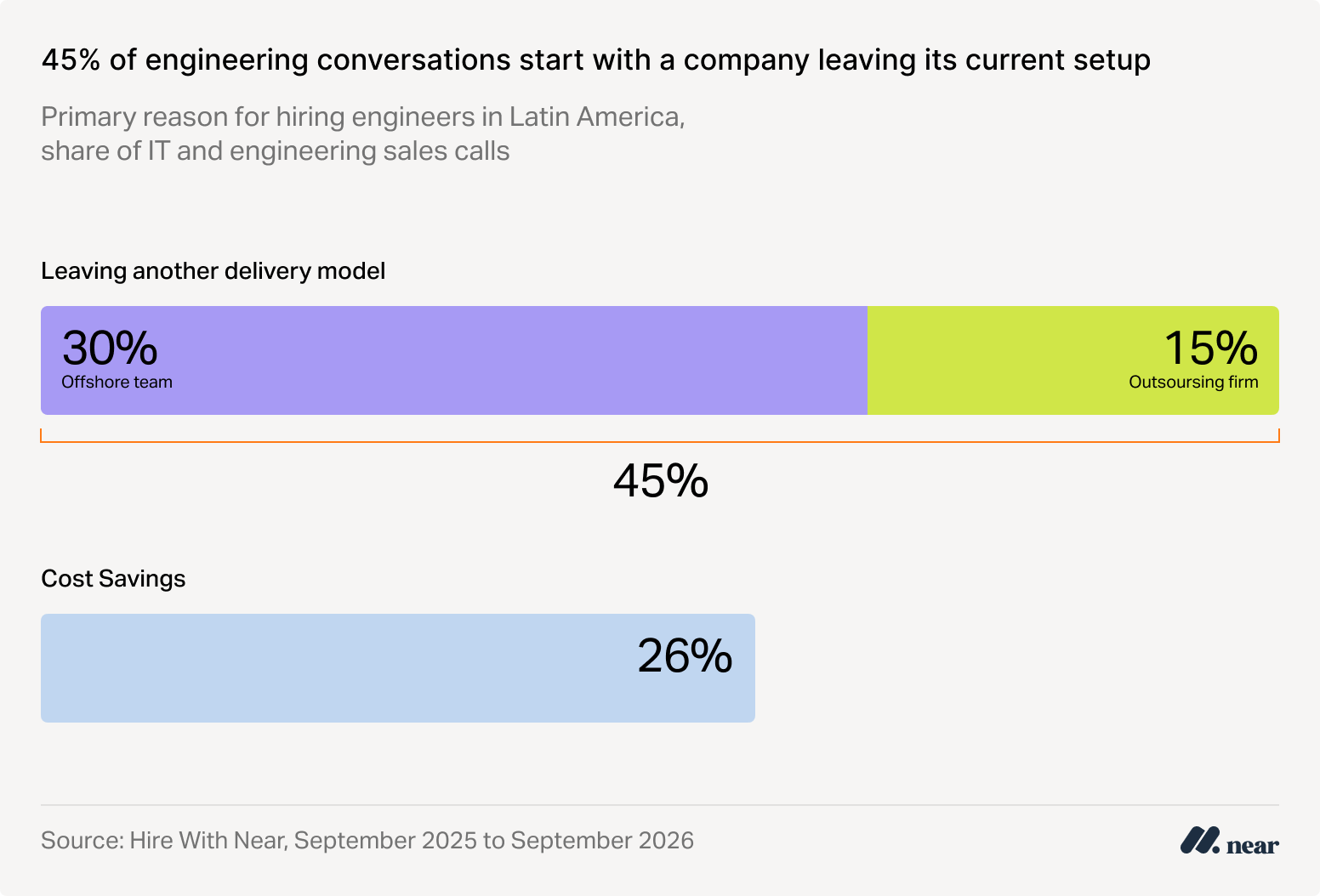
- Roughly 45% of engineering conversations start with a company leaving an offshore team in a distant time zone or a development outsourcing firm (30% offshore, 15% outsourcing firm), against just 26% who come primarily for cost savings. Every other department we work with leads with cost.
- Companies want to remove the agency middleman and time zone gap from their development processes.
- What they’re hiring for is normally a generalist, not specialist, and increasingly AI-aware. Half of all job postings name five or more technologies, full-stack is the largest single role family, and half mention AI.
.svg)
Why Engineering Teams Are Hiring in Latin America
When a US company gets on a call with us about hiring developers, they often start by telling us about the team they already have. About half the time, that team works through a development agency or is located in Asia or Eastern Europe. And because of the constraints those models create, these companies are now looking to hire developers who are located in US-aligned time zones and who will directly join their team.
We looked at a sample of 300 calls and sorted them by the main reason each company gave:
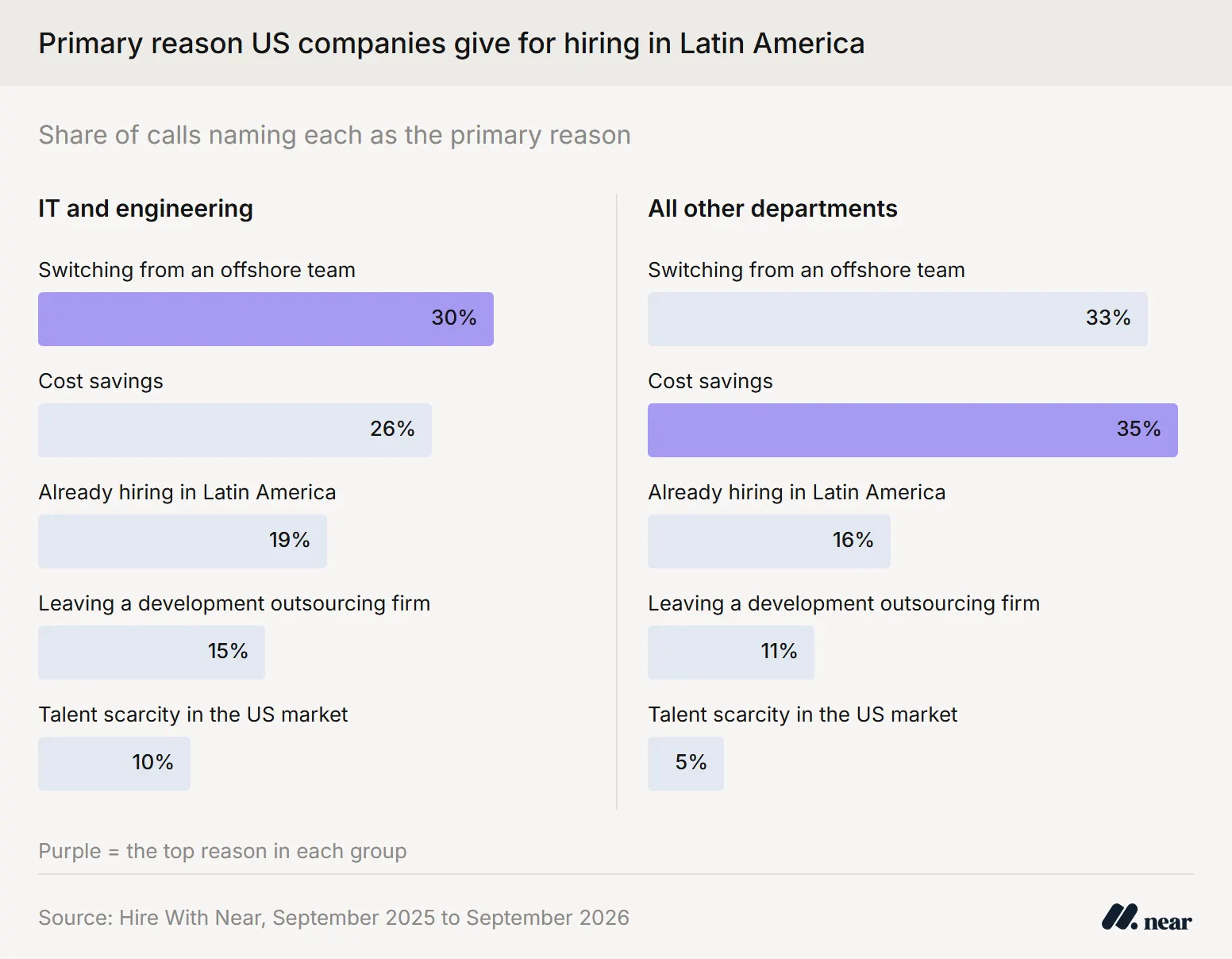
The biggest group, 30%, is moving engineering work off an offshore team. Another 15% are leaving a development outsourcing firm, which is a bigger share than in any other non-technical department.
Together, that’s 45% of engineering companies coming to us to change how their developers work with the rest of the business.
Cost savings comes in second at 26%. It still counts, but engineering is the one department we place talent for where it isn’t the top reason. The companies leaving an offshore team (or an outsourced team, as often offshore as well) have already captured most of the savings over US hiring, so cost isn’t what’s driving their move.
That matches a wider shift. Harvard Business Review argued this year that the question companies ask about outsourced work is moving from where it can be done most cheaply to which parts of it they should own.
The other two reasons are smaller. 19% already have developers in Latin America and are growing the team. 10% say they can’t find the engineers they need in the US. (That 10% figure may sound small, but it’s double the rate for non-technical roles.)
The next two sections cover: companies leaving offshore teams and companies leaving development agencies. For each, we look at the reasons they are leaving these models and what they want from their developers instead.
Why Far Offshore Teams Don’t Work
Let’s start with what an offshore arrangement in Asia or Eastern Europe does to a working day. An engineering team eight to twelve hours away is asleep when the US team is working. A question asked in the afternoon is answered the next morning, a clarification on that answer lands the morning after, and a decision that would take twenty minutes in a shared afternoon takes three days.
Large companies absorb that lag with process. They write specs that anticipate the questions, they staff a lead in the overlap window, and they plan in two-week blocks that can survive a slow feedback loop. Companies of twelve people don’t have any of that. The founder is the product manager, the reviewer, and sometimes even the person merging the branch, and every hour of lag lands on that person.
Nick Sawinyh, Head of Product at Veodyn, who ran engineering at DexGuru as co-founder and CEO from 2020 to 2024, pushes back on the premise. “The time zone was never the real problem,” he says. What hurt was how many decisions needed a synchronous answer to move forward. The solution his team found was “writing decisions down in a form someone could act on without asking a follow-up question.”
His fix works for a team that has already built that kind of written-decision process, and small companies often haven’t. That’s the pressure behind the push for US hours in our data.
Separately from the calls, we analyzed the job descriptions US companies sent us for IT and engineering roles. That dataset covers more than 400 roles, from September 2025 to September 2026. It shows what these employers prioritize when they hire in Latin America:
- 51% of these engineering postings name a US time zone or US business hours, against 46% across all role categories.
- The smaller the company, the harder they insist: 59% at companies with 50 or fewer employees, against 47% at companies of 51 to 250.
- A quarter of postings use explicit overlap language rather than fixed hours. It’s a simple way to say that the company cares about the hours you share, not the hours you keep.
Latin America closes that gap a founder might be absorbing alone: it sits between zero and three hours from most US time zones. A question asked at 3 p.m. gets an answer at 3:20 p.m.
Edward Tian, founder and CEO of the AI-detection company GPTZero, felt that gap as a support problem. He ran his engineering team out of Asia, and the lag showed up first in bugs:
Something needs fixing; I flag it; and by the time I flag it, my engineer in Asia has already logged off. Once they see my flag, a day has gone by for me.
— Edward Tian, Founder and CEO, GPTZero
He’s explicit that the fix had nothing to do with the team’s skill or the cost of running it. Once the team shifted to US hours, the same bug closed in an hour instead of a day.
Kade Robertson, CEO of Viral Distributors in Florida, ran into the Eastern European version of the same problem. He hired a developer in Bulgaria, and the seven-hour gap caught up with him fast: “If something critical broke at 3 p.m. my time, it was 10 p.m. for him.”
That experience had him looking at Latin America, and he hired a developer in Brazil instead. He told us:
The time zone gap is only one or two hours, so we get real overlap during the workday. Response times are much faster and we can solve problems in real time.
— Kade Robertson, CEO, Viral Distributors
Siim Kostabi, CEO of the project-management company Pageloot, kept his engineering team in Eastern Europe. But one incident shows exactly what that partial overlap costs:
A question that should take ten minutes to resolve would sit unanswered for eight hours, then generate a follow-up that sat another eight. One ambiguous API spec cost us six days of back-and-forth across three time zones, work that would have taken two hours in the same room.
— Siim Kostabi, CEO, Pageloot
Why Development Outsourcing Has a Shelf-life for Many Companies
The outsourcing story is about who owns the work.
In a dev shop engagement, the agency holds the team. It assigns the engineers, sometimes rotates them between accounts, keeps the product knowledge with its own staff, and hands the client a deliverable at the end. For a fixed-scope project with a clear end date, the outsourcing model does the job.
That arrangement doesn’t work well long term when software is the business’ main product. The client starts needing the engineer in the standup, on the customer call, and in decisions about what to build next. The agency layer is now sitting between the company and its own roadmap.
Kellon Ambrose, managing director of Electric Wheelchairs USA, is weighing exactly that trade-off. The friction point he names is specific: “With an agency, a seemingly small website issue could pass through an account manager or project queue before reaching the developer who could actually fix it.”
For an ecommerce business, he says that distance is the problem:
If something is creating friction in the buying process, I want our team to be able to explain the problem directly to the developer, answer questions immediately, and test the solution without another round of handoffs.
— Kellon Ambrose, Managing Director, Electric Wheelchairs USA
The same job descriptions describe the hire these companies want instead, and they describe it in ownership language:
- 51% of job descriptions ask for ownership.
- 56% ask for autonomy or a self-starter.
- 40% describe client-facing work, which for a small company means the engineer talking to customers rather than to an account manager.
- 76% ask for communication skills, more than any technical practice in the data.
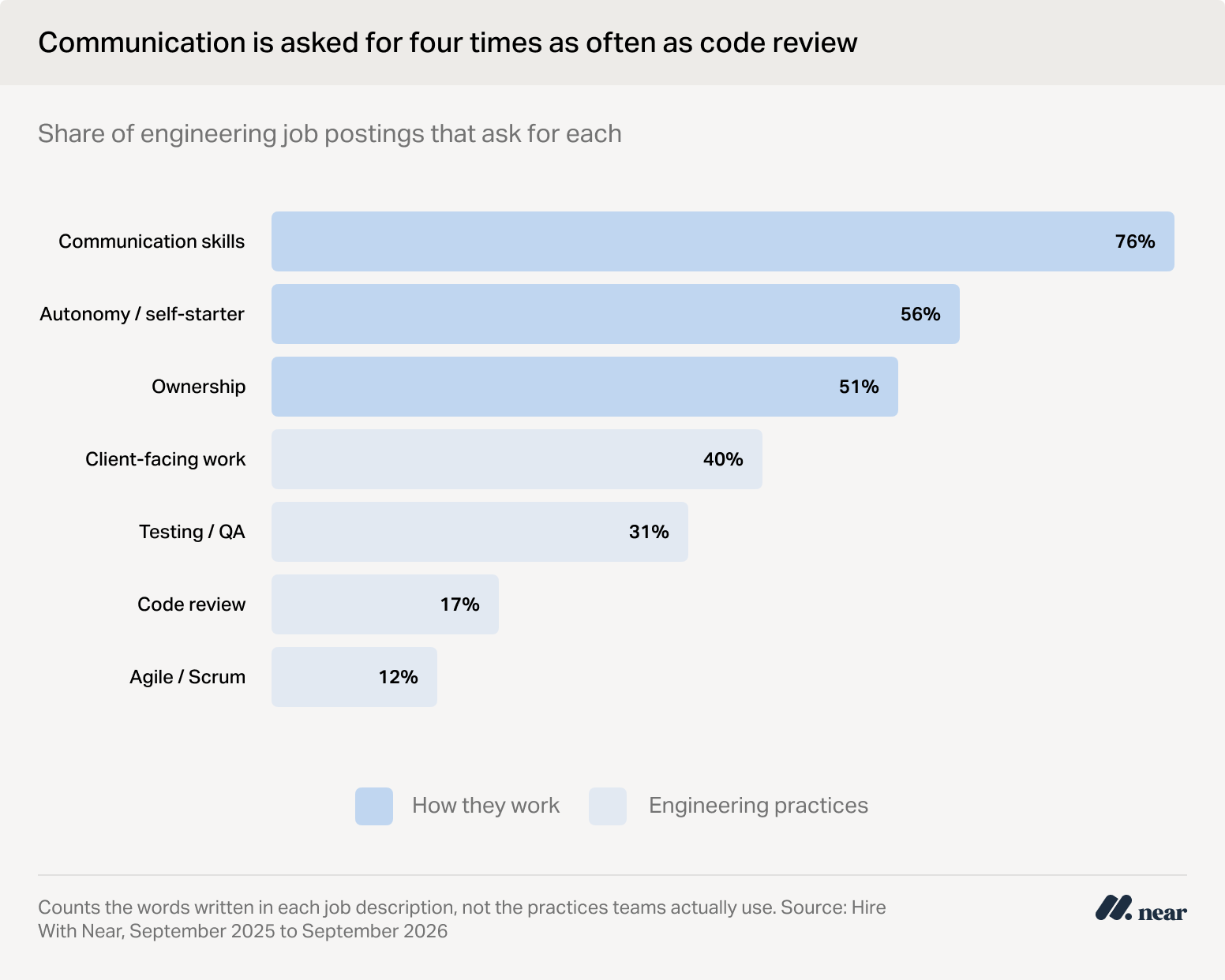
Taken together, those requirements describe an engineer who makes decisions without waiting for direction, talks to customers directly, and communicates with the whole company, not just a project manager.
That shows up in the shape of the demand too. Full stack is the largest single role family in this data, at 17%. A full-stack developer is a generalist by definition, someone who can work across the whole application rather than owning one narrow piece of it. That’s exactly the profile a company hires for its first or second in-house engineer.
A lot of the companies I’ve hired developers for are making their first IT hire. Maybe they’ve used an agency before, or someone built their website or an internal tool, but they’ve never had an engineer on their team.
— Julieta Gorodetzky, Tech Recruiter at Hire With Near
Dieter Blom sees this from the other side of the relationship. As Director of Versys Media, he watches his clients weigh this decision, and he argues the call isn’t universal:
There are also cases where staying with an agency is the better call. If the business only needs periodic development capacity, or the product isn’t yet stable enough to justify permanent hires, a good agency can provide broader coverage across architecture, QA, UX, and delivery without the overhead of building a full internal team too early.
— Dieter Blom, Director, Versys Media
Blom’s conditions mark the edge of that shelf life. An agency fits while the need is periodic or the product is still taking shape. Once the product is stable and the work doesn’t stop, companies start wanting the team inside the company.
ParkMobile reached that point after years of relying on third-party agency developers for its back-end and platform work.
From a business viability perspective, [outsourcing our development] creates a huge risk for us.
— Mariana Lepassar, ParkMobile’s Head of Engineering for Mobile Payments and Billing
Hire With Near placed nine engineers to replace that agency team, and once ParkMobile’s leadership saw the results, it expanded the program and started hiring team leads in Colombia. The agency arrangement ran for years. The in-house team that replaced it is still growing.
The fastest-growing companies are also drawing that line. In McKinsey’s Global Tech Agenda 2026 survey of more than 600 technology and business leaders, nearly half of top-performing companies plan to bring strategic technology expertise back in-house over the next two years, compared with 37% of other companies. McKinsey’s summary:
Outsourcing builds capacity, but insourcing builds capability.
— McKinsey’s Global Tech Agenda 2026
The Engineering Skills US Companies Hire for in Latin America
A fair question at this point is whether the skills US companies need from engineers in Latin America are available there.
We’ll start with what they ask for.
No single technology dominates the job descriptions we analyzed. JavaScript, Python, and React each appear in about a third of postings. TypeScript and SQL appear in 19%, PostgreSQL in 17%, and AWS in 24%.
What stands out is how much each posting asks of one person. Half of these postings name five or more distinct technologies, and the median is five, which describes a full-stack hire rather than a specialist (28% use the words “full stack”). Python and React demand sits level with JavaScript.
Automation and AI-workflow specialists are their own role family now at 9% of these job descriptions, built on Zapier, n8n, Make, and GoHighLevel rather than a traditional back-end stack. (We explain which automation hire fits which problem separately.)

AI is the standout number in this data: 49% of these engineering postings mention it, against 23% across every other job category, and 20% specifically ask the engineer to use AI tools to ship faster rather than to build AI into the product.
So can you find these engineers in Latin America? Yes. Over the same 12 months, we filled engineering roles calling for every technology in the chart above, from JavaScript and Python to AWS, Docker, and Next.js. The talent is there. Most of the work in a search goes into finding the engineer who fits your product, your team, and your hours.
If You’re Considering the Switch to Hiring Developers in Latin America
If your current setup has the problems described above, the switch starts before the first interview. How you brief the recruiter, write the job description, and plan the handover decides whether the new team fixes the old problem or repeats it.
Here’s what to do first, based on what we see in these searches.
Tell the recruiter what’s going wrong with your current setup
45% of the engineering companies that come to us are leaving an offshore team or an outsourcing firm, so this is the normal starting point rather than an awkward admission.
The requirements that matter most are usually the ones that would have made the last setup better. If the problem was the hours, the search should prioritize engineers who are available when your team works. If it was work passing through too many hands, or nobody on your side knowing how the code worked, the recruiter should screen for engineers who have owned a product from start to finish and are used to working directly with the people they build for.
Write your overlap hours into the job posting
51% of these postings do, rising to 59% at companies with 50 or fewer employees.
Name the hours you need someone available, rather than the time zone you want them to live in.
A company that needs four shared afternoon hours and says so opens the search up to a bigger pool than a company that writes “Eastern time zone only.”
Write ownership into the job description
Ownership comes up in 51% of these job postings, and autonomy in 56%.
If the reason you’re leaving an agency is that you wanted someone who’s part of the decision, not someone waiting to be told what to build, that belongs in the job description, so candidates know from the start that the role includes making decisions, not just completing tasks.
Jeffrey Zhou, CEO and Founder of the lending company Fig Loans, describes the shift in the same terms:
For me, the real shift is ownership. You are not only hiring people to write code. You are building a team that carries responsibility for how the product evolves.
— Jeffrey Zhou, CEO and Founder, Fig Loans
And this is backed up by what our account executives hear on calls all the time:
A lot of the companies I talk to have hired in Asia before, especially the Philippines, or they still have a team there. The main thing I hear from them isn’t about budget. It’s about what they need the person to do. At a startup, you’re hired to do one thing, and then a lot of other things come up that someone has to solve day to day. These companies want an engineer who can be flexible, think strategically, and go beyond the basics of the role. They’d still save money, but what they’re really after is someone who can take on more.
— Pedro Vasconcelos, Account Executive, Hire With Near
Decide whether you need a specialist or a generalist
As we saw above, most of these job descriptions ask for a generalist: a median of five technologies per posting, with full stack the largest role family, at 17%. That shows what these employers asked for, not what you should ask for. A product built around one core system may need a specialist, while a small team that covers the whole application may need someone who can work across it.
Before you write the stack, check each requirement against how the work gets done now. AI tools are changing how engineers work, so a skill you would have required a year ago may matter less, and a new one may matter more.
Decide whether you want AI built or AI used
Half of these postings mention AI, and they mean two different things:
- If you want AI built into your product, for example, a feature that answers customer questions or summarizes documents, say so.
- If you want an engineer who uses AI tools to write and test code faster, say that instead.
The generic phrase brings you candidates from both groups and a longer screening process.
Clients now ask about AI tools on almost every profile. But we also get requests for “an AI engineer” when what they want is an engineer who uses AI. Those aren’t the same role, so it’s a distinction we always have to make.
— Julieta Gorodetzky, Tech Recruiter at Hire With Near
Plan the handover before you hire
Context transfer is the cost of switching, and it lands on whoever holds the knowledge now. If that’s an agency, put the handover in writing while the relationship is still good: what documentation they owe you, how long they’ll keep answering questions, and who on their side answers them.
If it’s an offshore team you’re keeping in some capacity, decide which workstreams move and which stay before you write the first job description.
Our guide to hiring Latin American developers covers the hiring options, costs, and step-by-step process, and our software engineering hiring page covers what we do on our side.
How Hire With Near Helps US Companies Hire Developers in Latin America
Everything above describes what companies came to fix. This section is about what happens next.
When a company arrives after an offshore team or a development agency, the search is built around what went wrong with their previous teams. We take the requirements, source and screen candidates in Latin America for the stack and the working style the client needs, run the screening and the references, and present a shortlist.
On the engineering searches in this data, the first shortlist landed in a median of four days from the kick-off call, and within five days on 84% of searches.
ParkMobile, introduced earlier in this piece, is the clearest example of the process itself. Hire With Near ran sourcing, screening, and candidate management inside ParkMobile’s own applicant tracking system, guided the team on seniority, availability, and pay in a market it had never recruited in, and handled references and compliance.
The screening tested what ParkMobile’s hiring managers were going to test: whether a candidate could reason through tradeoffs, communicate under pressure, and own product work without a handoff.
First shortlists landed within a week of kickoff, and nine engineers were hired at an average of 24 days from kickoff, with Hire With Near placing more of those roles than any other channel, including ParkMobile’s own internal sourcing.
Akshay Gokarnakar, ParkMobile’s Talent Acquisition Lead, on the result:
The engineers we hired are performing exceptionally well. They show up, they take accountability, and they take a genuine interest in the team. Collaboration with Hire With Near is solving the problem of entering a completely new market for us.
— Akshay Gokarnakar, TA Lead, ParkMobile
ParkMobile fits the pattern in the data: a company decides the agency model is a risk to the business, decides it wants engineers who own the work, and needs someone who knows the market to make the hires.
If you’re considering leaving an agency or an offshore team, we can help. Book a free consultation to talk through your engineering roles with our team. We’ll share salary benchmarks and explain our process in detail.
Free Download: The 2026 State of LatAm Hiring Report
We studied data from 2,000+ remote LatAm hires to reveal how top US companies use nearshore hiring to grow faster and recruit top talent while saving $35,000+ annually per hire.
Usually not. Salaries in Latin America tend to sit above the rates companies pay in South and Southeast Asia, and 30–70% below US rates. Our US versus LatAm salary guide has the ranges by role.
Most of Latin America sits between zero and three hours from US time zones, so a normal working day overlaps with a normal US working day.
51% of the engineering postings in our data name US business hours or a US time zone, and a quarter use overlap language instead, meaning they name the hours they need someone reachable and leave the rest of the schedule flexible. That second version tends to work better for everyone.
It depends on the role, the stack, and how specific the requirements are, and how many assessment and interview stages you want.
What we can say is how fast our own process moves: on the engineering searches in this data, Hire With Near presented a first shortlist with a median of four days, and within five days on 84% of searches.
That’s a measure of our process, and it says nothing about Latin America in general.
The same skills you’d hire for in the US. Latin America has one of the fastest-growing developer communities in the world. GitHub counts more than 14 million developer accounts in Brazil, Mexico, Colombia and Argentina alone, up by about a third in the past year, and Brazil is already the fourth-largest developer community on GitHub.
GitHub names remote hiring by US and European companies as one of the main reasons for that growth. Whatever stack you're hiring for, the experience is there.
Our 2026 State of LatAm Hiring Report has the wider picture on supply.
No, small companies are the typical buyer. A large percentage of the engineering roles in our data come from US companies with 50 or fewer employees, and many come from companies with ten or fewer.
The working-hours problem that drives most of these searches hits small teams hardest, because they have no layer of process to absorb the lag.
It depends on what isn’t working. If your team runs on written specs, two-week planning cycles, and a lead in the overlap window, the lag is being managed and there may be nothing to fix.
If your afternoons are spent waiting for an answer to a question you asked yesterday, that’s what 30% of the engineering companies we talk to came to change.
For some companies, the stakes go further than a slower afternoon. Robin Lahiri, founder of the compliance fintech company EINSearch, felt this directly: “When a bug surfaces in our matching engine at 4 p.m. Eastern and your dev team is signing off for the night in Bangalore, that’s not a tomorrow problem. That’s a missed correction window for a client staring down a B-Notice.”
His conclusion:
If your product touches regulatory deadlines or requires rapid iteration based on real-world data behavior, time zone alignment isn’t a nice-to-have. It’s a risk management decision.
Plenty of companies move one workstream first rather than the whole team.
Yes, outsourcing software development is still worth it for the right kind of work. Outsourcing still fits a project with a defined scope and an end date, capacity you only need some of the time, or specialist expertise you couldn’t justify a full-time hire for.
Harvard Business Review expects companies to keep buying outside help for that kind of work, in areas like cybersecurity, data engineering and systems integration. And in McKinsey’s Global Tech Agenda 2026 survey, about 40% of companies outside its top-performer group expect to increase outsourcing of lower-demand technology work over the next two years.
It fits less well when the software is the product you sell. When the roadmap changes week to week and the engineer needs to be in the standup and on customer calls, an agency layer slows every decision. That’s when the companies we talk to start looking to bring the work onto their own team.
Plenty of companies run both: an agency for periodic or specialist work, and their own engineers for the core product. We compare the two models in more detail in our guide to software outsourcing and staff augmentation.
Further reading: Why Forward-Thinking CTOs Are Turning to LatAm to Build Better Engineering Teams
Methodology
This analysis uses Hire With Near data. The first is a sample of 300 calls with US companies looking to hire IT and engineering roles, where each call was categorized from the transcript by the primary reason the company gave for hiring in Latin America; calls where no reason could be determined were excluded from the base, and each call carries one primary reason even though companies often cite several. The second is 400+ IT and engineering job descriptions US companies sent us over the same period, where every skill or requirement percentage is calculated on the subset of roles that arrived with a full requirements document. Both datasets record companies that came to Hire With Near, so this is one agency’s data rather than a survey of the US market. The job description figures measure the words employers used: a company doing something it did not put in the job description does not appear here, and the absence of a term is not the absence of the practice.