.avif)


%203.svg)
Key Takeaways
- Hire an operations systems architect if your business lacks a clear automation plan; hire an automation engineer if the plan exists and someone just needs to build it.
- Vibe-coded automation systems accumulate security vulnerabilities, scaling failures, and API overspend that a properly hired architect or engineer prevents from day one.
- Hiring an operations systems architect, AI engineer, or an automation engineer in Latin America delivers the same technical capability at roughly 60% less than a comparable US salary.
Everyone’s trying to gain efficiencies by automating things right now, and for good reason. Over the past year at Hire With Near, we’ve seen firsthand how the right automation hire can change how a company operates.
What used to take hours now gets done in minutes. Entire manual workflows disappear. We’ve built things internally that we now can’t imagine running without.
But when we talk to companies every month, a question often comes up: Who do I need to hire to make this happen? The titles in this space don’t help: automation engineer, automation specialist, AI engineer, operations systems architect.
They all sound like they’re probably the same role. They’re not.
So I sat down with Kevin Dubon, our operations systems architect here at Near, to walk through the differences. What each role covers, what the work looks like in practice, and how to figure out which hire fits where your business is right now.
What Is the Difference Between an Automation Engineer and an Operations Systems Architect?
The most common mistake companies make is treating “automation engineer” and “operations systems architect” as the same thing. They’re not.
The title people reach for most often is “automation engineer” or “automation specialist.” This is someone who builds automations, often using tools like n8n, Zapier, or Make. But they typically work from a plan someone else has already created.
As Kevin explains it: “An automation engineer generally begins from a PRD, a product requirements document. Someone else already designed the whole thing, and they just have to build it, test it, and deploy it.”
An operations systems architect is responsible for creating that plan. They analyze your entire operation, look at how your tools and teams connect, identify where things are slow or breaking, and figure out what to build and in what order, before writing a single line of code.
“As an architect, you need to analyze on a systems level. What’s this system connected to? Who are the users? What are the pain points? You have to have a broader perspective of the whole operation.”
Another title you’ll run into is “AI engineer.” This is a different role again.
AI engineers typically work on more advanced infrastructure: training models, building data pipelines, and working at the layer below the tools most businesses are using.
Unless you have a large technical team doing something quite specialized, this is probably not the hire you’re looking for.
{{state-latam-hiring}}
If You Don’t Have a Plan Yet, Don’t Hire an Engineer
Hiring an automation engineer before you have a documented plan of what you need built is setting that person up to fail.
This is a common mistake Kevin has seen. A business knows things are slower than they should be, or that certain tasks are eating too much time, but they haven’t mapped out exactly what needs fixing or in what order.
“If you hire someone and tell them, ‘I’m not sure what’s broken or what needs to be automated, I just want things to be faster, so go figure it out,’ you need someone who can dive into all the tools and processes and figure things out on their own. That’s an architect.”
If you already have a clear, detailed plan of what you want built, an engineer can execute on it. But if you’re still at the “things are slow and I’m not sure why” stage, you need the architect first.
Kevin’s rule of thumb: when in doubt, hire for the more strategic role. A systems thinker can always execute. The reverse rarely works as well.
What Does an Operations Systems Architect Do?
An operations systems architect doesn’t just automate tasks. They design and build custom systems that pull data from multiple tools, add an intelligence layer on top, and scale as your business grows.
One of the things Kevin recently built for our sales team is a good illustration of this.
“The sales team needed quick access to customer contract data: pricing, addendums, hires needed, all of it was stored in our CRM. But the CRM didn’t have an intelligence layer on top of that data. So I built one. It’s a custom app, and you can ask it anything about a customer. When was the last contract signed? What’s their pricing structure? It also shows a visual timeline of every contract event, per customer.“
That system sits outside the CRM entirely. It extracts raw data, processes it, adds the AI layer, and presents it in a way that’s useful to how our account executives need to use it. That required knowing how to build custom infrastructure, not just connecting things in a no-code tool.
This is also where the tooling question comes into play. Automation engineers typically use visual tools like n8n. An architect will often move beyond those.
According to Kevin, “n8n gives you a good visual representation of a workflow, but it’s slow to debug and limited for advanced use cases. I’ve moved to serverless functions running on our own server. That gives us faster deployments, easier debugging, and much more advanced capabilities.“
The tradeoff is that you lose the visual representation. But for complex systems at scale, the custom code approach is more reliable.
Can I Vibe Code My Own Automation Systems Instead of Hiring Someone?
You can vibe code a system that works. Getting something working, though, is not the same as building something reliable, secure, and cost-efficient.
A lot of founders and operators are asking this question right now, and it’s fair.
The AI tools that are now readily available to all of us make it easier than ever to prototype something quickly.
But here’s Kevin’s take on the gap between a prototype and a production system:
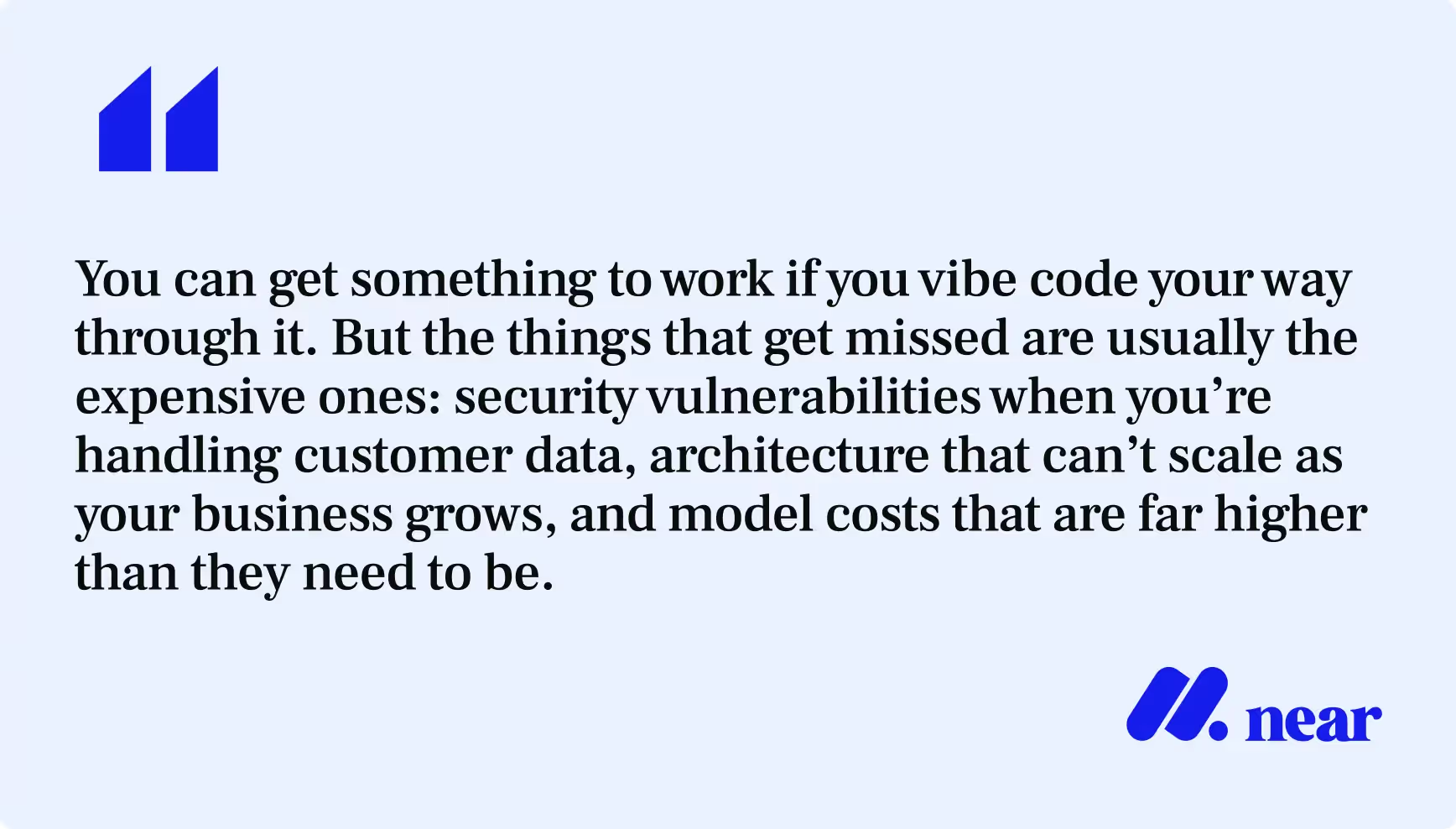
“You can get something to work if you vibe code your way through it. But the things that get missed are usually the expensive ones: security vulnerabilities when you’re handling customer data, architecture that can’t scale as your business grows, and model costs that are far higher than they need to be.”
The cost point is interesting and something most non-specialists don’t consider.
“I’ve seen systems running $50 a day in AI API costs that, built properly, could run for under a dollar a day. That comes from knowing the difference between models, architectures, and how to build efficiently,” Kevin explained.
The security risk is equally real. If your automation system handles customer data or credentials and it was built without proper security considerations, a publicly accessible workflow URL can be a serious exposure.
Getting something to work is different from building something reliable. That gap is where a good hire pays for itself quickly. When that gap is being filled by code an LLM produced in an afternoon, security checks need to keep pace, making Enterprise SCA tools part of the review process.
Is It Too Early for My Business to Hire for an Automation Role?
Probably not, even if you’re small. The earlier you bring someone in, the less manual workflow debt your team accumulates.
“I don’t think there are many cases where it would be too early, as long as your team can clearly explain what they do day to day. The ROI shows up in speed, accuracy, or cost efficiency. And the earlier you bring someone in, the less manual-workaround debt you accumulate.”
Teams that wait tend to build habits and processes around their current manual workflows. Those eventually need to be torn down and rebuilt, which is more disruptive and more expensive than starting earlier.
Even a small team can benefit, as long as the workflows are clear enough to document and improve.
Related reading: Every Business Has AI Tools Now. The Ones Getting Results Have the Right People Too.
What Is the Difference Between an Rpa Developer and an Automation Engineer?
RPA developers are a distinct role, suited to a specific type of work, and not a substitute for the roles above.
RPA (robotic process automation) developers specialize in automating high-volume, manual, rule-based tasks that are typically done by humans: data entry, document scanning, OCR workflows, and similar work.
They use specialized tools like UiPath and Blue Prism.
“The main difference is that RPA tools focus on very large volumes of data and automating what a bunch of data entry specialists would be doing, but without an AI layer. That’s an important distinction,” according to Kevin.
If your biggest bottleneck is high-volume, repetitive, human-manual processes that don’t require intelligent decision-making, an RPA developer might be exactly what you need.
But if you’re thinking about building connected systems, automating workflows that span multiple tools, or adding an AI layer to your operations, that’s the territory of an automation engineer or systems architect.
{{salary-guide-cta}}
What Job Title Should I Use When Hiring for Automation?
Don’t get too hung up on the title.
The most useful question to answer before you post a job isn’t “What title should I use?” It’s: “Do I need someone to make the plan, or just execute it?”
Kevin made a point in our conversation that I think is worth ending on.
“There are a lot of titles in this space, and they’re not interchangeable. Automation engineer, RPA developer, AI engineer, operations systems architect. Don’t get too hung up on the title. Focus on the job description. Do you need someone to execute a plan, or do you need someone to make the plan as well as execute? Then make sure the job description clearly represents that.”
Answer that question first. The right title will follow.
Why You Should Hire for Automation Roles in Latin America
We’ve seen firsthand what this hire can do. Kevin joined us as our first operations systems architect, and the results were visible quickly enough that we’ve since hired a second.
The work compounds fast once someone is in the role.
If you’re sold on the value but struggling to justify the budget, or if you’re not sure about the ROI on a role you’ve never hired before, this is exactly where hiring in Latin America makes the decision easier.
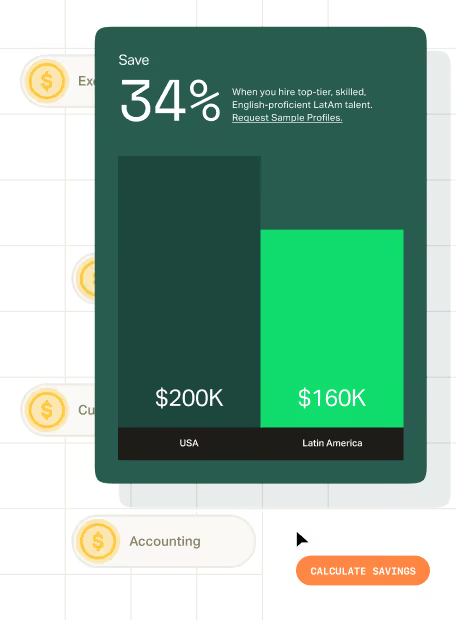
Salaries for even senior technical roles in LatAm run up to 60% lower than their US equivalents. We’ve placed remote operations systems architects and similar senior talent across LatAm, and our IT and tech recruiters know how to find the experience and skills you need.
For a lot of companies, the lower salary commitment is what makes it practical to take the chance on a role like this for the first time.
If you want to understand what hiring automation and AI talent in Latin America looks like, including salary benchmarks, a call with our team is a good starting point.
Schedule a free, no-commitment consultation call.
Related reading: How To Hire a Remote Business Operations Manager Successfully
If you want to go deeper before making the decision, we've covered the most common questions hiring managers ask in our FAQ on hiring data and AI talent in Latin America.




.webp)
.webp)




%203.svg)
.avif)






%20(1).avif)

%20(1).png)