


%203.svg)
Key Takeaways
- Hiring RPA developers in Latin America delivers 30-70% cost savings compared to US rates while maintaining the same quality of work, with LatAm developers earning competitive local salaries that translate to significant budget relief for US companies.
- Time zone alignment makes Latin America the practical choice for automation projects that require real-time collaboration—your RPA developer in Buenos Aires or Mexico City works during your business hours, eliminating the overnight wait times that plague offshore arrangements in Asia.
- Working with a recruiting company that specializes in LatAm tech talent accelerates your hiring timeline from months to weeks, with pre-vetted candidates who have both the platform certifications and the business thinking automation projects actually need.
Your team is drowning in manual processes. Data entry that takes 15 hours a week. Invoice processing that backs up every month-end. Reports that someone has to compile manually because your systems don’t talk to each other.
You know automation could fix this. You’ve looked into hiring an RPA developer to build the bots that would finally free up your team. But when you see what experienced automation specialists cost in the US, the ROI math stops working. The budget that seemed reasonable suddenly won’t cover the talent you actually need.
Or maybe you’ve found candidates in your price range, but they’re fresh out of certification courses with no production deployment experience. The kind of hire that needs hand-holding instead of solving problems.
Here’s what hundreds of US companies have figured out: hiring RPA developers in Latin America gives you access to experienced automation specialists at rates that actually make sense. Not as a compromise, but as a strategic advantage that opens up possibilities you didn’t think were available.
This is how you build the automation program you need with the team you didn’t think you could afford.
What Is an RPA Developer and Why Would You Want to Hire One?
RPA (Robotic Process Automation) developers build software bots that handle repetitive, rules-based tasks like data entry, invoice processing, and report generation, freeing your team from hours of manual work while delivering measurable ROI in weeks, not months.
If hiring an RPA developer isn’t even on your radar yet, here’s what you need to know.
RPA stands for Robotic Process Automation. An RPA developer builds software bots that handle repetitive, rules-based tasks that normally require a person sitting at a computer. Think data entry, invoice processing, report generation, moving information between systems—work that follows predictable patterns but eats up hours every week.
These aren’t physical robots. They’re software programs that interact with your existing applications the same way a human would—clicking buttons, filling forms, copying data—just faster and without breaks.
Here’s when you’d want one:
- Your team is drowning in manual work. If someone on your team spends 10 hours a week copying data from emails into spreadsheets, or moving information between your CRM and accounting software, or generating the same reports every Monday morning, an RPA developer can automate that.
- You need to scale without adding headcount. When your business grows and the manual work multiplies, you have two choices: hire more people to do the same repetitive tasks, or automate those tasks once and let your existing team focus on work that actually requires human judgment.
- You’re looking for quick ROI on automation. Unlike rebuilding entire systems or implementing expensive enterprise software, RPA can often automate a process in weeks. The bot works with your existing tools—no need to replace your tech stack.
The platforms RPA developers work with—UiPath, Automation Anywhere, Blue Prism, Power Automate—have matured significantly. What used to require custom coding can now be built with more accessible tools, but you still need someone who understands process design, error handling, and how to build automations that won’t break every time your systems update.
If you’re dealing with repetitive work that’s slowing your team down but you’re not ready for a full digital transformation, an RPA developer might be exactly what you need. Or if you’re tasked with finding efficiencies so you can “do more with less,” automation may be one solution.
Related reading: Automation Engineer, AI Engineer, Operations Systems Architect: Which Automation Hire Does Your Business Need?
What Are the Benefits of Hiring RPA Developers in Latin America
By hiring RPA developers in Latin America, you get the same expertise as hiring in the US, but at a lower cost.
RPA developers in Latin America have the same UiPath certifications, the same Automation Anywhere experience, and the same production deployment track record as US developers. Many have worked extensively with US companies and understand American business processes and expectations.
Cost savings that make hiring senior talent possible
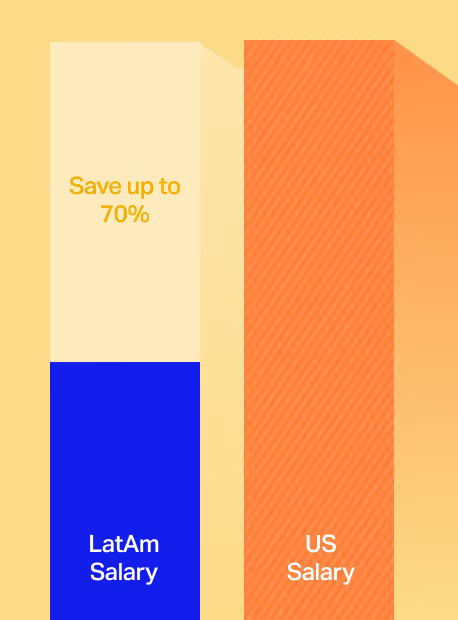
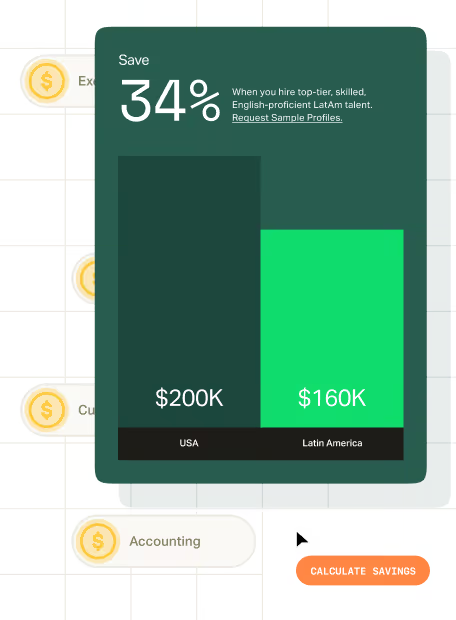
In the US, hiring an experienced RPA developer runs $85,000 to $144,000 for mid-level talent. In Latin America, that same level of expertise costs $54,000 to $72,000. For senior developers with 5+ years of experience, you’re looking at $111,000 to $183,000 in the US versus $72,000 to $96,000 in LatAm.
That’s 30-70% savings, depending on seniority and specific requirements.
The difference is cost of living, not capability.
These aren’t discounted rates for inferior work—they’re market rates that reflect regional economics while giving you access to developers who’ve built the same types of automations you need.
According to Julia Guillen, a senior tech recruiter at Near,
Clients are consistently surprised by the caliber of talent available in LatAm. They don’t expect to find senior engineers who’ve worked with major US companies, understand modern development practices, and often have more hands-on experience with specific frameworks than candidates they’d find locally.
Time zones make real-time collaboration possible
If you’ve considered or tried offshore hiring before and ruled it out because of time zone issues, or you’ve tried it and found the delays frustrating, hiring in Latin America works differently.
Most companies default to Asia when they think “offshore”—India, the Philippines, Vietnam. The challenge there is the 10- to15-hour offset. It’s workable if you’re handing off well-defined tasks, but it adds friction to anything that needs back-and-forth collaboration.
Latin America sits in the same time zones as the US—or close enough that it doesn’t matter. A developer in Mexico City is likely on Central Time. Someone in Colombia or Peru is on Eastern. Argentina and Brazil are 1-2 hours ahead of Eastern.
This means your RPA developer’s workday overlaps with yours the same way it would if you hired someone in a different US state. They’re online for your morning standup. If something breaks in production at 2 p.m., they’re there to help troubleshoot. Code reviews happen in real time instead of overnight.
You can schedule meetings at normal hours for everyone. No one’s working at 10 p.m. to accommodate the other side. It’s just regular business hours in compatible zones.
Research shows that each additional hour of time zone difference reduces real-time communication by 11%, shifting more work to async channels. With Latin America, that’s not an issue—you get the same real-time collaboration you’d have with a distributed US team.
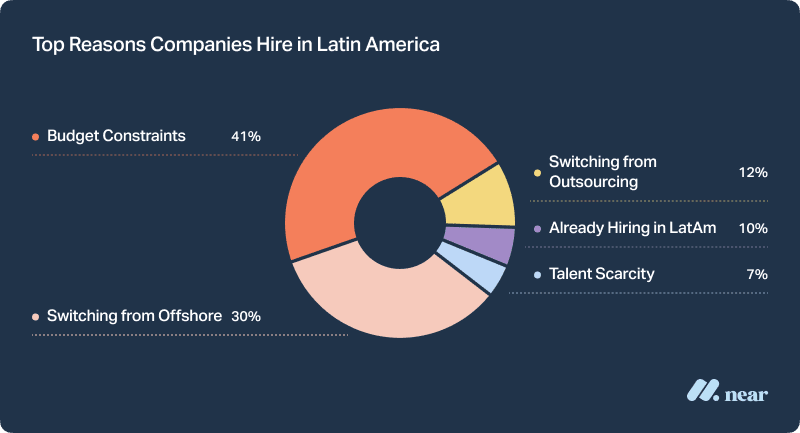
And Near’s report on why US companies hire in Latin America shows that switching from hiring in more distant countries like India and the Philippines is the second biggest reason at 30% behind budget concerns.
Read more about how the time zone alignment between LatAm and the US keeps development teams moving or why time zone alignment and AI are driving more companies to hire in LatAm.
What You Should Know About the LatAm RPA Talent Pool
Latin America’s mature tech ecosystem produces RPA developers with the same platform certifications, production deployment experience, and industry knowledge you’d find in US markets—backed by strong computer science programs and years of working with American companies.
The Latin American tech ecosystem has grown substantially. Countries like Argentina, Brazil, Mexico, and Colombia have invested heavily in technology education and produce developers with expertise in the same tools and platforms you’d find in Silicon Valley.
For RPA specifically, you’ll find developers with:
- Platform certifications: UiPath Certified Professionals, Blue Prism Developers, Automation Anywhere Advanced credentials
- Production deployment experience: Not just course completions, but actual enterprise automations they’ve built, tested, and supported
- Industry knowledge: Many LatAm RPA developers have worked in finance, healthcare, insurance, or other sectors where automation is mature
- Modern practices: Experience with CI/CD for bot deployment, version control, error handling frameworks, and integration with cloud platforms
The quality of education in top Latin American universities rivals US institutions. Many developers have computer science degrees from well-regarded programs, though—as with US talent—some of the strongest developers are self-taught or bootcamp graduates who’ve built extensive production experience.
Related reading: US Hiring May Be Slowing, But US Companies Hiring in LatAm Isn’t
What Are the Best Ways to Work with RPA developers in Latin America? Staff Augmentation vs. Direct Hiring
Direct hiring delivers better long-term results than staff augmentation for most automation programs—you get the same cost savings and time zone benefits, but with developers who invest in understanding your processes deeply instead of rotating between clients.
When companies first explore hiring in Latin America, they often consider nearshore staff augmentation—bringing on contractors through an agency for specific projects or time periods. This can work for genuinely short-term needs (building a specific feature, covering while you recruit full-time, testing the waters with LatAm talent).
But if you’re building an automation program, not just a one-off project, direct hiring makes more sense. With staff augmentation, developers may rotate between clients, and the agency retains the employment relationship. With direct hiring, the developer works for your company, invests in understanding your processes deeply, and isn’t expecting to be reassigned when your project ends.
You still get the same cost savings and time zone benefits. The difference is stability, deeper integration, and often lower overall costs since you’re not paying ongoing agency markups.
We think direct hiring is the way to go for most companies, but if you want to explore staff augmentation, we have a list of the top staff augmentation companies in Latin America.
How You Can Move Faster with the Right Recruiting Partner
Working with a recruiting partner who specializes in LatAm technical talent cuts your hiring timeline from months to weeks—you get pre-vetted RPA developers with proven production experience instead of sifting through resumes that list certifications but lack real-world deployment skills.
Finding qualified RPA developers on your own—whether in the US or internationally—takes time you probably don’t have. You’re competing for attention on job boards, vetting resumes that list every RPA tool under the sun with no proof of production experience, and trying to assess automation thinking during interviews when you might not be an automation expert yourself.
This is where working with a recruiting agency that specializes in LatAm technical talent changes the equation. Instead of posting and waiting, you get introduced to pre-vetted LatAm developers who already have relevant platform experience, certifications, and proven track records building production automations.
Here’s what this looks like in practice with a firm like Near:
- First candidates in 3-5 days: We maintain relationships with developers across Latin America and can quickly identify candidates who match your specific requirements—whether you need UiPath expertise, experience with document processing workflows, or knowledge of your industry’s business processes.
- Pre-vetted for both technical skills and business thinking: We don’t just check that someone took a UiPath course. We assess whether they’ve actually deployed enterprise-scale automations, how they approach process analysis, and whether they can explain technical concepts to non-technical stakeholders.
- Cultural fit matters: The best RPA developers aren’t just technically capable—they’re collaborative, communicate clearly, and understand the difference between automating a process and just replicating manual steps. We screen for these qualities because we know they determine long-term success.
- Clear pricing, no surprises: You always know what your hire earns. We provide salary benchmarks during discovery and explain our fees clearly. You set the salary for your hire.
Most companies that work with Near close hires in under three weeks. That’s the difference between starting your automation program now versus two months from now.
{{prevetted-banner}}
Final Thoughts
If you’re struggling to fill an RPA developer role, waiting weeks for qualified applicants, or facing budget constraints that make US hiring unrealistic, it’s worth exploring what’s available in Latin America.
At Near, we’ve helped hundreds of US companies build their technical teams with LatAm talent. We can help you hire top RPA developers who have the platform certifications, production experience, and business acumen your automation program needs. They’ll work in your time zone, speak fluent English, and come pre-vetted for technical skills and cultural fit.
If want to explore what’s possible, book a free consultation call. We’ll provide salary benchmarks for RPA developers and discuss your specific requirements. There’s no commitment, and with Near there’s never a fee unless you make a hire.







.webp)


%203.svg)
.avif)





%20(1).avif)

%20(1).png)