


%203.svg)
Key takeaways:
- The best nearshore staff augmentation companies in Latin America include Hire With Near, BairesDev, Revelo, Tecla, and Leanware, each suited to different engagement models.
- Latin America’s top staff augmentation companies all offer time zone alignment and strong English proficiency; the differentiators come down to model structure: rotational contractor placement vs. custom search with a dedicated, long-term hire.
- The right provider depends on your engagement type: BairesDev and Leanware for managed delivery, Revelo and Tecla for flexible contractor capacity, and Hire With Near for teams that want a dedicated, full-time developer embedded in their workflows long-term.
Sprint planning feels like triage. The feature backlog keeps growing. Your US hiring budget can’t keep up with what senior engineers cost.
Staff augmentation in Latin America has become one of the most practical solutions for US engineering teams in this position.
Time zone alignment, strong English proficiency, competitive salaries, and a deep pool of senior engineers. According to GitHub's 2025 Octoverse report, Brazil now has approximately 6.9 million developer accounts on GitHub. Country-level figures for the rest of Latin America weren't released in the 2025 edition, but the 2024 report counted Mexico at 1.9 million, Argentina at 1.1 million, and Colombia at 1 million, all with double-digit year-over-year growth.
So now the hard part is deciding which nearshore staff augmentation company is best for you.
I’ve put together this list of some of the best-known providers to help you figure out which company it may be.
I’ve included Hire With Near, and, of course, we think what we offer is strong. But no comparison article can determine the best company for your situation.
Your tech stack, team structure, timeline, and budget are specific to you.
My goal is to give you clear, honest information so you can build a solid shortlist and figure out who is worth a conversation.
How Does Staff Augmentation Differ Across Providers?
Staff augmentation, at its core, means adding IT and tech professionals to your team through a third-party provider who handles employment, payroll, and compliance. You direct their daily work.
Where providers differ is in how they structure the engagement:
- Traditional rotational staff aug: The agency maintains a bench of available contractors. Engineers are assigned to your project, may work across multiple clients simultaneously, and the engagement is designed to end when the project ends. This works well for defined-scope projects with a clear completion point.
- Long-term dedicated staff aug: The provider builds a custom search for your role, screens specifically for candidates who want long-term placements, and structures the hire so the developer is fully dedicated to your team. The employment and compliance infrastructure stays with the agency, but the hire is yours from day one.
Thinking about which model you need will make the rest of this comparison easier.
The Top 5 Staff Augmentation Companies in Latin America
To determine this list, I only included companies with an overall client rating of at least 4.5 on an established review platform (G2, Clutch, or Trustpilot).
From there, I evaluated hiring capabilities in Latin America, service model structure, speed-to-hire claims, and pricing transparency based on claims on their official websites.
My goal is to help you build a solid shortlist, not to declare a winner. The right fit only becomes clear through a conversation with the actual provider. And that’s why the companies below are listed in no particular order.
All five of these staff augmentation companies deliver on the core value proposition: access to skilled Latin American talent with time zone alignment, strong English proficiency, and an understanding of US business culture.
You get:
- developers who work within 0–3 hours of US time zones, enabling real-time collaboration
- candidates with experience working inside US company workflows and communication norms
- professionals vetted for the skills and tech stack proficiency you need
What matters are the differences in how they structure the relationship, who they specialize in serving, and how they handle compensation, retention, and long-term engagement.
Here’s what sets each apart.
Note: To keep the list up to date with our selection criteria, we regularly check ratings on third-party review sites and update the article as required.
1. Hire With Near

Website: hirewithnear.com
Headquarters: San Antonio, Texas
Rating: 4.9/5 on G2 (140+ reviews) as of July 2026
Services: Full-service nearshore staffing and recruiting, RPO, staff augmentation, executive search
Focus Regions: LatAm only
Hire With Near is a full-service staffing and recruiting agency that helps US companies hire top-performing remote talent in Latin America across software engineering, AI, data, finance, accounting, sales, marketing, operations, and customer support.
We know you’re not surprised we’ve put ourselves first. But we do think our staff augmentation model works differently from most.
Where traditional staff augmentation places whoever is available from a bench, we build every search from scratch. We help you hire Latin American developers who don’t rotate between clients. They are dedicated to your team, embedded in your workflows, and screened specifically for candidates who want long-term placements.
Unlike other staff augmentation providers, you control compensation with Hire With Near. We provide market benchmarks; you set the offer. We then handle payroll, compliance, and the employment infrastructure in the background.
According to Hire With Near’s 2026 State of LatAm Hiring Report, 98% of our engineering placements were mid-level to senior professionals. Our IT and tech recruiters know how to find the experienced developers you need.
Key features:
- Quality-first approach: Our 97% placement rate and 9.1+/10 client satisfaction score come from obsessing over fit: not just technical skills, but the drive, readiness, and ownership mindset to contribute from day one.
- Elite talent for tech positions: We place senior backend, frontend, mobile, QA, and data/ML engineers every week, with specialist tech recruiters screening beyond keywords for real-world impact. First candidates in 3–5 days with video introductions, most hires close in under 3 weeks.
- Custom search, not a bench: We don’t assign whoever is available. Every search starts from scratch against your specific requirements. We maintain a pre-vetted network of 160,000+ candidates and supplement with fresh sourcing on every search until we find talent that meets your exact expectations.
- Long-term retention: 80% of our hires stay 2+ years. Our candidates aren’t expecting to rotate to another client. They’re building institutional knowledge and personally investing in your company’s success.
Best for: Engineering teams that want dedicated, full-time developers embedded in their workflows, with a custom search process, full compensation control, and Hire With Near handling payroll and compliance in the background.
Limitations: Designed for long-term, dedicated placements. If you need a developer for a defined 2–3 month project with no intent to extend, other providers on this list are structured specifically for that. Our model is built for teams looking to hire developers who will be embedded in your workflows for the long term.
Pricing: Direct hire (one-time placement fee) or staffing model (monthly fee as a percentage of salary, payroll and compliance included). You set salary. No upfront costs. You pay only when you hire.
Guarantee: 180-day replacement guarantee, double the industry standard. If a hire doesn’t work out in the first six months, we find a replacement at no additional cost.
When Near isn’t the right fit: If you truly need someone for just 2–3 months and expect to end the engagement, traditional staff augmentation makes more sense. We’re built for permanent team building, not project-based contracting.
Read Hire With Near’s reviews to understand why the majority of our clients come back for hire after hire.
2. Tecla

Website: tecla.io
Headquarters: Austin, Texas
Rating: 4.9/5 on Clutch (20+ reviews) as of July 2026
Services: Tech staff augmentation, managed agile teams, full-project outsourcing
Focus Regions: LatAm only
Tecla earned a spot on this list because of their strong focus on the LatAm tech market and their transparent, published pricing structure. They specialize in placing Latin American software developers with US companies, offering flexible models from individual developer augmentation to fully managed agile teams for specific projects.
Their network of 50,000+ vetted tech professionals gives them solid depth for scaling engineering capacity quickly.
For a detailed side-by-side breakdown, see how Hire With Near compares to Tecla.
Key features:
- Strong focus on technical roles with deep software development expertise across LatAm
- Transparent, all-inclusive hourly rates published by role and seniority. Clients know what they’re paying before signing.
- 14-day trial period for staff augmentation placements, providing a low-risk entry point
- Notable clients include Mercedes-Benz, Major League Soccer, and HomeLight
Best for: Tech teams that want to scale engineering capacity quickly with hourly pricing transparency and a proven LatAm developer network.
Limitations: Because Tecla employs the developer and manages the employment relationship, clients typically don’t have visibility into the developer’s actual salary. It creates some distance between you and the talent’s compensation picture, which may matter if compensation transparency is a priority for you.
Pricing: All-inclusive rates published by role and seniority on their website.
If you're considering Tecla read our full roundup of Tecla alternatives for a wider field of options.
3. Revelo

Website: revelo.com
Headquarters: Miami, Florida
Rating: 4.7/5 on G2 (120+ reviews) as of July 2026
Services: Tech staff augmentation platform with managed services
Focus Regions: LatAm only
What stood out about Revelo is their scale: one of the largest networks of software developers in the LatAm region at 400,000+ pre-vetted engineers, combined with a self-serve platform that lets companies move quickly.
Their strength is flexible access to volume.
You can browse candidates, conduct interviews, and add or release developers month-to-month based on changing needs.
For a side-by-side model comparison, see how Hire With Near compares to Revelo.
Key features:
- Massive 400,000+ developer network providing extensive candidate options across all technical specialties
- Self-serve platform for browsing pre-vetted candidates and managing the hiring process
- 2-week risk-free trials and cancel-anytime flexibility for month-to-month scaling
- All-in-one platform handling interviews, payroll, benefits, and compliance
- Notable clients include Oracle, Dell, and Intuit
Best for: Engineering teams at large enterprises or fast-scaling companies that need proven processes, flexible month-to-month capacity, and access to a massive technical talent pool.
Limitations: Revelo’s model prioritizes scale and flexibility. It is primarily designed for companies adding capacity quickly rather than building tightly integrated, long-term development teams.
Pricing: Fixed all-inclusive hourly rates.
4. BairesDev

Website: bairesdev.com
Headquarters: San Francisco, California
Rating: 4.9/5 on Clutch (60+ reviews) as of July 2026
Services: Staff augmentation and managed project delivery
Focus Regions: LatAm only
BairesDev caught my attention for their rigorous vetting process and their proven track record on enterprise-scale projects. They operate as both a staff augmentation provider and a software development outsourcing company, offering fully managed development teams.
Their engineering roster of 4,000+ professionals is one of the largest in LatAm.
Their model works well for teams that want end-to-end software builds or need short-term project delivery with minimal management overhead.
For a direct model comparison, see how Hire With Near compares to BairesDev.
Key features:
- Large vetted network of 4,000+ professionals across Latin America
- Rigorous 7-stage vetting process with less than 1% acceptance rate; only senior-level candidates make it through
- Handles both individual staff augmentation and complete end-to-end project delivery
- Proven track record on enterprise-scale projects across multiple industries
Best for: Teams needing short-term project delivery, fully managed development teams, or end-to-end software builds with minimal management overhead on your side.
Limitations: BairesDev’s strength lies in delivering complete development projects and managed teams. For companies that want to build their own in-house capacity, with direct relationships, visibility into individual team members, and full control over compensation, this model may offer less transparency than providers structured around dedicated individual hires.
Pricing: Not publicly listed.
5. Leanware

Website: leanware.co
Headquarters: Bogotá, Colombia
Rating: 5.0/5 on Clutch (20+ reviews) as of July 2026
Services: Staff augmentation, managed teams, fixed-price project delivery
Focus Regions: LatAm only (Colombia-based)
I chose Leanware for this list because of their differentiated positioning around AI-first development. Rather than positioning as a pure staffing provider, they function as a development partner with proprietary AI-accelerated workflows.
Their three engagement models give clients flexibility depending on what they need: staff augmentation for adding individual expertise, managed teams that integrate with your processes, and fixed-price projects for well-defined scopes.
Key features:
- AI-first approach with proprietary frameworks designed to accelerate development timelines
- 200,000+ engineering hours executed across client engagements
- Senior developers available to onboard in 2–4 weeks
- 30%+ cost savings compared to equivalent US-based development teams
- 2+ year average client relationships, suggesting strong retention
Best for: Teams that want AI-enhanced development capability with flexible engagement options, including clients who want fixed-price project delivery rather than an ongoing staffing model.
Limitations: Leanware typically requires a six-month minimum engagement for full-time placements. That commitment may limit flexibility for companies needing shorter-term support. As a Colombia-based firm, their talent pool is primarily concentrated in that market rather than across all LatAm countries.
Pricing: Fixed-price monthly billing for full-time engagements; hourly billing for part-time work.
Final Thoughts
All five companies on this list offer solid nearshore staff augmentation from Latin America. They each have real strengths, and the differences come down to what structure fits your situation.
For teams that need complete project delivery with minimal management involvement, BairesDev is built for that. For large enterprises that want flexible, self-serve access to a massive developer network with month-to-month scalability, Revelo is the right fit. Tecla works well for tech teams that want hourly pricing transparency and a clearly structured staff augmentation model. Leanware is worth considering if you want AI-accelerated development capability with flexible engagement options, including fixed-price project delivery.
Hire With Near is built for engineering teams that want a different kind of staff augmentation: a custom search instead of a bench placement, a developer dedicated entirely to your team, full compensation control, and payroll and compliance handled in the background.
No comparison article can tell you which company is the right fit for your team. The best way to figure that out is a short conversation.
In a 20-minute call with Hire With Near, you'll understand exactly how our process works, what our fees are, what salary benchmarks look like for the engineering roles you need to fill, and whether our model is the right fit for your situation. No sales pitch. No commitment. Just a straight conversation that shortcuts your research process.
If you're open to exploring how the right LatAm engineering hire could strengthen your team, schedule a free, no-commitment consultation call today. Then talk to whoever else is on your list. The most successful nearshore hiring strategies are built on finding the right partner for your specific situation. That only becomes clear through actual conversations.
Frequently Asked Questions
What’s the difference between staff augmentation and hiring full-time in LatAm?
The main difference is how the employment relationship is structured, not the nature of the work itself. With traditional staff augmentation, the agency employs the developer, may rotate them across clients, and the engagement is designed around project timelines. With full-time hiring, the developer joins your company directly as an employee or long-term contractor.
Some staff augmentation providers, including Hire With Near, offer a third path: dedicated staff augmentation built around long-term placements. The developer is employed by Hire With Near for payroll and compliance purposes, but they work exclusively for your company, embedded in your workflows, with you controlling compensation.
What matters more than the "staff aug vs. full-time" label is whether the developer is dedicated to your team or shared across clients.
Is staff augmentation more cost-effective than US hiring?
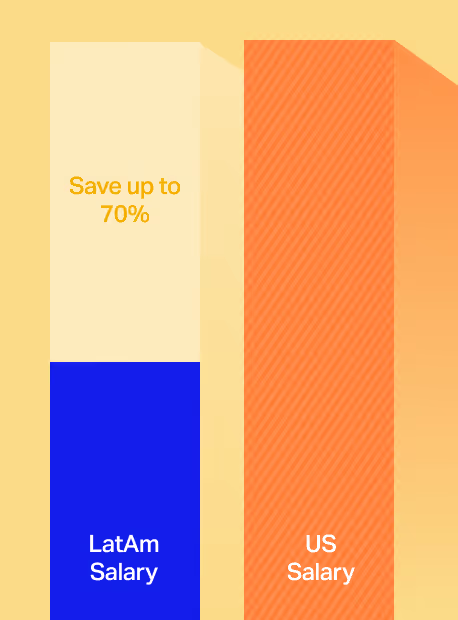
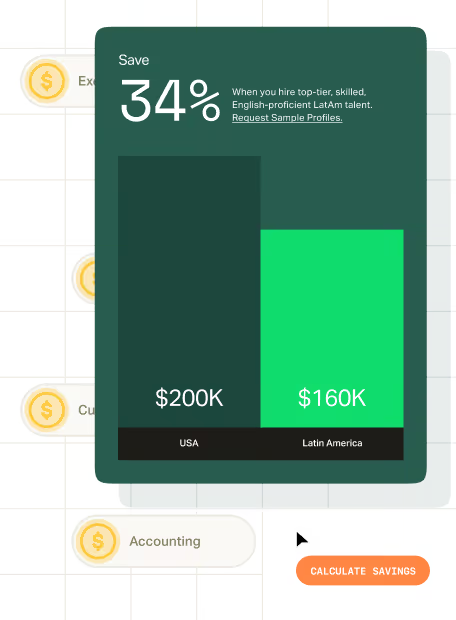
Yes, typically 30% or more less expensive than equivalent US salaries. How cost-effective it is over time depends on the provider's fee structure.
Some providers charge a fixed hourly rate that may increase as engagement extends. Hire With Near's staffing model charges a monthly fee as a percentage of the developer's salary, and the developer is dedicated to your team full-time; the ongoing fee reflects an ongoing staffing service with payroll and compliance handled in the background, not a markup on a rotating contractor.
Can staff augmentation arrangements become permanent?
With Hire With Near's model, the hire is dedicated and long-term from day one. There's no contractor-to-permanent conversion process to navigate.
Hire With Near screens specifically for candidates who want long-term placements, so the developer is building institutional knowledge in your company, not cycling between clients while waiting for a permanent offer.
If you're working with a provider that uses a rotational model and want to convert that person to a permanent hire, expect a conversion fee. With Hire With Near, the engagement is already structured for the long term.
Do I need to provide equipment for staff augmentation contractors?
This varies by provider. Some expect you to provide equipment, others include it in their pricing. Clarify this during your initial discussions. With a staffing partner like Hire With Near, equipment provision can be facilitated as needed.
What’s the difference between staff augmentation and full-project software development outsourcing?
Staff augmentation adds individual contractors to your existing team: you manage their day-to-day work and they integrate with your processes. Software development outsourcing hands off an entire project or function to an external team that manages the work independently and delivers the finished product.
With staff augmentation, you retain control and direction. With outsourcing, you delegate the execution. For a detailed breakdown of when to use each model, see our guide on software development outsourcing vs. staff augmentation.
What’s the difference between nearshore and offshore staff augmentation?
The main difference is time zones. Offshore staff augmentation typically involves contractors from Asia (India, Philippines, Vietnam) who work 10 to 13 hours offset from US time zones. "Nearshoring" focuses on Latin America, where developers work within a few hours of US time zones, enabling real-time collaboration.
The staff augmentation model itself stays the same regardless of location.
What industries use staff augmentation in Latin America?
Staff augmentation in Latin America is used across a wide range of industries. Any business that needs to add technical or operational capacity quickly, without committing to permanent headcount, is a candidate for this model.
For example, SaaS companies hire in Latin America to scale engineering teams for specific product builds or platform migrations without expanding their permanent workforce. Manufacturing firms bring in augmented talent to build out automation systems, ERP integrations, and operational tooling.
Oil and gas recruiting in Latin America is common for staff technology projects around data infrastructure, asset monitoring systems, and digital transformation initiatives.
Which LatAm countries are best for nearshore staff augmentation?
Argentina and Brazil have deep tech talent pools and excellent engineering education. Mexico offers the closest time zone alignment for West Coast US teams.
Colombia combines strong talent with competitive costs.
But in my experience, you can find great developers throughout LatAm. The best country depends on your specific technical needs and budget as each market has different strengths and salary ranges.






.webp)
.webp)


%203.svg)
.avif)





%20(1).avif)

%20(1).png)