%20(1).webp)


%203.svg)
Key Takeaways
- Hiring a mid-level offshore software developer costs $54K–$72K a year in Latin America against $115K–$195K for a comparable US hire, according to Hire With Near’s salary data. The region you pick decides how much of your workday you share with them.
- Offshore works when the work is well specified and can survive an overnight handoff, and it breaks when your team needs same-day iteration, which makes workday overlap the variable that decides most outcomes.
- Hire With Near places a full-time developer onto your own team, in your own workday, rather than selling you an outsourced development shop.
The reliable way to hire offshore software developers is to pick a region that shares your workday and a model that puts the engineer on your team. For most US companies, that means hiring software engineers in Latin America rather than on the other side of the world.
There’s a good chance this isn’t your first attempt. Hire With Near’s research on 2,000+ hiring conversations found that 30% of US companies had switched away from an offshore setup they already had, mostly to get workday overlap. The pattern behind that number is consistent: work a senior engineer ends up rewriting, and sprints that lose half their cycles to overnight handoffs.
One US healthtech startup went the other way, keeping its full 8-step interview process and still filling seven engineering roles based in Latin America at an average of 14 days each.
This guide covers what offshore developers cost, when offshore is the wrong call, how to vet for skill and communication, and which model fits.
When Should You Hire Offshore Developers (and When Shouldn’t You)?
Hire offshore developers when the work can be scoped tightly and reviewed on a predictable cycle, and don’t hire offshore developers when your team needs same-day iteration with the person writing the code.
When offshore works
Offshore is a strong call when the work is specified before it starts. If you can hand someone a defined service to build, a test suite to expand, or a migration to run, and review it every day or two, distance costs you very little.
It also works when someone senior on your team can define scope and review pull requests, and when the budget won’t stretch to a US hire at the seniority you need.
When it doesn’t
Skip offshore, or keep the hire closer to you, for anything that changes shape mid-sprint or depends on a product decision nobody has made yet. That loses more to a delayed feedback loop than it saves on salary.
Skip it for your first engineering hire too: if nobody can write a spec or review the code, no amount of vetting protects you.
Peer-reviewed research published in Organization Science by researchers at Harvard Business School and Georgetown University, using communication data from 12,038 employees, found that north-south corridors such as the US and Latin America keep almost the whole business day in common, which east-west corridors cannot. That overlap is exactly what a delayed feedback loop destroys.
That gap isn’t an abstraction. The founder of a small Web3 and entertainment startup described what it cost him:
We currently have a senior QA who is focused on both manual testing and automation. She’s based in Sri Lanka, and I don’t get her enough during my day to actually allow to keep that high quality and high throughput for my team. So we often release without her. So it’s not good, right?
Nobody in that story did anything wrong. The engineer is good, the hours are the problem, and the price is software shipping without QA sign-off. It’s also one of the main reasons US companies are moving their engineering hiring to Latin America instead of further offshore.
The honest version of the question
For most US teams, the real question is how far offshore. If you’ve tried hiring offshore developers and got burned, the fix usually isn’t retreating to local hiring at local salaries. That’s why teams comparing local and offshore developers so often land on Latin America instead.
Latin America is the version of offshore that keeps the overlap. Your engineer is working while you are, whether your team runs on Pacific, Mountain, Central, or Eastern hours, so a question asked at 2 p.m. gets answered at 2 p.m.
Our guide to hiring remotely in Latin America covers what that changes day to day, and our nearshore versus offshore comparison covers where each model still makes sense.
What Are the Benefits of Hiring an Offshore Software Development Team?
Hiring offshore gets you a much larger pool of experienced engineers, a shorter search, salary levels that let you hire at the seniority you need, and capacity you can scale in both directions.
A deeper pool of experienced engineers
The engineering talent pool outside the US is large and growing fast.
According to GitHub’s 2025 Octoverse report, Brazil now has approximately 6.9 million developer accounts on GitHub. Country-level figures for the rest of Latin America weren’t released in the 2025 edition, but the 2024 report counted Mexico at 1.9 million, Argentina at 1.1 million, and Colombia at 1 million, all with double-digit year-over-year growth.
The academic pipeline holds up in the comparison too:
Georgetown’s Center for Security and Emerging Technology found that just 20% of US graduates earn a STEM degree, well behind Mexico, where 37.5% of graduates earn STEM degrees, according to Mexico’s Secretariat of Economy.
A shorter search
Society for Human Resource Management’s 2026 recruiting benchmarking puts the median time-to-fill at 39 calendar days for nonexecutive roles, measured from open requisition to accepted offer. Offshore searches usually beat that, mostly because the candidate pool is bigger and less picked over.
Working with a partner compresses it further. Hire With Near sends a shortlist in 3 to 5 days and most of our clients make a hire in under three weeks.
Salary levels that let you hire at the seniority you need
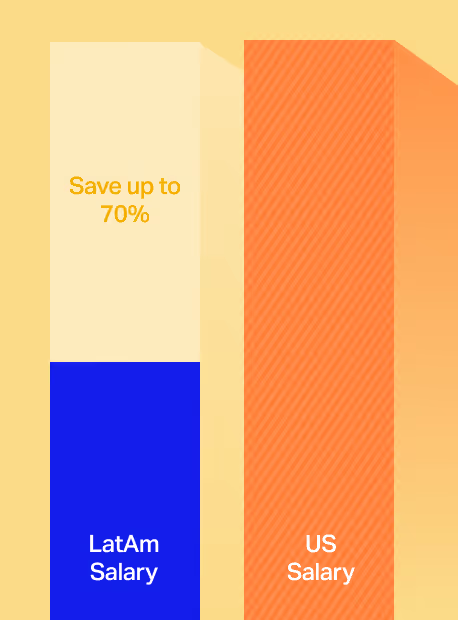
Salaries in Latin America run 30–70% lower than comparable US salaries, because the cost of living is different, not because anyone is underpaid relative to their own market.
What that changes is the seniority question: companies that couldn’t hire a senior engineer domestically at their budget can hire one offshore.
Our breakdown of the benefits of offshore software development covers the rest.
Capacity you can scale in both directions
Offshore hiring makes it easier to add engineers for a defined push and to hold headcount flat when the roadmap changes. That matters most for product teams under release pressure, which is why we do a lot of recruiting for SaaS companies scaling their engineering teams.
How Do You Hire Offshore Software Developers, Step by Step?
Hiring an offshore software developer takes five real decisions and about three weeks. Here’s the shape of it before we get into each step.
If you’ve been burned by a recruiter who forwarded fifty unvetted resumes and called it a search, ask any partner which of these steps they own and what gets filtered at each one. The interview and the decision should always stay yours.
Step 1: Define the role and the stack
Write down which layer of the product this person owns, then separate the tools you require from the ones you’d like.
Then, check whether your stack is well supplied in the region. In my nearly four years recruiting technical talent at Hire With Near, this is the most useful thing I can tell a client: I can fill a .NET, C#, PHP, or WordPress role quickly, but Shopify, Amazon e-commerce, and blockchain roles take considerably longer, because those stacks are thin in Latin America.
Go easy on framework version requirements too, since experienced engineers pick up a specific version quickly once they understand the principles.
Decide the shape of the hire while you’re here. A generalist who moves across the stack, a specialist who owns one service, and a remote mobile developer for a platform your web team doesn’t touch are three different searches.
And don’t make a college degree a must-have: plenty of strong Latin American engineers started working before they graduated and never finished, and they aren’t weaker candidates because of that.
Step 2. Choose a region and an engagement model
Pick the region on workday overlap and the model on how certain you are about the role. Both are covered below, and settling them before you source saves you from interviewing people who were never going to fit how your team works.
Step 3. Source and shortlist
Decide whether you run the search or hand it over. Doing it yourself means job boards, outreach, and your own screening capacity; a partner sources against your stack and seniority bar and returns a shortlist.
Either way, do the diligence on the provider before the candidates: references you can call, reviews read for specifics, not star ratings, and redacted profiles of engineers they’ve placed at your level.
Step 4. Vet technical ability and communication
This is the step that decides the hire, so it gets its own section below.
In practice, that means a live technical conversation, not just a resume review or a written test. Budget one to two weeks and resist the urge to add assessment rounds beyond that; extra rounds slow down good candidates without improving your signal on the ones you should hire.
Step 5. Make the offer and onboard
Get the offer in writing with deliverables, payment terms, IP assignment, and confidentiality spelled out.
Then, plan the first two weeks: equipment, repo and infrastructure access, and who this person reports to day to day.
Set a 30-day and 90-day review with named goals now, since that catches a mismatch while it’s still cheap to fix.
How Much Does It Cost To Hire an Offshore Developer?
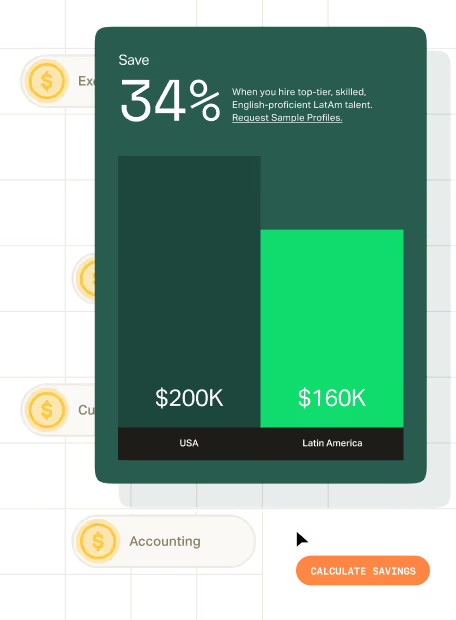
Hiring a mid-level offshore software developer in Latin America costs $54K–$72K a year according to our salary data, against $115K–$195K for a comparable US hire.
For an independent anchor on the US side, the US Bureau of Labor Statistics (BLS) puts the median annual wage for software developers, quality assurance analysts, and testers at $133,080 as of May 2024, and projects 15% employment growth for the group from 2024 to 2034.
Four things move that number: where you hire, how senior the engineer is, how specialized the skill set is, and how long the work runs.
Location and region
Region is the first cost decision and the first collaboration decision, and they pull in opposite directions.
We publish a dollar figure only for Latin America, because that one comes from our own placement data. No authoritative source publishes a comparable mid-level benchmark for the other three regions.
If you’re considering Asia specifically, we’ve done the side-by-side work on Latin America and India and on Latin America and the Philippines.
Our guide to hiring Latin American developers breaks costs down market by market, and we’ve published how much US companies save by hiring in Latin America.
Seniority and experience level
Seniority is the biggest single lever inside a region. Here’s what hiring a software engineer in Latin America costs against an equivalent US hire, according to Hire With Near’s salary benchmarks:
For the most up-to-date figures, see Hire With Near’s US vs Latin America Salary Guide.
A senior engineer in Latin America carries a salary expectation at or below what a junior engineer in the US does, which is why most companies hiring offshore are hiring for experience rather than headcount.
Paying at the bottom of a band, though, usually costs you the hire within a year.
Our IT roles salary guide runs the same comparison across every engineering title, and our breakdown of offshore developer rates covers how the numbers move by region.
Technical skill set
Specialized skills price above the general engineering band. AI developers and cybersecurity analysts are the clearest examples: demand is high and the experienced population is small. The useful question isn’t whether to pay the premium; it’s whether the specialization is load-bearing for the next twelve months.
Project scope and duration
Longer, clearer engagements price better than short, vague ones. Define the scope in writing before you agree on comp, because scope creep is the most common reason an offshore budget overruns and it rarely shows up as a rate change.
The costs people forget
Salary isn’t the all-in number. Budget for equipment and software licenses, onboarding time from your own senior engineers, ongoing quality assurance and maintenance, and the administrative load of paying someone in another country.
The highest hidden cost is a hire that doesn’t work out, since three months of ramp plus a second search dwarfs any rate you negotiated.
Hire With Near handles payroll, local benefits, and compliance so that administrative line stops being yours.
How Do You Vet an Offshore Developer?
A resume tells you almost nothing about an offshore developer, so vetting is one of the most important steps in the hiring process. Consider two things: a small real-world task you review together on a call, and a conversation about a project they own.
The bar has to be higher than it was because the inputs got worse. A 30-year veteran of the IT industry who runs a US consulting and staffing firm put it bluntly:
I’ve been in this industry for thirty years and I have never seen anything like what’s happening right now with fake resumes. It’s an epidemic. AI is generating entire work histories that never existed.
There’s also the fake seniority problem. A talent acquisition leader at a mid-market compliance software company described it from the buyer’s side:
Right now, [our current vendor] is sending us candidates, and their resumes do look good, but when they do make it to our technical assessment and our interview rounds, our hiring team is finding that they’re maybe not as senior as we’re hoping for. So we’re just looking for candidates that are more senior than what we’ve seen over the last several months with [them].
A real filter produces a different distribution. According to Hire With Near’s 2026 State of LatAm Hiring Report, 98% of our engineering placements were experienced professionals: 51% senior-level and 47% mid-level.
Companies aren’t hiring offshore to save money on junior engineers. They’re hiring the experience they couldn’t hire domestically at the same salary level.
The healthtech startup from the introduction is the proof that rigor and speed aren’t a trade-off. It kept all eight steps of its process, deep technical screens and coding assessments included, hired seven engineers across backend, DevOps, QA, mobile, frontend, process, plus staff-level roles, averaged 14 days to hire, and saved $323,000 a year against US salaries. Nobody lowered a bar to move faster.
Vetting technical ability
Give the candidate a small, real task rather than a puzzle: debug an existing piece of code, refactor something for scalability, or implement a basic API with tests. Live or take-home both work.
The part that matters is what happens next. Review the code together on a call. You’re not checking whether it runs, you’re finding out whether they understand what they wrote, why they made each choice, and what they’d do differently. That conversation is hard to fake and it’s where weak candidates come apart.
Then, ask them to walk you through a recent project, pushing on one question: what was your role, specifically? Not which languages the team used, but what they personally built, decided, and got wrong.
Federico Bilello, a Recruiter for Software Engineering at Hire With Near, screens for something a code sample won’t show you:
The main thing I look for is ownership. I always look for developers who have worked in startups or smaller companies, because those are the people who probably have ownership. If you bring them a problem, they won’t ask how to solve it, they’ll try their own ideas, they’ll be creative.
— Federico Bilello, Recruiter, Software Engineering, Hire With Near
Across the engineers and DevOps candidates I’ve placed for US clients, most rejections come down to one of two things: communication in the interview, or the technical assessment.
The take-home is where the majority get filtered out, which is why one well-designed task beats three. Stacking assessments doesn’t raise your signal much and it loses you the strongest candidates, who have other processes running.
The red flags I watch for are consistent:
- A candidate who can’t explain what they personally contributed.
- One who deflects every question about mistakes.
- One who claims proficiency across an implausibly wide stack of tools picked up in a short window.
- A developer who tells me they’re holding two or three jobs in parallel. That’s a warning sign, not a resume highlight: either they aren’t performing at any of them, or the expectations are low enough that none of them are real.
On seniority, ask for years of professional, on-the-job experience with the specific tool, not total years in the industry. Someone with eight years of engineering and five months of the framework your product runs on is a mid-level hire for your role, whatever the title says.
Our five-question test for spotting a fake senior engineer has the exact questions, and we’ve collected tech interview questions for the assessment round. Run reference and background checks as confirmation, not as the filter.
We put together a short walkthrough of how to keep an AI-assisted candidate from sliding through a coding assessment:
Vetting communication
Test communication by asking the candidate to explain a project they own to someone who isn’t a developer, and don’t prompt them to simplify. No English certificate measures the thing you’re worried about, which is whether they can articulate why a deploy broke production while your VP of Product is on the call.
When I’m evaluating a developer, that’s the screen I rely on most. If they can only describe their work in framework names and acronyms, they’re usually repeating terminology, not explaining what they built. If they can walk a non-technical person through a decision they made and the tradeoff they accepted, the technical depth is almost always there too.
What Are the Common Engagement Models for Hiring Offshore Developers?
There are five common ways to hire offshore developers, and they differ mainly in how much of the work stays yours and whether you end up with a teammate or a vendor. We’ll go from most complex to simplest.
Outsourced development shop or agency
With a dev shop, you buy an outcome rather than a teammate. A project manager sits between you and the people writing your code by design, which is right for a self-contained project with a clear finish line and wrong when you need direct access to the engineer.
We keep a list of LatAm outsourcing companies for work that really is project-shaped, and a comparison of hiring in-house versus outsourcing for the tradeoff.
Freelance and contractor platforms
Marketplaces give you fast access to contractors and are built for project work. The structural catch is attention: making a living on a platform means running several clients at once, so split focus isn’t a failure of policy, it’s the design.
Our comparison of freelancers and offshore development companies covers where each fits.
Source it yourself and use an employer of record
You can find the engineer yourself and use an employer of record to handle payroll, tax withholding, local benefits, and compliance in their country. Name the gap before you choose it: an EOR handles employment logistics, not recruiting.
You still source, screen, and vet every candidate yourself, which is the part that takes the time and where a bad decision costs the most. This model fits companies that have already identified the person they want.
Staff augmentation
Staff augmentation puts pre-vetted engineers on your team to work under your direction while the firm handles employment, payroll, and compliance. It fits when scope or duration is uncertain, when you’re staffing a defined project, or when you need capacity without adding permanent headcount.
Direct-hire staffing and recruiting partner
A direct-hire partner is the all-in-one solution, and where most companies hiring full-time offshore engineers end up. You describe the role, we source and vet against your stack and seniority bar, you interview and choose, and after you hire we handle payroll, benefits, and compliance through our nearshore staffing and recruiting services.
The distinction that matters day to day: the engineer joins your team. They’re in your stand-ups, on your board, reporting to you, and under your day-to-day management.
Which of the last two you pick follows from something you already know. If you’re not sure the role exists in a year, staff augmentation matches that uncertainty; if you know you need this person for years, direct hire matches that instead. It’s a question about your own certainty, not about which is cheaper.
What goes into the all-in number
Ask every provider for the same five line items and you can compare them honestly: the engineer’s salary, the provider’s fee and how it’s structured, equipment and software, benefits and local employment costs, and what happens financially if the hire doesn’t work out.
The fifth is where the surprises live. A model with a low headline fee and no replacement coverage can cost more than a higher one with a real guarantee behind it.
If the plan is to grow this into a full engineering team, the leadership layer works the same way. We handle VP of Engineering, Director of Engineering, and CTO searches through executive search in Latin America.
What Should You Look for in an Offshore Development Partner?
Judge an offshore development partner on six things you can ask about on a first call: how they vet, who they’ve placed, how long those people stay, what happens when a hire fails, how they handle IP and security, and whether they cover your workday.
Can they show you how they vet, and do they source for your stack?
Ask them to walk through the filter stage by stage and say what gets removed at each one. Then ask whether candidates are sourced for your stack or drawn from a bench: a pre-vetted pool is faster, a fresh search is what a specific stack requires, and what you want is a partner who tells you which one your role calls for and where a given candidate came from.
Our guide to choosing a software developer recruitment agency covers the rest of the diligence.
Have they placed engineers like yours, and will they show you profiles?
Ask for placements at your seniority level, in your stack, at companies around your stage, and ask for redacted profiles rather than a logo wall. Logos tell you someone signed a contract; profiles tell you who got hired.
Bonfire, an e-commerce platform for custom merchandise and fundraising, ran that comparison directly. After working with several firms it hired through Hire With Near, cut time-to-hire from two or three months to six weeks, saved $53,000 a year, and still had the hire two years later. Their VP of Product Management put it this way:
It was shocking to see the difference between the talent Hire With Near brought versus other firms I worked with. Our hires are extraordinary and a great cultural fit.
— Thomas Elliott, VP of Product Management, Bonfire
How long do their placements stay?
Engineering churn is often the most expensive churn there is, so ask for the number, not a philosophy. The benchmark worth asking any provider for is the share of placements still in the role after two years.
Hire With Near placements stay an average of three years, and 80% of our hires stay 2+ years. Retention comes from incentives, not contract language: our placements stay because they’re earning well above their local market with career growth they wouldn’t get locally, working with recruiters who specialize in IT and tech roles.
What happens if the hire doesn’t work out?
Ask for the replacement terms and the window in writing. Every Hire With Near placement is backed by a 180-day replacement guarantee, double the industry standard, and we fill 97% of the roles we take on. A guarantee is a safety net, not a strategy, and the real protection is the vetting that makes replacement rare.
How do they handle IP, NDAs, and data security?
For fintech, healthtech, and security work, this question decides the deal. Require an NDA and IP assignment signed by the individual engineer, not just by the agency. Get data-handling terms in writing: what they can access, from what device, and what happens to it when the engagement ends.
Ask which security practices the partner requires of its own people, and ask the partner to carry contractual responsibility rather than pointing at the engineer. Be skeptical of anyone who tells you cross-border enforcement is a solved problem. It isn’t. Good contracts, scoped access, and a partner with something to lose are the honest version of the answer.
Do they cover your workday, not just the region?
A partner that places across many regions isn’t the same as one that places in yours. Ask where their engineers are and what their hours look like against yours, whether the engineer joins your stand-up, and who you call when something breaks at 4 p.m. your time.
Where Can You Find Offshore Software Developers?
You can find offshore software developers through four kinds of providers, and knowing which kind you’re looking at matters more than any individual name:
- Freelance marketplaces (Upwork) sell you access.
- Vetted freelance networks (Toptal, Arc.dev) sell you a filter.
- Directories (Hubstaff Talent) sell you a list.
- Staffing partners (Hire With Near, Andela) find the person and handle the employment.
Full disclosure before the list: Hire With Near is one of these providers, so we have an obvious interest here. These are not arranged in any order.
1. Hire With Near

We belong on this list for one specific reason: we place full-time developers onto US engineering teams. We don’t sell project capacity, and we don’t hand you a bench. Our recruiters are based in Latin America and source against your stack and your seniority bar.
Salaries for the engineers we place run 30–70% lower than comparable US salaries. We send a shortlist in 3 to 5 days, and we handle payroll, benefits, and compliance after the hire.
If your work needs same-day iteration, that’s the case for us. If it’s a fixed-scope project you want delivered as a package, a dev shop is the better fit and we’ll say so.
2. Upwork
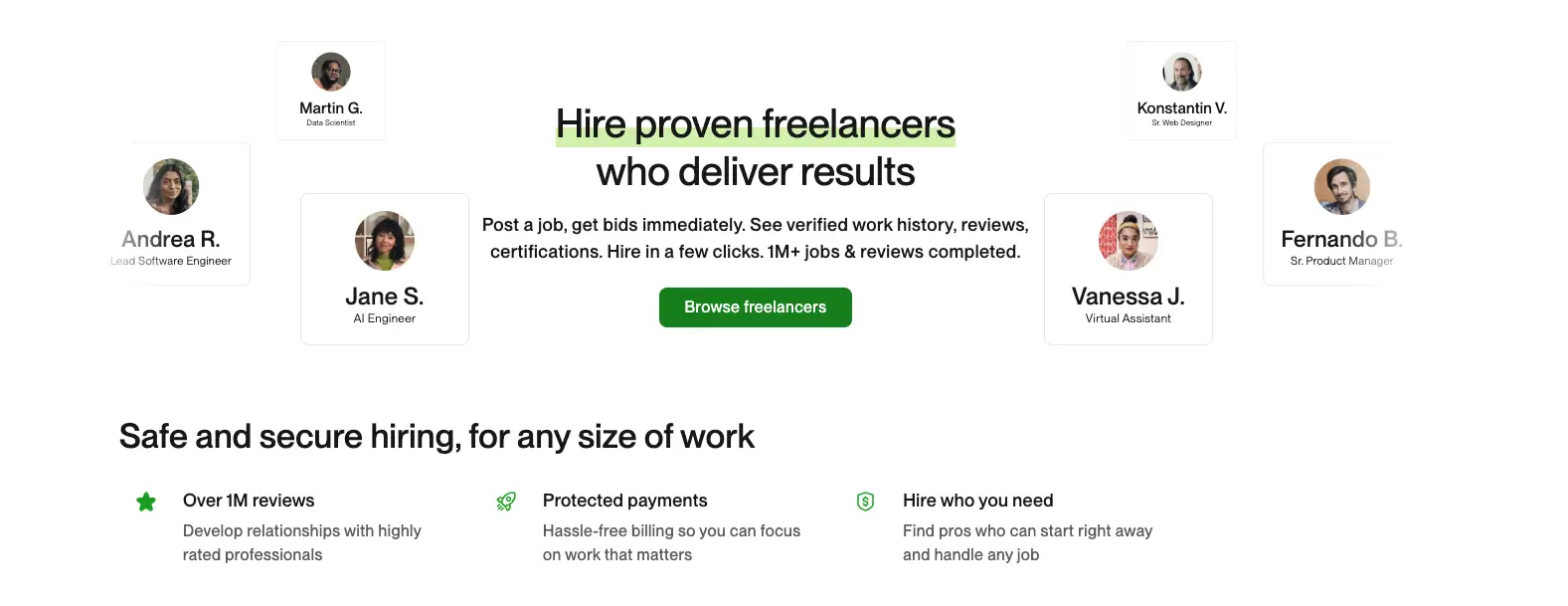
Upwork is the largest general freelance marketplace, with profiles, client reviews, and several payment models. Useful for short, well-defined work where a wrong hire costs you little.
3. Toptal

Toptal screens freelancers heavily and claims to match companies with the top 3% of applicants. It also acquired YouTeam in January 2025, so the Eastern European and Latin American engineering supply YouTeam used to broker now sits inside Toptal rather than being a separate option.
4. Arc.dev
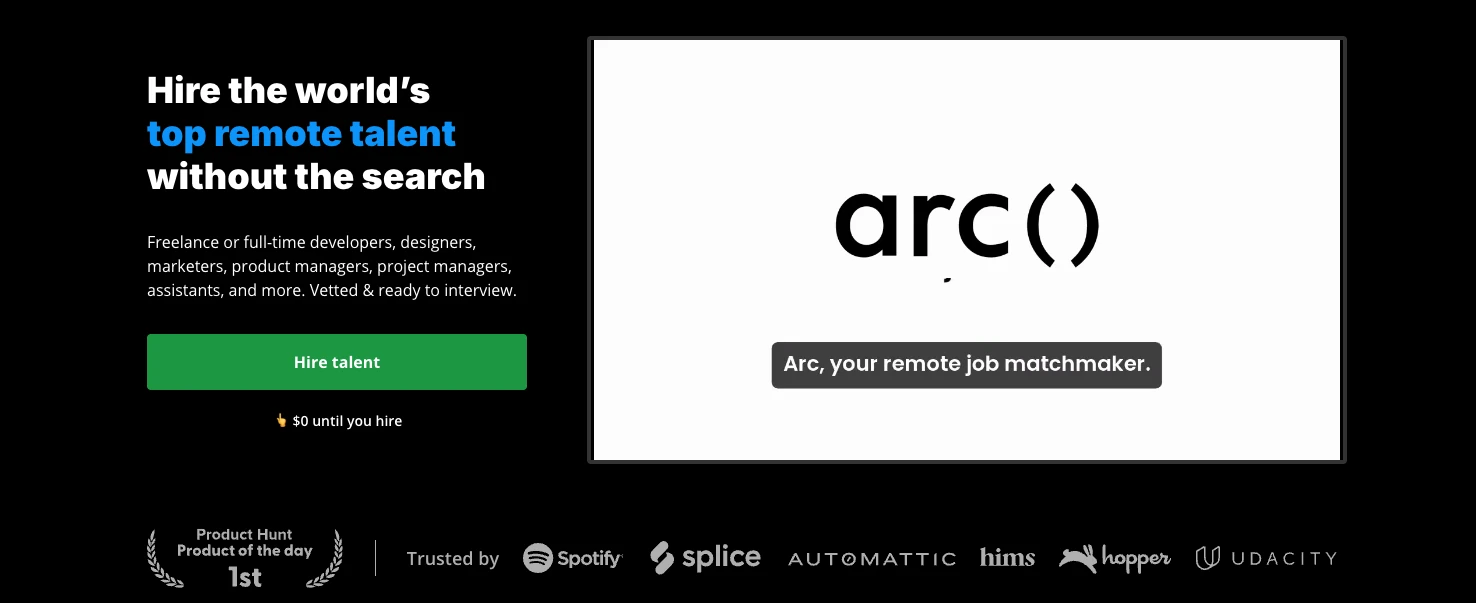
Arc.dev is a vetted network for full-time and contract remote developers, weighting cultural fit alongside technical screening. More curated than a marketplace, more hands-off than a staffing partner.
5. Hubstaff Talent

Hubstaff Talent is a free directory of remote professionals, including offshore developers. There’s no vetting layer, so treat it as a sourcing tool rather than a filter.
6. Andela
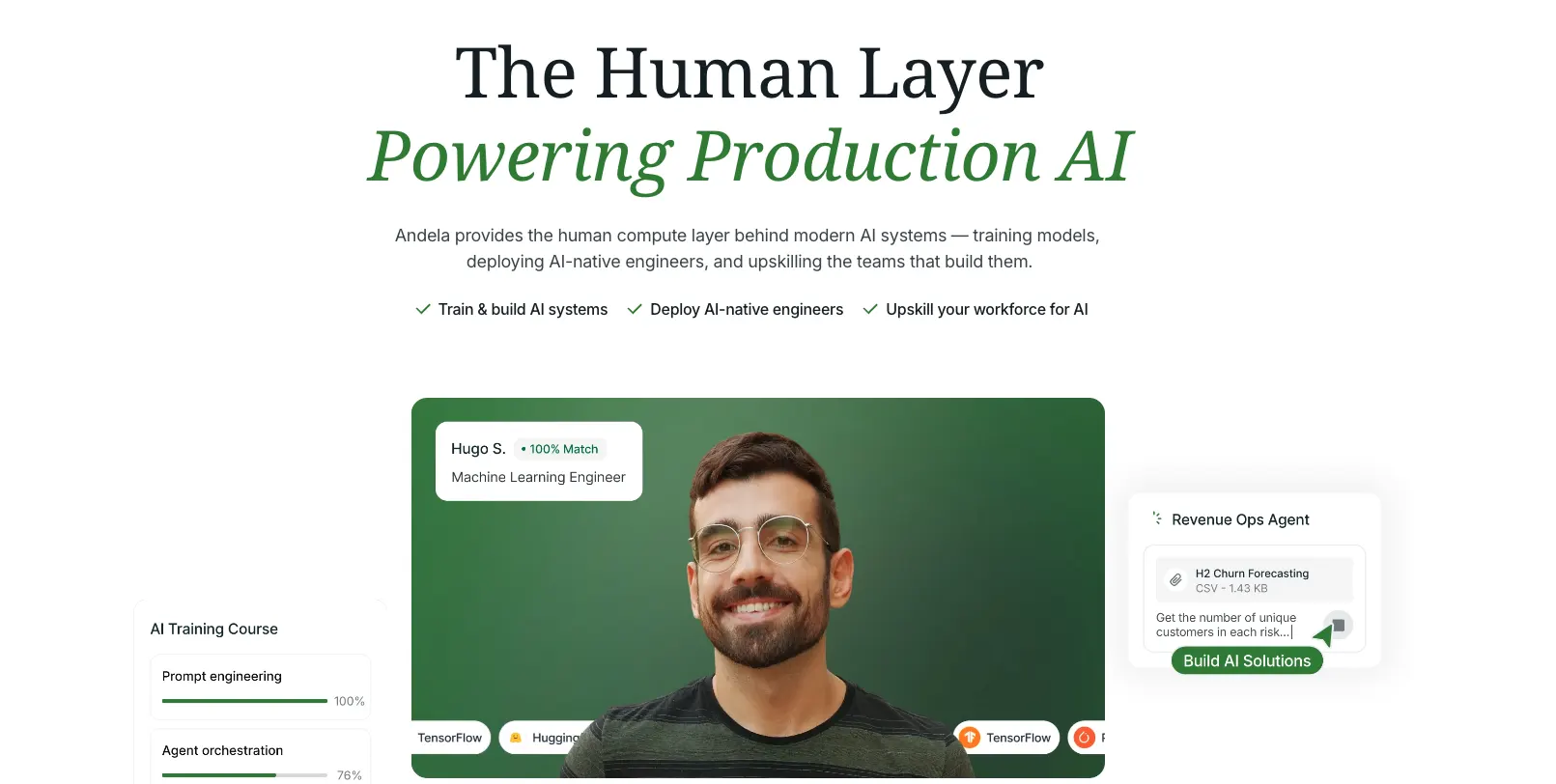
Andela places engineers based in Africa and other regions onto distributed teams, with its own vetting and matching process. Worth a look if your work survives a wider time zone gap.
If you’ve decided against far-offshore, we’ve compared the best companies to hire developers in Latin America and the broader field of nearshore staffing companies placing full-time hires across functions. For role-specific options, we’ve curated a list of the top 13 software engineer staffing agencies.
Final Thoughts
Hiring offshore software developers comes down to the two decisions this guide opened with:
- How far offshore you go sets your workday overlap
- The engagement model decides whether you get a teammate or a vendor
Salary is the easiest variable to compare and the least likely to determine whether the hire works.
For most US engineering teams, both questions point the same way: Latin America, and a full-time developer on your own team rather than an outsourced development shop. Hire With Near handles sourcing, vetting, payroll, benefits, and compliance, so your team spends its time evaluating engineers, not managing the pipeline.
If you’re ready, you can hire a dedicated software engineer through Hire With Near, or book a free consultation to talk through your requirements with our team. We’ll give you salary benchmarks for your stack and walk you through the process, so you can decide with real numbers instead of a guess.
{{consultation}}
Frequently Asked Questions
What is an offshore software developer?
An offshore software developer is a software engineer you hire in another country, working remotely as part of your team or through a provider, rather than being employed locally. The term describes location, not employment structure or quality, which is why offshore hires range from a freelancer on a two-week project to a full-time senior engineer in your stand-ups.
Offshore programmer and offshore developer mean the same thing, so companies looking to hire offshore programmers are running the search described here. Our explainer on nearshoring, offshoring, and onshoring covers how the distinctions work.
How do you hire an offshore development team?
Hire an offshore development team by defining each role and its stack, choosing one region for the whole team so they share a workday with you and with each other, then hiring sequentially rather than all at once. Start with the most senior role, because that person helps you evaluate the rest. Building a team raises questions a single hire doesn’t, including who runs stand-ups and how code review works across time zones, which our guide to hiring an offshore development team covers in detail.
What happens if an offshore developer doesn’t work out?
A good partner replaces the hire at no additional fee inside a defined window, and Hire With Near’s window is 180 days, double the industry standard. That covers the case where a placement fails in month two or month five, which is when it usually happens. The stronger protection sits upstream, in vetting rigorous enough that replacement is rare, so ask any provider what share of their placements are still in the role after a year.
Which countries are best for hiring offshore software developers?
For US companies that need workday overlap, Brazil, Colombia, and Argentina are the strongest markets, and in our experience they account for most of the engineering placements we make.
Brazil has the deepest talent pool by a wide margin, Colombia’s working hours overlap most closely with a US workday, and Argentina is strong on senior full-stack and DevOps experience. Treat country as a second-order question, though: pick for depth in your specific stack and the overlap you need first.
Our ranking of the best countries to hire remote software engineers compares 22 of them.
What other engineering roles can I hire in Latin America?
Beyond software engineers, US companies hire the full range of engineering roles in Latin America, including remote full-stack developers, nearshore back-end developers, nearshore front-end developers, remote QA engineers, and nearshore DevOps engineers.
Most teams that start with one engineer add QA and DevOps next, because those roles make everyone else faster. All of them come with the same workday overlap and the same salary differential against US hires.
We tried offshore hiring before and the time zone gap killed it. Is Latin America different?
Yes, and the difference is structural: a developer in Latin America is working while you are, so a question asked in your afternoon gets answered in your afternoon, whether your team runs on Pacific, Mountain, Central, or Eastern hours.
Most of the region sits inside a US time zone or within an hour or two of one, depending on where you are and the season. That means live stand-ups, real-time debugging, and same-day code review, not overnight handoffs.
Our breakdown of nearshore versus offshore software development covers the mechanics, and we’ve collected the questions engineering leaders ask about hiring developers in Latin America.






.webp)
.webp)


%203.svg)
.avif)





%20(1).avif)

%20(1).png)