%203.svg)
Key Takeaways
- Latin American marketing professionals who work with US clients understand US culture, references, and brand voice. The cultural gap that kills content work in Southeast Asia doesn’t follow the same pattern in Latin America.
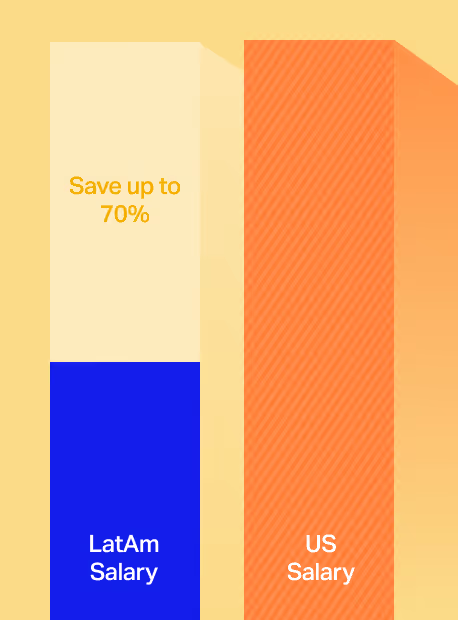
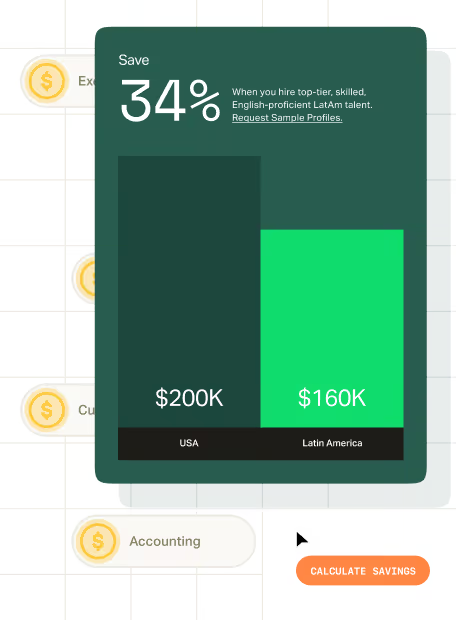
- The specialized roles that feel too niche to find offshore (senior media buyers, technical SEO specialists, HubSpot admins, performance marketers) exist in Latin America in meaningful numbers and at 50–70% of US cost.
- Time zone alignment makes real-time campaign collaboration possible. You can review creative, adjust live ads, and get Slack responses during your business hours, not 12 hours later.
Your marketing team is underwater, or you've been running it yourself. You've been paying US rates for talent you can't always keep, or burning through agency retainers for work a good in-house hire would do better and faster.
You've heard that Latin America has strong marketing talent. The cost savings have your attention. Then the questions start.
They're different from the questions people ask about hiring a developer or a customer support rep. Marketing requires cultural instincts. Brand voice. Platform fluency. The ability to write copy that lands for a US audience, not copy that sounds purely translated.
You're thinking: Will they really understand US culture well enough to write for my market? Do they know the tools we use? Is my role too specialized to be filled by offshore talent?
These are the right questions to ask.
In my three years recruiting marketing talent at Hire With Near, I hear some version of all of them on almost every intake call. When companies ask me about hiring marketing professionals in Latin America, here are my direct answers.
“Can they write copy that sounds American?”
Yes, with the right sourcing criteria. Latin American marketers who've worked with US clients understand US cultural references, brand voice, and the style of English that US audiences respond to.
This is the question marketing leaders are most hesitant to ask, but it's the right one. If you're producing blog posts, ad copy, social content, or email campaigns for a US audience, the person writing them has to feel native to that market, not just fluent in the language.
The concern usually comes from experience with Southeast Asian hires, where the cultural overlap with the US is thinner. When the gap is wide enough, it shows up in the writing: missed idioms, references that don't land, copy that sounds technically correct but slightly foreign. One agency owner described it plainly: “They don't speak memes as fluently as people in this hemisphere.”
Latin America is different in this specific way. Professionals across Colombia, Mexico, Argentina, and Brazil consume US media, follow US brands, and work in US business culture in ways that don’t require the same cultural bridge. One business owner put it simply: “They get everything. They know the new movies that are coming out, all those things.”
That said, cultural fluency still needs to be verified in screening. Passing an English test doesn’t tell you whether someone can write with the idiomatic feel your brand needs.
When I evaluate candidates for content-heavy roles, I ask for writing samples aimed at a US audience and look for voice, not just grammar. I want to see whether they use American phrasing or whether the writing has the slightly formal, slightly translated quality that content teams notice immediately.
The good news: You can hold a high bar here, because the candidate pool is large enough to support it. Latin America has a deep bench of marketing professionals with US-facing experience. If you're specific about what you need, the talent exists. You just need a sourcing process that finds it.
Roles you can fill through Hire With Near in this category: social media manager, content writer, copywriter, content marketing manager, and more.
“Do they know our tools? We use HubSpot, Meta Ads, Google Analytics.”
Platform expertise is available, but it varies by tool. Meta Ads, Google Ads, SEO, and HubSpot talent exists in depth in Latin America. For niche enterprise MarTech, it’s thinner but not out of reach.
The most common platforms I place candidates for: Google Ads, Meta Ads, HubSpot, Google Analytics, Klaviyo, and ActiveCampaign. The talent pool for these is large. Candidates hold certifications, have worked in agencies running US-client accounts, and can show real performance history.
Paid media is the most-requested marketing hire I see. About a third of the marketing searches I run are for media buyers or paid social specialists. The combination of agency-trained professionals with US-client exposure and platform expertise isn’t hard to find in Latin America.
On the more specialized end, marketing automation on platforms like Marketo or Salesforce Marketing Cloud takes longer to source. These tools are less common in LatAm agency environments, so the candidate pool is smaller. It’s doable, but plan for a slightly longer search window and be ready to hire for aptitude alongside direct tool experience.
Local SEO, on-page SEO, and content-driven SEO are strengths across the region. I fill SEO specialist roles regularly, including for US agencies with technical requirements. Highly technical programmatic SEO needs more targeted sourcing, so build extra time into your search if that's your requirement.
Whatever the role, list the specific tools and the level of proficiency you need in your brief. A requirement like “5 years in Google Ads, Meta, and GA4 with proven ROAS benchmarks across DTC accounts” gives a recruiter something concrete to source against. "Knows digital marketing tools" doesn’t.
Roles available: marketing automation specialist, email marketing specialist, Google Ads expert, digital marketing specialist.
{{prevetted-banner}}
“Is my role too specialized? I need a senior media buyer, not a generalist.”
Specialized roles aren’t harder to fill from Latin America. They are harder to fill everywhere, and the search requires more precision. The issue is scoping, not the talent market.
One of the concerns I hear most often from marketing leaders is that their role is too specific for a nearshore hire to fill: a performance marketer focused on Amazon Ads, a creative strategist building UGC frameworks, or a head of marketing who can build the function from scratch.
Across the marketing searches I've run, the roles that feel “too niche” to clients at the start are usually the ones that get filled. The challenge is scope definition. Companies often try to combine three or four specialist responsibilities into one role, which is hard to fill anywhere. Part of my intake process is helping marketing leaders separate the must-haves from the wish-list items, so sourcing has a clear target.
What changes for specialized roles isn’t availability. It’s screening precision. A senior media buyer role requires a different interview than a generalist one. I ask for specific performance benchmarks: what accounts they managed, what spend levels, what ROAS they delivered, and what they would do differently. A candidate who can answer those concretely is a different caliber from one who can list platforms they have used.
The candidate profile I look for in senior marketing roles: large-company experience combined with startup experience. Large-company experience provides the structured training filter, the process orientation, the discipline. Startup experience provides adaptability, ownership, and comfort operating without a full playbook. That combination exists in Latin America and is worth specifically sourcing for.
For senior roles, including head of marketing, digital marketing manager, growth marketing manager, and creative director, nearshore executive search gives you access to senior-level Latin American marketing talent with real leadership track records.
“We tried offshore before and the quality wasn't there. Is Latin America different?”
Latin America is different from Southeast Asia in important ways for marketing specifically: time zone overlap, cultural proximity to the US market, and direct experience working with US clients.
About 40% of the marketing leaders I talk to come to the call with a prior offshore experience that didn’t work. The Philippines is the most common. The failure patterns they describe are consistent: time zone gaps that made real-time campaign work impossible, content that missed US cultural cues, communication pattern where the hire waited for instructions rather than taking ownership.
The time zone difference is structural. A hire working overnight to match US hours isn’t in the same headspace as someone working their normal business day. For marketing, where you need someone who can respond to campaign performance in real time, join a morning creative review, and push back on a brief if something is off, that 12-hour lag matters.
The cultural proximity point shows up in the work itself. Marketing is tied to the culture it is communicating with. Professionals in Latin America who follow US brands, consume US media, and have worked with US clients bring a level of contextual understanding that doesn’t need to be trained from scratch.
One thing I notice about business owners who have hired offshore before: they’re often better prepared. They've already built systems for remote work, clear brief templates, and a feedback process. They know what went wrong before. That experience is an asset when you hire in Latin America.
“Will they work our hours?”
Yes. Latin America overlaps fully with US time zones, typically within one to two hours of Eastern time.
Time zone alignment is the single most common reason marketing leaders tell me they’re looking at Latin America specifically. It’s the structural advantage that separates nearshore hiring from offshore hiring.
For marketing roles, you need someone who can join a morning stand-up, review a campaign brief before a client call, respond to a platform alert on a running ad, and be reachable during your working day for fast feedback cycles.
Argentina, Brazil, and Colombia are common source countries for Hire With Near's marketing placements. All three sit within one to three hours of US Eastern time. A professional in Bogotá or Buenos Aires starts their morning when you start yours.
One marketing director put it simply: “We are 8 a.m. to 5 p.m. Eastern. And I know that's something that's easy for you guys.”
“How long before I actually have someone in the seat?”
Most marketing hires close in two to three weeks from when sourcing starts. First candidates typically reach you within seven to ten business days.
Marketing roles don’t take longer to fill from Latin America than other functions. The talent pool is large, and Hire With Near runs marketing searches regularly enough to have active pipelines rather than starting from scratch on most briefs.
After the intake call, sourcing starts the same day. The timeline from the first conversation to the accepted offer typically runs two to three weeks for standard marketing roles. Senior or highly specialized roles may take an extra week or two, depending on fit criteria.
If you have a deadline, say so at intake. One agency owner described the urgency well: “Thinking about demand coming up in October, what's the lead time?” The answer for most marketing searches is that if you start the conversation now, you can have someone onboarded before you need them.
Final thoughts
If your marketing function is behind where it should be, or you have been running it yourself while managing everything else, the questions above are the right ones to answer before you start. Latin America has the marketing talent you need.
Talk to Hire With Near's team about what a marketing hire looks like for your role and company stage.


.webp)

.webp)





%203.svg)
.avif)





%20(1).avif)

%20(1).png)