


%203.svg)
Key Takeaways
- The most common concerns about hiring offshore (moonlighting, English quality, data security) are largely manageable with the right upfront expectations, access controls, and hiring process.
- LatAm professionals tend to be proactive, creative, and willing to push back, making them a strong fit for companies that want team members who contribute ideas, not just execute tasks.
- Offering 40–60% of US rates isn’t lowballing. Lower cost of living means those salaries provide a genuinely strong quality of life, which is why they consistently attract ambitious, senior-level candidates.
Every time I talk to a founder who’s thinking about hiring in Latin America, there’s a version of the same conversation.
They’re interested. They’ve done some Googling. Maybe they’ve talked to someone who’s done it. But there are a handful of questions they haven’t found straight answers to.
Things like: What if they’re secretly working two jobs? Can I actually enforce an NDA overseas? Will my clients be able to understand them?
Those questions don’t go away on their own. And when they don’t get answered, they become the reason nothing happens.
Recently, one of my co-founders, Michael Girdley, and I ran a live webinar on building remote teams with Latin American talent. We had founders, operators, and hiring managers joining from across the US—and the Q&A got real, fast. The questions were the exact concerns that were standing between these people and making a hire.
So instead of letting that conversation live and die in a Zoom recording, I wanted to pull it out here. What follows are some of the most common questions we got, with the same answers I’d give you if you asked me directly.
If you’ve been on the fence about hiring in Latin America, there’s a good chance something in here is exactly what’s been holding you back.
“How can I know if a remote hire is secretly working two jobs?”
This came up early in the webinar, and I get why. It’s one of those fears that feels uniquely remote—like not being able to physically see them in the office makes it easier for someone to split their attention between you and someone else.
Here’s the honest answer: you can’t fully prevent it. But you also can’t fully prevent it when someone’s sitting in your office. People have side businesses, freelance clients, second jobs. Proximity doesn’t change that.
What you can do is make it much less likely. And there are a few layers to this.
The first is just being explicit about expectations upfront. If you don’t want your hire working other jobs, say that clearly before you make an offer.
That conversation filters out people who weren’t planning to commit fully, and it creates a documented baseline if you ever need to come back to it.
The second layer is engagement. In my experience, people don’t look for side work when they’re well paid, see a path to grow, and feel like they’re actually part of something.
The employees most likely to be moonlighting are the ones who feel expendable or underpaid. Build the kind of environment where someone doesn’t want to leave, and that problem largely takes care of itself.
And then there’s the practical side: if someone is consistently slow to respond during work hours, regularly misses deadlines, or seems distracted in calls, those patterns often mean something.
As Michael put it during the webinar, the moment you suspect someone is spending a significant chunk of their time elsewhere, they probably are.
“How do you vet for culture fit when you can’t meet a remote hire in person?”
This is where a lot of companies go wrong. They run a couple of calls, like the person, and make an offer. That’s not vetting for culture fit. That’s just liking someone.
What we do, and what Michael does with his companies, is a topgrading-style interview. That means going through someone’s full career history in real depth: not just what they did, but why they made the decisions they made, what they’re proud of, what they’d do differently, what frustrated them.
You’re looking for patterns. High performance isn’t a one-time thing. Neither are red flags.
We pair that with a personality assessment—we use Culture Index—which gives us a snapshot of how someone is wired: how autonomous they are, how much they need variety versus consistency, how they handle feedback.
We don’t treat it as pass/fail. It’s just another data point. But it helps us ask better interview questions, because we’re probing to confirm or challenge what we’re seeing on paper.
The traits I’m specifically looking for in remote hires, regardless of the role: autonomy, judgment, and ownership. Those aren’t skills you can train quickly.
A remote employee doesn’t have someone down the hall to ask when they’re unsure. They need to know when to act and when to escalate, and they need to take responsibility when something goes wrong. Without those three things, nothing else really matters.
“What makes hiring LatAm talent different from hiring in the Philippines or India?”
Across Latin America—whether it’s Buenos Aires, Bogotá, São Paulo, or Mexico City—you can easily find people who are career-focused, ambitious, and proactive.
Not just people who will follow instructions well, but people who will push back if they think something doesn’t make sense, come to you with new ideas, and try to solve problems before escalating them.
For some roles and some companies, you want someone who will execute a process exactly as written and not deviate. You can find that in LatAm too.
But if you want people who will contribute, who will bring something to the table, who will tell you when your approach has a flaw, that’s consistently what we see in the candidates we place.
That’s not a knock on talent from other regions. It’s just a different profile. And for most of the US companies we work with, that proactive, problem-solving orientation is exactly what they need.
The other thing—and this is probably underrated—is proximity. Same or near-same time zones, shared cultural references, a business culture that rhymes with the US.
When you hire in Latin America, your new team member is joining your calls in real time, not waking up at 3 a.m. to do it.
“How do I protect my company’s sensitive data when hiring remote workers offshore?”
This question came in a couple of different forms: protecting against intentional leaks, and also protecting against accidental ones (like an employee uploading something sensitive to ChatGPT), and whether you can still use NDAs.
On the intentional side, this is really a multi-layer problem. It starts with trust—hiring people with integrity, being clear about expectations, and building the kind of loyalty where someone doesn’t want to hurt your company.
Pay people fairly, give them room to grow, treat them like real team members. That’s your first and most important layer of protection, and honestly, it’s true whether someone is sitting in your office or working remotely from Bogotá.
Then there’s access control. Most tools let you define exactly what level of access each person has. There’s no reason your SDRs need to be able to export your full CRM. A lead generation rep doesn’t need access to your client contracts.
Think carefully about what each role actually requires.
For more sensitive environments, you can go further: work devices only, virtual desktops, logged access to critical systems. These don’t prevent everything, but they significantly limit the blast radius if something goes wrong.
On NDAs: yes, you should have one. But be clear-eyed about the fact that enforcing it internationally is difficult. You’d be pursuing legal action across jurisdictions, which is expensive and slow.
What the NDA really does is give someone pause before doing something stupid, and creates a record if things escalate.
Here’s the honest take, though: in five years of placing thousands of candidates, I have never once heard of a data security incident coming from a LatAm hire. That doesn’t mean the risk is zero. But it’s probably not the risk you should be losing sleep over.
“If I hire offshore, how do I know their English will be good enough?”
The simple answer: talk to them.
Your interview process should require the same level of English that the role requires. If they’ll be on calls with customers, interview them in a scenario that mimics that.
If they’ll be writing client-facing emails, have them write something. Don’t outsource this judgment to someone else. Test for what you need.
One thing we do at Near is have every candidate record a short video answering questions in English before they ever meet a client. It saves everyone time. You’re not sitting through a full interview with someone whose English isn’t up to standard for your needs.
Written English is a little harder to vet now that everyone has AI tools helping them polish their writing. I’d weigh the spoken interview more heavily.
One more thing worth saying: the level of English you need depends on the role. A software engineer collaborating internally with your team needs different English than an account executive selling to enterprise clients.
Be specific about what you actually need before you start evaluating candidates.
“What should I pay to attract good people when hiring offshore in Latin America?”
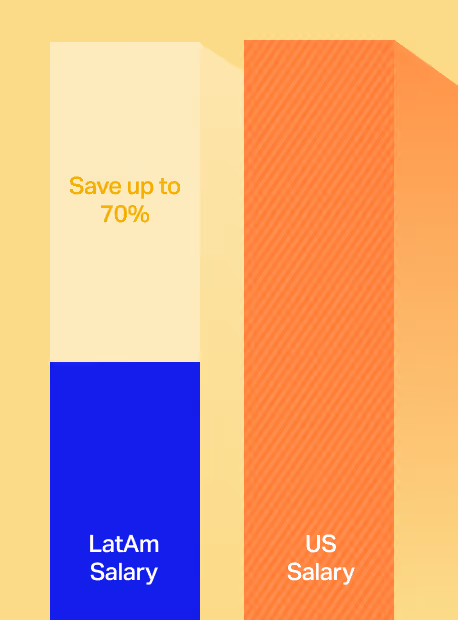
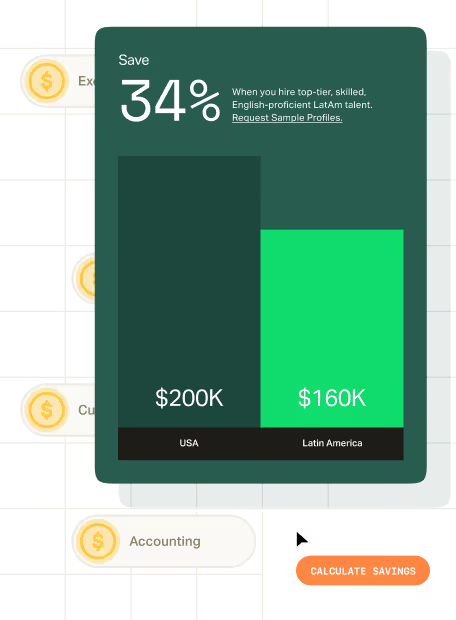
A simple starting point: take the US salary for the equivalent role and target somewhere between 50% of that.
For highly specialized technical roles, you might need to go up to 60% to be competitive. For more commoditized positions, 40% or even a bit below can still attract strong candidates.
But here’s the thing people miss when they see those percentages: they assume it means asking someone to take a step down. It doesn’t.
The reason this works—for both sides—is cost of living.
A salary that looks modest by US standards can provide a genuinely excellent living in Buenos Aires, Bogotá, or Mexico City.
We put together a US vs. LatAm Salary Guide that goes into this in detail: it covers typical salary ranges across common roles, but also breaks down living expenses across five LatAm countries.
If you’ve ever wondered how a 50%-of-US-salary offer can still attract ambitious, senior-level professionals, that guide is worth spending 10 minutes with.
{{salary-guide-cta}}
But salary is only part of it.
This is something Michael made the point about well in the webinar: you can have a well-paying job that people hate.
Comp matters, but so does the opportunity to grow, the quality of management, the mission of the company, and whether people feel respected. Don’t neglect any of those in the name of optimizing on cost.
One thing that translates well internationally is performance-based compensation. Bonuses, commission structures, quarterly kickers.
These attract the kind of people who want to be accountable for their outcomes. If you’re hiring for a results-driven role, like hiring an SDR, building some of the comp around results is smart regardless of geography.
Final thoughts
There’s a lot more we covered in that webinar that didn’t make it into this piece. But honestly, the most useful conversation is usually the one that’s specific to your company, the role you need to fill, and your actual concerns.
If you have questions that this roundup didn’t answer, the team at Near is happy to walk through them with you.
Even if you’re not ready to move forward on anything yet, we’ve found that the most useful first step for most people is just getting their specific questions answered.
Book a free, no-commitment consultation call to have a conversation about what you’re trying to build and whether hiring in Latin America makes sense for it, without any pressure to be further along than you are.



.webp)
.webp)


.webp)


%203.svg)
.avif)





%20(1).avif)

%20(1).png)