.webp)


%203.svg)
Key Takeaways:
- AI-titled roles grew roughly sevenfold as a share of Hire With Near's placements in Latin America, from under 0.5% in the second half of 2025 to 3% in the first half of 2026.
- More than half of the AI-titled roles filled in the first half of 2026 sat in marketing, content, and creative teams, not engineering.
- The bigger signal is in ordinary job descriptions: one in three marketing roles now asks for AI skills, and finance nearly doubled to 16% of roles.
When a company creates a job with “AI” in the title, you’d probably picture the hire sitting with the engineers. Six months ago, our data agreed with you. Every AI-titled role we had ever filled was an engineering position: AI engineer, machine learning engineers, AI prompt engineers, AI solutions engineers, and so on.
Then the first half of 2026 happened, and that pattern broke.
AI Job Titles Went From a Footnote to a Category
We track every role US companies open and fill through Hire With Near: from the job descriptions they open to the placements that get made.
In the second half of 2025, roles with AI in the title made up less than 0.5% of everything we placed. In the first half of 2026, that number increased to 3%.
That’s roughly a sevenfold jump in just six months. It’s still a very small slice of all hiring, and we want to be straight about that. But the direction is unmistakable, and it’s backed by a much bigger signal underneath, which we’ll get to below.
The more surprising part is where these roles landed. More than half of the AI-titled positions filled in the first half of 2026 sat in marketing, content, and creative teams, not engineering.
These are some of the titles we placed:
- AI marketing manager
- AI marketing automation specialist
- Manager of SEO and LLM
- AI video editor and ad creative specialist
- Content creator and AI specialist
- AI and social media specialist
Engineering AI roles kept growing too. But the trend we’re seeing in 2026 is that companies are hiring AI specialists who happen to be marketers, editors, or SEO leads, not the other way around.
Related reading: Every Business Has AI Tools Now. The Ones Getting Results Have the Right People Too.
The Signal Under the Titles: Job Descriptions
New AI job titles are just the visible tip. The bigger shift is that ordinary roles, the ones without “AI” in the name, are asking for AI skills too.
We analyzed more than 2,100 roles that US companies asked us to fill between June 2025 and June 2026 and counted how often each description asked for genuine AI skills.
Here’s how AI skill requirements shifted by department between the second half of 2025 and the first half of 2026:
One in three marketing roles now asks for AI skills. For hiring finance roles, it nearly doubled, reaching 16% of the roles. Sales is slightly ahead with 17%.
That means AI-titled placements aren’t the whole story. They’re the leading edge of a requirement that’s spreading through regular roles in the same departments.
Two things keep these numbers honest. First, we only counted genuine AI terms, things like generative AI, machine learning, prompt writing, and named tools, with careful matching so words like “email” never get counted as “AI.”
Second, we excluded the word “automation” entirely.
Automation language has been in job descriptions for years and, across the roles we tracked, is actually declining, from 16% of roles to 13%. This growth is AI demand, not repackaged automation.
Companies Are Also Naming Different Tools
Inside those descriptions, the tools that companies name are shifting.
Mentions of AI assistants, like Claude, Copilot, and Gemini, more than doubled over the year, from 2% of all roles to nearly 5%, while ChatGPT mentions stayed flat at around 4%.
These are small numbers and early signals, but companies are clearly broadening past a single default tool. For hiring, that matters: a candidate who only knows one AI tool may not be equipped for the environment they’re walking into.
Why Is Marketing Leading the Increase?
Marketing professionals have been earlier adopters of AI. Marketing tasks are where AI produces visible output fastest: draft copy, ad variations, video cuts, briefs, and research summaries.
A marketer who runs AI tools well genuinely covers more ground, and companies have noticed that the difference shows up in campaign volume within weeks, not quarters.
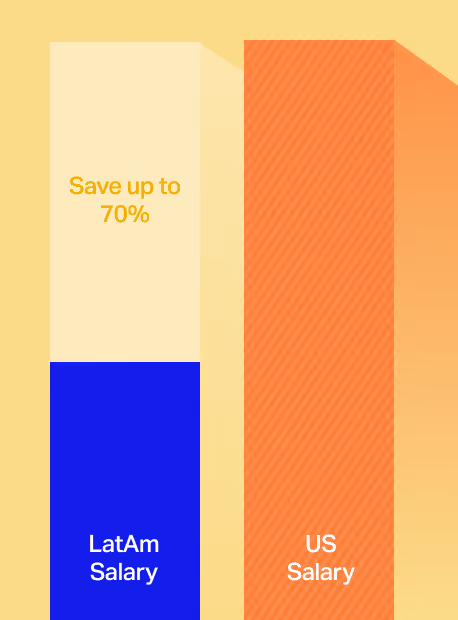
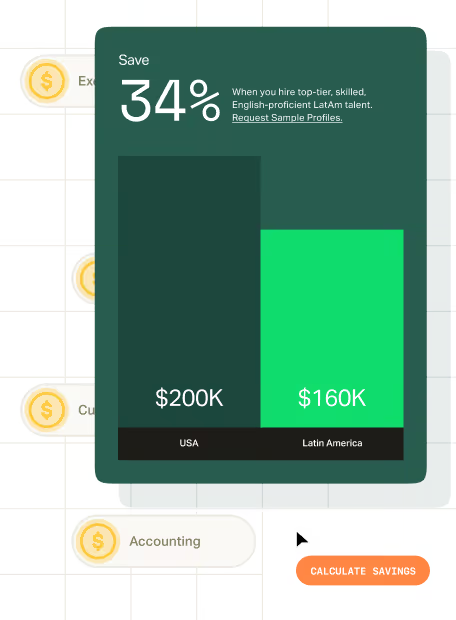
The talent supply made it easy to act on. The marketers and creatives Hire With Near places in Latin America are trained on the same tools US teams use, work US hours, and often have salary expectations 30 to 70% less than their US peers. That savings, paired with increased output from strong AI use, means the ROI on hiring marketing talent in Latin America is too compelling to pass up.
So when companies started testing “AI-first” roles, they had a low-risk (but high reward) place to start.
If you’re planning a hire in any of these departments, this shift has practical implications for how you write the job description and what you screen for.
Related reading: How to Hire Marketing Talent in Latin America
How to Hire for AI Skills and Get the Talent to Use AI Well
If you’re hiring for a role that touches AI, here are three lessons that stand out from these placements we made:
Screen for judgment, not tool lists
The valuable skill is knowing when to reach for AI and how to check its output. Ask candidates for a specific example of how they used AI in their last role. Strong answers sound like “I cut first-draft time in half and here’s how I fact-check the output.” Weak answers are lists of product names.
Decide whether you need an AI-titled role or an AI-fluent one
An AI-titled role is a dedicated job where AI is the work: someone will spend most of their week building or running AI workflows. An AI-fluent one is a normal role done by someone who uses AI well.
Most companies need the second. If that’s your case, add AI fluency to the requirements of the role you were already hiring for, rather than creating a new job category to fill it.
Put it in the job description either way
Candidates read your job description as a signal of how modern the team is. The companies in our data that ask for AI skills explicitly are the ones attracting candidates who already have them.
In practice, instead of “experience with marketing tools,” write “comfortable using AI tools like Claude or Gemini to accelerate research, drafting, and content ideation.” Specific beats generic, and it filters for candidates who are already working this way rather than ones who will figure it out later.
Final Thoughts
AI hiring stopped being an engineering story in the first half of 2026. The fastest growth in AI skill requirements is in finance and marketing, and most of the new AI-titled roles being filled sit with marketers and creatives. Both signals come from the same place: what US companies actually asked for, and who they actually hired.
If you’re thinking about what an AI-fluent marketer, analyst, or bookkeeper would do for your team, the talent exists in Latin America.
If you want to understand the broader hiring picture, Hire With Near’s Midyear Hiring Report covers how US companies built teams in Latin America in the first half of 2026.
When you’re ready to explore a specific role, book a free consultation with our team. We’ll walk you through what sourcing looks like for your exact hire and share salary benchmarks so you have what you need to decide.
{{latam-hiring-cta-v2}}







.webp)


%203.svg)
.avif)





%20(1).avif)

%20(1).png)