


%203.svg)
Key Takeaways
- You can hire full-time marketing talent in Latin America for 30–70% less than US equivalents, with professionals who work your hours, understand US culture, and integrate as dedicated team members rather than contractors.
- The fastest route for most companies is a nearshore staffing partner that sources, vets, and employs the hire in one relationship; doing it yourself or using an Employer of Record both leave the recruiting work on you.
- The strongest source countries for marketing are Argentina (senior and leadership roles), Colombia (highest placement volume), Mexico (largest pool, Central time), and Brazil (creative and growth talent).
Someone told you companies are hiring marketing talent in Latin America for a fraction of US salaries. Now, you’re wondering if it’s actually true, whether the talent is any good, how to set compensation, and how you’d even go about doing it.
It is true. The talent is strong. And the process is more straightforward than most people expect. Companies that want to hire marketing talent in Latin America instead of stretching their budget on US salaries are making one of the most common moves our recruiting team sees.
In Hire With Near’s analysis of 2,000+ conversations with US companies exploring Latin American hiring, marketing was the most common department for companies leaving the outsourcing and agency model behind: 44% of that group were filling marketing roles.
This guide covers everything you need to know: why companies are making this move, which roles work best, what to pay, which countries to hire from, and how to run the hiring process start to finish.
Why Are US Companies Hiring Marketing Talent in Latin America?
US companies are hiring marketing talent in Latin America because of the full-time, dedicated marketing professionals who work your hours, understand US culture, and deliver the same output as a US hire at 30–70% less cost
That combination doesn’t exist in other marketing offshoring markets, which is why the shift toward Latin America for marketing roles has been so pronounced.
Here’s what’s driving it.
Time zone alignment
Latin America sits within two hours ahead to three hours behind US Eastern time, offering a near-perfect workday overlap, as the table below shows:
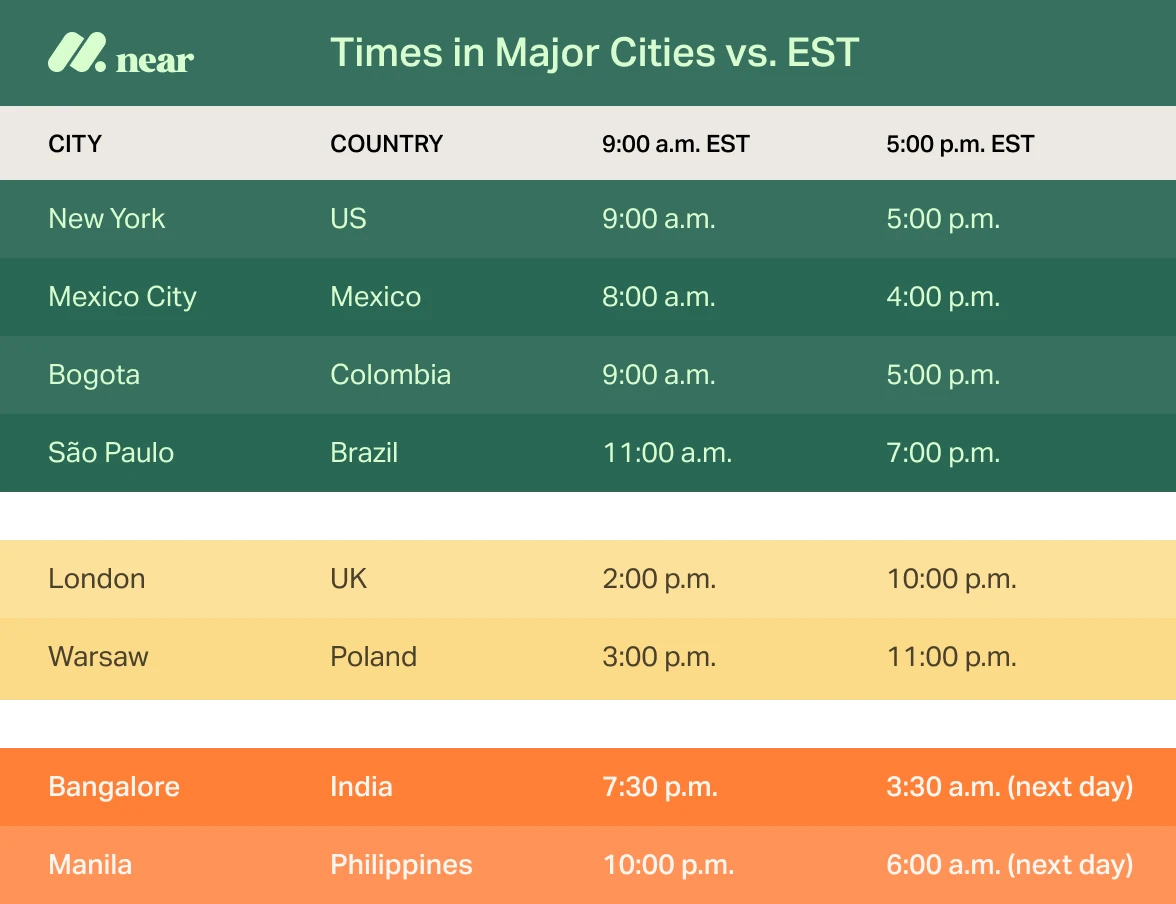
In the recruiting for the marketing industry, that matters more than most people anticipate. You need someone who can join a morning stand-up, review a campaign brief before a client call, react to ad performance in real time, and respond on Slack during your working day.
A study by Harvard Business School and INFORMS found that each additional hour of time zone difference reduces real-time communication by about 11%, and that teams organized along a north-south axis (such as the US and Latin America) hold up better than ones stretched east to west.
A hire who works overnight to match US hours isn’t in the same headspace as someone working their normal business day. That difference shows up in the quality of the work and the speed of the collaboration.
It’s a pattern marketing leaders feel firsthand when they go the other direction. As one founder at a professional-services firm described working with a fractional, India-based marketing lead:
“She’s great for a lot of reasons, but she’s fractional and has a lot of other competing interests and priorities… The time zone is also so difficult, even though there’s some overlap because she works a little bit of a U.S. schedule, it’s still just a couple of hours a day. So she’s not full-time. She’s not fully focused on us. She’s not engaged in our Slack channels or our meetings.”
That founder was now looking to work with Hire With Near to get away from both of the issues causing friction: working with professionals in misaligned time zones and working with fractional talent.
Cost savings
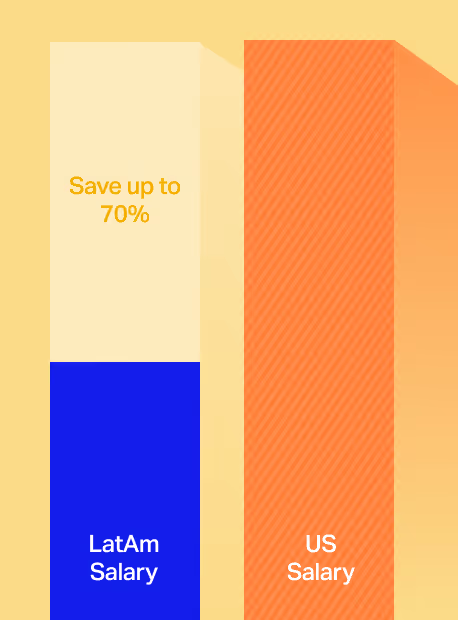
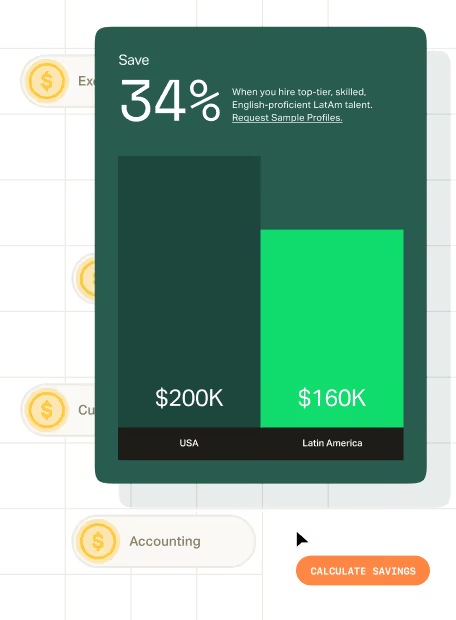
Companies hiring marketing professionals in Latin America consistently save 30–70% compared to US-equivalent roles, with an average annual savings per hire running between $35,000 and $64,000, according to Hire With Near’s 2026 data.
A digital marketing manager who would cost $89,000–$152,000 annually in the US typically earns $30,000–$42,000 in Latin America. A paid media specialist who would run $85,000–$134,000 annually in the US can be hired for $36,000–$54,000.
The lower salaries reflect the lower cost of living in Latin America, not lower caliber. And the data backs this up: according to Hire With Near’s 2026 State of LatAm Hiring Report, an analysis of 2,000+ placements, 84% of LatAm hires were mid-level or senior rather than junior. Companies are accessing experienced professionals they couldn’t afford or find domestically.
{{state-latam-hiring}}
English proficiency and US cultural fluency
Marketing is cultural work. The people writing ad copy, managing social content, and running email campaigns need to understand the audience they’re writing for.
Latin American professionals who’ve worked with US clients consume the same media, follow the same brands, and operate in the same consumer culture as your US audience.
This is the single biggest advantage Latin America has over Southeast Asia for marketing specifically.
As Sofía Berardi, Hire With Near’s Recruitment Manager, puts it:
When clients interview Latin American candidates, they’re often surprised at just how familiar and aligned we are. We consume the same products, watch the same content, and engage with the same brands.
Talent caliber
Some companies run simultaneous searches in the US and through Latin America to compare. The finding is consistent: the caliber of candidates is comparable, often surprisingly so, at significantly lower cost.
Ashley Black founded Candid Consulting after spending years at Google. When she needed a Graphic Designer and Google Ads Specialist, she turned to Hire With Near and came away with a 60% reduction in overhead and a new benchmark for what remote hiring could look like.
The talent Hire With Near provided is incredibly high quality. I worked at Google for 10 years, where the bar for talent is very high, and I would say the people I placed through Hire With Near are comparable to the people I worked with at Google.
Read the full case study: How Candid Consulting Hired Google-Level Marketing Talent and Saved 60% on Overhead
What Are the Most In-Demand Marketing Roles (and What Do They Cost)?
Based on Hire With Near’s placement data, here are the marketing roles companies hire most often from Latin America, and what each role does:
- Digital marketing manager: Owns the overall digital marketing strategy (paid channels, SEO, content, and analytics). Best for companies ready to run a full marketing function rather than just one channel. A strong fit for LatAm because the role requires strategic thinking, not just execution, and Latin America has real depth of senior marketing talent.
- Media buyer: Manages paid advertising across Meta, Google, and other platforms. The most-requested marketing hire role at Hire With Near. Latin American professionals with agency backgrounds often have high-spend US-client experience and real ROAS benchmarks they can speak to.
- SEO specialist: Owns organic search (keyword research, on-page optimization, technical audits, and content strategy). Strong talent pool in Latin America, particularly for English-language SEO targeting US audiences.
- Content writer/Copywriter: Produces blog posts, ad copy, email copy, social content, and landing pages for US audiences. The key screen is writing quality and cultural fluency, not just English proficiency. Candidates with US-client agency experience are the strongest.
- Social media manager: Manages organic social presence, content calendar, and community engagement. Requires strong English and cultural fluency. Works best with candidates who actively consume US social media and understand US platform culture.
- Email marketing specialist: Manages email campaigns, list segmentation, automation sequences, and deliverability. Platform expertise (Klaviyo, HubSpot, ActiveCampaign) is verifiable and widely available in Latin America.
- Marketing automation specialist: Builds and manages marketing automation workflows across tools like HubSpot, Marketo, and Salesforce Marketing Cloud. Strong demand, with slightly longer sourcing timeline for enterprise MarTech platforms, but findable.
- Head of marketing: Builds and leads the marketing function. Best sourced from Argentina, where leadership-level talent with both strategic and hands-on experience is strong and more affordable than in other markets.
Here’s what these roles typically cost in Latin America versus the US:
Source: Hire With Near's 2026 US vs. Latin America Salary Guide
For the full range across seniority levels and additional roles, see the Hire With Near Salary Guide and our breakdown of marketing salaries in Latin America.
For senior leadership hires like a CMO or VP of marketing, Hire With Near also runs executive search, so you get a structured process built around that level of role.
What Are the Top Countries to Hire Marketing Talent in Latin America?
For marketing roles, the four countries worth prioritizing are Argentina, Colombia, Mexico, and Brazil. Each brings something distinct: Argentina leads on senior creative and strategic talent, Colombia on bilingual professionals and cost efficiency, Mexico on US cultural familiarity, and Brazil on sheer talent pool depth.
Argentina
Buenos Aires has one of the most developed creative and digital agency ecosystems in Latin America. Major global networks like WPP, Publicis, and McCann have long-established offices there, and the local independent agency scene is equally strong.
That means the candidate pool is full of professionals who have managed US-facing campaigns, worked within structured creative processes, and been held to performance standards that translate directly to what US companies expect.
Sofía Berardi puts it plainly:
Argentina is a top choice for senior roles. Clients are often pleasantly surprised by the leadership caliber and personality, and since salaries are generally lower, it’s often easier to source talent from there.
Argentina is strong for head of marketing, creative director, and growth marketing hires.
Related reading: Hiring in Argentina: What US Companies Need to Know in 2026
Colombia
Colombia is the highest-volume market for marketing placements, particularly Bogotá and Medellín, which have developed strong digital agency ecosystems over the past decade.
The country operates on UTC-5 year-round, aligning perfectly with New York (EST) during the winter and switching to match Chicago (CDT) during US Daylight Saving Time in the summer. This guarantees a near-total workday overlap for US teams.
Especially strong for paid media, SEO, content, and digital marketing specialists with US-client agency backgrounds.
Related reading: Hiring in Colombia: What US Companies Need to Know About the #1 Nearshore Talent Market
Mexico
Mexico offers the largest talent pool in Latin America and aligns well with Central time, making it a strong fit for teams based in the Central and Mountain time zones.
With a deep strength in paid media and content marketing, Mexico City, in particular, has a large concentration of professionals with major brand and agency experience.
Related reading: Hiring in Mexico: Deep Talent, Close Time Zones, and What US Companies Need to Know
Brazil
Brazil has one of the most creatively decorated advertising industries in the world. Brazilian agencies from São Paulo and Rio de Janeiro are perennial heavyweights at Cannes Lions, consistently outperforming much larger markets, and that culture of creative excellence runs deep into the talent pool.
One thing to account for upfront: the primary business language in Brazil is Portuguese, not Spanish. This matters most for companies hiring marketing talent to produce Spanish-language content for the US Hispanic market. A Brazilian candidate, however strong their English, won't cover that need.
For roles where English-language output is the core deliverable (copywriting, content, social media), sourcing needs to be more targeted. The English-fluent, US-market-experienced talent exists, but it takes more precision to find.
For roles where written English isn’t the primary output, like paid media, analytics, and marketing automation, Brazil is one of the strongest markets in the region.
Related reading: Hiring in Brazil: What US Companies Need to Know in 2026
If you want a deeper look into this, check our “22 Best Countries To Hire Remote Marketing Talent” guide.
What Are the Skills to Look for When Hiring Marketing Talent?
Most hiring managers know the roles they need. What’s less clear is which skills separate a strong LatAm marketing hire from a weak one. In dozens of conversations with Hire With Near’s marketing recruiters this year, a consistent picture emerges of what predicts a strong hire.
Here’s how to think about it across three categories:
Core marketing skills
Not every hire is going to have all of these skills, but depending on the role, you are likely going to be looking for at least one of these:
- Content creation and copywriting: Marketing is cultural work. For US-facing output, cultural fluency matters as much as English proficiency. Candidates with US-client agency experience tend to be the strongest. Our guide to hiring a content writer goes more in depth into the skills to look for here.
- SEO: Latin America has a deep pool of SEO talent, particularly for English-language search. Look for candidates who can cover both technical and content-driven SEO, not just one side of it. Our guide to hiring an SEO specialist covers how to look for GEO as well as SEO experience.
- Paid advertising: The most in-demand skill in LatAm marketing hiring. Professionals with agency backgrounds often come with high-spend US-client experience and real performance benchmarks they can speak to. Read our guides to hiring a media buyer or Google Ads expert for more information.
- Marketing analytics: The difference between a good and a great LatAm hire often comes down to this: whether they use data to make decisions or just to report. Probe for this in interviews.
- Email marketing: Platform expertise is verifiable and widely available in Latin America. Klaviyo, HubSpot, and ActiveCampaign are all well-represented in the candidate pool.
- Conversion rate optimization: Less common as a standalone skill, but strong candidates in paid media and growth marketing roles often have hands-on CRO experience from agency work.
Technical skills
Platform expertise is verifiable; ask for specifics. The most commonly required tools in Hire With Near’s marketing searches:
- HubSpot (CRM and marketing automation)
- Google Analytics
- Google Ads
- Meta Ads Manager
- Ahrefs or Semrush
- Klaviyo or ActiveCampaign (email platforms)
- Salesforce or Marketo (for mid-market and enterprise roles)
Soft skills
These are harder to screen for, but in practice, are more important than any tool certification. The strongest LatAm marketing hires share four traits:
- Communication: Clear, proactive, direct. They tell you what’s happening without being asked, flag problems early, and write in a way your team can act on.
- Ownership: They treat the work as theirs, not as a task list. The difference shows up within the first 30 days.
- Collaboration: Marketing rarely sits alone. Strong candidates know how to work with sales, design, and leadership without friction.
- Strategic thinking: For anything above an execution role, you want someone who can connect their work to outcomes, not just complete assignments.
One signal our marketing recruiters flag consistently: candidates who’ve lasted more than 18 months at a startup are particularly strong.
Startup survival requires adaptability and ownership; large-company experience provides structured training and a quality filter. The best candidates have both.
{{prevetted-banner}}
How Do You Hire Marketing Talent in Latin America?
You have three ways to hire nearshore marketing talent: do it yourself, use an employer of record company, or work with a nearshore staffing partner.
For most companies, filling one or a few marketing roles, a staffing partner is the fastest route to a strong full-time hire. Here’s how the three compare, from most to least complex:
Option 1: Hire directly on your own
You handle everything: sourcing, screening, contracts, payroll, and compliance for an international hire. Most companies start on LinkedIn, then widen the search to nearshore job boards built for Latin American talent.
Freelance marketplaces are an option for project work, though they pull in a different talent pool than a full-time hire does, which is why most companies building a marketing function eventually move to dedicated hiring over freelance platforms.
Direct hiring gives you the most control, but it costs the most time and requires you to know the regional market and manage international employment on your own.
Option 2: Use an employer of record (EOR)
An employer of record is a third-party company that becomes the legal employer of your hire on paper, while you manage the work day-to-day.
The EOR handles everything on the back end: employment contracts, payroll processing, tax withholdings, benefits administration, and compliance with local labor laws. You pay the EOR, and they pay your employee according to local requirements.
The catch for marketing teams: an EOR doesn’t handle the recruitment of top remote marketing talent. You still source and vet candidates yourself, so this fits best when you’ve already found the person or you hire across several countries and want one standardized payroll setup.
Popular EOR companies include Deel, Globalization Partners, Remote, and Oyster. For a full breakdown of how EOR arrangements work, see this guide to hiring remote foreign employees.
Option 3: Work with a nearshore staffing partner
This is the simplest route for most companies, and the one Hire With Near is built for.
A specialist staffing partner for hiring in Latin America handles sourcing, screening, and vetting, then manages payroll, benefits, and compliance once you hire. You describe the role, interview a shortlist of pre-vetted marketing candidates, and make the hire, while the partner handles the rest.
Our nearshore staffing and recruiting model means you get both the recruiting expertise and the employment logistics in one, without building an international HR infrastructure of your own.
If you want to compare options, our roundup of the best companies to hire LatAm marketers and the top 11 marketing recruitment agencies in 2026 are useful starting points.
This is also where agency-fatigued teams tend to land. As one director of marketing at a B2B software company put it:
Most of the agencies that I’ve worked with in the last two or three years have been offshoring all their talent and they’ve been raising their prices. And so there’s pros and cons of using an agency. We have a pretty lean team right now. I have eight people on the marketing team and they are all using offshore talent. And so part of me has just started thinking like maybe we should consider just removing the middleman essentially and doing the same thing.
Here’s a summary to help you decide which approach works best for your company:
The Step-by-Step Nearshore Marketing Hiring Process
Here’s what the process looks like in practice, from deciding what you need to having someone in the seat:
Step 1: Define the role precisely
Before you start sourcing, get specific about what you truly need. A vague brief produces a vague search, and in marketing, where specializations are genuinely distinct, the wrong hire is expensive to undo.
Sofía Berardi sees this play out regularly:
Companies come to us thinking all their marketing responsibilities can be covered by one person. There’s a general knowledge gap about what marketing roles actually entail. They list a bunch of unrelated tasks under a title like ’Digital Marketing Specialist.’ But under that title, there are responsibilities that actually belong to multiple highly specialized roles, like SEO or Google Ads. Part of our job is helping them understand that.
So separate must-haves from nice-to-haves. Decide whether you need a specialist or a generalist before you start. The more specific the brief, the faster and better the search.
Step 2: Decide how you’ll hire
Before you start sourcing, decide whether you’ll hire directly, use an employer of record, or work with a nearshore staffing partner that handles sourcing and compliance in one.
Step 3: Screen for the right things
For marketing roles, English and cultural fluency are non-negotiable. A platform certification tells you nothing about whether someone can write a subject line that a US audience will open, so ask for writing samples and evaluate them as a US reader would.
For paid media roles, go beyond the resume. Ask what accounts they ran, at what spend levels, and what results they drove. If a candidate can only tell you which platforms they’ve used but can’t speak to outcomes, that’s a yellow flag.
Step 4: Set competitive compensation
Use benchmark data to build your offer. Target 50–60% of the US equivalent for most roles; highly specialized positions may need to go slightly higher.
Compensation that’s below market for LatAm will get you below-market candidates. Performance-based components (bonuses, quarterly targets) attract the kind of people who want to be accountable for outcomes.
Step 5: Onboard for real-time collaboration
The time zone advantage only works if you use it. Set up Slack or Teams, establish core hours for overlap, build a brief template so the hire knows what a good request looks like, and schedule a weekly check-in for the first 90 days.
A structured onboarding period catches misalignment early, when it’s still cheap to fix.
Should You Hire a Marketing Generalist or Specialist?
The answer depends on where your company is, not which type of hire sounds more appealing. Here’s a simple framework:
That said, the company stage is a starting point, not a rule. What matters more is your primary growth lever. If one channel (paid social, SEO, email) is responsible for most of your revenue, hire a specialist to own it, regardless of stage.
A generalist makes sense when no single channel is dominant yet and you need someone to figure out where to focus first.
What Are the Most Common Concerns About Hiring Marketing Talent in Latin America?
If you’ve never hired in Latin America before, skepticism is healthy. You’ve probably heard the pitch and you’re wondering what the catch is.
Here are the concerns that come up most, and what the data actually shows:
“Will they understand US culture well enough to write copy?”
Yes, with the right sourcing criteria. Latin American professionals who’ve worked with US clients understand US cultural references, brand voice, and the style of English that US audiences respond to. This is different from Southeast Asia, where the cultural distance requires a bridge that often shows up in the work itself.
That said, cultural fluency needs to be verified in screening, not assumed. Ask for writing samples and evaluate voice and idiom, not just grammar. For content-heavy roles, hold a high bar. The talent pool is large enough to find it.
“We tried offshore before and it didn’t work.”
The failure patterns from Southeast Asia are consistent: time zone gaps that make real-time campaign work impossible, content that misses US cultural nuance, and a communication style where the hire waits for instructions rather than taking initiative.
Latin America is structurally different on all three of these: full time zone overlap, genuine cultural proximity to the US market, and a work ethic oriented toward ownership.
Companies that have hired offshore before and had bad experiences often come to LatAm hiring better prepared. They’ve already built clear brief templates and feedback processes. That experience is an asset.
“How long does it take?”
Most marketing hires through Hire With Near close in two to three weeks of the start of the search. First candidates typically reach you within three to seven business days. Senior or highly specialized roles may add a week or two.
If you have a specific deadline, say so at intake, so the search is planned around it.
For a deeper look at this question and other common concerns, read “Can They Actually Write in American English?” and Other Questions Marketing Leaders Ask.
What Hiring Marketing Talent in Latin America Looks Like in Practice
Rankings.io is an Inc. 5000 SEO agency specializing in legal industry marketing. When the firm needed to scale, leadership was spending too much time recruiting instead of growing the business. They had a single HR manager stretched across a long list of open roles: SEO specialists, paid ads, PPC, web design, web development, and project management.
Through Hire With Near, Rankings.io filled 11 roles and saved $463,000 annually, a 54% reduction versus US-based talent. Traditional hiring had stalled for months; those same roles closed in an average of three weeks each, and the team saved three to five hours per role on sourcing and interviewing.
The outcome wasn’t just cost savings. The new hires integrated quickly across departments, and the results spoke for themselves. Gillian Alvillar, Rankings.io’s Human Resources Director, put it this way:
When I check with department managers, they say ’It’s like 100 out of 10.’ The talent through Hire With Near has been professional, articulate, intelligent, and absolutely the right fit for our team.
Final Thoughts
Hiring nearshore marketing talent gives you full-time, dedicated professionals who work your hours, understand your audience, and cost a fraction of US equivalents.
The hardest part isn’t whether the talent is there. It’s defining the role clearly and choosing the right way to hire. Get those two right, and the rest moves fast.
The companies that get the most out of it tend to stick with their hires. As one digital marketing agency owner who hired through Hire With Near described it:
We hired with you guys in 2022, and we’ve had that person in the position now for three years, and we had a great experience. She did some excellent work for us, did some stuff that we couldn’t have done otherwise for a price that was more reasonable than what we might have had to pay here.
If you want to explore hiring marketing talent in Latin America, the best thing to do is book a free consultation to talk through your specific requirements with our team.
We’ll give you salary benchmarks per role and level and explain the process so you have the info you need to consider whether it’s right for you.
Or if you want the broader picture first, our guide to hiring remotely in Latin America walks through the fundamentals.
{{latam-hiring-cta-v2}}
Frequently Asked Questions
What marketing roles can I hire in Latin America?
Virtually any marketing role that can be done remotely. The most commonly placed roles include digital marketing managers, media buyers, SEO specialists, content writers, copywriters, social media managers, email marketing specialists, marketing automation specialists, marketing assistants, programmatic marketing specialists, and heads of marketing.
Hire With Near also places senior and specialized roles across the full marketing function: from creative directors in Latin America and nearshore growth marketing managers to product marketing managers, community managers, and senior leaders like a nearshore CMO.
Do Latin American marketers produce content that works for US audiences?
Yes, with proper vetting. Latin American professionals who’ve worked with US clients understand US cultural references, brand voice, and idiom in ways that Southeast Asian hires often don’t.
The key is screening for writing quality and cultural fluency specifically, not just English proficiency. Ask for writing samples aimed at a US audience and evaluate them as a US reader would.
Which Latin American country should I hire from for marketing?
It depends on the role. Argentina is best for senior and director-level marketing talent. Colombia has the highest volume of placements and strong digital agency talent at all levels. Mexico has a large pool and is ideal for Central time zone teams. Brazil is strong for creative and growth marketing.
In practice, Hire With Near sources across all four simultaneously to find the best candidate for the specific brief.
How long does it take to hire a marketer in Latin America?
Most searches close in two to three weeks from the start of sourcing. First candidates typically arrive within three to seven business days. More specialized or senior roles may take slightly longer.
Hire With Near’s no-hire, no-fee model means you don’t pay anything unless you make a hire.
What if I need to build a whole marketing team, not just fill one role?
Many companies start with one hire and scale from there. Hire With Near has placed entire marketing functions for clients, from a first content hire through to a high-performing marketing team with dedicated specialists by channel.
The same recruiter who placed your first hire stays on for subsequent searches, which speeds up sourcing because the intake process is already done.



.webp)






%203.svg)
.avif)





%20(1).avif)

%20(1).png)