


%203.svg)
Key Takeaways
- US companies hire in Uruguay for a dense professional and technical workforce, English that holds up outside the capital, and a working day that overlaps theirs, at salaries well below US equivalents.
- Depending on the hire arrangement you choose, Uruguay requires two payments most US employers never budget for: a thirteenth month of salary called the aguinaldo, paid in two installments, and a vacation bonus called the salario vacacional.
- Uruguay’s talent pool is small but deep, strongest in software engineering, fintech and data roles, and client-facing positions, which makes it a better fit for hiring one or two specialized professionals than for hiring at volume.
When US companies look to hire in Uruguay, they tap into one of Latin America’s most stable, well-educated, and tech-capable talent pools: high income equality, an exceptional rule-of-law record, and a free, high-quality public education system that produces top-tier technical professionals.
The country’s technology sector punches far above its weight, spawning global scale-ups like dLocal and PedidosYa, and candidates bring strong English proficiency in Montevideo along with real-time time zone alignment with the US.
The main trade-off is candidate volume: Uruguay is a small country, meaning its talent pool is deep rather than wide. Sourcing thousands of applicants at high volume isn’t the draw here. Instead, for roles where precision, data security standards, and technical maturity matter far more than raw numbers, that trade-off consistently works in your favor.
This guide covers what you need to know before you hire in Uruguay: how to structure the engagement, what the talent looks like, which roles Uruguay is strongest in, what you’ll pay, and the parts of Uruguayan labor law that tend to catch US employers off guard.
Why Are US Companies Hiring in Uruguay?
Uruguay has roughly 3.4 million people and the region’s highest GDP per capita, which makes buyers hesitate: the pool sounds too thin and the wages too high. The data says otherwise. US companies hire in Uruguay because it packs an unusual amount of professional and technical talent into a small population, and because that talent works your hours.
Three things explain why: talent density that outpaces the country’s size, real-time overlap with your workday, and a budget case that holds even against the assumption of high wages. It’s a quality-and-fit market rather than a volume market, which suits a company hiring two people much better than it suits a company hiring 20 people quickly.
Talent density that outpaces its size
The density is what surprises people. A study of Uruguay’s IT workforce by Microsoft and CUTI, the Uruguayan technology chamber, found 64 IT professionals per 10,000 inhabitants, the highest concentration in the region, against 187 per 10,000 in the United States. That data runs through the end of 2022, so read it as directional rather than current.
Uruguay XXI, the government’s investment and export promotion agency, calls the country the largest software exporter per capita in Latin America. For a country this small, that’s not a coincidence: it’s the result of decades of investment in free, high-quality public education feeding directly into a technology sector built to serve outside markets.
A working day that overlaps yours
Uruguay’s professional workforce concentrates in and around Montevideo, which sits within a workable band of the US Eastern time zone. That overlap means live standups, same-day answers, and collaboration that happens during your business day instead of on an overnight delay.
You can see how the time zone alignment works in the table below:
Our guide to hiring remotely in Latin America walks through how US companies build teams across the region using exactly this kind of time zone advantage, and Uruguay is one of the clearest examples of it working in practice.
English proficiency strong enough for client-facing work
Uruguay ranks 34th out of 123 countries on the EF English Proficiency Index 2025, third in Latin America behind only Argentina and Honduras.
That matters for the kind of hire Uruguay is best suited for. When you’re bringing in one or two specialized, senior professionals rather than a large team, you need those hires to communicate clearly with stakeholders and clients from day one, not just get by in internal Slack threads.
The budget case holds
Cost is what starts most of these nearshore hiring conversations, even for a market with wages on the higher end of the region.
Hire With Near’s research into why US companies turn to Latin America found that 41% name budget as the primary driver, ahead of time zones and talent scarcity. That figure covers Latin America as a whole rather than Uruguay specifically, but it matches what companies say out loud: they can see the role they need, and they can’t fill it at US rates.
It’s worth understanding why US companies are hiring Latin American talent more broadly before deciding whether Uruguay’s specific trade-off (smaller pool, higher wages, deeper specialization) is the right fit for your role.
In the video below, Hire With Near’s COO, Franco Pereyra, explains what makes Latin American professionals stand out to US companies:
Related reading: Why More US Companies Are Hiring in Latin America
How Can a US Company Hire in Uruguay?
US companies have three options for hiring in Uruguay: establish a legal entity, use an employer of record, or work with a specialist staffing and recruiting company. For most, the third is the fastest path to a great hire.
Here they are in order from most complex to simplest.
Option 1: Establish a legal entity
Registering an entity means setting up a Uruguayan company so you can employ people directly under your own name, with a local tax presence and compliant payroll and benefits systems.
For a company operating at a large scale, with dozens of local employees and a long-term commitment to the market, that’s the right call. Uruguay’s political stability and investor-friendly regulatory environment make it one of the easiest Latin American countries to incorporate in relative to the region.
But “easier relative to the region” still means real overhead: forming a local entity, registering with the tax authority and BPS (Uruguay’s social security institute), and setting up compliant payroll typically takes a few months and ongoing local accounting support.
For a company testing the market with one or two hires, that’s a disproportionate amount of infrastructure to stand up before you’ve even confirmed the role works.

Option 2: Use an employer of record
If registering an entity is too much infrastructure for the size of your hire, an employer of record removes that overhead: it becomes the legal employer of your hire on paper, handling contracts, payroll, tax withholding, and compliance with Uruguayan labor law, while you direct the day-to-day work.
Deel, Globalization Partners, Remote, and Oyster are among the best EOR companies that can stay compliant in Uruguay. This guide to hiring remote foreign employees covers how these arrangements typically work.
What an EOR won’t do is make Uruguay’s cost structure disappear. The Aguinaldo, a mandatory salary supplement paid in two installments each June and December, each equal to one-twelfth of the salary earned that half-year, is baked into the cost of employment from day one. It isn’t discretionary and it isn’t something an EOR can negotiate away.
The gap an EOR leaves is sourcing. It handles the legal and financial machinery of employment, but you’re still the one finding, screening, and interviewing candidates, and in a market where the strong professionals are concentrated in a small pool around Montevideo, that’s the harder half of the job, not the easier one.
Option 3: Work with a specialist staffing and recruiting company
A specialist staffing and recruiting partner, like Hire With Near, closes that gap by handling both halves at once: you describe the role, we present pre-vetted candidates, and once you hire, employment, payroll, and compliance are ours to run.
This is the option where Uruguay’s size works in your favor. A market with thousands of comparable candidates rewards a provider with a big database and a fast turnaround. A market as concentrated as Uruguay’s rewards a provider that already knows who the strong people are, because there’s no volume of applicants to sift through your own way to a good outcome.
Payroll, benefits administration, and compliance are included in our nearshore staffing and recruiting services by default, not sold as an add-on later.
If you’ve relied on platforms like Upwork or Toptal for project work and now want someone permanent, the difference shows up faster here than in larger markets: fewer, better-matched candidates instead of a wide, unfiltered pool.
What Can US Companies Expect from Uruguayan Professionals?
When hiring in Uruguay, US companies can expect senior, well-educated professionals with strong written and spoken English, a working day that overlaps yours, and a market where people tend to stay in a job for years.
Uruguay is strongest in software, data, finance, and client-facing roles that require real conversation.
The roles US companies hire most
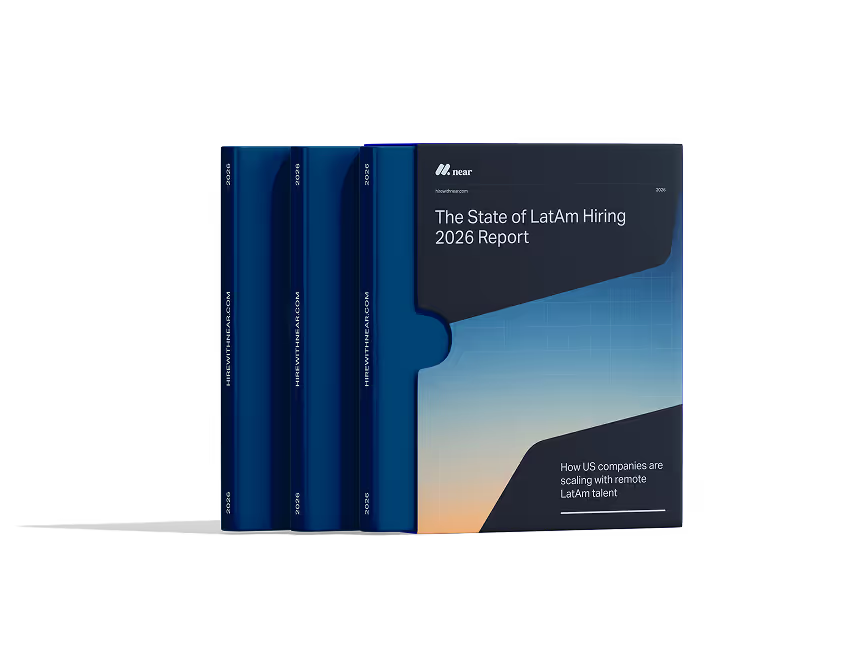
According to Hire With Near’s 2026 State of LatAm Hiring Report, the roles US companies most commonly hire across Latin America are in accounting and finance (23.4% of placements), sales (18.9%), and IT and engineering (10.1%).
That’s a Latin America-wide picture rather than a Uruguayan one. For this part of the region, requests skew toward accountants in Latin America, companies that want to hire a remote software engineer, and companies looking to hire a remote data analyst.
Related reading: How To Hire Developers in Uruguay
Where Uruguay’s talent runs deepest
Uruguay’s professional strength concentrates in a few specific areas, and knowing which one your role falls into shapes how realistic your search is.
- Software engineering is the deepest and most established pool. Uruguay has exported software for more than two decades, long enough that a mid-to-senior engineer here has usually spent most of their career building for clients abroad rather than on internal, in-house tools. That history shows up in code quality, documentation habits, and comfort working async with a distributed team.
- Fintech and data roles are the fastest-growing category, driven directly by the rise of dLocal, Uruguay’s first unicorn, and the wave of fintech and payments companies that followed it. If you’re hiring a data analyst, data engineer, or hiring a finance professional with exposure to payments or cross-border transactions, Uruguay’s candidate pool has genuine depth here, not just generalist finance backgrounds stretched to fit.
- Client-facing and account management roles benefit from a specific trait Hire With Near’s recruiters flag consistently: Uruguayan professionals tend to be direct and comfortable pushing back in a conversation, rather than deferring reflexively to whoever’s paying. For a customer success or account management hire where you need someone who will tell a client an uncomfortable truth instead of just agreeing, that’s a meaningful signal, not a soft one.
Where the pool thins out is anything highly specialized outside these three areas, marketing, for instance, or niche technical stacks with little export history. If your role sits there, expect a narrower search and factor in more time to find the right fit.

Top universities to recognize on a resume
Uruguay’s professional talent concentrates in and around Montevideo. A handful of universities show up consistently on strong resumes:
- Universidad de la República (UdelaR): The country’s largest and oldest public university, and the primary pipeline for engineering, computer science, and finance professionals.
- Universidad ORT Uruguay: The leading private university for technology and business, with a strong reputation specifically in software engineering and IT.
- Universidad Católica del Uruguay: Known for strong business, economics, and finance graduates, frequently recruited into client-facing and analytical roles.
What Are the Salary Ranges for Uruguay Hires?
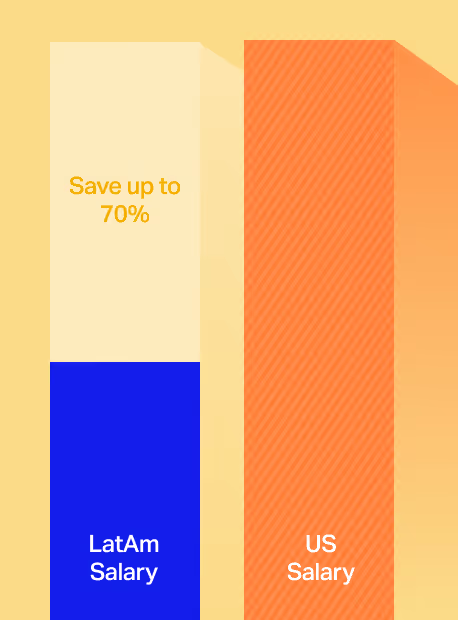
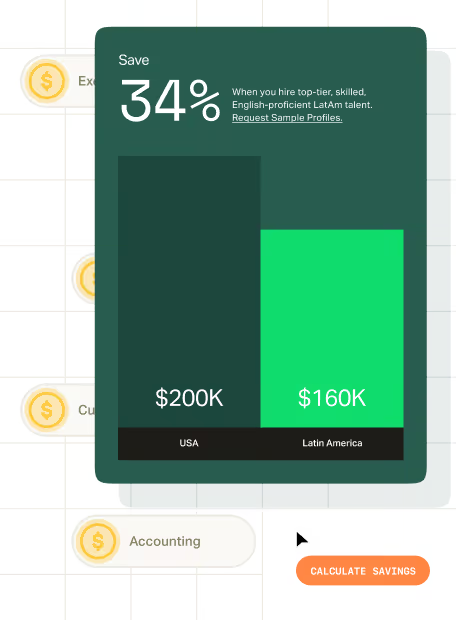
Salaries for the roles US companies hire most run roughly $22,000 to $108,000 a year depending on function and seniority, typically 30% to 70% less than the same hire in the US. These are Hire With Near’s regional benchmarks rather than Uruguay-specific figures.
To put that in concrete terms, here’s what hiring these roles costs compared to equivalent US hires, according to Hire With Near’s salary benchmarks in our Latin America salary guide:
For the most up-to-date figures, see Hire With Near’s US vs Latin America Salary Guide.
Uruguay’s wages sit at the higher end of the region, a direct consequence of the same GDP per capita and cost of living that shaped the trade-off in this guide’s introduction.
Even so, hiring in Uruguay lands well below equivalent US costs. The average annual savings per hire run between $35,000 and $64,000 in the region, and Uruguay’s premium relative to its neighbors narrows that gap without closing it.
Here’s how Montevideo compares to Austin, Texas, a benchmark US city with a comparable role mix, on everyday costs:
Source: Numbeo.com
What Do US Companies Need to Know Before Hiring in Uruguay?
Two things catch US companies off guard when hiring in Uruguay: the Aguinaldo, which effectively adds a 13th month of salary paid in two installments, and a country-wide slowdown during Carnival and Tourism Week that no salary line accounts for. Both are easy to plan around once you know they’re coming.
Whether these apply to your hire depends on how you structure the engagement. Either way, they’re worth understanding: professionals in Uruguay know exactly what the local market provides, and they factor it into their compensation expectations.
Paid leave
Formal employees in Uruguay get a minimum of 20 working days of paid annual leave after a year of service, and the entitlement grows. From the fifth year onward, a worker earns one additional day for every four years of seniority, with no ceiling.
Maternity leave is 14 weeks, paid by the national social security institute at 100% of average earnings rather than by the employer.
Public holidays, and the two tiers nobody explains
Uruguay distinguishes between non-working holidays and commemorative working holidays:
The 5 mandatory non-working days
Under Article 18 of Ley N° 12.590, the five statutory paid non-working holidays are:
- January 1 (New Year’s Day)
- May 1 (Labor Day)
- July 18 (Constitution Day)
- August 25 (Independence Day)
- December 25 (Christmas/Día de La Familia)
Employees who do not work receive their regular salary. Employees who perform work on these 5 days are legally entitled to double pay (monthly workers receive an additional full day’s pay, and hourly workers receive twice their hourly rate).
Workable holidays
All other national holidays (such as Epiphany on Jan 6, Landing of the 33 Orientals on Apr 19, Battle of Las Piedras on May 18, Birthday of Artigas on Jun 19, etc.) belong to the “workable” tier.
Employers can require employees to work. Monthly salaried workers receive their standard monthly salary without extra double pay, and hourly workers are paid single time for hours worked.
Tourism week
Uruguay officially renamed Holy Week to Semana de Turismo (Tourism Week) to maintain a secular state calendar.
Holy Thursday and Good Friday are the two official statutory holidays of that week, but they sit in the workable tier rather than the mandatory paid non-working tier. In practice, though, public entities, financial institutions, and many private businesses close or run minimal staffing.
It’s one of Uruguay’s highest domestic vacation weeks. Scheduling major project rollouts, product launches, or onboarding during Semana de Turismo is widely avoided in local business practice.
Semana de Turismo is explicitly exempted from the rule that moves certain midweek holidays to Mondays. It always stays fixed to Holy Week.
In the video below, Franco Pereyra explains his recommendation on handling holidays for remote employees in Latin America:
The Aguinaldo: budget thirteen months, not twelve
For formal employees, Uruguay requires the Aguinaldo, a full thirteenth month of salary, calculated as one twelfth of the ordinary earnings the employee received over the year. It’s paid in two installments every year: the first by 30 June, the second by 20 December.
The mid-year installment is what catches people: those who know about thirteenth-month pay usually assume it lands at Christmas, then meet an unbudgeted payment five months in.
Other statutory benefits Uruguay employers owe
- Salario vacacional (vacation bonus): On top of ordinary vacation pay, companies owe an extra sum equal to the employee’s net daily wage for each day of leave taken, paid before the leave starts. It’s the item most often missed entirely.
- Social security contributions, and this one is good news: Employer contributions to BPS, Uruguay’s national social security institute, total about 12.6% of nominal salary, with mandatory workplace accident insurance on top at a rate that varies by activity. An employer-side payroll burden in the low teens is light by regional standards.
- Severance: On dismissal without just cause, severance is one month’s salary per year of service, capped at six months’ salary.
Navigating these details for the first time can feel like a lot, so we put together a guide to the most common questions about hiring in Latin America. We’ve also collected lessons from hiring in Latin America drawn from thousands of placements.
{{latam-hiring-calculator}}
How Does Hire With Near Help US Companies Hire in Uruguay?
Hire With Near finds and vets candidates in Uruguay and then employs them, so you run one process instead of assembling a recruiter, a payroll provider, and a compliance advisor separately.
Our recruiters work the region rather than a single country, so we can tell you where a role is realistically fillable, what candidates expect to earn, and when a neighbouring market is the better answer.
How is the hiring process with Hire With Near?
We start the hiring process with a kickoff call, where we get a sense of the role you need and the type of professional you’re looking for. What sets the process apart is how much time your dedicated recruiter spends on the kickoff call before a single candidate is shortlisted, because vague briefs produce slow searches.
From there, it moves quickly. Your recruiter sources from a pool of 160,000+ pre-vetted candidates and runs fresh sourcing for the specific role, rather than pulling only from who’s already available. Within 3 to 5 days of the kickoff call, you get a shortlist of pre-vetted candidates with video introductions, so you hear the person before you meet them. Spoken English is assessed on every placement rather than assumed.
If your search calls for a technical assessment or case study, we can help design and administer it, though most clients run their own once they have a shortlist.
From kickoff to accepted offer, most companies hire in under three weeks.
Retention comes from the same groundwork. People accept knowing what they’re joining, and they stay: our placements stay 66% longer than the typical US hire.
How a UX engineer became affordable for a US company
Bonfire, a custom products e-commerce platform, needed a UX engineer, a specific, senior, hard-to-source role. At US market rates, the position simply wasn’t viable for a company their size; the hire would have priced itself out of existence before it ever got approved.
Through Hire With Near, Bonfire filled the role in roughly half the time their US search had already been running, and saved $53,000 a year against what the same hire would’ve cost domestically.
Its VP of Product Management put it this way:
It was shocking to see the difference between the talent Near brought versus other firms I worked with. Our hires are extraordinary and a great cultural fit.
— Thomas Elliott, VP of Product Management, Bonfire
It’s the kind of result Uruguay is built for: not a large team assembled quickly, but the one specific, senior professional a smaller search couldn’t find or afford at home.
For companies filling director-level or leadership positions, Hire With Near also handles executive search in Latin America across all departments.
If you’re ready to hire remote talent in Uruguay, book a free consultation to talk through your requirements with our team. We’ll walk you through what a search for your specific role looks like and share salary benchmarks so you have what you need to move forward.
If you’re also considering hiring in other Latin American countries, check out the Hiring in Guatemala, Hiring in Argentina and Hiring in Chile guides.
{{latam-hiring-cta-v2}}
Frequently Asked Questions
Can a US company hire employees in Uruguay without setting up a legal entity?
Yes. Most companies hire through an employer of record, which becomes the legal employer on paper while you manage the day-to-day work, or through a specialist staffing partner that finds the person and handles employment, payroll, and compliance in one relationship. Both routes typically take days to weeks instead of the three to six months a legal entity requires.
A legal entity only makes sense once you’re building a permanent, large presence in Uruguay, generally when you’re planning to hire well beyond a handful of people. For a first hire, or even a small team, either alternative gets you employing legally without the setup cost or timeline.
Is Uruguay in a compatible time zone with the US?
Yes, and with remarkable consistency. Sitting in the easternmost time band of Latin America (UTC-3), Uruguay stays on standard time year-round. Depending on the season, a Montevideo-based hire is just 1 to 2 hours ahead of the US East Coast and 4 to 5 hours ahead of the West Coast.
That guarantees a solid 4 to 7 hours of live, real-time overlap with your team every single day without anyone working unusual hours.
Is 13th-month salary required in Uruguay?
Under a formal employment arrangement, yes. Uruguay requires the Aguinaldo, a mandatory salary supplement equal to a full 13th month, and it’s not something you can negotiate around once someone is a direct employee.
The detail that catches first-time employers off guard is the timing: it’s paid in two installments rather than one lump sum, the first by June 30 and the second by December 20, each equal to one-twelfth of the salary earned in that half of the year.
Budget for roughly 13 months of salary annually, and build both payment dates into your cash flow planning rather than treating it as a single year-end cost.
What roles do US companies most commonly hire in Uruguay?
The same broad functions US companies hire across Latin America: accounting and finance, sales, marketing, engineering, and customer support. Uruguay’s own talent pool skews more heavily toward the technical and analytical end of that list than the regional average.
Software engineers in Latin America are the deepest category, backed by two decades of the country exporting software to US and European clients. Data analysts and data engineers hired remotely follow closely, driven by the fintech sector that grew around dLocal, Uruguay’s first unicorn. Financial analysts with cross-border experience round out the strongest categories.
Roles outside these areas, marketing and generalist admin support, for example, are available but draw from a shallower pool.
What level of English can US companies expect from professionals in Uruguay?
High, and unusually consistent across the country. Uruguay scores 542 on the 2025 EF English Proficiency Index, well above the global average of 488, up 44 points from the previous edition.
How long does it take to hire in Uruguay through Hire With Near?
Most companies get a shortlist within 3 to 5 days of the kickoff call and accept an offer in under three weeks. The kickoff call is where that time is saved or lost: a recruiter who leaves it knowing what would disqualify a candidate usually fills the role off the first shortlist.
What industries do US companies hire most for in Uruguay?
US companies hiring in Uruguay concentrate most heavily in fintech and financial services, SaaS and technology, and companies looking to hire software engineers and IT talent in Latin America. This tracks directly with Uruguay’s own economy: the country’s software export history and the rise of dLocal, its first unicorn, built a talent pool specifically suited to these industries.
Beyond those three, data and AI-focused companies also draw on Uruguay’s talent pool for data analyst and data engineering roles tied to payments and cross-border transaction work. Companies outside these industries can still hire well in Uruguay, but the deepest, fastest searches happen within them.




.webp)




%203.svg)
.avif)





%20(1).avif)

%20(1).png)